Is the Dollar Overvalued or Undervalued?


The latest claim running around is that the dollar is overvalued relevant to its trading partners, and it will decline as the economy recovers due to imports. You really have to wonder if these analysts are just working from home and have lost all sense of the world because they are locked down. In that forecast, they are ASSUMING that the world economy will recover as if nothing has taken place.


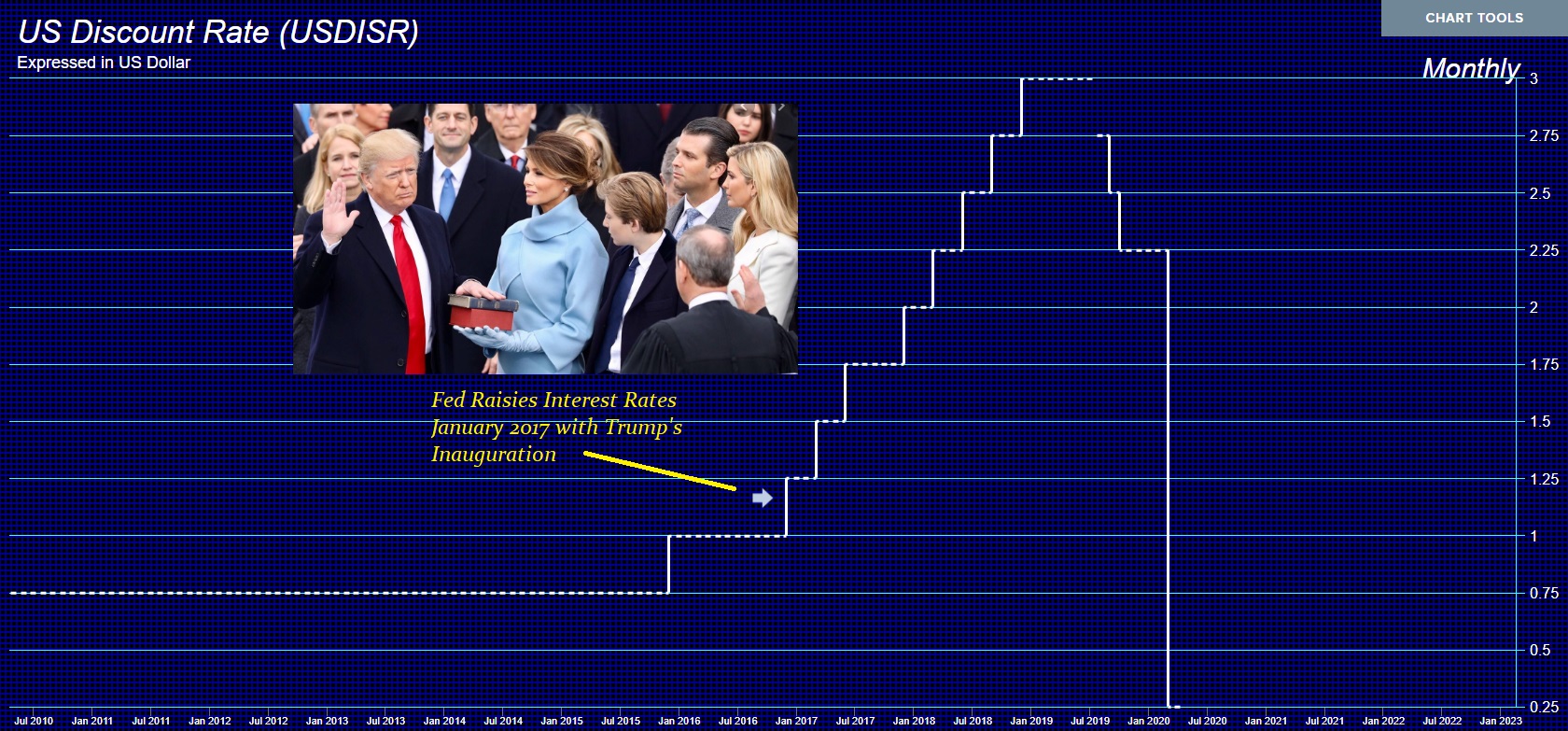
This is the typical analysis that simply focuses on domestic numbers and assumes that if you import more goods, then the dollar must decline. This theory is up there with thinking raising interest rates will be bearish for the economy and the stock market. Interestingly, both the economy and the stock market rallied as long as interest rates were RISING!


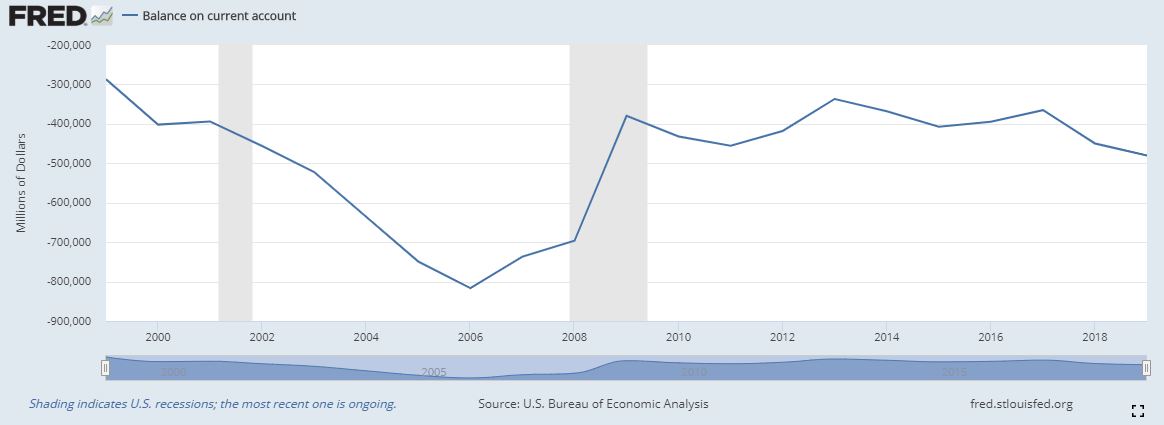
This is not a world that you can judge simply by looking at trade statistics. It is pure sophistry. In 2018, exports of goods and services from the United States made up about 12.22% of its gross domestic product (GDP), while US imports amounted to 15.33%. We have allocated trade according to the flag the company flies, and then you will see that the US has a trade surplus. Moreover, I assisted the Japanese on how to reduce their trade surplus buying gold in New York, taking delivery, and exporting it to London and selling it there. It does not matter what is exported; the statistics only look at dollars — not goods. This theory about trade to claim the dollar will decline is laughable.

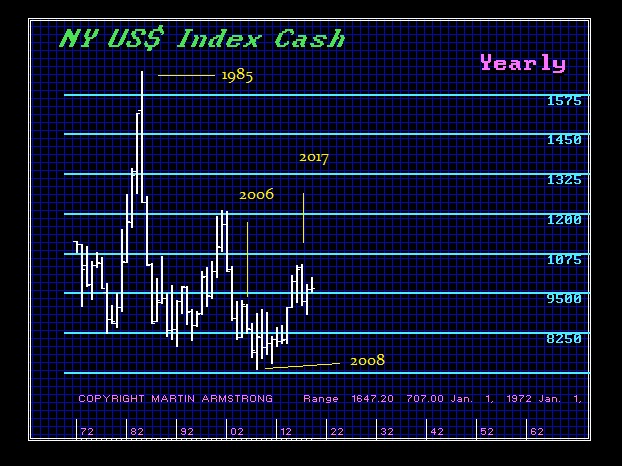
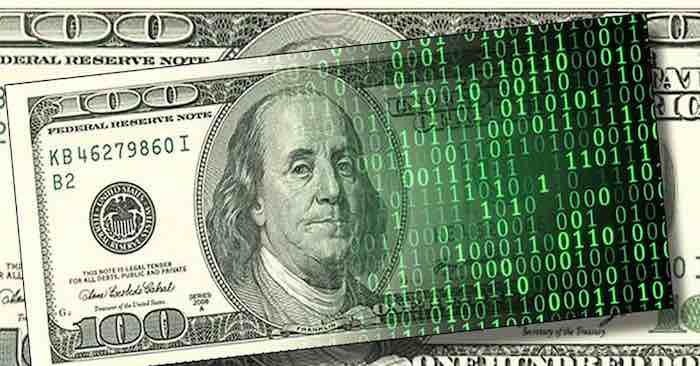
All you have to do is real correlation analysis. Here is the US dollar Index, which was wrongly constructed based upon trade rather than capital flows, and the low in the trade deficit took place in 2006. It began to IMPROVE as the world economy turned down, and in 2008, we see an outside reversal with the dollar rising. The dollar peaked in 2001 on this index and that was the crash in the market from the 2000 peak in the Dot.com Bubble.


The true trends that reveal the future are based upon capital flows. The dollar rallied and peaked in 1985 during that recession, but on the US stock market, the Dow performed a rare outside reversal to the upside in 1982, which began the explosion from 1,000 to 6,000. That also attracted capital flows for investment. The dollar peaked in 2001 during that recession as capital contracted.

Italexit – New Party in Italy to Exit the EU


We are witnessing the rise of the new party in Italy headed by Gianluigi Paragone calling for the exit of there EU. New Italian party calls for the exit from EU bolding saying: “Germany takes everything and leaves the crumbs to the rest of the states.” As the economic hardship rises thanks to the virus scam, this risk our computer shows is not that they will win, but they are sowing the seeds of their own destruction. They will move to eliminate the physical currency and then they will advocate for perpetual bonds.

Paragone began as a journalist. In 2018 he was elected Senator of the Five Star Movement. Then on January 1, 2020, he was officially excluded from the Five Star Movement but remained in the Senate as an independent. Then now in July 2020, Paragone has launched his own political movement, Italexit, with the aim of bringing Italy out of the European Union

The oppression of this virus agenda to force compliance with their Great Reset runs the risk of destroying the economies of Southern Europe which have a very high reliance upon tourism which has been brought to a halt in Europe.

The Humane Side Of Capitalism


Re-posted from Uncommon Knowledge by Russell Roberts  Thursday, July 23, 2020

A lot of people reject capitalism because they see the market process at the heart of capitalism—the decentralized, bottom-up interactions between buyers and sellers that determine prices and quantities—as fundamentally immoral. After all, say the critics, capitalism unleashes the worst of our possible motivations, and it gets things done by appealing to greed and self-interest rather than to something nobler: caring for others, say. Or love. Adam Smith said it well:

It is not from the benevolence of the butcher, the brewer, or the baker that we expect our dinner, but from their regard to their own self-interest.

Capitalism, say its critics, encourages grasping, exploitation, and materialism. As Wordsworth put it: “Getting and spending, we lay waste our powers.” In this view, capitalism degrades our best selves by encouraging us to compete, to get ahead, to win in business, to have a nicer car and house than our neighbors, and to always look for higher profits and advantages. In the great rat race of the workplace, we all turn into rats. Is it any wonder so many want to kill off capitalism and replace it with something more just, more fair, more humane?

This urge to try something else seems to be on the rise. In a 2019 Gallup poll, 43 percent of respondents said socialism would be good for the country. A self-avowed socialist, Bernie Sanders, came closing to winning the Democratic nomination for president in 2020, finishing a close second as he had four years earlier.

One answer to this increased taste for socialism is that socialism has to be specified in order to compare it to capitalism. I think a lot of people are attracted to socialism because they believe it means capitalism without the parts they don’t like. How to get there from here is left unspecified. A second answer is that the American economic system is, in fact, a hybrid of capitalism and socialism. Some parts of the American economy are pretty free market, or what we might call capitalist: those parts where profit and loss determine success or failure, where prices and wages are mostly free to adjust to what the market will bear, and where subsidies are small or nonexistent. But other parts of the American economy, such as education, health care, and housing, are highly distorted—they are heavily subsidized or regulated in ways that make innovation and competition very difficult. They’re not fully socialist, but you can’t really call them free market, either.

Capitalism, somehow, gets blamed for anything that goes wrong. Consider health care—it is highly subsidized; its prices are distorted by those subsidies along with incredibly complex regulations; the supply and allocation of doctors are highly constrained by regulations; hospital competition is curtailed by certificate of need requirements; and finally, on top of that, a highly regulated private insurance business is tangled up with everything. And when outcomes go sideways, people claim it proves that markets don’t work for health care. One of the essential pillars of capitalism is people spending their own money on themselves. The essence of the health-care market is people spending other people’s money, often on other people.

People decry the high price of housing in New York and San Francisco, and some blame it on the greed of landlords. But greed is as old as humankind. What has changed in recent decades and driven prices upward is ever more restrictive zoning that has made it harder to build new rental units in cities where the demand is highest.

But let’s put aside the question of whether capitalism can fairly be blamed for the ills of health care in America or the high price of housing in certain American cities. Let’s look at the more basic charge of immorality.

Is capitalism good for us? Does it degrade us or does it lift us up? The critics are right that competition is an important component of the capitalist system, but the dog-eat-dog nature of that competition is greatly exaggerated. We call it competition, but it can also be thought of as the availability of alternatives. As Walter Williams likes to point out, I don’t tell the grocery store when I’m coming. I don’t tell them what or how much I want to buy. But if they don’t have what I want when I get there, I “fire” them. The existence of alternatives, choices of where to shop, and competition incentivizes the grocer to stock the shelves with what I want.

My cleaning crew speaks almost no English and has little or no formal education. Yet I pay them about double the legal hourly minimum. It isn’t because I’m a nice person. If I paid them only the minimum, they wouldn’t show up, because many other people are willing to pay much more to have their houses cleaned. Competition, not the minimum wage, is what protects my cleaning crew from the worst side of me and anyone else they work for.

Competition in sports is typically zero sum. The team with the higher score wins and the other team must lose. But economic competition is positive sum. Market share has to sum to 100 percent. When highly reliable Hondas and Toyotas showed up in the United States at very reasonable prices in the 1970s and 1980s, for example, they took market share from American companies. But the total number of cars sold wasn’t fixed. By making better and cheaper cars, the number of cars sold increased. And the quality wasn’t static, either. Spurred by Japanese competition, American car companies improved their products’ quality. And the American consumer was better off.

The essence of commercial life is positive sum. You hire me at a wage that makes it worthwhile for you to do so. I work for you because the wage is high enough to make me better off as well. Without both of us gaining, there’s no deal to be made.

Of course, some people have fewer or less attractive alternatives than other people. Why does Walmart pay what its critics claim are inadequate wages? It’s not because Walmart is especially cruel or greedy. (After all, I could make more on Wall Street than I do in academic life. That’s not because Goldman Sachs is kinder than Stanford University.) Walmart pays what it does because it can. And it can pay what it does because the people who choose to work there have unattractive alternatives. Otherwise, they’d take a job somewhere else.

Similarly, workers in overseas factories make very little relative to their American counterparts because their alternatives are much worse than those available to American factory workers. It’s not the cruelty of greedy international corporations that keeps the wages low. It’s the poor alternatives those workers have available to them. In fact, poor workers in poor countries typically line up for the opportunity to work for an international corporation. Wages there, while low by American standards, are much higher than in other parts of the economy.

Over time, the poorest workers in countries such as China have seen their wages rise dramatically. Again, this is not because of the compassion of corporate employers but because of the competition they face in attracting good workers. There are two positive ways to help both foreign workers and low-wage American workers at places such as Walmart: increase the demand for their services and find ways to help them increase their skills. That makes them more attractive to employers, who can pay them more because the workers are more productive.

Competition in a free-market system is about who does the best job serving the customer. Unlike traditional competition, there isn’t a single winner—multiple firms can survive and thrive as long as they match the performance of their competitors. They can also survive and thrive by providing a product that caters to customers looking for something a little different.

Finally, there is a great deal of cooperation in capitalism. One kind is obvious: investors cooperate with managers, who cooperate with employees to produce a great product or service. Many people find the opportunity to work with others in this way—to produce something of value for the consumer—deeply rewarding in ways that go beyond money. Part of the reason people start businesses is money, of course. But there is a large nonmonetary component: the experience of joining with others to create a great product or service that people value.

In the second Keynes-Hayek rap video I created with filmmaker John Papola, we tried to capture the best of this entrepreneurial side of capitalism:

Give us a chance so we can discover

The most valuable way to serve one another.

When Apple introduced the iPod in 2001, the 10GB model held two thousand songs, the battery lasted ten hours, and its price was $499. By 2007, the best iPod held twenty times that number of songs, the battery lasted three to four times longer, and its price was $299. Apple didn’t improve the quality and lower the price because Steve Jobs was a nice or kind person. Apple improved the iPod because its competitors were, as always, constantly trying to improve their own products. But I don’t think money was the only thing motivating improvement at Apple. Steve Jobs was happy to get rich. But he was also eager to keep his firm afloat in order to employ thousands of people at good wages and to work alongside those workers to create insanely great, ever better products. The money was nice. But it was not all (and maybe hardly at all) about the money.

Steve Jobs wanted to put what he called a dent in the universe. He wanted to make a difference. To do that, he needed to convince people of his vision, and then that vision had to be made real in a way that could profitably sustain an enterprise. Free markets gave Jobs the landscape where he could make his vision a reality.

You do have to pay the bills. The money that comes from consumers who value your product has to be sufficient to cover your costs. That’s the profit-and-loss criterion that underlies capitalism—you have to do as good or better than your competitors at serving your customers. But that’s not enough. You also have to do it at a price and pay a wage to your employees that result in a profit.

The other moral imperative of capitalism comes from repeated interactions between buyers and sellers. When there are repeated interactions, sellers have an incentive to treat their workers and their customers well—otherwise, they would put future interactions at risk. The safety of air travel, for example, is highly regulated. But cutting corners to save money and thereby putting passengers at risk are bad ideas for an airline that wants to exist past tomorrow. Crashes caused by negligence destroy an airline’s reputation. In markets, reputation helps insure honesty and quality. Being decent becomes profitable. Exploitation is punished by future losses.

None of the above rules out a role for government. You can defend free markets and capitalism without being an anarchist. Government plays a central role as the most effective enforcer of property rights and contracts. It administers the legal system. And it can and should restrict opportunities for people to impose costs on others. There’s nothing un-capitalist about making it illegal to dump your garbage into the air or water.

But what about the poor? How can we applaud the morality of capitalism if its gains go only to the richest Americans? Who wants to champion a system that gives the 1 percent the richest of chocolate cake and leaves everyone else with crumbs?

While there is evidence that supports this claim of the poor as bystanders who are left unchanged by decades of economic growth, this evidence typically looks at snapshots of workers at two different points in time, comparing changes in income or wealth of the top 1% to the to the standing of the top 1% decades later. The implicit assumption is that the people who were at the top in the past got much richer over time. This approach ignores economic mobility and falsely assumes that the top 1 percent are a fixed group. The people composing that 1 percent change; the same people do not simply get richer while everyone else treads water. The 1 percent includes people who once were much poorer but, now that they have reached the top, are richer than the people who previously were at the top. Similarly, the bottom twenty percent today are not the same people who were at the bottom in the past. When you follow the same people over time, rather than comparing group snapshots at two different points in time, all groups—poor, middle class, rich become more prosperous over time. A rising tide lifts all boats and not just the yachts. (I’ve explored these issues in videos and essays published elsewhere.)1

I would also point out that the guards in Cuba face south; they prevent Cubans from escaping the egalitarian paradise of Cuba for the unequal American economy. Poor people from all over the world risk their lives to come to the United States. Certainly they come here for opportunity for themselves and for their children. They expect—correctly, in my view—to share in the future growth of the American economy.

But I think poor people come here for more than just the financial opportunities of the American economy. They come for a chance for their children, and for themselves, to flourish, to use their gifts and skills in ways that bring meaning well beyond financial rewards. Money is pleasant, and not starving beats starving. But the real morality of capitalism and of the American system, with all its flaws, is that it gives people the chance to flourish through their work.

Not everyone has this chance in America today. But I believe that many of the challenges that the poorest among us face are not the fault of capitalism but the result of the breakdown of other institutions, which makes it hard for people, especially young people, to acquire the skills that would allow them to thrive. The US school system needs an overhaul. In particular, it could use more competition. The charter school movement is one part of a potential policy improvement. Even more competition—including private school options funded by scholarships—would go a long way toward allowing the poorest among us a chance to share in the American economic system, imperfectly capitalist that it is.

Unhyphenated American Lloyd Marcus is gone—but the Trump Train He Created Rides On


“This is what we are up against, folks. A large percentage of the country get their news from mainstream (fake news) media. Consequently, they are clueless regarding many important issues. In many of his columns, Lloyd wrote about his much beloved

Judi McLeod image

Re-posted from the Canada Free Press By  —— Bio and ArchivesJuly 25, 2020

Unhyphenated American Lloyd Marcus is gone—but the Trump Train He Created Rides On

No words could ever convey the sorrow here at Canada Free Press upon hearing the news that our courageous columnist,  “unhyphenated-American” Lloyd Marcus has passed.

An early morning email from our mutual friend Valerie Price alerted me this morning, and I haven’t been able to shake my worries about his beloved wife, Mary, who adored him, all this day.

Lloyd and Mary kept their love alive from decades-ago days when they were high school sweethearts.

Lloyd died, aged 71, one day after his 44th Wedding Anniversary.

The shock of Lloyd’s death of a heart attack on Friday was all the more unnerving because it was only on Thursday, he sent us his last column, ‘Last Stand to Save America as Founded’:

“Seriously folks, we must do everything in our power to reelect our remarkable president. This election is our last stand to save America as founded. America is counting on you.”

A talented singer and songwriter, Lloyd’s latest popular music production was the ‘Trump Train 2020’ music video.

In his Thursday column he urged readers, “Please spread the Trump Train 2020 music video far and wide to counter Neil Young’s song, “We Got to Vote Him Out!”

A down-to-earth, unassuming Tea Party legend, Lloyd and Mary, gave up a peaceful home life, appearing at countless rallies and gatherings across the country.

Like all conservatives putting America first, he sometimes ran into resistance, and found it hard to understand how so many people are buying into media propaganda.

“For example: My sister is one such low-info Christian voter. I recruited her awesome alto voice to sing in the choir at the recording session of my Trump Train 2020 song. The choir was mostly white, all Trump supporters. She noticed that they were good friendly everyday people, not the rabid racists portrayed by media. Her eyes popped out of her head in disbelief when I told her San Francisco gives tourists maps to avoid the piles of human feces on the streets left by vagrants. She had no idea that Trump was responsible for black unemployment being its lowest in U.S. history.

“In the Trump Train 2020 music video, she is the beautiful black woman singing the solo line, “Don’t you feel the engines roar!”

“Folks, in these final months leading up to the November election, the Democrat/communist party will launch every wicked scheme in their depraved playbook to attack the American people to stop them from reelecting one of the greatest presidents in U.S. history, Donald J. Trump.

“Black Lives Matter, ANTIFA and various other anti-christian and anti-American hate groups do not want “brotherhood” as desired by Dr King. They want to punish white America. They demand that whites physically kneel to blacks and beg forgiveness for their sin of being born white. The people in these groups are wicked and must not be tolerated. At the top of your lungs, scream the word, “No!” to them.

“I’ve awakened 2am in the morning, turned on my TV and have encountered lie-filled news stories trashing Trump. The hits on Trump just keep on comin’.

“This is what we are up against, folks.

“A large percentage of the country get their news from mainstream (fake news) media. Consequently, they are clueless regarding many important issues.”

In many of his columns, Lloyd wrote about his much beloved Father, the late Rev. Lloyd E. Marcus, the first man who broke the color barrier in the Baltimore Fire Department.

He wrote on Thursday, “I am the eldest of 4 boys and one girl. My sister was Dad’s princess. He purchased her first car, a brand new Fiat. He made me work to purchase my first “used” car. The good news is Fiats were lemons; just kidding.

“Seriously folks, we must do everything in our power to reelect our remarkable president. This election is our last stand to save America as founded. America is counting on you.

“We have so much work to do. This is all hands on deck. This election is our last stand to save our founding father’s divinely-inspired vision of America.

“Please talk to your neighbors, family and friends encouraging them to vote for Trump. Let them know what is at strike. that they were good friendly everyday people, not the rabid racists portrayed by media.”

‘The Man in the Black Hat’ served his country well, calling out for its protection even on his last day among us.

Canadian Valerie Price, his biggest fan north of the border and I will dry our tears and pray for the Creator to comfort Mary in her heartbreak and grief.

But the thousands of those whose lives Lloyd Marcus touched will go on riding the Trump Train as if he were still here—because to all who knew and love him, he IS.

Trudeau Brand Analysis


What does the Trudeau brand really stand for? Privilege, Arrogance, Disdain, Self-Promotion, Indifference, and Failure. Image over substance

Ken Grafton image

Re-posted from the Canada Free Press By  —— Bio and ArchivesJuly 24, 2020

 The Salmon Arm Salute – Jenn KovachikThe Salmon Arm Salute - Jenn Kovachik

With the Prime Minister facing yet another investigation by Ethics Commissioner Mario Dion, his third since taking office in 2015, Canadians need to take a hard look at the Trudeau brand.

How does brand promise contrast with operational reality?

What does the Trudeau brand really stand for?

The Trudeau brand values were Young, Hip, Smart and Liberal. Image over substance

In order to understand the Trudeau brand, it is necessary to travel back through the mists of time to a different age; the turbulent 1960s. Hippies, Pot, Acid, the Counterculture, Carnaby Street, Andy Warhol, the Grateful Dead, Timothy Leary, the Vietnam War, Civil Rights, rioting in the streets, Martin Luther King…Bobby Kennedy was running for President…the Beatles were still together…it was an exciting time to be young and alive.

In this atmosphere of social revolution, a little-known lawyer from Montreal named Pierre Elliott Trudeau was appointed Minister of Justice and Attorney General by then Prime Minister Lester Pearson. In April of 1968 Trudeau won the Liberal Party leadership and became Prime Minster in the June election. The first celebrity politician in Canada, his campaign ran on personality and generated an intense emotional energy amongst supporters that was dubbed “Trudeaumania”, due to the hoards of screaming female fans that drew a parallel to the hysteria of Beatles fans.

Against Conservative Robert Stanfield, the stodgy scion of a prominent New Brunswick family; the witty, charismatic, socially-liberal 48-year-old bachelor Trudeau cleaned up easily with 154 seats.

Despite being a middle-aged lawyer, Trudeau dated attractive movie stars, drove a Mercedes 300 SL, and sometimes wore denim. Somehow, he could pull it off. His initials were PET. Overnight, Canada was suddenly cool.

This was the genesis of the Trudeau brand. Forged in the psychedelic, drug-fueled, rock and roll, colour TV, FM radio atmosphere of the late 60s.
You had to be there.

The Trudeau brand values were Young, Hip, Smart and Liberal. Image over substance.

He was friendly with Cuban Dictator Fidel Castro—Bragged He Was A Communist

While Trudeau had charmed Canadians in 1968, the love affair didn’t last. Winning only a minority in 1972, he was defeated on a vote of non-confidence in 1974, which led to another majority win in the resulting election. He was defeated by Conservative Joe Clark in 1979, who was also brought down by a vote of non-confidence, and then defeated by Trudeau in the 1980 election. Facing dismal poll numbers, which had dropped to 25% by 1982, Trudeau resigned in 1984 and handed over to Finance Minister John Turner (making 70 unpopular backroom patronage appointments as part of the deal).

His time in office was fraught with controversy.

Feb 16th, 1971 Trudeau was accused of having told opposition MP’s in the House to go forth and multiply. This became known as the “fuddle duddle” incident. In a CBC interview (CBC Digital Archives, 1971) Tory MP, Lincoln Alexander “He mouthed two words. The first started with the letter F, the second word the letter O.”

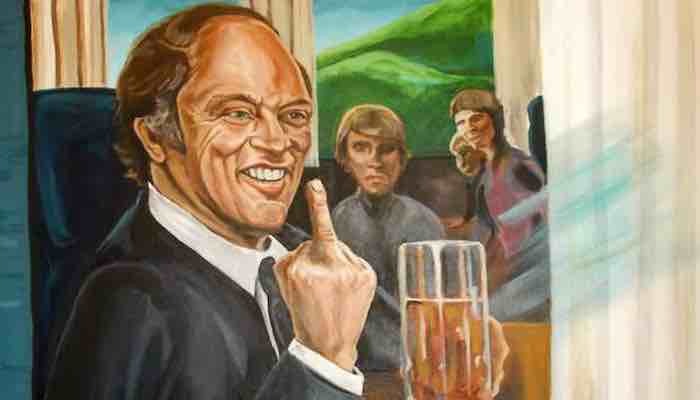
During a vacation trip in 1982, the PM extended a middle finger to local BC protestors from the borrowed Governor General’s railcar, in an incident famously recorded in history as the “Salmon Arm Salute”. Visitors can view the preserved railcar (National Post, 22 Aug 16) and pose with a cardboard Trudeau at a resort near Craigellachie, BC.

He was friendly with Cuban Dictator Fidel Castro and praised the Soviet Union (Maclean’s, 28 Feb 18) during the Stalin years, bragging that he was a communist.

The Reality Behind the Image

In 1970 he deployed the military on Canadian streets under the War Measures Act.

In 1971, the 51-year-old Prime Minister married Margaret Sinclair, the 22-year-old flower-child daughter of Liberal MP and Cabinet Member James Sinclair of Vancouver.

The March 21st, 1977 cover story in Maclean’s featured a photo of Margaret Trudeau and Mick Jagger, with the banner “Margaret and the Rolling Stones” which detailed her exploits with the bad-boy rockers.

At a state dinner in Venezuela, she honored the country’s first lady with an impromptu song instead of a planned toast, and later admitted that she had taken peyote (Bazaar, 17 Mar 16) beforehand. The press had a field day.

In 1978 Margaret Trudeau, then separated from her husband, appeared in a High Society Magazine cover story entitled “Margaret Trudeau – Caught With No Panties!”. The photo, which showed Canada’s first lady seated on the floor of notorious New York disco Studio 54 sans lingerie, was auctioned in 2017.

She hung with Andy Warhol.

Not unlike say Paris Hilton officially representing Canada abroad. Viral quality clickbait potential definitely, but embarrassing for most Canadians.

Three decades later, in a new age of post-truth and social media, all that remained in the minds of a majority of Canadian voters was brand recognition. Succeeding generations and a large immigrant population were unaware that the Trudeau brand had tarnished since it’s introduction in 1968. Celebrity had become the key value in political contests, and almost seven-million Canadians looked no further than the Trudeau name and tinsel-town allure at the polls in 2015.

Since then, Prime Minister Justin Trudeau has continued in the family tradition, with scandal after scandal keeping Liberal spin-doctors in a state of perpetual angst.

Justin Trudeau’s List of Scandals

Without limiting the generality of the foregoing, these include:

  1. Lavalin-gate
  2. Aga Khan Gate
  3. Embarrassing Indian Costumes and Bhangra dance
  4. Indian Terrorist Invited to Trudeau Reception in Delhi
  5. Elbow-gate
  6. Black Face x 3
  7. Vice Admiral Mark Norman Trial
  8. Various Cash for access scandals
  9. Praise for Cuban Dictator Fidel Castro
  10. Castro serves as pallbearer with Justin Trudeau at Pierre Trudeau’s funeral
  11. 20,000 Missing Public Works Projects
  12. WE Charity Scandal.

Pierre Trudeau tripled Federal spending between 1969-79 (MacDonald Laurier Info Wars Debate, 27 Sep 11) and plunged the country into recession in 1982, almost bankrupting it. His National Energy Program (NEP) nationalized foreign oil interests and repelled investors. Wage and Price controls contributed to the economic nightmare. It took thirty years to repair the damage done. He gutted the military, polarized parties through evoking the War Measures Act in 1970, and alienated English Canadians through his blatant favouritism of Quebec. As author Bob Plamondon wrote in his book “The Truth About Trudeau”, “No prime minister did more damage to national unity.”

Justin Trudeau has also virtually destroyed Canada’s economy, gutted the energy sector

The apple doesn’t fall far from the tree.

Since 2015, Justin Trudeau has also virtually destroyed Canada’s economy, gutted the energy sector, failed to win a UN Security Council seat, ditched his promise to create a proportional electoral system (which would have meant a Liberal loss in 2019), flooded the country with controversial refugees, inspired Quebec voters to elect a separatist party to Parliament, inspired a Western separatist party, and alienated just about everyone in the country without a special-interest lobby (and some who do). Disunity now threatens Canada’s future.

What does the Trudeau brand really stand for?

Privilege, Arrogance, Disdain, Self-Promotion, Indifference, and Failure. Image over substance.

Edmonton artist Jenn Kovachik captured it all in “The Salmon Arm Salute”. It would make a great logo.

Milton Friedman Myths v Reality


The Last Stand to Save America as Founded


Seriously folks, we must do everything in our power to reelect our remarkable president. This election is our last stand to save America as founded. America is counting on you

Lloyd Marcus image

Re-Posted from the Canada Free Press By  —— Bio and ArchivesJuly 23, 2020

My patriotic mood began re-watching Whitney Houston’s spectacular performance of our National Anthem at Super Bowl XXV in 1991. Whitney’s rendition was re-released as a single after the 9/11 terrorists attacks. She donated all proceeds to charity.

“Fourscore and seven years ago our fathers brought forth, on this continent, a new nation, conceived in liberty, and dedicated to the proposition that all men are created equal.”— Abraham Lincoln

Wow! Lincoln said it right there in his Gettysburg address that America was founded upon the principle that all men are created equal. Leftist schools have taught our kids for decades that America was founded by evil white guys with no desire for equality. Yes, it took awhile to reach our goal of equality for all Americans; 600,000 dying in the Civil War to free the slaves and years of civil rights battles paved the way to elect our first black president. But, we got there folks. We got there!

“The thing that sets the American Christian apart from all other people in the world is he will die on his feet before he’ll live on his knees.” —George Washington

I pray that Christians will stop kneeling to wicked cultural demands and begin standing up again for Godly principles. Far too many youths are Marxist zealot domestic terrorists because we’ve allowed leftist schools to poison their minds about their God, their family and their country. Outrageously, across America “yutes”  are scolding, lecturing and punishing their parents for being Christians, patriotic Americans and gun-owners.

“I have a dream that one day on the red hills of Georgia, the sons of former slaves and the sons of former slave owners will be able to sit down together at the table of brotherhood.”—Dr Martin Luther King, Jr.

Black s Matter, ANTIFA and various other anti-christian and anti-American hate groups do not want “brotherhood” as desired by Dr King. They want to punish white America. They demand that whites physically kneel to blacks and beg forgiveness for their sin of being born white. The people in these groups are wicked and must not be tolerated. At the top of your lungs, scream the word, “No!” to them.

Blessed is the nation whose God is the Lord.—Psalm 33:12

America is a Christian nation, brilliantly and divinely founded upon biblical principles. Stating this truth enrages BLM and ANTIFA causing them to vomit green-slime and their heads to spin around backwards. Evil is repulsed by good. Alexis de Tocqueville said “America is great because America is good.”

Folks, in these final months leading up to the November election, the Democrat/communist party will launch every wicked scheme in their depraved playbook to attack the American people to stop them from reelecting one of the greatest presidents in U.S. history, Donald J. Trump.

We have so much work to do. This is all hands on deck. This election is our last stand to save our founding father’s divinely-inspired vision of America. Please talk to your neighbors, family and friends encouraging them to vote for Trump. Let them know what is at strike. Here is a list of 42 crazy disastrous things Biden will implement if elected.

I’ve awakened 2am in the morning, turned on my TV and have encountered lie-filled news stories trashing Trump. The hits on Trump just keep on comin’. This is what we are up against folks.

A large percentage of the country get their news from mainstream (fake news) media. Consequently, they are clueless regarding many important issues.

For example: My sister is one such low-info Christian voter. I recruited her awesome alto voice to sing in the choir at the recording session of my Trump Train 2020 song. The choir was mostly white, all Trump supporters. She noticed that they were good friendly everyday people, not the rabid racists portrayed by media. Her eyes popped out of her head in disbelief when I told her San Francisco gives tourists maps to avoid the piles of human feces on the streets left by vagrants. She had no idea that Trump was responsible for black unemployment being its lowest in U.S. history.

We flew many of our singers from the east coast to California to perform in the Trump Train 2020 song music video. Upon landing in California, my sister was stunned to see the “all gender” restrooms with signs welcoming transgenders at the airport. This opened the door for me to educate her about the extreme LGBTQ agenda that Biden and the Democrats want to implement across the country. My buddy, Robert Kirk, brilliantly exposes the wacko California LGBTQ mandates in his award-winning comedy short film, “Nightmare in Paradise.”

I suspect my sister will vote for Trump. In the Trump Train 2020 music video, she is the beautiful black woman singing the solo line, “Don’t you feel the engines roar!”

Please spread the Trump Train 2020 music video far and wide to counter Neil Young’s song, “We Got to Vote Him Out!”

I am the eldest of 4 boys and one girl. My sister was Dad’s princess. He purchased her first car, a brand new Fiat. He made me work to purchase my first “used” car. The good news is Fiats were lemons; just kidding.

Seriously folks, we must do everything in our power to reelect our remarkable president. This election is our last stand to save America as founded. America is counting on you.

The Coming Coin Shortage


The Federal Reserve also established a U.S. Coin Task Force

Dr. Ileana Johnson Paugh image

Re-Posted from the Canada Free Press By  —— Bio and ArchivesJuly 22, 2020

The Coming Coin Shortage

As if the global economic disaster caused by the Chinese Covid-19 viral pandemic was not bad enough, the looming global “coin shortage” and the “unknown pneumonia” (Covid-20?) in Kazakhstan are here.

Why exactly do we have a coin shortage?

  • Banks tell us that the Fed are not releasing enough coins.
  • Armstrong Economics wrote that faith in governments has been eroded. It sees governments as promoters of the idea that money is dirty, and the solution is to eliminate coins and paper money even though physical money as a medium of exchange has been in circulation for centuries.
  • The U.S. Treasury reported a disruption in the coin supply chain and its velocity of circulation due to the lockdowns and the huge reduction in consumption in the last four months of forced lockdowns in all 50 states. People shopped mostly for food and avoided all other venues of direct commerce for fear of Covid-19 infection and because so many places were closed. Many shopped online or in large retailers like Costco, Target, Walmart, and Amazon.
  • Allegedly, the U.S. Mint has minted less coins to protect employees from COVID-19. It is an interesting issue to ponder since minting coins and printing paper currency are highly automated operations, with expensive computers driving the printing and minting presses and requiring very few employees, mostly in checking roles to make sure the machines run properly and the mint/print are done correctly, as well as controlling the quality of each batch that is bound and packaged for distribution and circulation.
  • Some central banks are sterilizing money with UV light to prevent the spread of viral infections.
  • The Fed purportedly quarantined for ten days U.S. dollars returning from Europe and Asia.

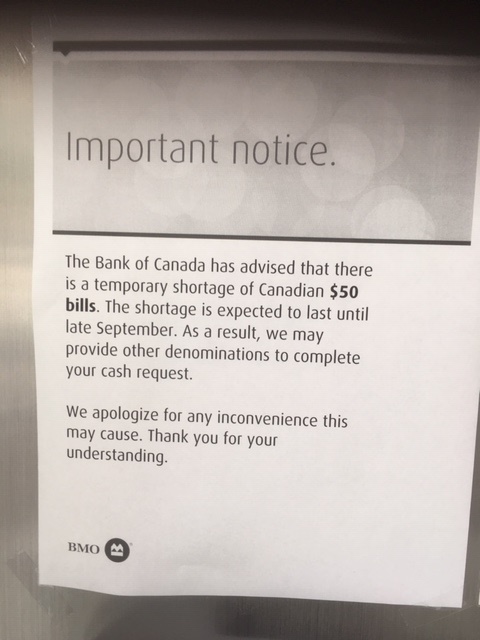
The U.S. Treasury sees the current coin shortage in U.S. businesses as a decrease in velocity of various coins in circulation. The Treasury estimated the value of coins in circulation in April 2020 of $47.8 billion as an adequate coin supply, larger than last year’s supply of coins by at least half a billion. But the closing of retail shops, many permanently, bank branches, transit authorities, and laundromats due to Covid-19 fears, eliminated the typical places where coins enter circulation.

Nobody knows exactly if people are hoarding coins on purpose or if the businesses that have closed temporarily or permanently have cleared out all their cash registers of coins and paper currency.

“The coin supply chain includes many participants, from the U.S. Mint who produces new coin, to the Federal Reserve who distributes coin on the U.S. Mint’s behalf, to armored carriers, banks, retailers and consumers, all of whom have a role to play in helping to resolve this issue.”

On June 11, the Federal Reserve announced the Strategic Allocation of Coin Inventories which was a temporary coin order allocation in all Reserve Bank offices and Federal Reserve coin distribution locations effective June 15, 2020.

The Federal Reserve also established a U.S. Coin Task Force in early July to deal with disruptions to normal coin circulation.  All interested parties participated – U.S. Mint, Federal Reserve, armored carriers, American Bankers Association, Independent Community Bankers Association, National Association of Federal Credit Unions, Coin aggregator representatives, and retail trade industry.

The Federal Reserve said that “it is confident that the coin inventory issues will resolve once the economy opens more broadly and the coin supply chain returns to normal circulation patterns, however, “it recognizes that these measures alone will not be enough to resolve near-term issues.”