The Twitter Bot Inquiry Intensifies as Musk is Seemingly Stiff Armed


Posted Originally on the conservative tree house on May 16, 2022 | Sundance

The ramifications for Twitter surrounding fake users or algorithmic bots are considerable.  One issue is overcharging advertisers for ad impressions based on mDAU’s, which are “monetized Daily Active Users.”  The second issue is an outcome of the first and relates to the valuation of Twitter.  If Twitter bots are higher than Twitter estimates, then the mDAU rate is overstated.

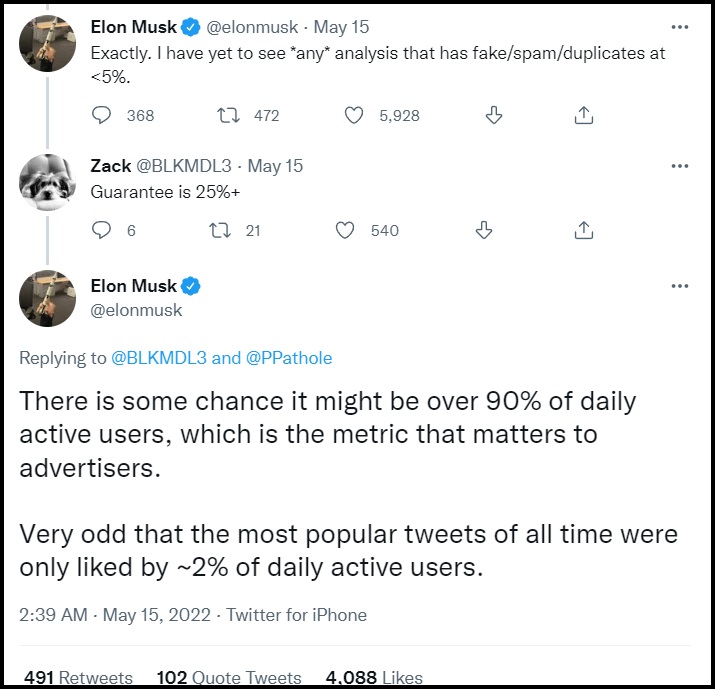
Elon Musk is indicating there may need to be a lowering of the purchase price unless Twitter becomes transparent with how they are calculating the number of bot users at less than 5%.  All outside reviews attempting to estimate the number of fake accounts, or bots, puts the estimations considerably higher than the claims by Twitter.  Elon Musk tweeted:
At “The All In Summit 2022,” Elon Musk gave the impression the purchase price of Twitter may be tenuous.  He said that a deal with a lower price tag is not “out of the question,” Bloomberg reported.  “Currently, what I’m being told is that there’s just no way to know the number of bots… It’s like, as unknowable as the human soul,” Musk said at the Miami conference, per a social media video, Bloomberg added.

Twitter CEO Parag Agrwal has responded to the controversy in a very obtuse twitter thread:
Let’s talk about spam. And let’s do so with the benefit of data, facts, and context…

First, let me state the obvious: spam harms the experience for real people on Twitter, and therefore can harm our business. As such, we are strongly incentivized to detect and remove as much spam as we possibly can, every single day. Anyone who suggests otherwise is just wrong.

Next, spam isn’t just ‘binary’ (human / not human). The most advanced spam campaigns use combinations of coordinated humans + automation. They also compromise real accounts, and then use them to advance their campaign. So – they are sophisticated and hard to catch.

Some final context: fighting spam is incredibly *dynamic*. The adversaries, their goals, and tactics evolve constantly – often in response to our work! You can’t build a set of rules to detect spam today, and hope they will still work tomorrow. They will not.

We suspend over half a million spam accounts every day, usually before any of you even see them on Twitter. We also lock millions of accounts each week that we suspect may be spam – if they can’t pass human verification challenges (captchas, phone verification, etc).

The hard challenge is that many accounts which look fake superficially – are actually real people. And some of the spam accounts which are actually the most dangerous – and cause the most harm to our users – can look totally legitimate on the surface.

Our team updates our systems and rules constantly to remove as much spam as possible, without inadvertently suspending real people or adding unnecessary friction for real people when they use Twitter: none of us want to solve a captcha every time we use Twitter.

Now, we know we aren’t perfect at catching spam. And so this is why, after all the spam removal I talked about above, we know some still slips through. We measure this internally. And every quarter, we have estimated that <5% of reported mDAU for the quarter are spam accounts.

Our estimate is based on multiple human reviews (in replicate) of thousands of accounts, that are sampled at random, consistently over time, from *accounts we count as mDAUs*. We do this every quarter, and we have been doing this for many years.

Each human review is based on Twitter rules that define spam and platform manipulation, and uses both public and private data (eg, IP address, phone number, geolocation, client/browser signatures, what the account does when it’s active…) to make a determination on each account.

The use of private data is particularly important to avoid misclassifying users who are actually real. FirstnameBunchOfNumbers with no profile pic and odd tweets might seem like a bot or spam to you, but behind the scenes we often see multiple indicators that it’s a real person.

Our actual internal estimates for the last four quarters were all well under 5% – based on the methodology outlined above. The error margins on our estimates give us confidence in our public statements each quarter.

Unfortunately, we don’t believe that this specific estimation can be performed externally, given the critical need to use both public and private information (which we can’t share). Externally, it’s not even possible to know which accounts are counted as mDAUs on any given day.

There are LOTS of details that are very important underneath this high-level description. We shared an overview of the estimation process with Elon a week ago and look forward to continuing the conversation with him, and all of you.  (Link to Twitter Article)

Methinks Parag Agrwal doth protest too much….  Especially if you overlay the ideological incentives that Twitter carries into its operational platform.

If you accept that Twitter is manipulating the public conversation intentionally (they are), then Twitter bots would serve an ideological function.  However, the issue of ‘bots’ operating on the Twitter platform is interesting when you consider the cost of platform operation.

On one hand, extensive auto-generated ‘bots’ would be an issue of cost and data-processing, a net negative.  On the other hand, the use of bots would be a manipulative practice for the creation of false impressions to generate advertising revenue.
If the scale of data-processing was subsidized, an outcome of a network of data processing centers -the AWS cloud- linked to government resources, the bots would not be a cost issue for the operation.  Despite the false impressions generated, bots would, however, under this weird situation, be useful for the manipulation of the conversation.

At the root of Elon Musk’s line of inquiry is the need to discover if this suspicion is true.

If the scale of bots has been underestimated (likely by a willfully blind operation) the advertising fees charged by Twitter were potentially fraudulent.  This is another operational reason (mitigating lawsuits from advertisers) for Musk to make the determination prior to the final purchase of the platform.

Taking Twitter private as a company, eliminating bots (which is essentially removing fraudulent users) then carries the potential benefits of both lowering costs and positioning the company to increase genuine ad revenue from authenticated users as real people.

Many people suspect the size of the political left on the Twitter platform is manipulated by programatic bots.  Meaning there seems to be more people on the left side of the spectrum because bots are deployed to give the impression of like-minded users.  I am one of the people who believe this suspicion is accurate, because it would be a typical way the ideological left operates.

The bots would be in addition to the deployment of algorithms that are designed to suppress speech the platform operators do not like.

I have long suspected the Twitter algorithm process is essentially assigning certain users into specifically designed data-processing containers where their voice is suppressed.   Some people call this ‘shadow-banning,’ I simply call it suppression.

Elon Musk represents a threat to the way the platform was/is designed to operate.  If Musk removes the discussion constraints, opens the containers and removes the restrictions, while simultaneously eliminating bots and fake accounts, the entire perspective of the platform could change very quickly.  This is what I think the current board and operators are trying to avoid.

Another rudimentary way to look at it…. Think about the last several months of public opinion polls.   Despite the efforts of a compliant media, repeatedly we see a 75/25 split against Biden and leftist policies.  The 3:4 and/or 4:5 ratio has been a consistent pattern for several months.  That ratio shows up in almost every poll.  However, if you look at Twitter that ratio is not present in the “organic” conversation about the same issues.

As CTH has said for many years, there are more of us than them.  However, Big Tech controls the mechanisms we use to communicate – and as a consequence the scale of our assembly is severely understated.

Twitter user fraud is the digital and social media equivalent to voter election fraud.   The voices raised in opposition to researching both issues are exactly the same.

Suspicious Cat remains, well, suspicious….

The BMJ: Evidence Based Medicine has Been Corrupted by “Corporate Interests, Failed Regulation, and the Commercialization of Academia”


Posted originally on TrialSite by Staff originally on April 21, 2022

A March 16 opinion piece in The BMJ raises some serious questions about what they call, “The illusion of evidence based medicine.” Authors Jon Jureidini and Leemon B. McHenry posit that the prominence of evidence-based medicine constituted a paradigm shift, meant to give a solid foundation in science for our medical care system. But the validity of the paradigm depends of accurate data from clinical trials, and most of these are conducted by the pharma industry and then published under the name of “senior academics.” Public release of what had been confidential pharma industry documents gives the medical world key insights into the level to which pharma-sponsored trials are mischaracterized. Getting a bit philosophical, The BMJ argues that critical rationalism is key for both the integrity of science and the role of science, “in an open, democratic society.” But this ideal is under threat by corporate power, a world in which, “financial interests trump the common good.” The dominance of massive pharma firms involves some competition, but all these players are united in working to expand the general pharma market. And while what the authors call, “free market champions” have embraced privatization, “the unintended, long-term consequences for medicine have been severe.”

Medical Schools Take Neo-Liberal Approach

Knowledge and data ownership hamper progress in science due to the fact that the pharma industry tends to suppress negative trial outcomes, not report adverse events, and not share their raw data with the research community. To quote The BMJ, “Patients die because of the adverse impact of commercial interests on the research agenda, universities, and regulators.” And duty to shareholders’ “hierarchical power structures” prioritizes both product loyalty and public relations over integrity. Further, while our fancier universities face influence from their endowments, “they have long laid claim to being guardians of truth and the moral conscience of society.” And facing reduced government funding, these schools have taken the, “neo-liberal market approach,” seeking out pharma funding, with strings attached.

Doctors as “Product Champions”

And thus, science departments at a broad swath of our universities can be seen as “instruments of industry.” When you combine firm-level control of the research agenda and the “ghosting writing of medical journal articles and continuing medical education,” scholars can transform into promotors of commercial products. Further, media reports of “industry-academe partnerships[s]” add to a general mistrust of our academic institutions that betrays the very vision of an open society. And what The BMJ calls the “corporate university” itself undermines the idea of academic leadership. Where once deans were folks with “distinguished contributions to their disciplines,” now they are more of fundraisers/academic managers who must show their “profitability” and ability to attract corporate sponsorship. And medical academia’s stars, who tend to be opinion leaders, advance their careers via industry opportunities. These folks are hired based largely on their influence on the “prescribing habits” of other doctors. The opinion leaders are also often well-paid by pharmaceutical advisory boards and speakers’ bureaus in the context of presenting results of pharma industry trials. And instead of being “independent, disinterested scientists,” they can become “product champions,” in the parlance of marketing executives.

Reforms Called For

Proposals for reform can include, “liberation of regulators from drug company funding; taxation imposed on pharmaceutical companies to allow public funding of independent trials; and, perhaps most importantly, anonymized individual patient level trial data posted, along with study protocols, on suitably accessible websites so that third parties, self-nominated or commissioned by health technology agencies, could rigorously evaluate the methodology and trial results.” For readers seeking more information, the American Medical Association’s Code of Medical Ethics Opinion 7.1.4 sets out that organization’s policies on conflicts of interest in industry-funded research.

A March 16 opinion piece in The BMJ raises some serious questions about what they call, “The illusion of evidence based medicine.” Authors Jon Jureidini and Leemon B. McHenry posit that the prominence of evidence-based medicine constituted a paradigm shift, meant to give a solid foundation in science for our medical care system. But the validity of the paradigm depends of accurate data from clinical trials, and most of these are conducted by the pharma industry and then published under the name of “senior academics.” Public release of what had been confidential pharma industry documents gives the medical world key insights into the level to which pharma-sponsored trials are mischaracterized. Getting a bit philosophical, The BMJ argues that critical rationalism is key for both the integrity of science and the role of science, “in an open, democratic society.” But this ideal is under threat by corporate power, a world in which, “financial interests trump the common good.” The dominance of massive pharma firms involves some competition, but all these players are united in working to expand the general pharma market. And while what the authors call, “free market champions” have embraced privatization, “the unintended, long-term consequences for medicine have been severe.”

Medical Schools Take Neo-Liberal Approach

Too Dangerous to Allow Elon Musk Control Over So Much Data Says Washington Post


Posted originally on the conservative tree house on April 19, 2022 | sundance

The latest developments in the effort to purchase the unsustainable magic coffee shop are quite revealing.

According to the New York Post, “Musk himself is willing to invest between $10 billion and $15 billion of his own cash to take Twitter private, two sources close to the situation said. That’s up from the current 9.1% stake in the company he revealed on April 4, which is worth about $3.4 billion.”

However, more revealing about the overall issue are the comments from the PR firm of the U.S. Intelligence Community, The Washington Post:

(WaPo) […] “Putting so much power in the hands of one company is bad enough, but putting it in the hands of one person, as is largely the case with Facebook shareholder Mark Zuckerberg and would be the case if Twitter were owned by Musk, would be incompatible with democracy.” 

“There are simply no checks and balances from any internal or external force,” … “It would leave Musk, like Zuckerberg, with an amount of assembled data about people and the ability to use it to manipulate them “that cannot be compared to anything that has ever existed, and allows intervention into the integrity of individual behavior and also the integrity of collective behavior.” (read more)

People are starting to catch on to the reality that costs for data processing on many social media platforms (the free coffee), exceeds the ability of the platform to generate revenue.  People are starting to understand that behind the scenes of the Big Tech consortium, there is something else, some other operational construct and mechanism, that subsidizes & facilitates their existence.

It is very revealing how the intelligence apparatus of the United States had no issue with Twitter data and influence, until the potential for private ownership, perhaps uncontrolled private ownership, surfaced.  Do not be naïve in pretending not to know how The Washington Post represents the interests of the intelligence apparatus.

In the long arc of history, I truly believe we will discover the inflection moment for the merge of U.S. Deep State (intel community) and U.S. Social Media, will be identified in the early moments of the Arab Spring of 2010/2011.  That was when Facebook and Twitter became tools for the State Dept operation in Egypt, Libya, Tunisia, Syria, Bahrain and beyond.  That was the beta-test of synergy.

“Arab Social Media Report by the Dubai School of Government give empirical heft to the conventional wisdom that Facebook and Twitter abetted if not enabled the historic region-wide uprisings of early 2011.” (LINK)

It was from that original, albeit misguided and manipulative partnership, when the actual details about how to create the social surveillance state was first tested.   Everything after those events more than a decade ago, has been this rapidly evolving blend of social media technology and the capacity of the U.S. intelligence apparatus to create and fund the underlying structures.

Daily, we see numerous examples of the ideological control that surfaces as a direct result of this public-private partnership, the closed-conversations between deep government interests (the Fourth Branch) and social media companies which are dependent on the subsidized technology for them to exist.

Perhaps 2022 represents the first time the commonsense of the American electorate begins to recognize the fallacy of the ‘free coffee’ business model.  Personally, I am very optimistic people will soon recognize what many have suspected for a long time.

Ultimately the question becomes, how far will the U.S. Fourth Branch of Government go to stop people from understanding?

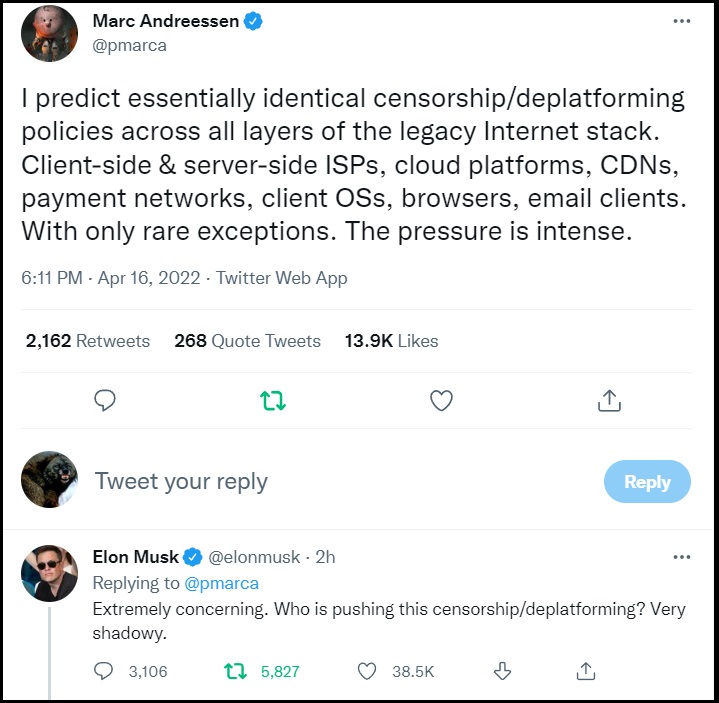
Marc Andreessen believes Govt and Big Tech will double, triple and quadruple down to keep their public-private partnership, the backbone of the Free Coffee Shop, hidden.  I cannot say I disagree, because ultimately it is still only the minority of people who understand the stakes.  However, on the upside, the number of people who are starting to understand it, is growing almost exponentially thanks to Elon Musk.

(Source Link)

This is one of those situations where we should all welcome being called ‘conspiracy theorists’, because no matter how big the crowd is that refuses to believe it, ultimately the impossible business model of Jack’s Magic Coffee Shop will reveal everything.

That’s why the public-private partnership must stop Elon Musk.  As the Washington Post noted, this level of revelation “cannot be compared to anything that has ever existed.”

“Very shadowy” indeed.

Elon Musk Could Takeover Twitter


Armstrong Economics Blog/BigTech Re-Posted Apr 17, 2022 by Martin Armstrong

Media Admits It is Their “Job” To Control What People Think


Armstrong Economics Blog/Press Re-Posted Apr 17, 2022 by Martin Armstrong

Armstrong on USA Watchdog April 12th, 2022


Armstrong Economics Blog/Armstrong in the Media Re-Posted Apr 16, 2022 by Martin Armstrong

Smart Investor Article (English Translation Provided)


Armstrong Economics Blog/Armstrong in the Media Re-Posted Apr 15, 2022 by Martin Armstrong

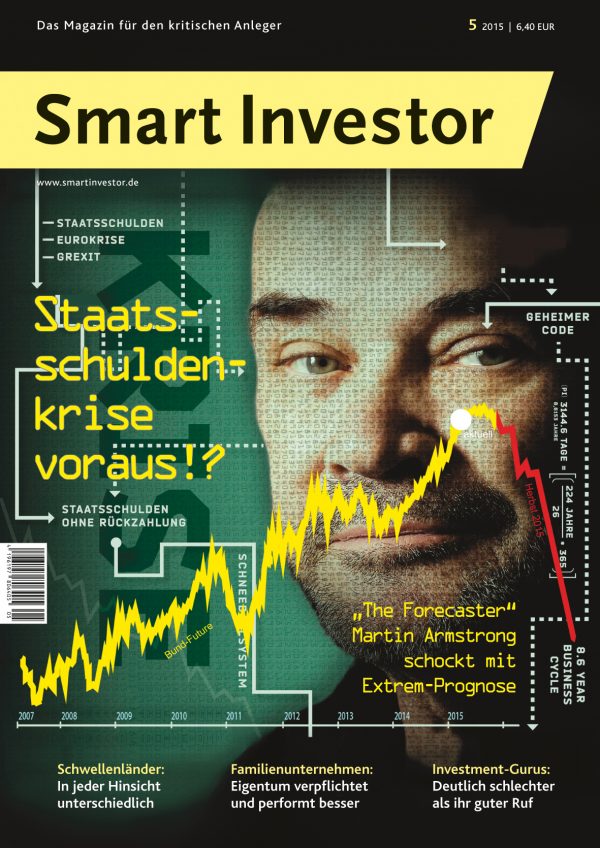
I recently appeared on the cover of “Smart Investor” after being approached by journalist Ralph Malisch. Click here to read the full interview (German).

The English translation is available below:

Smart Investor talks to legendary cycle analyst Martin Armstrong about Corona, war and reshaping the world

Smart Investor: Mr. Armstrong, in 2015, The Forecaster, a powerful film about your life, was released. We interviewed you extensively in Smart Investor 5/2015. How have you been doing in the meantime and what are your current projects?
Armstrong:  I was involved in a sequel to the film that will be out later this year. Otherwise, we have expanded our services and have now launched our computer system, which is the system that the government wanted for itself. It now produces over 1,000 written reports every day all over the world without human intervention. We now use it in over 40 countries, which means we probably have the largest institutional customer base in the world.

Smart Investor 5/2015

Smart Investor: Would you briefly explain your forecasting approach to our readers again?
Armstrong:  In the 1980s and 1990s, I was one of the top international hedge fund managers, even being named hedge fund manager of the year for predicting the collapse of Russia, which triggered the 1998 hedge fund Long-Term Capital Management crisis. During that time, I’d watched global investment capital refocus on markets and then move on—leaving Japan in 1989, Southeast Asia in 1994, and Russia in 1998, followed by the euro. All of this was fueled by capital flows. One can follow these movements of capital and see how they cause the boom-bust cycles around the globe.

Smart Investor: The topic of Corona has kept us under its spell for more than two years. Was this turning point, or a drastic event like this, visible in your cycle model?
Armstrong: Yes, I warned at our own World Economic Conference that if our model flipped in January 2020 (= year 2020.05) the market would crash. We were even able to pinpoint the exact day for the March 2020 bottom. Had an event like Corona happened during an uptrend, it would have been largely ignored. But if something like this happens while the model is turning down, then sentiment is inherently bearish. We also warned that there would be a scarcity-based commodity cycle from January 2020 to 2024.

Smart Investor: In our perception, major pandemics occur with a certain regularity. Have you thought about some kind of plague cycle and how it might continue?
Armstrong: Such epidemics have always existed – but never in history have governments reacted so madly. The global lockdown has cost jobs and created bottlenecks in supply chains that will persist for several years to come. It was an absurd response that was proven wrong and caused a lot more damage. Most people know someone who got sick from COVID but didn’t die from it. Those who died would likely have died from any form of respiratory disease, such as occurs during the annual cycle of influenza. It was not a dangerous plague that killed 30% to 50% of the population like smallpox or the black plague in the 14th century.

Smart Investor: Now a new dominant event has been triggered with the hot war in Ukraine. How does this war fit into your model, specifically the war cycle?
Armstrong: That too came at exactly the “right” time. Our model showed 1/16/2022. Unfortunately, instead of trying to bring peace to the world, the West has demonized Putin. The claim that Putin wanted to restore the old Soviet Union was pure propaganda. For the past 22 years he has made no attempt to restore communism, only calling Lenin himself a communist. He did not try to expand the borders but warned against NATO encroachment. In war, both sides spread propaganda, and it is always important to be objective about the claims of both sides. Putin’s invasion of Ukraine was consistent with his warnings and came four days after US Vice President Harris recommended Ukraine join NATO. That was totally irresponsible.

Smart Investor: Can you see in your models which regions or countries will suffer the most in this conflict, who will get off lightly and who will be the beneficiaries?
Armstrong: On both sides there are what we call neocons, people who just hate the other side. They cannot sleep at night as long as their enemy exists. Unfortunately, the deteriorating economic outlook is a reminder that war has often served as a diversionary tactic in the past. It looks like China is allying itself with Russia. I believe the confiscation of Russian private property was a serious violation of international law. Others, too, will realize that their assets could be confiscated if their country got into a dispute with the West. This would, of course, lead to a drop in global investment. It is precisely this process that seems to have started and, according to our models, will only get much worse over the next ten years. Disputes between countries are likely to remain at this level. The arrest of individuals simply because they are Russian is reminiscent of the internment camps for Japanese in the US during World War II solely on the basis of their ethnicity. It is very detrimental to the world economy when free investment is hampered.

Image: © Angelov – stock.adobe.com

Smart Investor: If we understand it correctly, the cycles develop largely independently of the specific actions of individuals. It’s hard to imagine, but would an escalation have been inevitable even if the Russian President hadn’t given the order for the invasion?
Armstrong: That’s right. Demonizing Putin is absurd. There have been far worse leaders in history, like Hitler or Stalin, who could kill millions of people without thinking twice. The development of things is primarily determined by the economy. Normally you don’t bite the hand that feeds you. But imposing sanctions on Russia has exactly the opposite effect: they isolate Russia and sever economic ties, leading to casualties and in turn evoking anger and retaliation. Rome survived for 1,000 years because the conquered provinces benefited from selling their products to Rome. The confiscation of Russia’s currency reserves is above all a warning to China to be very careful in its dealings with the West. For China, the exclusion of Russia from the SWIFT system only means that it is working flat out to introduce its variant of CIPS. Saudi Arabia just agreed to sell oil for yuan. These measures only guarantee that conflicts will continue to escalate and the world economy will be split in half.

Smart Investor: As investors, we try to prepare for strong cycles like these. Which asset classes or sectors should one avoid in this situation and where can one expect safety?
Armstrong:  Government bonds in particular are to be avoided. Governments will default and you will get nothing back. The loans from European governments from before the Second World War are now just an attractive wall decoration. When a company goes bust, its assets are sold and at least you get something back. But you can’t just run into the art museum and steal Picassos in the government. In times of war and geopolitical conflict, real assets are the best security.

Smart Investor: Gold is considered the safe haven, and Bitcoin is also perceived as such in some places. However, these two assets are also more of a thorn in the side of our governments. What do you think of the idea that the Russia argument could make life difficult for investors here in the future?
Armstrong: Gold has lost its mobility – so you can’t hop on a plane and fly somewhere with a briefcase full of gold coins or bars. Cryptocurrencies are vulnerable, because without a power grid, credit cards are a thing of the past. The government is trying to switch to digital currencies and they will not allow competition so they will confiscate cryptocurrencies. The best is paper money or small denomination silver coins that are recognizable to the average person. Tin cans will also have an exchange value if there is no electricity grid.

Smart Investor: Gold and cryptocurrencies are also the main alternatives to paper money, which the war is putting additional pressure on. Will the US dollar and euro survive this?
Armstrong:  The US dollar will outlast the euro, but if we get into a real world war, the paper dollars could lose their value too. Europe has historically canceled its fiat money, while the
US dollar has never been cancelled. Even Canada is now nullifying its currency.

Smart Investor: The Great Reset, the World Economic Forum and Prof. Dr. Klaus Schwab are making waves in Europe. During the corona pandemic, the government measures literally dismantled the medium-sized economy. What do you think of the corporations’ “Big Plan” and are the actors’ ideas compatible with the cycles?
Armstrong: The Great Reset is indeed a real goal. It’s not a conspiracy theory. The three stumbling blocks along the way were Trump, Putin and Xi. They got rid of the first one, and now the propaganda has turned to demonizing Putin and Xi. They believe that if they get rid of these two leaders, they can unite the world under the United Nations. Our models have warned that authoritarianism will rise in this final decade. But they will fail. Marx succeeded only because serfdom in Russia did not end until 1861, while in Europe it only lasted until the fourteenth century. So the people owned nothing, and it was easy to confiscate the wealth of the aristocrats. Today people own their own houses, cars and save for the future. The slogan “You will have nothing and be happy” propagated by the WEF is a red herring. Governments can no longer borrow indefinitely and there will be a default. To disguise this fact, the impression is given that all debts are being forgiven and that they are doing it for you. The guaranteed basic income will be there to replace the pension funds that hold government debt today.

Smart Investor: Thank you very much for your very interesting explanations.

In stock market circles, the American Martin Armstrong (born 1949) is considered a legend. As early as the early 1980s, he correctly predicted the stock market crash of 1987 – and in the midst of the panic he predicted new highs for 1989. He also predicted the bursting of the Japanese stock bubble at the end of 1989. He made his forecasts using the “Economic Confidence Model” (ECM) he developed himself, which is based on a database on the history of coins, which Armstrong used to reconstruct the (financial) history. You can find his daily updated assessments on the blog https://armstrongeconomics.com .

Nunes: Building Truth Social piece-by-piece to prevent Big Tech cancellation


Posted original on Rumble by Devin Nunes  Published originally on April 7, 2022 

Trump Media & Technology Group CEO Devin Nunes joins One America News’ Dan Ball to discuss the latest news regardless Truth Social and Special Counsel John Durham on April 7, 2022.

Living in the Past – Stalin v Lenin


Armstrong Economics Blog/Russia Re-Posted Apr 7, 2022 by Martin Armstrong

COMMENT: Hi,
I live in Finland/Helsinki. The Soviet Union attacked Finland in 1939, Stalin was one who arranged a false flag in Manila. A lot of Finnish soldiers and civilians died. But we survived. We Finnish people know Russians extremely well. It is a historical fact that Russians always arrange false flags and try to slave other nations and people. And that is happening just now in Ukraine. Putin attacked Ukraine and he is trying to slave Ukraine.
Best Regards from Finland

JT

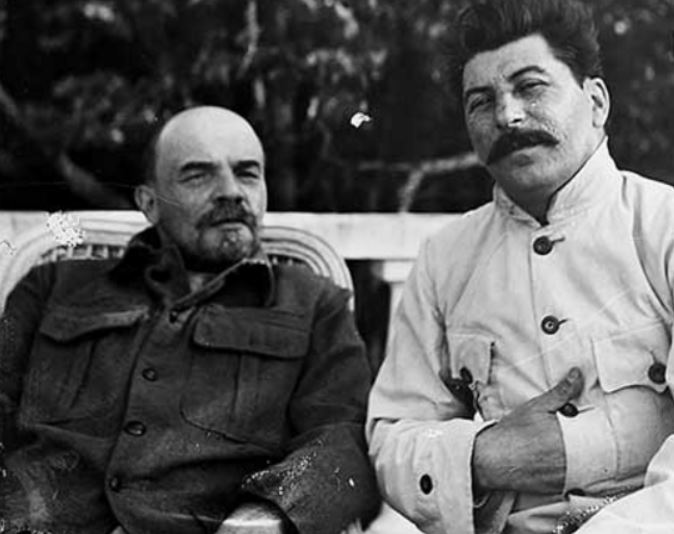
REPLY: It is important to not judge a country by its leaders. There are always left and right in every country and no country enjoys 100% approval of its people. Just look at the United States. There are ONLY three presidents who won with 60% or more, FDR 1st term, Johnson following Kennedy’s assassination, and Richard Nixon who promised to end Vietnam. All others won with just a few points over 50%. In the 2008 Election of Obama v McCain score his victory with just 52.9%. Even Lenin warned not to put Stalin in charge.

It is wrong to judge Russia by Stalin and today the powers that be just hate the Russian people and attribute everything to Putin. It is essential to also understand that there is a left and a right in Russia that still prevails today and Putin is a moderate that if ignored by the West, will drive Russia into the hands of the extreme right.

We MUST understand history for there has always been a question of where Russia begins and ends and who constitutes the Russian people. These questions have been debated by Russian thinkers themselves for centuries post-Russian Revolution which ended more than 300 years of tsarist rule. Believe it or not, Putin is NOT trying to resurrect the Soviet Union for that was not even the vision of Lenin – but Stalin.


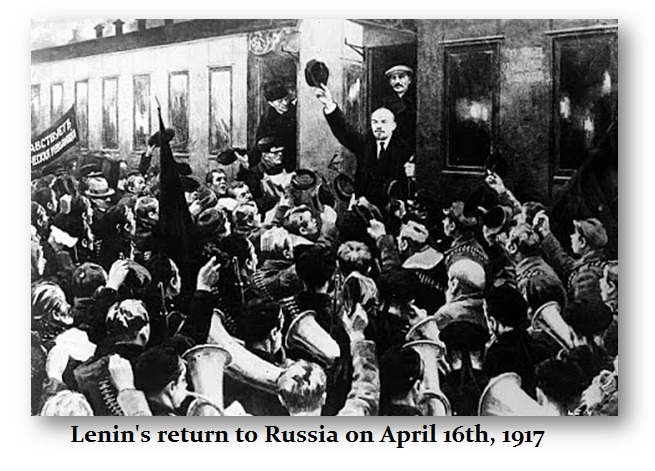
At first, Lenin was revered as the architect of the new Russia. He was the elder statesman of the Bolshevik revolution. Stalin, on the other hand, was what we would call a Neocon. He was the ambitious party leader with visions of absolute authoritarian control. The two clashed not only over their political vision for Russia but also on a very personal level hurling insults steeped in grudges. It was this battle that actually proved to be too much for Lenin resulting in his premature death.

The conflict between these two Russian leaders reached a climax in the last days of December 1922. This is when 2,000 delegates from all over the former Russian empire gathered together in Moscow to create a new state which would become the Union of Soviet Socialist Republics. The vision of this new state was starkly different between the two men. There were republics of Ukraine, Belarus, and Transcaucasia, which were formally independent of Russia. When Georgy Chicherin, the Soviet Russian commissar for foreign relations, signed the treaty with Germany where each surrendered their claims against the other for war reparations in July 1918, there was a problem of unity. Ukraine and Belarus were independent before 1919 but were then overrun by the Bolsheviks in 1919. They had objected to forgiving Germany.

Ukraine and Belarus took the position that the Russian authorities had no right to speak on behalf of Ukrainian and Belarus. In Georgia, there too they objected insisting that their rights as the members of an independent republic were violated. This is was ultimately set in motion the birth of the final version of the Soviet Union.

It was in August of 1922 when Joseph Stalin created a special commission to recommend a new political model of relations between the communist Party’s Central Committee, Russia and the republics. Stalin’s proposal was called the “autonomization of the republics” whereby the formally independent republics would be incorporated into the Russian Soviet Federation with rights of autonomy. However, the Russian Federation would become the central authority subordinating the formally independent republics. This resulted in a rebellion with the Georgians led the revolt against Stalin’s model. They were joined by the Ukrainians and Belarusians.

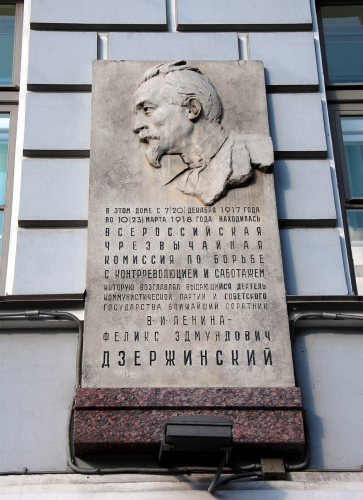
This conflict between Lenin’s vision of a union more akin to the United States model and Lenin’s vision of absolute central power resulted in the heated conversation with Feliks Dzerzhinsky, who was the head of the secret police and a supporter of Stalin. Stalin and many of his supporters, such as Ordzhonikidze and Dzerzhinsky, were actually non-Russians. Stalin was Georgian and Dzerzhinsky was actiually Polish. Interestingly, Felix Dzerzhinsky was remembered in St Petersburg on a Commemorative plaque dedicated him.

But the stroke prevented him from taking any decisive steps against them. Two days later, a commission of party officials, led by Stalin, placed strict limitations on Lenin’s activities, effectively isolating him. They said the restrictions were designed to prevent the worsening of Lenin’s health. But they also served a political purpose.

Lenin could not attend the congress and he certainly did not trust Stalin. Consequently, the paralyzed Lenin dictated his famous thoughts on the nationality question in a document he sent to the party leadership. It was a letter titled “On the Question of Nationalities or ‘Autonomization.’” On December 31st, 1922, he attacked Stalin’s policies criticizing the rights provided to the republics by the Union treaty, deeming them inadequate to stop the rise of Great Russian nationalism. Lenin called this threat as “great-power chauvinism.” To Lenin saw these people as non-Russians who he did not trust and feared for the future of the Russian people.

In Lenin believed that Stalin, who was not Russia, posed a major threat to Russia. He viewed Stalin’s dream of the USSR as a threat to the unity of state which he was correct. Lenin’s idea of a union of independent states would be sustained by local autonomy taking into account their local customes. Lenin was prepared to replace the Union he had originally proposed with a looser association of states with the centralized powers to be confined to matters of defense and international relations exclusively. Lenin also maintained that the republics should retain the right of secession to prevent Stalin’s central dominance of authority.

I highly recommend watching the movie Mr. Jones. While this will NOT show the battle between Lenin and Stalin, it will show the ruthlessness of Stalin that Lenin feared. But Stalin was NOT a Russian, but he has tarnish the reputation of all Russians ever since. It is ironic that Stalin was a Georgian, which is in the Caucuses bordering Turkey where they hate Russians for the very oppression of Stalin.

So, as you can see, this is a very complex subject. Putin is not a follower of Stalin wheras other behind him are. So we should be very care what we wish for when it comes to Regime Change. Just maybe they know this as well and want Regime Change to ensure war. Very interesting indeed. We should NOT judge Putin by Stalin or all Russians for that matter. That is the propaganda of the Neocons who are still fighting against Stalin.

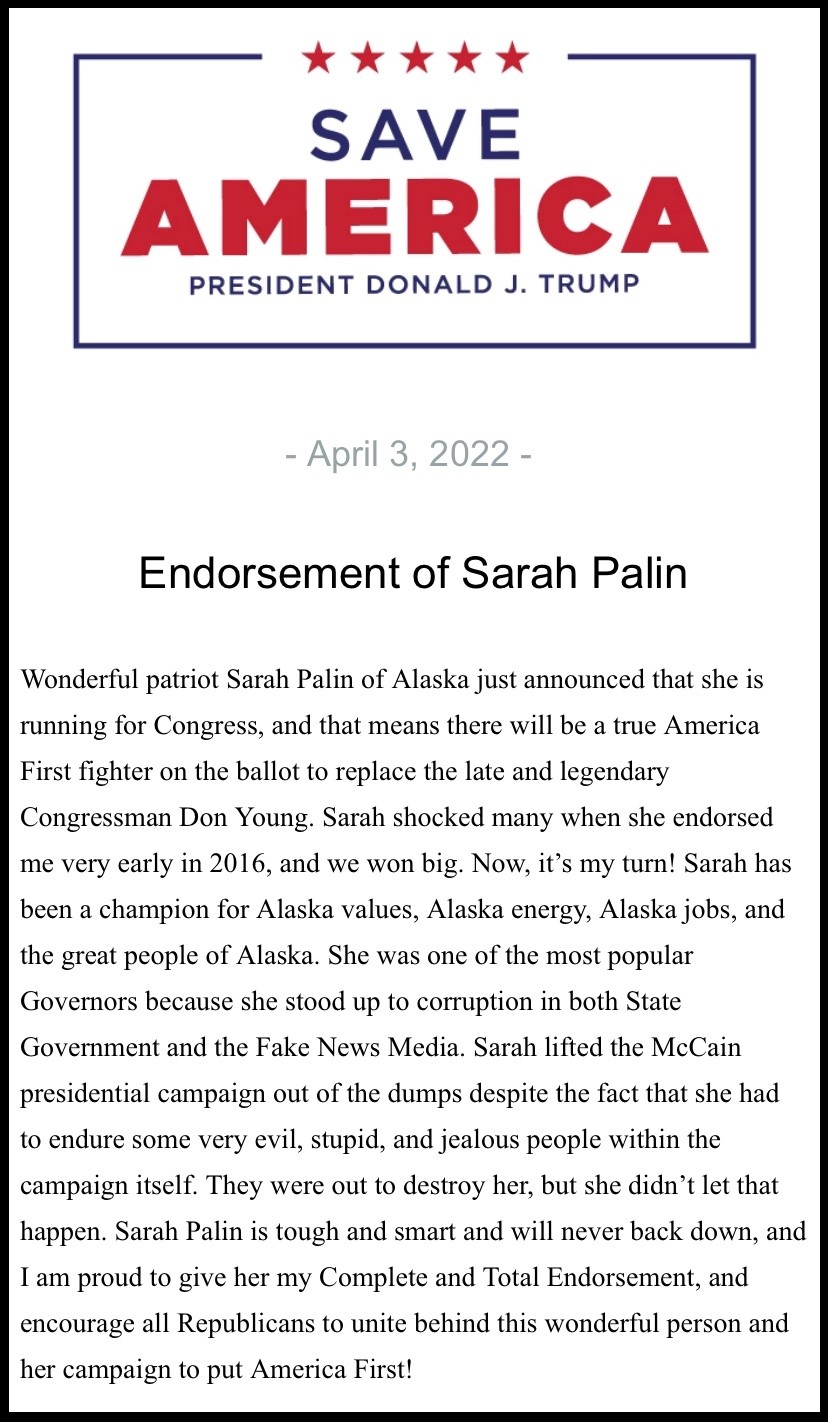
President Trump Endorses Sarah Palin for Congress


Posted originally on the conservative tree house on April 3, 2022 | Sundance |

Today, President Donald Trump gives his complete and total endorsement to Sarah Palin:

Visit Sarah For Alaska HERE

Sarah Palin enters a crowded field of nearly 40 candidates to fill the seat held by Don Young, who died last month.  Alaska’s special election’s primary is scheduled for June 11th. The top four candidates will advance to the general election on Aug. 16th.