Conservatives Celebrate Stunning Win in Australian Elections…


The Australian election was held today; voting is compulsory as everyone over the age 18 is required to vote; turnout was greater than 95%…  and all the media and pollsters are stunned, shocked, jaws-agape, as the conservative coalition has received a stunning, unexpected, unanticipated victory.

Australian Prime Minister Scott Morrison has won the election.  Yes Alice, 2019 media in Australia look identical to media in the U.S. circa November 2016.

The economy, immigration and push-back against the insufferable climate-change nonsense appear to be the top issues that led to Morrison’s surprising win.  None of the pollsters or media saw it coming.  The BBC are stunned:

BBC – […] The final result of the election may not be known for some hours, but with more than 70% of votes counted the [Conservative] Coalition has won, or is ahead in, 74 seats in its quest for a 76-seat majority, with Labor on just 66 seats.

[…] Try finding someone who says they saw this result coming.

For well over two years, the coalition has trailed behind Labor in the opinion polls, and the assumption had been it would be Labor’s turn to govern.

But somehow Scott Morrison managed to turn things around at the 11th hour – and he did it largely on his own.

With some of his cabinet colleagues considered too toxic to appear in public on the campaign trail, ScoMo made this election about him, and his ability to be the trustworthy, daggy-dad Australia needed.  (read more)

Labor leader Bill Shorten , who has led Labor since it lost office in 2013, conceded defeat and congratulated Morrison.  Shorten’s losing moonbat platform was centered on creating a “fairer society”, similar to the social justice movement in the far-left U.S. Democrat party.

The labor movement planned to increase taxes on the wealthy and bring social justice demands to central government.  Their agenda was counting on strong support from college-aged students and climate change activists.  However, the majority of Australians saw the predictable economic damage that was certain from the proposals to raise taxes and institute the Australian version of the Green New Deal.

Australian left-wing media is going bananas….

The progressive movement is crying in the streets.

Regulating Monopolies: A History of Electricity Regulation – Learn Liberty


Published on Feb 10, 2012

SUBSCRIBE 190K
Prof. Lynne Kiesling discusses the history of regulating electricity monopolies in America. Conventionally, most people view regulation of monopoly, such as the Sherman Antitrust Act, as one of government’s core responsibilities. Kiesling challenges this notion, and finds that government regulation of monopoly actually stifles innovation and hurts consumers. The American electricity industry was booming in the 1890s, with several small firms competing against one another. Over time, Kiesling argues that the fixed costs began to escalate, increasing the cost of entry into the industry. Put another way, large competitors gained a significant competitive edge over smaller competitors through economies of scale. Eventually, in places like New York and Chicago, Kiesling claims that the competitive process led to one large firm. These monopolies were feared by the public, and led to demands for government regulation. The electricity industry, knowing that regulation was coming, used these demands for regulation as cover to construct legal barriers to entry. Ultimately, the regulations passed by the government reduced competition by granting legal monopoly privileges to powerful firms within a certain geographical territory. In modern times, we are seeing the real cost of these old one-size-fits-all regulations: 1) People aren’t adjusting their energy consumption behaviors. For instance, in peak hours, technological solutions that could smooth electricity consumption are being ignored. 2) The electricity industry doesn’t evolve and account for new types of renewable energy. 3) Innovations have been discouraged. If these archaic regulations were removed, innovations and improvements beneficial to consumers would flourish. For more information, check us out here: http://lrnlbty.co/zcPIQr

Opportunity Costs: The Parable of the Broken Window – Learn Liberty


Published on Nov 17, 2016

SUBSCRIBE 190K
Some people argue that natural disasters and other acts of destruction create wealth and employment as we repair the damage they’ve caused. Professor Dan Russell explains that this fallacy fails to take into “opportunity costs” into consideration. Whenever we use a resource for one purpose, like fixing a window, we give up the opportunity to use that resource for another purpose. We only know if the use of a resource has created value if we compare it with the the alternate uses we had to forego. forego.


The Unprecedented Equality of the 21st Century


Published on Aug 7, 2017

SUBSCRIBE 190K
The rich get richer, and the poor get … cell phones, cars, and nice TVs? Prof. Mike Munger says we’re actually more equal than ever. Full interview here: https://www.youtube.com/watch?v=-FlQ1… SUBSCRIBE: http://bit.ly/2dUx6wg LEARN MORE: Debate: Is There Too Much Inequality in America? (video): The question of income inequality has become a key issue in contemporary politics. The Institute for Humane Studies asked two professors– Prof. Steve Horwitz, economist at St. Lawrence University, and Prof. Jeffrey Reiman, philosopher at American University- to answer questions about wealth, fairness, and inequality in the United States. This is their debate: https://www.youtube.com/watch?v=p047t… Income Inequality and the Effects of Globalization (video): Income inequality in America is a serious issue. People are worried about a widening gap between the rich and the poor in the United States. But is the global story the same? Professor Tyler Cowen explains how globally, income inequality worldwide is on the decline. https://www.youtube.com/watch?v=ja15p… How to Fight Global Poverty (video): Have you heard the news? The number of people living in abject poverty—defined as living on less than $1.25 per day—has been halved since 1990. How did that happen? Prof. Stephen Davies explains that extreme poverty has been on the decline in part because two of the world’s most populous countries, China and India, have embarked on a path of economic liberalization and development over the past two to three decades. https://www.youtube.com/watch?v=JzmxQ…

5 Inequality Myths


Published on Oct 2, 2017

SUBSCRIBE 190K
If you really want to understand how the world works today, you need to rethink almost everything you’ve been told about inequality. Prof. Antony Davies explains.

Yield v Reason


QUESTION: I see all of these people calling for a major crash of 50%+. With interest rates so low and the dividends on the Dow twice that of interest rates, does anyone look at yield anymore?

PH

ANSWER: I fully agree. The yield on the Dow Jones is 5.34%, which is about double the 10-year rate. Back in 1983, I presented these two charts that show the earnings and book value of the Dow Jones Industrials. The majority were calling for a crash and our computer warned of a Phase Transition and a 600% rise in the Dow. I was blamed for creating the takeover boom, but it was clear that the earnings were at least 5% and the stocks were trading out of a major historical low on price v book value. So earnings do come into the mix

Capital Controls v Protectionism


QUESTION: Marty; You mentioned at the cocktail party in Rome, which was spectacular BTW, that your concern would be capital controls emerging when the euro starts to break hard. Do you have a time frame for that?

WJ

ANSWER: Yes, the view from the cocktail party was spectacular. A bit cold; we could have used that global warming.

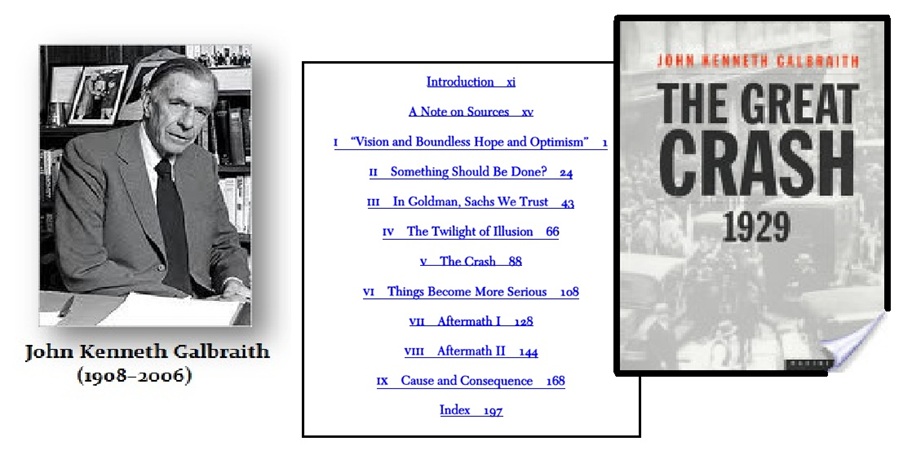
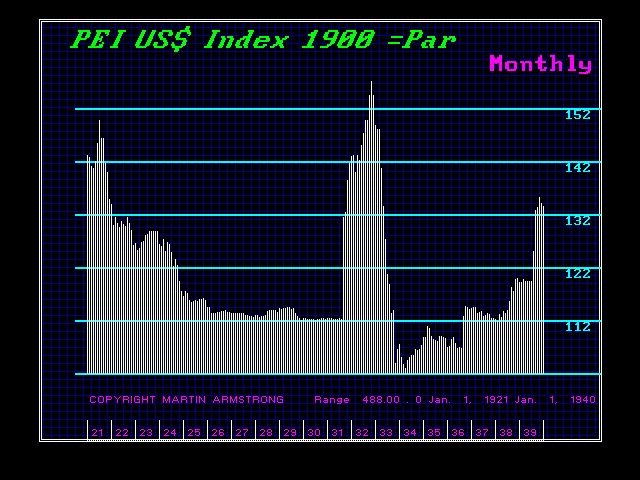
We saw Turkey move to entertain that which set off the contagion in emerging markets overnight. While the history books tend to put the blame for the Great Depression at the feet of corporation, as did Galbraith, they never mention the Sovereign Defaults of 1931 or the fact that there were capital controls imposed.

The flight of capital to the dollar was met by imposing capital controls. These capital controls may have solved the flight of capital immediately, but at the cost of a complete collapse in confidence in Europe as a whole. The lesson from 1931 was not that of PROTECTIONISM, which killed trade, but it was the imposition of capital controls that brought international trade to a halt. If capital could not be exported, then commerce could not buy any goods. This was far more drastic than protectionism with tariffs. There just seems to be very questionable analysis applied which was either by true idiots, or more likely, the analysis deliberately hid the actions of government to justify the takeover by Marxist Socialism.

The time frame where we may see governments resort to capital controls may arrive in 2021-2022. We MUST be realistic that capital controls are far worse that trade disputes.

Capt. America Throwback: New U.S. Army Uniform Recalls World War II


Published on May 10, 2019

SUBSCRIBED 127K
The new U.S. Army uniform is a near replica of the World War II version. Can the Army meet its recruitment quotas of teen millennials with a throwback image from the Greatest Generation? Bill Whittle thinks the it’s brilliant. There’s a place you can go to think, and unburden your mind, and share the fellowship of liberty-lovers like you. It’s a place of reasoned thought, civil discourse, and great humor. There you find like-minded folks who put their commitment where their convictions live. If you enjoy this video, you’re going to love being part of the team that produces it at https://BillWhittle.com

The Rising Anti-EU Sentiment Ahead of the EU Elections


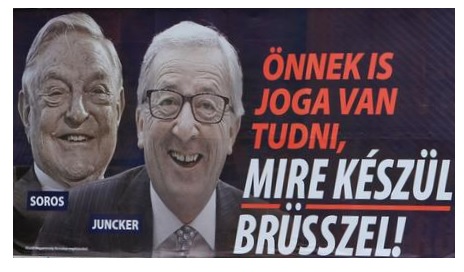
In Hungary, the anti-EU movement runs intense and links Soros and his funding behind the curtain as the number one problem. There have been protests in Hungary implicating the fact that Soros has been behind everything. The anti-EU sentiment is rising ahead of the May 23rd elections. The main issue that has torn Europe apart is the Refugee Crisis.

Victor Davis Hanson Questions Obama’s Political Past


Published on Oct 31, 2008

SUBSCRIBE 105K
Complete video at: http://fora.tv/2008/10/20/Victor_Davi… Conservative columnist and Hoover Institution Senior Fellow Victor Davis Hanson discusses several accusations regarding Barack Obama’s political career. —– Victor Davis Hanson discusses Obama, Palin, and the Culture Wars. This event was part of the Hoover Institution’s Fall Retreat 2008. Victor Davis Hanson is a Senior Fellow at the Hoover Institution, Stanford University, a professor emeritus at California University, Fresno, and a nationally syndicated columnist for Tribune Media Services. He is also the Wayne & Marcia Buske Distinguished Fellow in History, Hillsdale College, where he teaches each fall courses in military history and classical culture. He was a full-time farmer before joining CSU Fresno, in 1984 to initiate a classics program. In 1991, he was awarded an American Philological Association Excellence in Teaching Award, which is given yearly to the country’s top undergraduate teachers of Greek and Latin. Hanson has written for the New York Times, Wall Street Journal, Los Angeles Times, International Herald Tribune, New York Post, National Review, Washington Times, Commentary, The New Republic, Claremont Review of Books, American Heritage, Policy Review, Wilson Quarterly, Weekly Standard, Daily Telegraph, and has been interviewed often on National Public Radio, PBS Newshour, the Hugh Hewitt Show, and C-Span’s BookTV. He serves on the editorial board of Arion, the Military History Quarterly, and City Journal. Since 2001, has written a weekly column for National Review Online, and in 2004, began his syndicated column for Tribune Media Services. In 2006, he began writing a blog for Pajamas Media, Works and Days.

SHOW MORE