The California Contagion – PacWest Teters on Becoming the Next Regional Bank to Collapse as Regional Banking Stocks Continue Severe Drops


Posted originally on the CTH on May 4, 2023 | Sundance 

According to those who relish the Cloward-Piven strategy, things are proceeding swimmingly.

…”As long as the decisionmakers continue doing the things that are creating the crisis, the crisis will continue.”
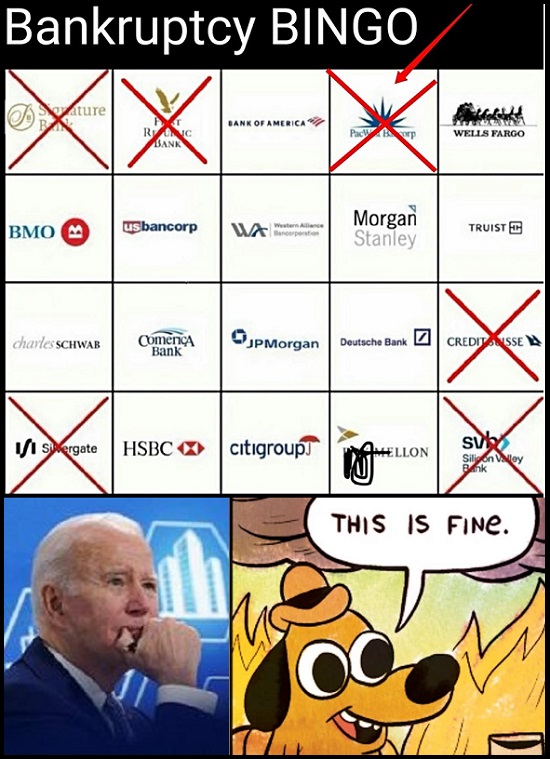
Federal Reserve Chairman Jerome Powell said yesterday the “U.S banking system is sound and resilient,” insert uncomfortable snicker here.  However, uncertainty is continuing to pummel the banking industry, despite assurances from the Fed, Treasury, FDIC financial regulators and bankers such as Jamie Dimon who are all saying there is no crisis in the banking industry.

If you want to know the big picture source of the uncertainty, it’s the great pretending.  The average person can sense something is wrong, and the person who pays attention has the experience of institutional lying over the past several years.  The last ten years of lying and pretending has created the biggest collapse in institutional trust in U.S. history.

Russians interfered with the election – trust us. Stick this needle in your arm, it’s safe – trust us.  The FBI are the good guys – trust us. Biden won more votes – trust us. This inflation is merely transitory – trust us.

See the problem?

So, when the same voices shout, “the banking industry is sound, trust us,” well,… yeah, that suspicious cat sense that’s on high alert isn’t buying the chorus.

Reasonably intelligent people who accept things as they are, not as they would have us pretend them to be, can see the core connection to the World Economic Forum, Central Banks, and western globalist policy to change the entire dynamic of economics and finance around the “Climate Change” agenda, or Build Back Better, or Green New Deal.

Overlay that commonsense and pragmatic outlook with the logical consequences of the activity, and this banking collapse issue is a self-fulfilling prophecy.  As long as the decision makers continue doing the things that are creating the crisis, the crisis will continue.

(Via Wall Street Journal) – Regional-bank stocks tumbled Thursday despite assurances from the Federal Reserve that the banking system is on solid footing.

PacWest Bancorp PACW -47.04%decrease; red down pointing triangle, which has been hit hard since the collapses of several banks, dropped by about 40%. The stock started falling in after-hours trading Wednesday evening, after a report that it was considering selling itself.

PacWest said in a statement after midnight Eastern Time Thursday that its core customer deposits were up since the end of the first quarter, and that it hadn’t experienced any unusual deposit flows since the collapse of First Republic.

[…] Investors have been wondering how much further the problems in regional-banking could spread, and whether they will spill over to the broader economy. Some analysts said the decline in PacWest and others reflected the market’s tendency to view news as categorically good or bad, rather than worries about PacWest specifically. Western Alliance, another bank whose stock has been hit hard, fell by about 35%.

[…] Regional banks, as major lenders to businesses and families across the U.S., also tend to fall when investors are expecting a recession. The 10-year Treasury yield slipped this week, and Brent crude hit a 52-week low on Wednesday.

[…] On Wednesday afternoon, the Fed said the U.S. banking system “is sound and resilient,” echoing language from its March statement. Fed Chair Jerome Powell added then that deposit flows at banks had eased and that this week’s seizure and sale of First Republic should further stabilize the industry.

[…] PacWest shares were recently trading around $3.70, putting them on track for their lowest close on record. The stock has now lost some 85% of its value since March 8, the day that SVB spooked bank investors by announcing a loss and a planned capital raise.

Many of PacWest’s customers are tied to technology startups—a tightknit clientele that pulled from high-balance accounts en masse at Silicon Valley Bank before it failed. (more)

REMINDER: Inflation was at 1.4% When Biden Took Office


Armstrong Economics Blog/Inflation Re-Posted Apr 27, 2023 by Martin Armstrong

Inflation was only 1.4% when Biden took office. He began implementing policies on his first day that directly created the energy crisis in the US. He refused to reopen the economy under the pretense of COVID for as long as possible, disrupting the supply chain and damaging small businesses. Biden has created multi-trillion dollar spending programs that saddled the nation with more debt and increased price volatility. His team has been working to divide the people and create civil unrest. I could go on about his failures, but his worst move was involving America in the Russia-Ukraine war. Inflation has steadily risen to unsustainable levels nearly every month since Biden took office.

Biden’s team toys with the numbers to tout that inflation has gone down, but they are comparing the high and low both created under Biden. Wages cannot support the increase in costs and absolutely no one is better off under Biden. Considering the dire situation, it is infuriating that the US had a 1.4% inflation rate not long ago.

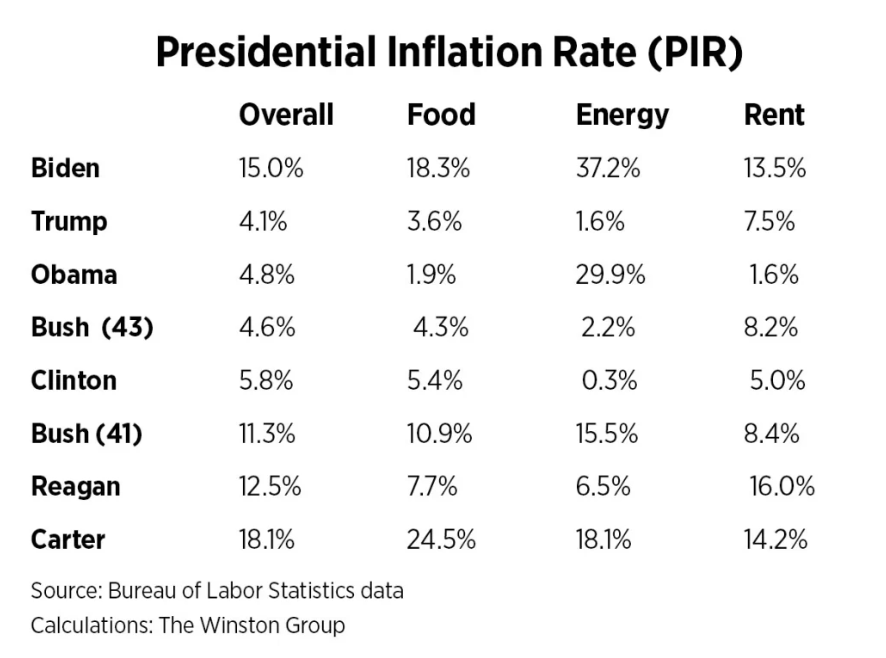
Inflation has soared by over 15% since Biden’s inauguration in January 2021. The “Presidential Inflation Rate,” (PIR) developed by the Winston Group, measures a president’s progress in handling inflation over time, from their inauguration month to the month of the most recent CPI report. As of March, inflation under Biden is 15%, which makes him the most inflationary president since Carter. Biden’s 24% “Presidential Inflation Rate” for rising electricity costs is higher than any of the previous seven presidents as it is now up 37.2%. The cost of food rose 18.3% under Biden, and eggs alone have soared by nearly 80%. Shelter costs are now at a 42-year high, and Biden’s PIR for rent has surpassed 13.5%.

Joe Biden takes no responsibility for the inflation caused by his policies and failures as a president. Inflation will continue to increase under Biden. He has absolutely no plans to address the issue, and the legislation he creates to address the problem only exacerbates it. Biden is a corrupt politician who lines his pockets with money from Ukraine and China. The investigation into his crime family that the media is sweeping under the rug reveals the truth. This man needs to be removed from office immediately, but the people alone must decide when they’ve had enough.

Only 32% of Lenders Profited on Mortgages in 2022


Armstrong Economics Blog/Real Estate Re-Posted Apr 13, 2023 by Martin Armstrong

The talking heads have been warning of a housing crash, but that is not what Socrates indicated. The 30-year fixed rate is around 6.89% at the time of this writing. Housing costs continue to rise, causing the costs of servicing mortgage debt to rise. Housing inventory is limited, and a recent report explains why we saw mass layoffs in the banking sector. The demand is still there and it is a sellers’ market. Cash is king when it comes to real estate for those who can afford it. Mortgage lenders are in trouble. In fact, only 32% of mortgage companies were profitable in 2022 compared to 98% in 2020.

The Mortgage Bankers Association (MBA) recently announced that independent mortgage banks and subsidiaries of chartered banks lost around $301 for every mortgage they financed in 2022. This marks a 113% decline from the prior year’s average and the first-time banks are seeing losses on mortgage products. This is not 2008 when banks handed out loans to anyone who asked.

“The rapid rise in mortgage rates over a relatively short period of time, combined with extremely low housing inventory and affordability challenges, meant that both purchase and refinance volume plummeted,” said Marina Walsh, CMB, MBA’s Vice President of Industry Analysis. “The stellar profits of the previous two years dissipated because of the confluence of declining volume, lower revenues, and higher costs per loan.” Production costs reached a high of $10,624 per loan last year. Productivity was 1.5 loans originations per production employee, down from 2.5 per employee the year prior, and an indicator of why we are seeing layoffs in the banking sector. No one is refinancing at these rates either and most chose a fixed rate, as we saw what happened in 2008 with adjustable costs.

First-time mortgages reached an all-time high of $323,780 last year, up from $298,324, the largest annual increase since the MBA began collecting data. The increased cost of loans increased the cost of serving mortgages. The MBA expects volume to decline further in 2023 before rallying in 2024 and 2025. The banking crisis may lead to banks and lenders selling off their mortgage debts once they cannot afford to service the debt. Again, the housing crisis today is not relative to the 2008 crash.

When It Comes to Economics, Trust Your Instincts


Posted originally on the CTH on April 11, 2023 | Sundance 

A few days after the terror attack of 9-11-01, someone in media asked George W. Bush what Americans can do to help.  Dubya’s response drew instant criticism, because he asked people to go shopping… but in the big picture, President Bush knew what could happen if the economic freeze continued.

When it comes to politics and economic outlooks, trust your instincts.  The economics of the ‘thing’ is always the reason the ‘thing’ exists or does not exist.

When you are looking at economic news, always remind yourself… the people producing the news have a vested interest in maintaining a very specific outlook.  The motive behind what Dubya said in September of 2001, pertains every bit as much today.  Economic outcomes can topple entire governments.

Remember, this current ‘supply-side energy policy driven inflation‘, a purposeful effort to shrink the economy and yet tenuously maintain control, has never happened before.  The people behind the Build Back Better agenda are, in reality, experimenting with a theory. DATA…

(ISM) – The Institute for Supply Management’s PMI contracted for the fifth straight month in March registering 46.3, the lowest level since May 2020. Any reading below 50.0 indicates contraction.  The employment index declined by 2.2 percent to a level of 46.9.

Most of the impediments to manufacturing growth — such as shortages and lockdowns — have subsided, said Tim Fiore, chair of the ISM’s manufacturing survey committee, with the exception of pricing. ISM’s pricing index fell below 50 in March but at 49.2 remains higher than pre-pandemic levels.

“The beginning of the second half may not be the beginning of a recovery,” said Fiore. “Manufactures reduced headcounts because of uncertainty of demand and over-ordering has burned off. Demand isn’t coming back quickly enough to support current headcounts.”

All these trends were prevalent in March, he added, although the PMI has only lost 3 to 4 points since October 2022.

Back in December, ISM panelists anticipated an uptick in demand by the beginning of Q2. “We thought this recovery would be lumpy, but I think this indicates the recovery has been delayed,” Fiore said. “I think we are talking about expansion toward the end of Q3—it’s unlikely we’ll see a lot of activity in the summer.” (read more)

It’s not a recovery now, it will not be a recovery this year.

On a per unit basis, we have been in an economic contraction cycle since mid 2021.  However, because economic outcomes are measured in dollars, the shrinking unit output, and the fewer units being sold at wholesale and retail level, is being hidden.

Inflation has hidden serious drops in unit purchases…. and fewer unit purchases mean lowered production output…. and lowered production output means less production is needed.

(CNBC SURVEY) – Inflation, economic instability and a lack of savings have an increasing number of Americans feeling financially stressed. 

Some 70% of Americans admit to being stressed about their personal finances these days and a majority — 52% — of U.S. adults said their financial stress has increased since before the Covid-19 pandemic began in March 2020, according to a new CNBC Your Money Financial Confidence Survey conducted in partnership with Momentive.

Anxious and uncertain about whether they can get a better handle on their money, some may be intimidated by the prospect of creating a budget or unsure of where to stash their cash to get the highest returns. Others may be wondering how to begin saving for retirement when they’ve gotten off to a late start. 

“People are worried that the money they’ve saved won’t last and are worried they’re going to have to lean more on their credit cards and other sources of debt just to get by,” said Bruce McClary, a senior vice president at the National Foundation for Credit Counseling. (read more) 

If you want to know what’s going on in the larger U.S. economy, just look around you.

Don’t turn on the television and read the newspaper to see what is happening in the U.S. economy for your purchasing or life planning.  Just look around you.

Look at restaurants and bars.  Do you see continued high-volume business or not.

Look at the grocery stores. Do you see continued optimism, or not.

Look at the malls and shopping centers. Do you see foot traffic, or not.

Look at the real estate in your neighborhood – your local view.  Do you see prices going up or going down.

That’s the reality of the economy as it impacts you….. and critically, that’s the reality of the economy nationwide.

When it comes to data and economics, do not let the media created ‘illusion of the thing‘ cloud your ability to see the reality of the thing.

Trust your instincts.

Yellen Admits Truth Behind the Inflation Reduction Act


Armstrong Economics Blog/Corruption Re-Posted Apr 11, 2023 by Martin Armstrong

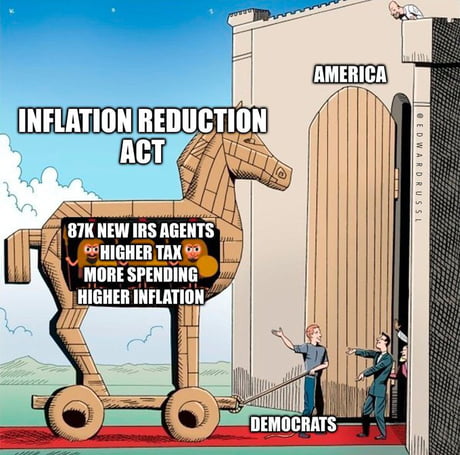
The Inflation Reduction Act has only increased inflation. Secretary of the Treasury Janet L. Yellen came out and admitted the truth – the act’s entire premise is to push the climate change agenda forward. “The Inflation Reduction Act is, at its core, about turning the climate crisis into an economic opportunity,” Yellen admitted.

It provided the government with an opportunity to eliminate our energy independence. We did not have an energy crisis before Joe Biden took office. He killed the Keystone deal on his very first day in office and has been promoting the larger WEF Build Back Better plan at the expense of the nation. Biden implemented policies that worsened inflation and then convinced mindless politicians, who never read the large bills put forward, to vote for a $369 billion act under the premise of fixing a problem he created.

Now Joe Manchin, who brokered the deal with Biden, claims he was duped into believing the act was actually designed to reduce inflation. In an op-ed published in the Wall Street Journal, Manchin criticized the need to raise the debt ceiling as a “needless emergency.” Manchin wrote:

“America is fast approaching another needless emergency—the raising of the national debt ceiling. This impending crisis isn’t an accident but a result of the inaction of various actors who refuse to confront fiscal reality, sit down, negotiate and make hard decisions for the sake of our nation’s future. While all parties have a responsibility to negotiate in good faith, recent actions make clear to me that the Biden administration is determined to pursue an ideological agenda rather than confront the clear and present danger that debts and deficits pose to our nation.”

He goes on to state that the national debt is nearly $31.5 trillion, “or close to $95,000 for every man, woman, and child, and represents 120% of our gross domestic product.” He proposes negotiating the debt ceiling and is pleading with “Mr. Biden to instruct his administration to implement the Inflation Reduction Act as written and stop redefining its credits and other subsidies.”

The Senator from West Virginia stated that Americans will pay the price for generations if Biden fails to act, but Yellen has now admitted that the goal of the IRA has been achieved. As Trump said, if you put the worst five presidents in American history together, they’ve done less damage to the nation than Biden in under three years.

The Myth of Fair Value


Armstrong Economics Blog/Understanding Cycles Re-Posted Mar 13, 2023 by Martin Armstrong

QUESTION: If the metals are not trading at a fair value relative to everything else, then does that not prove they are manipulated?

SN

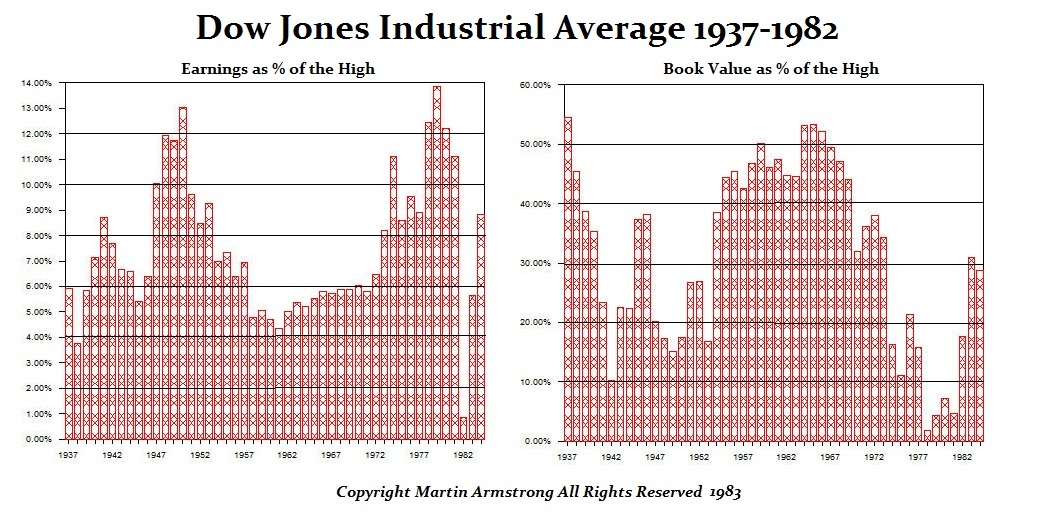
ANSWER: Your problem is the assumption that everything must be trading at some fair value. That is up there with the theory of random walks.  ALL markets trade for periods where they remain well below fair value. That was the entire takeover boom of the 1980s which they also blamed on me because I was advising many of the takeover players. I simply showed these charts back then which show in terms of book value, the Dow Jones bottomed in 1977. The market was grossly undervalued because you could buy a company, sell all its tangible assets, and double or triple your money. Michael Douglas’ famous speech in that movie about “greed” would not even be possible if everything always trade like some mythical robot at fair value. Everything overshoots and undershoots.

The metals are NO DIFFERENT. Every market swings between grossly UNDERVALUED and then grossly OVERVALUED. This is part of the business cycle. If there were no periods of gross undervaluations, there would not be a sudden boom either.

This is what you have to come to grips with. There is such a thing and the business cycle. Our cyclical analysis would not be possible if everything was trading at a flat line of fair value. This nonsense in metals is made up of people who have been wrong, and need to blame someone else. It is like blaming climate cycles on CO2. This notion of fair value is rooted, I hate to tell you, in Marxism, because he too did not understand  the business cycle.

Manufacturing Indexes Continue Downward Trend as Consumers Leery of Big-Ticket Purchases


Posted originally on the CTH on March 6, 2023 | Sundance

Coming out of the pandemic related disruption, the larger story of U.S. manufacturing has been an odd blend of good data and bad data depending on the sector.  While some manufacturing was growing as a result of clearing supply chains, other sectors of manufacturing remained soft.

In total, the full supply chain rebound should have completed around the end of the third quarter, beginning of the fourth quarter of 2022.

However, simultaneous with the correction within the supply chain(s), consumer purchase activity began contracting.

The consumer pullback led to very weak holiday sales last year, and a combination of increased inventories of finished goods.

Keep in mind that Maersk overseas shipping noted significant drops in orders for the movement of material in the third quarter of last year.  Considering the lag, the previously noted inventory buildup in combination with the drops in unit sales of durable goods, would generally mean lower manufacturing purchase order activity Q4 (’22) and Q1 (’23).   This reality is reflected in the actual data as reported by The Wall Street Journal:

(Via WSJ) – […] New orders for manufactured goods contracted for the sixth straight month through February, according to surveys by the Institute for Supply Management. Manufacturing output is down 1.7% from its postpandemic peak in May 2022, according to a three-month moving average of Federal Reserve data. And the Commerce Department’s measure of civilian capital equipment orders, excluding aircraft—the building blocks of business—was down 3.4% in January from its recent high in November 2021, after adjusting for inflation.

[…] Production of appliances, furniture and carpeting was down almost 15% in January from the previous year, according to the Fed. That coincides with sales of previously owned homes falling for 12 straight months. Consumers often buy furnishings after they move.

Production of steel, iron and other primary metals was down 3.6% and machinery production fell by 1.8%. Output of plastics, food, beverage and tobacco products, and computers and electronics, also fell during that period.

[…] Business inventories swelled in the fourth quarter of last year, when consumer spending cooled. The ratio of inventories to sales for durable goods was higher in November and December than at any point since 2009, with the exception of April and May 2020, when pandemic-related lockdowns froze commerce.

Pat Weiler, chief executive of paving-equipment maker Weiler, said inventory levels are up more than 50% over the last two years. (read more)

Unfortunately, the U.S. doesn’t really manufacture much any longer.  Manufacturing only accounts for around 11% of GDP.  However, if purchase orders for inbound component goods are down for six straight months, we can generally infer the absence of downstream consumer demand.

I fully expected a recession statistic in the fourth quarter last year and was quite surprised we didn’t see one.  The scale in the drop of imports was statistically the majority reason for the outcome.  Imports are a deduction to GDP.  However, that said, there is nothing visible in the consumer purchasing side to indicate why durable good manufacturing is even as strong as it is.

We are in a very weird economic environment that is not helped by the financial punditry pretending that things are going swimmingly.

The Collapse in Confidence in Biden is Building


Armstrong Economics Blog/Neocons Re-Posted Mar 1, 2023 by Martin Armstrong

I know a lot of people are deeply concerned about how the Biden Administration has been usurped by the Neocons who are deliberately driving us to war. I can tell you that writing letters to your representatives does have an impact. Getting everyone to flood your senator and congressman for that is the only way to stop it.

WRITE TO YOUR CONGRESSMAN & SENATOR ASAP

I have been in contact with the military and I can say they are not so supportive of Biden. One said today, “we are we sticking our nose in everyone’s business. What does Ukraine really mean to us the people?” The 8th Air Force dismissed two people because they lost confidence that they would wage nuclear war. The official wrote:

“Maj. Gen. Andrew J. Gebara, commander of 8th Air Force, relieved two commanders today from their positions of leadership at Minot Air Force Base, North Dakota, due to a loss of confidence in their ability to complete their assigned duties.”

We must respect that there are people in the military who also disagree with this insanity!

It was a Russian who disagreed with Khrushchev and Alerted Kennedy to the missile he intended to send to Cuba. The Russians later staged a coup and overthrew Khrushchev because he too was obsessed with war like our American Neocons today. Hopefully, someone brave will overthrow them as well to save the world.