Rebel News on the WEF Infiltration of Governments


Aemstrong Economics Blog/WEF Re-Posted Apr 9, 2022 by Martin Armstrong

These people are against Democracy where the people make decisions. Republics are authoritarian regimes in sheep’s clothing. They run pretending one thing and then do everything in their power to accomplish undemocratic goals.

Worsening Food Price Increases Gain Global Attention – UN Food and Agriculture Organization Tracks Highest Prices Ever Recorded


Posted originally on the conservative tree house on April 8, 2022 | Sundance

The UN Food and Agriculture Organization reported on Friday they are recording the highest Food Price Index since they started recording thirty years ago. With record highs in prices for cereals, vegetable oils, dairy and meats

This issue has been a slow burning fuse toward the biggest powder keg in modern history, and it is about to get very serious.  We have been warning about it since last fall {Go Deep}.  In the most deliberate and painstaking ways possible, we have been urging everyone to take this issue seriously.

The background cause is complex and started with the 2020 government response to the pandemic.  U.S. and international government intervention in the food supply process has been FUBAR from the beginning. Every action taken since early 2020 has been one bad policy after another; building failure upon failure, crisis upon crisis, bad decision upon bad decision, bringing us to a precipice summed up by saying “the absence of food will change things.”

Some will say the food prices we are about to experience –and the crisis it will create– was deliberate.  Others will say this was the cumulative outcome of major failures on the part of the government.  At this point the former makes more sense, and the latter looks like a justification and excuse, because if government entities were really serious about food prices and shortages, they would be taking pragmatic steps to mitigate the problem; they are not.

There are simple things government could do, such as helping farmers offset targeted fertilizer costs, providing relief for diesel fuel and energy costs, and taking other simple steps that would help the agricultural industry.

Instead of responding with the urgency this would demand, the collective government action has been to ignore the problem (talk soundbites), and give speeches about using subsidies to offset the end result (consumers) – without ever addressing the root cause.  All this while fueling conflict in Ukraine and chasing radical energy policies under the guise of global climate change.

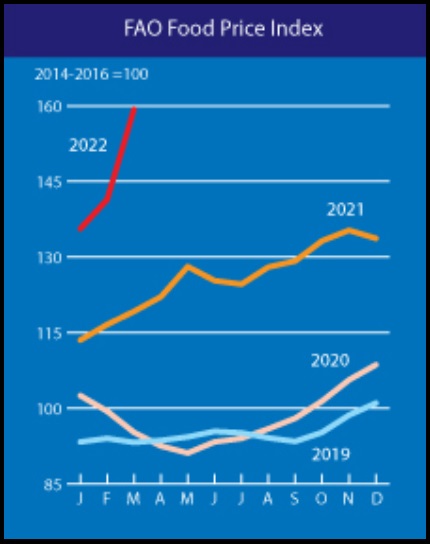
The UN Food and Agriculture Organization (UNFAO) keeps track of food prices and projections using a global index [SEE HERE].  What they are calculating, and what they are projecting based on the current calculations, is a major increase in food prices combined with a major increase in food scarcity due to the unaffordability of food products.

The baseline of 100 is the monthly rate of change for a basket of food products using the period from 2014 to 2016.

The current rate of change is indexing at 159.3, meaning the monthly increases in price are almost 60% higher than the base period.  Trying to chart this rate of index is almost impossible, as it seems literally exponential. (red line in graphic)

In 2020, the monthly rate of change increased to an index of around 110.  In 2021, the monthly rate of increase went from 110 to around 135.  In the first three months of 2022, the index has jumped from 135 to almost 160 (in three months), and there is no end in sight.

The FAO Food Price Index* (FFPI) averaged 159.3 points in March 2022, up 17.9 points (12.6 percent) from February, making a giant leap to a new highest level since its inception in 1990. The latest increase reflects new all-time highs for vegetable oils, cereals and meat sub-indices, while those of sugar and dairy products also rose significantly.

The FAO Cereal Price Index averaged 170.1 points in March, up 24.9 points (17.1 percent) from February, marking its highest level on record since 1990. This month’s increase reflected a surge in world prices of wheat and coarse grains, largely driven by conflict-related export disruptions from Ukraine and, to a lesser extent, the Russian Federation. The expected loss of exports from the Black Sea region exacerbated the already tight global availability of wheat. With concerns over crop conditions in the United States of America (USA) also adding support, world wheat prices rose sharply in March, soaring by 19.7 percent.

The FAO Vegetable Oil Price Index averaged 248.6 points in March, up 46.9 points (23.2 percent) from February and hitting a new record high. The sharp rise of the index was driven by higher sunflower, palm, soy and rapeseed oil prices.

The FAO Dairy Price Index averaged 145.2 points in March, up 3.7 points (2.6 percent) from February, marking the seventh consecutive monthly increase and lifting the index 27.7 points (23.6 percent) above its value a year ago. The upward trend of dairy product prices persisted, mainly supported by the tightening of global markets due to inadequate milk output in Western Europe and Oceania to meet global demand. Quotations for butter and milk powders rose steeply.

The FAO Meat Price Index* averaged 120.0 points in March, up 5.5 points (4.8 percent) from February, also reaching an all-time high. In March, pig meat prices registered the steepest monthly increase on record since 1995.

The FAO Sugar Price Index averaged 117.9 points in March, up 7.4 points (6.7 percent) from February, reversing most of the previous three months’ decline and reaching levels more than 20 percent above those registered in the corresponding month last year. [DETAILS]

In the United States and North America as a whole we are blessed and fortunate.  We have abundant, healthy and fertile land that allows us to grow more food than we consume.  We are a net exporter of food products.  However, while we do not have to worry about shortages at the scale of other nations, there will be scarcity.

Additionally, the price increases will hit the U.S. consumer at a lesser, yet still big time significant, scale.  The issue in the U.S. will be food insecurity due to massive increases in price.   The middle class will spend more of their earnings and wages on food, and people will literally make changes to their food purchases based on these massive increases in price.

In food dependent nations, the scale of the issue will be far greater.  In part, this is the reason the southern border crisis will be much more severe this year.  We will see an influx of migration due to food availability and unaffordability issues, that is certain; however, that issue is also incidental to the massive influx that is going to happen as a result of the Biden open-border policy.

In the strongly food dependent nations, the food price and scarcity issue has already triggered panic.

We are several generations separated from any time in history where people have worried about the United States having abundant affordable food.  Arguably, those under 40 to 45-years of age do not have any reference to the type of food scarcity and food inflation that is coming.

As we have mentioned for quite some time, “the absence of food will change things.”

We are in an abusive relationship with government leaders.

There It Is, The Canadian 2022 Budget Authorizes a Central Bank Digital Currency


Posted originally on the conservative tree house on April 7, 2022 | Sundance 

CTH noted earlier, in the aftermath of the COVID-19 control mechanisms, things were being done legislatively to follow a ‘new world order’ for western democracies {Go Deep}.  One of the nations we noted following this new direction, was Canada.  Today, a review of the proposed Canadian 2022 budget finds something to align with the new version of democracy – the establishment of funding to create a central bank digital currency.

That should not necessarily come as a surprise.  After all, despite a massive amount of denial from the Canadian Finance Minister and Canadian Prime Minister toward the context of CTH research {Go DEEP}, the direct evidence we were looking for is now discovered.

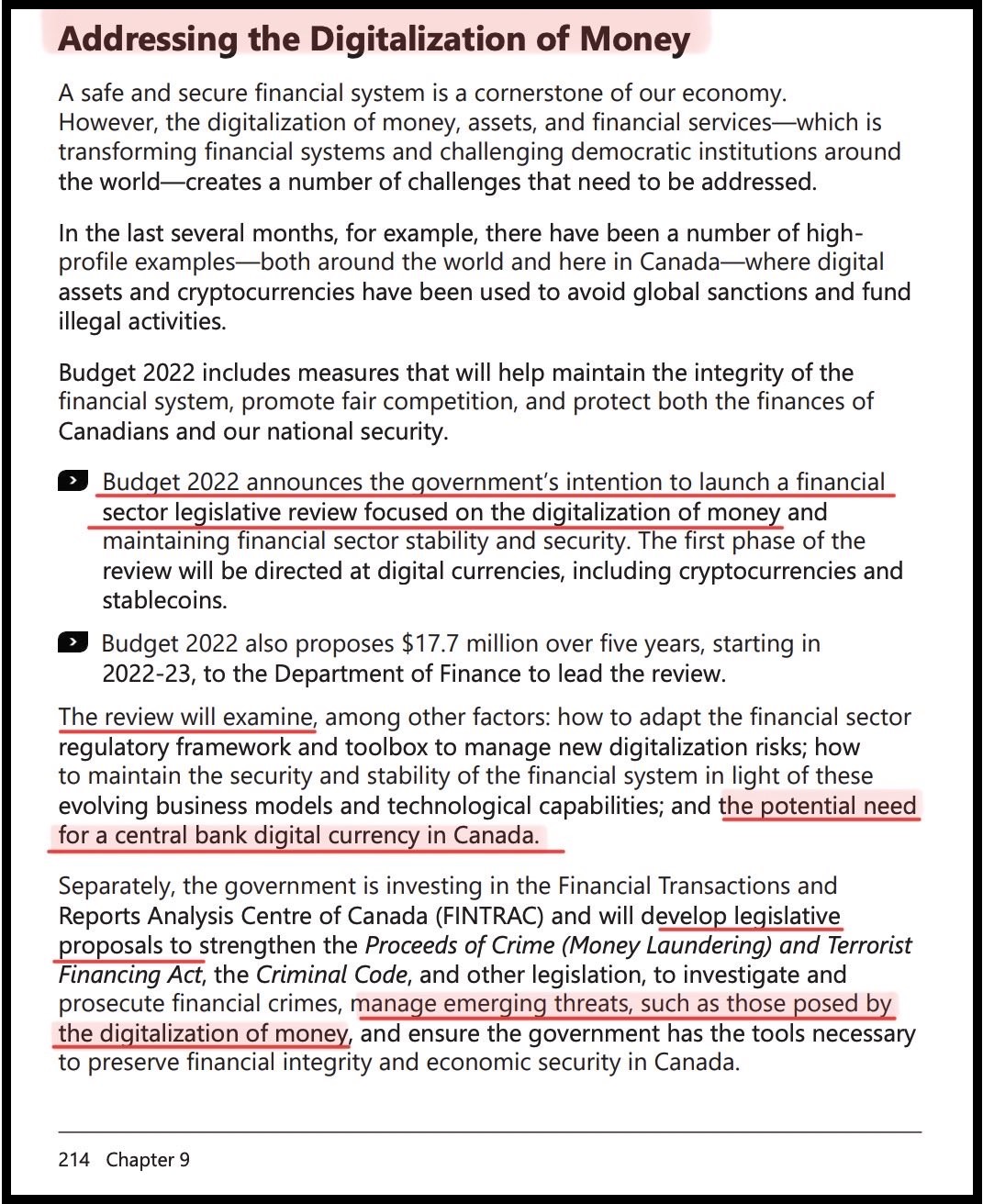
Buried deep, very deep, in Chapter 9.2 of the Canadian Budget you will find this:  …”In the last several months, for example, there have been a number of high-profile examples—both around the world and here in Canada—where digital assets and cryptocurrencies have been used to avoid global sanctions and fund illegal activities.”

(Chapter 9.2) […] Budget 2022 includes measures that will help maintain the integrity of the financial system, promote fair competition, and protect both the finances of Canadians and our national security.

  • Budget 2022 announces the government’s intention to launch a financial sector legislative review focused on the digitalization of money and maintaining financial sector stability and security. The first phase of the review will be directed at digital currencies, including cryptocurrencies and stablecoins.
  • Budget 2022 also proposes $17.7 million over five years, starting in 2022-23, to the Department of Finance to lead the review.

The review will examine, among other factors: how to adapt the financial sector regulatory framework and toolbox to manage new digitalization risks; how to maintain the security and stability of the financial system in light of these evolving business models and technological capabilities; and the potential need for a central bank digital currency in Canada. (LINK)

Huh. Imagine that.  What was called a “conspiracy theory” just a few weeks/days ago, is now the expressed intent of the same government who denied it was ever being considered.

(Source link – Chapter 9, sub section 9.2)

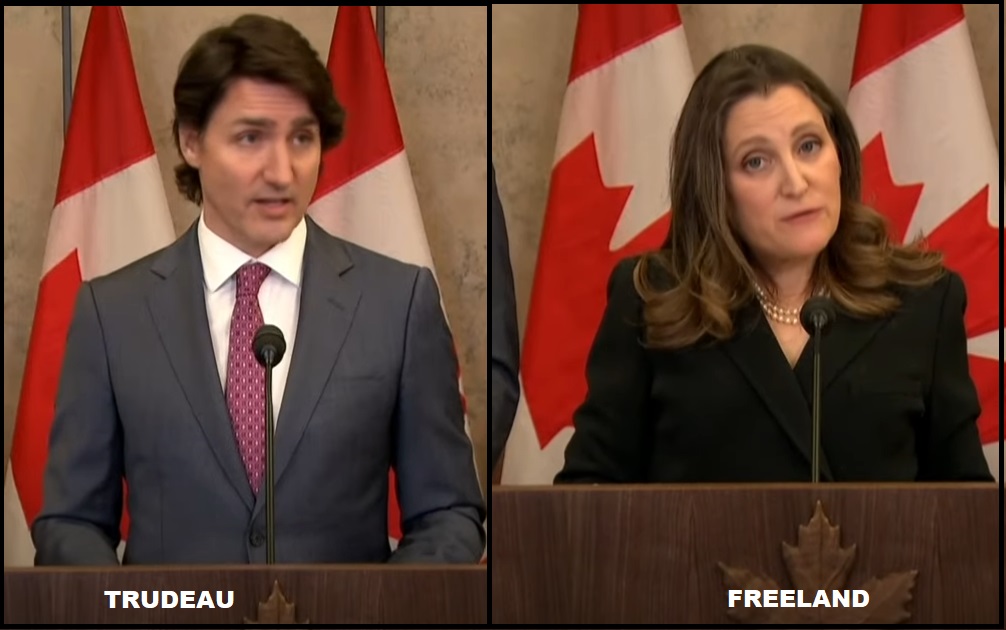
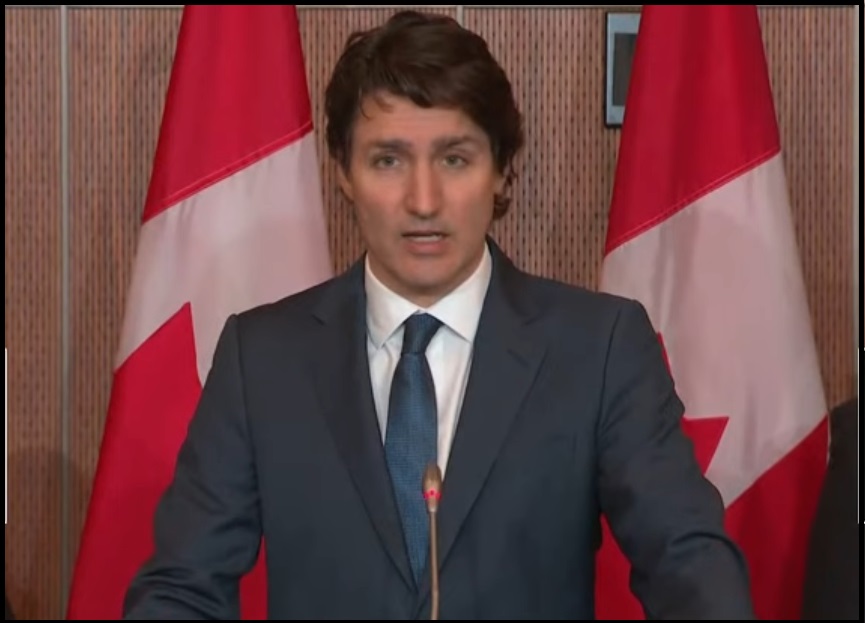
You may remember when Chrystia Freeland and Justin Trudeau triggered their use of the Emergency Act to confiscate the bank accounts and financial assets of protest groups.  Trudeau and Freeland essentially broke the financial code of Omerta, by highlighting how easy it is for government to seize your bank accounts, credit cards, retirement accounts, insurance, mortgages, loan access and cut you off from money (without due process).

However, when Prime Minister Justin Trudeau and Finance Minister Chrystia Freeland announced they would use the Emergency Act declaration to target the financial support systems, banks and accounts of the people who were protesting against COVID mandates, they not only undermined the integrity of the Canadian banking system – they also inadvertently stuck a wrench into the plans of the World Economic Forum and the collaborative use of the Canadian Bankers Association to create a digital id.  WATCH:

If the Canadian government can arbitrarily block citizen access to their banking institution without any due process, what does that say about the system the Canadian Banking Association (CBA) was putting into place as part of their Digital ID network?

If the CBA digital identity were in place during the trucker protest and the deployment of the Emergency Act, the same people targeted by Trudeau’s use of the Act could have their entire identity blocked by the same government measures.  The realization of the issue, reflected by a severe undermining of faith in the banking system, surfaces as a dramatic problem for those working to create and promote the Digital ID.

It is not coincidental the financial targeting mechanism deployed by Trudeau/Freeland, the Canadian banking system, was/is the same mechanism being used to create the digital identity, which is now the same mechanism they are budgeting to begin establishing the Canadian digital currency.

♦ It is all one continuum.

Using the COVID-19 pandemic, they created a specific vaccine mandate.  Using the vaccine mandate, they created a vaccine passport.  The vaccination passport and registration process tracked/monitored human behavior.  In actual substance, the vaccine passport can be looked at as the beta test for a larger mission of a comprehensive digital identity and/or social credit tracking system.  Most Canadian’s complied, willingly.

Now, it is a simple process to shift into a digital identity, as noted above by the Canadian Banking Association, and presto – the government has just created the foundational infrastructure for the digital currency.

The 2022 Canadian budget provides the funding to create the digital currency mechanisms.

Once the mechanisms are in place, then it becomes a simple process to control how the digital currency is spent.

That car is not environmentally friendly, transaction denied.

You’ve exceeded your allotment of beef this month, transaction denied.

Or perhaps…

{Support CTH Research HERE}

There Is Something Very Troublesome About the Western Govt, Post-COVID, Rules-Based Order


Posted originally on the conservative tree house on April 7, 2022 | Sundance 

While the western media quickly jumped from the COVID crisis to the Ukraine crisis, in the background of current events there is a lot of activity amid western government that does not look very democratic.

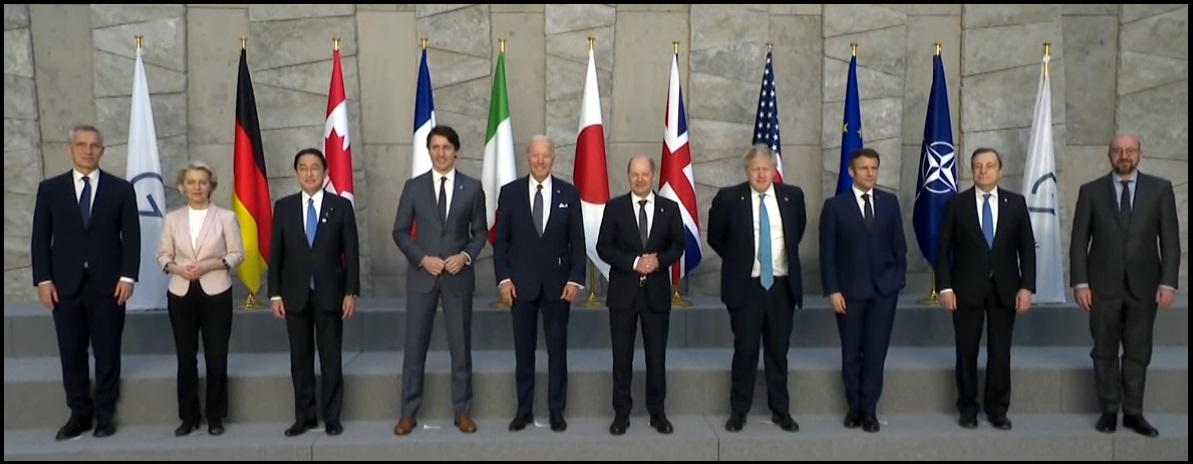
The word ‘autocracy‘, with all its variants, has been used a lot frequently by western government politicians as they attack the ideology of Russia, China and essentially every national leader who does not join their “rules-based order” club.  There is so much linguistic repetition from the same western leadership, it’s impossible not to see this autocracy narrative as some form of talking point that stemmed from some G7 or NATO collaboration meeting.

It does not seem coincidental the new catch phrases of “autocracy” vs “rules-based order” surfaced at the tail end of the COVID crisis, when Build Back Better shifted from a talking point into an actual set of western legislative constructs  perhaps intended to codify the emergency powers those same officials deployed.

What kind of democracy, or rules-based order mindset, was the European Commission carrying when they decried the overwhelming national election in Hungary?  Surely if the EU wanted to celebrate democracy, they would cheer for the high voter turnout that reelected Prime Minister Viktor Orban, yet they did exactly the opposite.  Apparently, some democracies are more valued than others.

At the same time the EU is clutching pearls over the results in Hungary, another western ally, Canada, is codifying the government’s emergency act power to seize property without due process.  As we are directed to be distracted by everything Zelenskyy, it might be worth noting that Ontario Bill 100 is about to permanently change the rules of permitted political protest. You can read about Bill 100 here and watch the economic debate here.

Essentially, Bill 100 gives the Canadian government the power to seize your home, finances, bank accounts and assets if you take part in any form of protest that would create economic harm to any loosely defined entity.  Protest at the border, lose your house; at least that’s the threat they are about to make into a law.

It seems rather incredulous to me that securing a corporate financial interest would override the concerning possibility of forever losing liberty and freedom for the individual citizen. However, in this new post-COVID ‘rules-based order’, that’s the official justification from the Canadian government.  Slippery slope and all that accepted, this Ontario Bill 100 is a few slides beyond the slippery.

Similar actions are taking place in New Zealand and Australia, where codifying the emergency powers of public health officials post-COVID rules, is at the forefront of their legislative and constitutional reform efforts.

Creating new era ‘rules-based democracy’ stuff is filling up the business end of western government attention in Europe, North American and the land down under.

But it’s not just Europe, Canada, New Zealand and Australia doing this.  In the United States we have a combination of new restrictions on liberty and freedom around emergency health issues in combination with J6 “threat to democracy” outcomes being created.  The J6 committee is looking at Trump supporters the way the EU commission is looking at Hungarian citizens.

Add it all up, and this new version of western democracy doesn’t look like it is based on the same principles the older version, the non-rules-based version, was using.

These new “rules of democracy” are also being overlaid by new rules for discussing democracy as found in the guidelines from the tech overlords.

Google just recently announced, in the era post-COVID, they will no longer tolerate content that “makes claims that are demonstrably false and could significantly undermine participation or trust in an electoral or democratic process.

So, if you are to speak against the new “rules of democracy”, or the legislation that is going through the “democratic process” in the EU, NZ, AU, Canada or the United States, you can be targeted by the online Google wrong-think police.  Isn’t that convenient considering the effort to codify the totalitarian tendencies of the new “western democracies.”

If you speak against the newer version of the ‘rules-based order‘, the leaders of western democracies will enjoy protection from the internet police.  A rebellious sort, as defined by a person who still thinks independently, might say that sounds almost autocratic or something.

There was always a concern that any political leader who granted themselves extreme powers, under the pretense of the pandemic threat, would never want to relinquish that scale of control over their citizens.  Indeed, it can be argued we are seeing those concerns come to fruition with supportive action from ruling elites in the various parliamentary and congressional offices.

A wise fellow of steward-minded disposition stated today that if U.S. government officials were genuinely concerned about the welfare of Americans, they would immediately be holding legislative sessions to ramp up energy production, cut through regulatory hurdles, lower gasoline prices, seal our borders and prepare our national food stocks for a concerning global food shortage.

Perhaps, just perhaps, if a legislative body was truly representative of the citizens, they would be using a few billion taxpayer dollars to purchase or offset fertilizer costs, help farmers with diesel fuel prices and work earnestly to insure full harvests this year.

Alas, the only nation worthy of such financial consideration is a tenuously manipulated -by them- country called Ukraine.

These new western democracy rules certainly appear to be rules of priority for the few, and not rules that would be a priority for the many.   Perhaps that’s the whole point.  Maybe that’s the bigger picture.

As it appears by action and consequence, this new western, post-COVID, ‘rules-based order’ is focused exclusively on providing benefit for the self-described elites.

I wonder what will happen if the many just don’t comply?…

… Or have the autocrats thought about that with the open border rules coming May 23rd?

World Government Summit Introduces the New Financial World Order – The Intent of the Digital ID That Follows the Vaccination Passport


Posted originally on the conservative tree house on March 31, 2022 

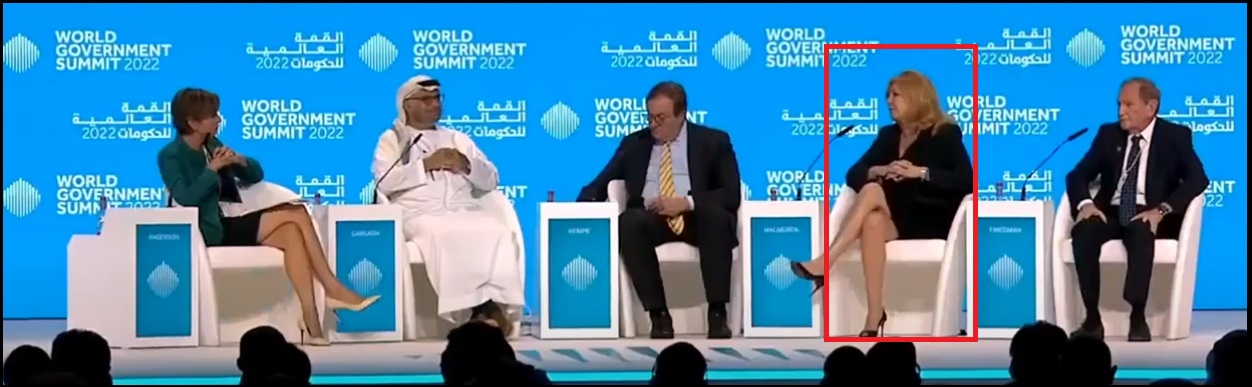
The World Government Summit 2022 took place on March 29 and 30 in Dubai, hosting more than 4,000 individuals from 190 countries including senior government officials, heads of international organizations, and global “experts.”   The invited participants presented ideas and worldviews from within their various fields of specialty.

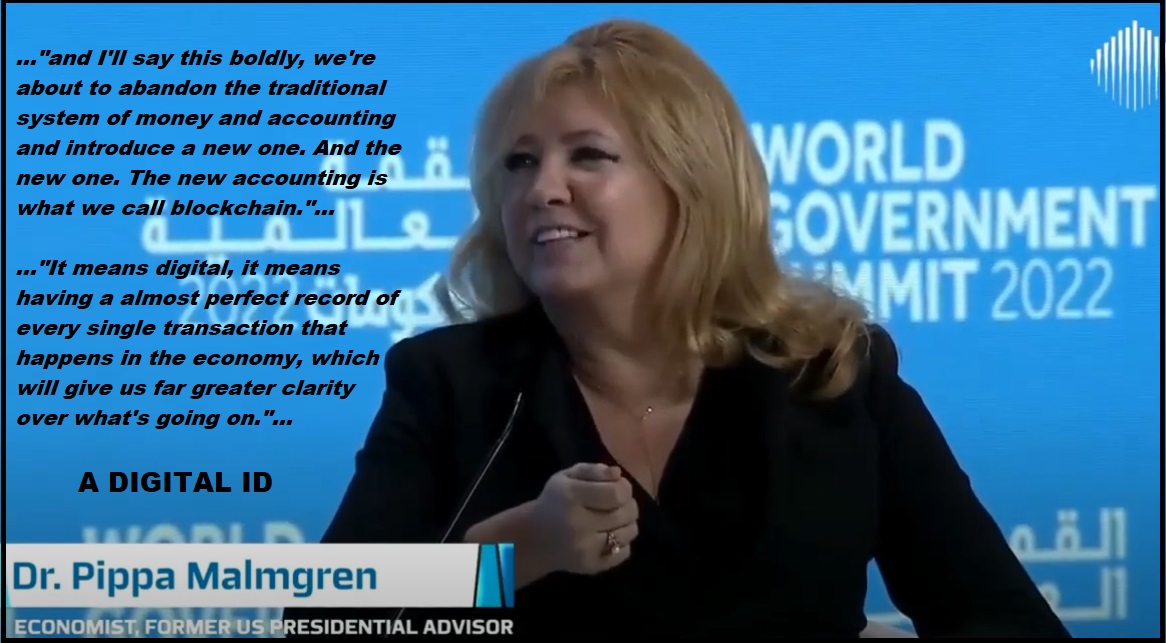
One presentation that needs to be highlighted was from Dr. Pippa Malmgren, an American economist who served as special advisor on Economic Policy to President George W. Bush.

Her father, Harald Malmgren, served as a senior aide to US Presidents John F. Kennedy, Lyndon B. Johnson, Richard Nixon, and Gerald Ford.   In this segment, Mrs. Malmgren says the quiet part out loud.  Yes, they are no longer hiding the construct; indeed, as you will hear they are saying quite openly what the future will look like.  WATCH (2 minutes):

[Full Source – 6 hours (internal segment at 18:30)]

Transcript – Dr. Malmgren: “What underpins a world order is always the financial system. I was very privileged. My father was an adviser to Nixon when they came off the gold standard in 71. And so, I was brought up with a kind of inside view of how very important the financial structure is to absolutely everything else.

And what we’re seeing in the world today, I think, is we are on the brink of a dramatic change where we are about to, and I’ll say this boldly, we’re about to abandon the traditional system of money and accounting and introduce a new one. And the new one. The new accounting is what we call blockchain.

It means digital, it means having a almost perfect record of every single transaction that happens in the economy, which will give us far greater clarity over what’s going on. It also raises huge dangers in terms of the balance of power between states and citizens.

In my opinion, we’re going to need a digital constitution of human rights if we’re going to have digital money. But also this new money will be sovereign in nature. Most people think that digital money is crypto, and private. But what I see our superpowers introducing digital currency, the Chinese were the first the US is on the brink, I think of moving in the same direction the Europeans have committed to that as well.

And the question is, will that new system of digital money and digital accounting accommodate the competing needs of the citizens of all these locations, so that every human being has a chance to have a better life? Because that’s the only measure of whether a world order really serves!”

The entry into a digital currency, needs a digital identity.

The end goal of a digital currency is why western political leaders have not been worried about following the COVID-19 spending demands from the World Economic Forum. {Go Deep}

When the global trade currency does not need to be pegged to anything to determine value, it is completely fiat.  This is the current problem with global trade and transactions taking place in U.S. dollars, which arbitrarily lifts the standard of life for Americans while providing no similar benefit to other nations. That view became the underlying motive for Osama Bin Laden to target the World Trade Center, twin towers.  That view was/is also the perspective carried by Barack Obama, that lay behind his “fundamental change” statement.

A digital currency allows ultimate control on a global basis by a one world government, or western system of collective governments, that can assign value.  No other mechanism will have as much control over the life of a person than a digital currency that will create a system of transactional credits and debits, perhaps also influenced by your social credit score.

The digital currency requires a digital identity in order for apportionment based on your value to society.  This is essentially an extension of the Fabian mindset into the world of financial transactions and monetary evaluations.  Fabians believed that some form of socioeconomic tribunal would be needed in order for each citizen to be quantified according to their “worth” to society.  The Chinese social credit score is a variant of that same concept.

The phrase “you didn’t build that,” when espoused by former President Obama and current Senator Elizabeth Warren is also based on this collective worldview. Both believe that individuals do not succeed independently, but rather gain their ability to grow wealth by using the resources of the larger society, infrastructure, labor and education.  The phrase “it takes a village” to raise a child, as espoused by Hillary Clinton is another variant of the same collective advocacy.

A digital currency and digital identity is not a conspiracy theory, these “global leaders” are explaining it to us out loud.  However, I am concerned that most will not hear it, or understand it, until it is too late.

Remold it nearer to the hearts desire”

Or

Build Back Better

Same/Same

Why Can’t We All Just Get Along?


Armstrong Economics Blog/Russia Re-Posted Mar 25, 2022 by Martin Armstrong

COMMENT: Dear Martin,
I am a frequent follower of your blog. I read your article tonight “ Putin puts Bidens King check mate”
Being an economist myself with 30 years of experience I completely agree with your proposals of a two tier Ruble. I would fine tune it even further by backing the international ruble up with oil/gas and the domestic with Gold as you said!

This would be a genius move in my opinion. Thank you for your work and keep up the very insightful Job you are doing! I personally appreciate it a lot- quite frankly I only read …. & You 🙂 Everything else is pure “ Mass psychosis influenser propaganda” backing a Political agenda. Good luck in sending the right advise to Russia! Not because I lőve Russia being a Hungarian but because supplying Russia with Smart financial and economic advise will bring restoration of peace ASAP which is the interest of the whole world!
Kind Regards,

Viktor

REPLY: Thank you. That is a good idea for we are dealing with the catastrophic collapse of the monetary system of the world. I do not think this will end well. It is ironic, but I try to defeat my own computer. I have never won yet. In the words of Rodney King – Why can’t we just all get along?

Blackrock CEO Advances Proposal for Global Digital Payment System and Digital Currency


Posted originally on the conservative tree house on March 24, 2022

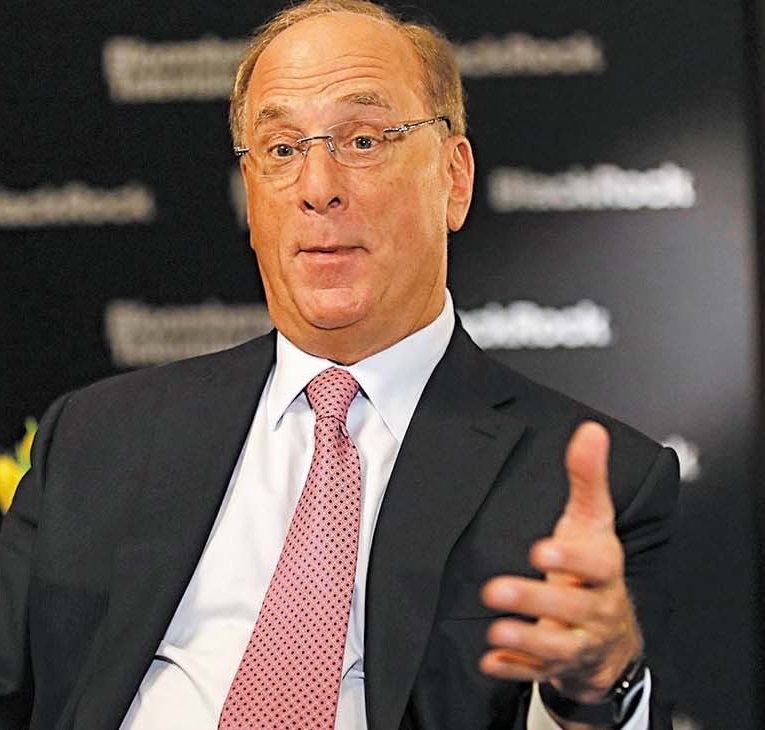
When CTH outlined the ‘Destination Handbasket’ framework {Go Deep}, we had no idea Blackrock CEO Larry Fink was essentially going to confirm the premise of our prediction.  Keep in mind, any digital currency can only work if there is a digital identity attributed to it – what some have called a digital passport which then creates a crypto wallet.

I have based the framework, of what appears to be over the horizon, on a set of inevitable geopolitical outcomes if the current path is continued.  The letter by Blackrock CEO Larry Fink [LINK] seems to affirm the strongest likelihood of a western-inspired digital currency eventually replacing the dollar.

NEW YORK, March 24 (Reuters) – BlackRock Inc’s (BLK.N) chief executive, Larry Fink, said on Thursday that the Russia-Ukraine war could end up accelerating digital currencies as a tool to settle international transactions, as the conflict upends the globalization drive of the last three decades.

In a letter to the shareholders of the world’s largest asset manager, Fink said the war will push countries to reassess currency dependencies, and that BlackRock was studying digital currencies and stablecoins due to increased client interest.

“A global digital payment system, thoughtfully designed, can enhance the settlement of international transactions while reducing the risk of money laundering and corruption”, he said.

[…] In the letter on Thursday, the chairman and CEO of the $10 trillion asset manager said the Russia-Ukraine crisis had put an end to the globalization forces at work over the past 30 years.

[…] “While companies’ and consumers’ balance sheets are strong today, giving them more of a cushion to weather these difficulties, a large-scale reorientation of supply chains will inherently be inflationary,” said Fink.

He said central banks were dealing with a dilemma they had not faced in decades, having to choose between living with high inflation or slowing economic activity to contain price pressures.  (read more)

You see that problem, that “dilemma” Fink mentions in the last paragraph above.  That is what we have been talking about on these pages for more than two years.   It is a dilemma western government created when they all joined together and followed the exact same financial path during the pandemic.

When western governments used the justification of the global pandemic to shut down their economies, enforce lockdowns and all of the subsequent rules, restrictions and economic pains as a direct result of those decisions, they put us on a crisis path that was always going to bring us to this “dilemma.”  Quite frankly, I do not see that unity of action as accidental, nor do I see it as organic.

All of the western leaders followed the same monetary and financial policy that was being advanced by the World Economic Forum.  They all spent like crazy, and provided tens-of-trillions in bailouts, subsidies and cash payments to cover the economic losses created by their COVID lockdowns.  They all did exactly the same thing, and that collective action is why we have ‘global inflation.’

Perversely, while inflation crushes the working class, global inflation works to their benefit by lowering the cost of the debt the politicians created, which the central bands and federal reserve facilitated.  We the citizens are suffering under inflation, but the governments that created the inflation actually benefit from it.

I will say with great deliberateness, these western governments want inflation.  Sure, it provides a political challenge for those who need to get reelected by voters, but in the bigger of big pictures, they need inflation.  Think about it in very simple terms.  If they did not want inflation, those same central banks and federal reserve policy makers would have raised interest rates six to eight months ago.

None of what is happening in supply chains and inflation is a surprise to them; they might pretend not to know, but these are not stupid people.  This is by design.  Media covers for them because, well, I’ll accept the PR firms for the regimes are idiots. However, the people who constructed these policies to take advantage of COVID-19 are not dummies.  They knew what all that intervention, manipulation and govt spending would lead to.

Where we are going now is a self-fulfilling prophecy, a destination that is a result of specific action the guided policymakers have taken.

Yes, in hindsight, all of it does seem planned to a long-term eventual conclusion.  However, I’m not going to make that specific affirmation just yet; there are still strong elements of ‘not letting a crisis go to waste’ as the leading driver.  Did these governing bodies create the underlying crisis?  We can debate that, but the point is essentially moot.  We are where we are.

The vaccination protocol created the Vax-Passport.  That has opened the door to the digital identity, “digital id.”   Any government created digital currency is going to need a digital id from the outset.

There are a lot of people asking where this is going, and what can be done to stop it.  I’m pretty certain we have accurately identified “Where This is Going,” and I’m a lot more confident now about that aspect than I was even just 24 hours ago.  However, knowing that, now we need to look closer at what they would do to stop us from disrupting it.

Tucker Carlson Asks, Is Ukraine the Representative Autocracy Washington DC Hopes To Achieve Here?


Posted originally on the conservative tree house on March 21, 2022 | Sundance

Tucker Carlson used his monologue tonight to note something we have discussed at length here.  Western government leaders continue to make statements about “representative democracy” in comparison to “autocratic non-western government”, yet they make these public statements while personifying autocracy itself.

An example was Joe Biden making statements to the media during a 9-11 commemoration visit to Shanksville Pennsylvania. In his remarks, Joe Biden decried Chinese Chairman Xi Jinping and Russian President Vladmir Putin as autocrats, yet Biden had just announced forced mandatory medical procedures for all U.S. workers a mere 36 hours before. It is a fact that throughout the last two years – the leaders of Europe, New Zealand, Australia, Canada and the United States have used declarations of emergency to position themselves with massive power.  This is not debatable.

As a consequence, the prior definition of “western representative democracy” collapsed under the weight of COVID-19 and was replaced with unilateral authoritarian emergency power.   When you look around, every single government in the west is still trying to extend those COVID powers by extending the emergency declarations that provide them.   Again, none of this is up for debate; it is empirically true.

Tucker asks a really good question.  Is the autocratic system of government that existed in Ukraine before the Russian invasion – which is (not coincidentally) identical in many ways to the COVID-19 inspired system of government created by Western leaders – actually, the real motive for those western leaders to unite in their support and current propaganda campaign on behalf of Ukraine?  I think he might be onto something.  WATCH:

.

Is western autocracy the real objective, and is modern fascism (i.e. corporatism) the technique to get there?

There is a massive synergy visible if you think about the WEF selecting leaders in this process.  The problem for western leaders, who want to be dictators, has always been the voice of the people.   Replace traditional democracy by merging modern corporatism with a new version of western autocracy, and we end up with a never-ending system of oppressive government just like we have been dealing with for the past two years throughout the pandemic.

“They are starting to notice the quiet part”…

Infowars Interview Martin Armstrong


Armstrong Economics Blog/Press Re-Posted Mar 21, 2022 by Martin Armstrong

If U.S. Intelligence Will Lie So Easily About Anything, Why Would We Believe Them About Ukraine?


Posted originally on the conservative tree house on March 19, 2022 | Sundance

Why would we believe anything from them about Ukraine?

(New York Post) […] “There have been no consequences. Twitter and Facebook still censor information based on political bias, and Congress takes no action. Many of the letter signers continue to be used as “experts” by the media.” (read more)

When we wrote about the media effort in 2018 {Go Deep}, specifically the collusion between the intelligence and national security agencies of the United States government, I asked the question, “Do we really think such a catastrophic level of corrupted journalism could reconstitute into genuine reporting of fact-based information?”  The answer then, as now, is the same, NO.  Indeed, it has only gotten worse in the past four years.

For the past several days, I have been highlighting a simple question on social media about something missing in the Ukraine story.

Where are the social media posts, from Ukraine citizens, that would support the narrative, as it is being told by Western media, about events happening in Ukraine?

Seemingly, Ukraine is the only conflict in modern human history where a pop culture society of more than 40 million technologically connected people decided not to document every moment of it on social media.

Considering the scale and scope of the conflict, and considering the Ukraine population of more than 40 million is far larger than Canada, and considering that population is located in a country the size of Texas, and considering they are a western technologically connected society with tens of millions of cell phones, we should be seeing a great deal of footage, pictures and images from ordinary Ukrainian citizens.  However, we don’t. Why?

I’m not talking about the professional war social media accounts, and/or military-centric accounts, which, to be fair do have lots of images and footage of Russian and Ukrainian conflicts.  I’m talking about the ordinary man/woman in the major population centers, who under normal circumstances would be generating tens-of-thousands of social media posts to Facebook, Twitter, Instagram, Telegram, YouTube, etc.

Western media are telling us that Russia is randomly shelling, bombing and targeting all of these civilian targets in urban areas.  Yet, there’s nothing visible.  Almost everything you see is from Eastern Ukraine where a civil war has been ongoing for over a decade.

Whatever is happening in the rest of Ukraine is the least documented conflict in modern social media.  It just seems odd.  It’s as if there is a massive disconnect between the portrayal of western media, in comparison to the actual reality inside Ukraine.

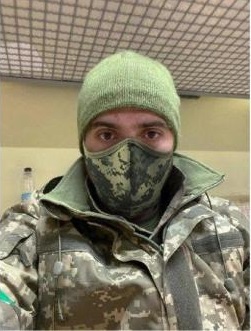
(CNN Portugal) – [TRANSLATED] – Ukraine has opened the barracks to foreign fighters, who join an army that has to adapt those who have not been trained there. Some are Portuguese, “fighters in quotation marks”, as the government of the government Portuguese. Among these Portuguese there are former commandos, ex-paratroopers – and a 29-year-old mechanic, who spent 15 days at the Yavoriv military base, was bombed and left for not giving him weapons. I’ve never taken one before. It is the first account of a Portuguese about how the fighting lived at the military base and why he gave up fighting.

We call it n.s. The 29-year-old Portuguese mechanic had never taken a weapon of war in his life, but it was in the first waves of foreigners joining the Ukrainian military in the so-called international legion. He entered the Yavoriv military base on March 1. He left two weeks later – after the heavy Russian bombardments on this city of Ukraine, which caught him with the Ukrainians but unarmed.

N.S.’s account serves to realize an ongoing history in the war in Ukraine, which opened the borders, doors, barracks and arms to foreign fighters. Many continue to arrive, “knock on the door” at the border and say they want to fight. The first ones entered soon, now there are those who have signed up and are in hotels waiting to be called.

The international legion is seen with reservations by many experts and even governments – such as Portuguese – because there is everything: professionals and amateurs, mercenaries and volunteers, ex-military and people with no experience, who receive quick formations and weapons to hand.

They are “fighters in quotes”, so called them two days ago the Minister of Foreign Affairs, Augusto Santos Silva, without hiding their reservations. Portugal “does not agree with these procedures” of people, he stressed. “We understand that this is not the most effective way to support Ukrainians in their right to self-defense and is not part of the tradition or way of being of the Portuguese, nor is it the way Portugal contributes to international security,” explained the head of Portuguese diplomacy. Santos Silva commented on the news that at least seven Portuguese were in Ukraine with military objectives. Some of them were at the Yavoriv military base when it was attacked on Sunday by Russian troops

One of them was N.S.

From the couch to the war – What made N.S. take the car and go from southern France, where he has lived since 2014, to poland’s border with Ukraine to say he wanted to fight? One impulse: “I didn’t think it made sense to sit around and watch a country, civilians, including children, being killed. In addition, there is a risk that one day the Russians will attack the rest of Europe.” He made the decision and left overnight, leaving his wife and four-year-old son at home. “I left a letter explaining. It was a shock to her. It’s all right now.”

“When I got to the Ukrainian border I told him what I was going to. They then called some men who took me to the advanced command post. I was the subject of an interrogation. In the end, they took me to the military base, which was already active.” When he arrived, he signed an uncertain term contract “until the war was over” – that’s how he said it – and they gave him the uniform.

At first, he says, platoons with foreigners were not yet well organized and constituted. The volunteers walked around the base – a large structure, with several buildings and dressing rooms. He soon met Portuguese, a former paratrooper who, meanwhile, was placed on special forces teams that are on missions through Ukraine, to “clean up the cities attacked by the Russians”.

He spent 15 days at the base in training. He’d wake up at 6:30 a.m. and join the military parade in the courtyard to listen to the commander. At 7:00 a.m. they exercised and an hour later they had breakfast. The morning was then devoted to training. “They gave us lectures of various kinds. Some to know the Russian weapons and the weak points of the opponent, others about first-hand.” They had lunch and were still in training. In the second week he lived at the base began to have intensive training of combat tactics, offensive, lines of defense, among many other topics. “I learned the art of war,” says N.S., who at a young age tried to join the Marines but broke an arm, which prevented him from following his career.

N.S. was one of the Portuguese volunteers who were at the Yavoriv military base on Sunday when Russia bombed the land in that area, just 25 kilometres from the NATO border. A few hours later, at least 35 people were killed and 134 wounded in the attack on the base near Lviv.

Because he had no military experience, he did not have weapons assigned that day. Unlike other colleagues, I had never left the base on a mission. “It was planned that that day – when the bombing took place – my platoon would finally receive the weapons.”

It was a night of terror, he reports. “I was in bed when I was 4 in the morning I noticed from the noise that we were going to be attacked.” At the first explosion he jumped out of bed. Since he always slept dressed in his uniform, he just had to stick his boots on his feet – he didn’t even tie them – pick up his phone and get out of the dressing room.

Unarmed, he even made a first attempt to go to the area where the special forces were installed, to see if there were weapons, “but at that time everything was still locked.” He was in the middle of the explosions.

“I watched live two explosions and two buildings falling. About 100 meters away, a missile went straight into a barracks where people were, was destroyed, burned. The same thing happened in front of me in a building by the canteen.” I could feel the missiles going over him. “I’m not quite sure of the time, I think there were many for 30 minutes.”

Without weapons, he recalls, he went into hiding in the nearby forest, as the security protocol that was transmitted to them. He stood there, in the middle of the trees, where other colleagues were, until everything calmed down. “When the missiles were over, we returned to the base and were regrouped to see if there were dead, missing or injured. It took four hours to regroup and put together the defense plan.”

At the base there would be about 2000 in several companies, he estimates. These, based on the strategic plan defined, were spread over several points of defense of the base, that of N.S. was on the runway of helicopters. They were ordered to stay in line with the defense, “to defend the basis of the Russian attack that everyone believed was going to happen.” In the area where it was placed there would be about 200 volunteers, mostly unarmed. That’s when his distress and that of some other military personnel began. “We made ‘pools’ trying to get supplies and weapons.”

It was after he decided to abandon the Ukrainian army, leave the base and return home. “After the bombing, everyone in the army thought there was going to be a russian ground attack. And that’s why they told us to stay in lines of defense. I stood there, no gun, no vest, no helmet. I realized that I could not continue like this”, tells CNN Portugal the volunteer who prefers to keep discretion in his identification for fear of being confused with a mercenary, which he guarantees not to be. “My goal was to fight, and if I died, it would be a gun in my hand. So we were just cannon meat.” (read more)