Posted originally on CTH on June 30, 2025 | Sundance
For those who have spent time in the lead up to this moment, you may remember our warning that Elon Musk would eventually take a position against President Trump and actively work to undermine the MAGA agenda therein.
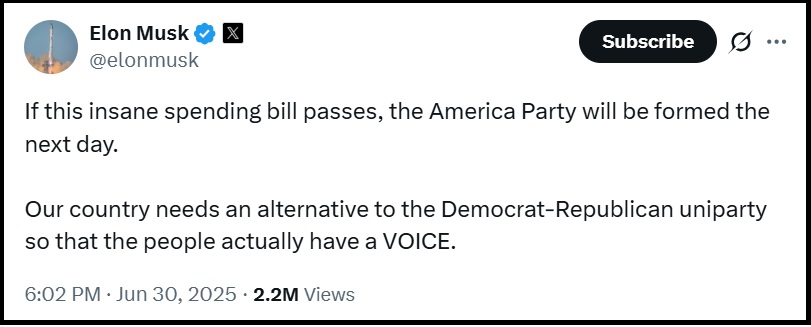
Tonight as the Senate debates the Big Beautiful Bill, that does not include subsidies for his electric vehicles and green energy initiatives, Elon Musk promises to organize a third party. This was all predictable.
Sometime around April of 2026 (approx. 15 months), if not sooner, Elon Musk will be in opposition to Donald Trump and demanding people choose.
The bill is imperfect, yes. However, the BBB contains the priorities of President Trump and those priorities are the goals and objectives of the people who voted to support his vision. Elon Musk is now actively working against the interests of the Make America Great Again movement, and he is intent on dividing the MAGA coalition.
Posted originally on CTH on June 29, 2025 | Sundance
“Elbows up” and knees bent. As expected given the nature of their dependency, the Canadian government has rescinded the digital services tax against U.S. tech companies.
The June 30th collection is halted and the Canadian government led by Mark Carney will be bringing legislation to rescind the tax entirely.
CANADA – […] Minister of Finance and National Revenue, the Honourable François-Philippe Champagne, announced today that Canada would rescind the Digital Services Tax (DST) in anticipation of a mutually beneficial comprehensive trade arrangement with the United States. Consistent with this action, Prime Minister Carney and President Trump have agreed that parties will resume negotiations with a view towards agreeing on a deal by July 21, 2025.
The DST was announced in 2020 to address the fact that many large technology companies operating in Canada may not otherwise pay tax on revenues generated from Canadians. Canada’s preference has always been a multilateral agreement related to digital services taxation. While Canada was working with international partners, including the United States, on a multilateral agreement that would replace national digital services taxes, the DST was enacted to address the aforementioned taxation gap.
The June 30, 2025 collection will be halted, and Minister Champagne will soon bring forward legislation to rescind the Digital Services Tax Act. (LINK)
In the bigger picture Canada has a serious problem.
Canada is entirely dependent on the USA; there is no part of the Canadian economic system that can survive without total dependence on the USA. The Canadian economy is currently stagnant and their leftist government is desperate to find a way to collect revenue somehow, any way possible. Additionally, President Trump is going to end the USMCA trade agreement and shut down a majority of the benefits Canada has been extracting.
The most remarkable aspect to this reality is the denial within Canada. There are maybe a handful of honest Canadian economists, financial types and/or pundits who understand economic matters that are willing to outline and explain the details of Canada’s vulnerability…..
…. The rest are in denial, shouting ‘elbows up’ as if that is going to change the inevitable. The pretending is strong amid the snow Mexicans. Their denial is a mass formation psychosis. Stunningly so.
Posted originally on Jun 28, 2025 by Martin Armstrong
COMMENT: Marty,
After reading AJP Taylor’s History of WW1 (an esteemed English historian), I realized that your statement about the Lusitania bringing the USA into WW1 is rather inaccurate: the Lusitania was sunk in May 1915; USA entered WW1 in April 1917, essentially two years later.
The real impetus was the unrestricted submarine warfare declared by Germany, which targeted US corporate profits that impelled the US to declare war on Germany, as Germany declared unrestricted submarine warfare in February 1917. Initially, this was a great success for Germany, but through the introduction of convoys, it failed dramatically, especially as it instigated the US ago enter WW1.
Hope you’re doing well,
LB
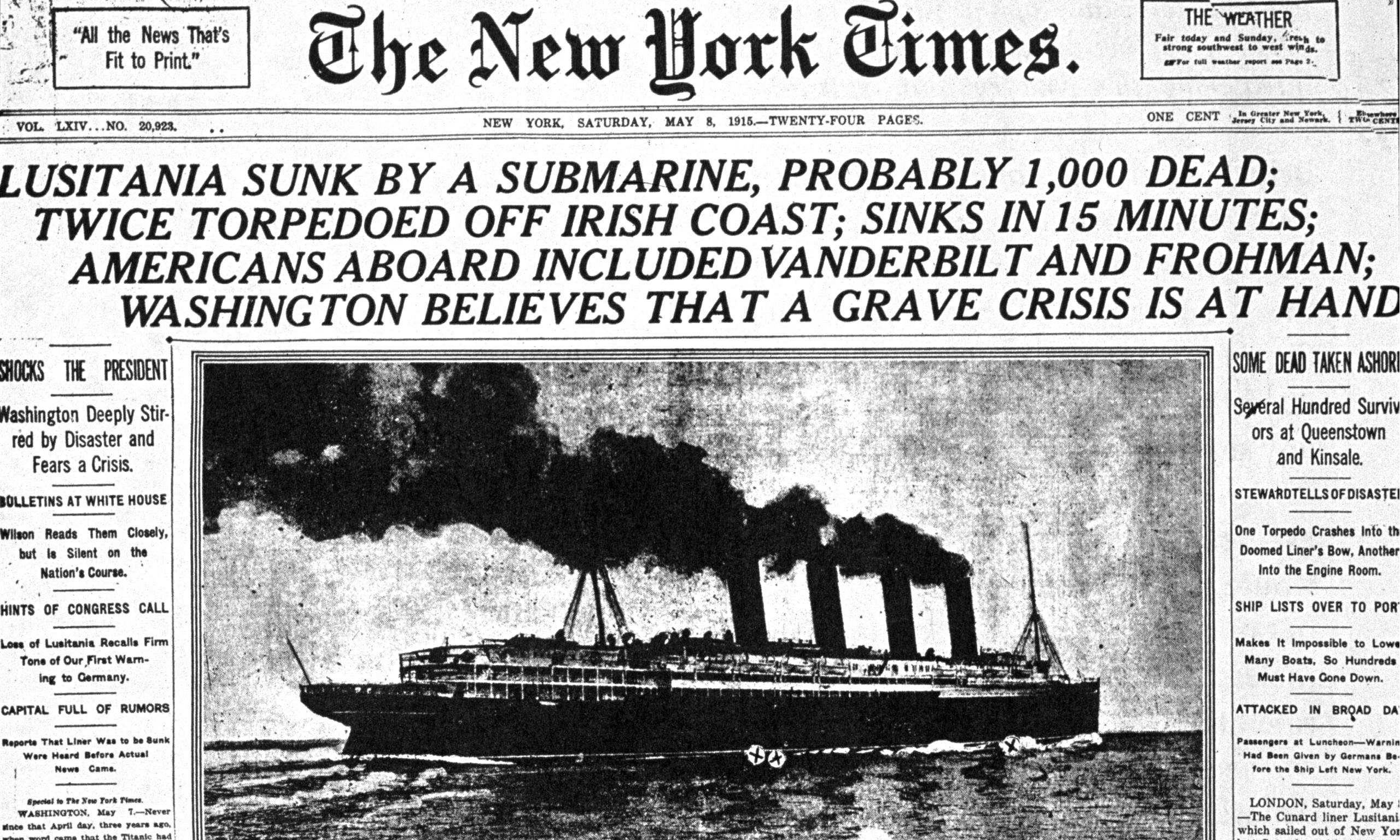
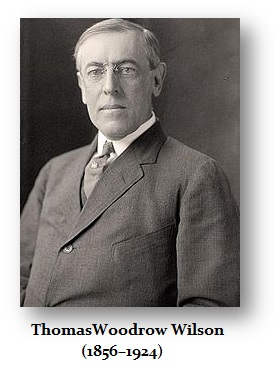
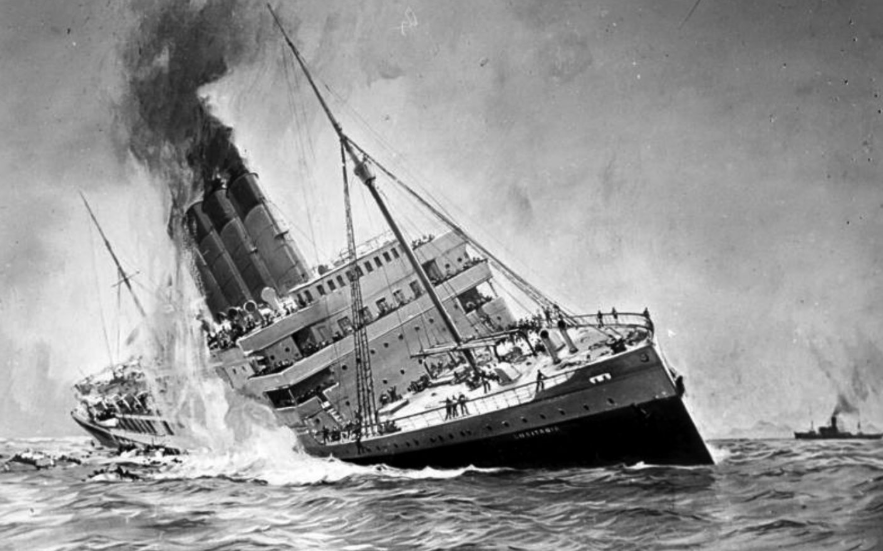
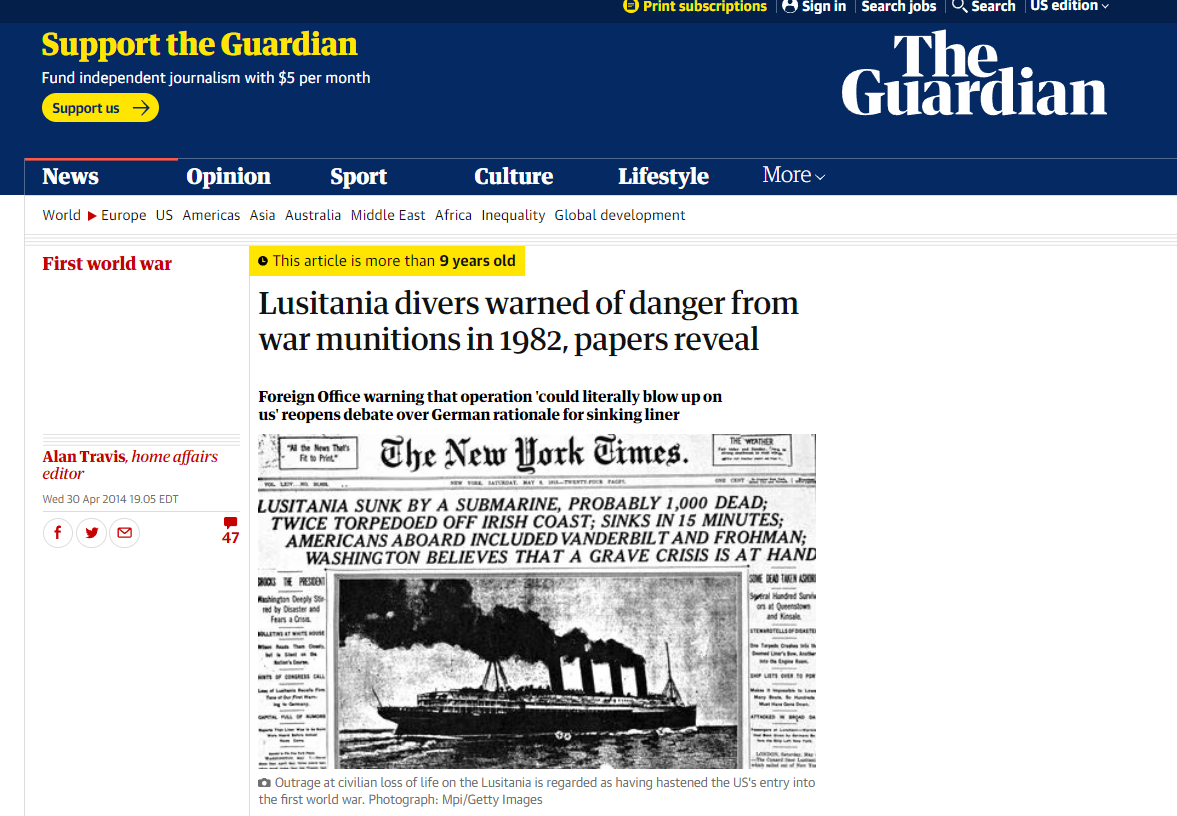
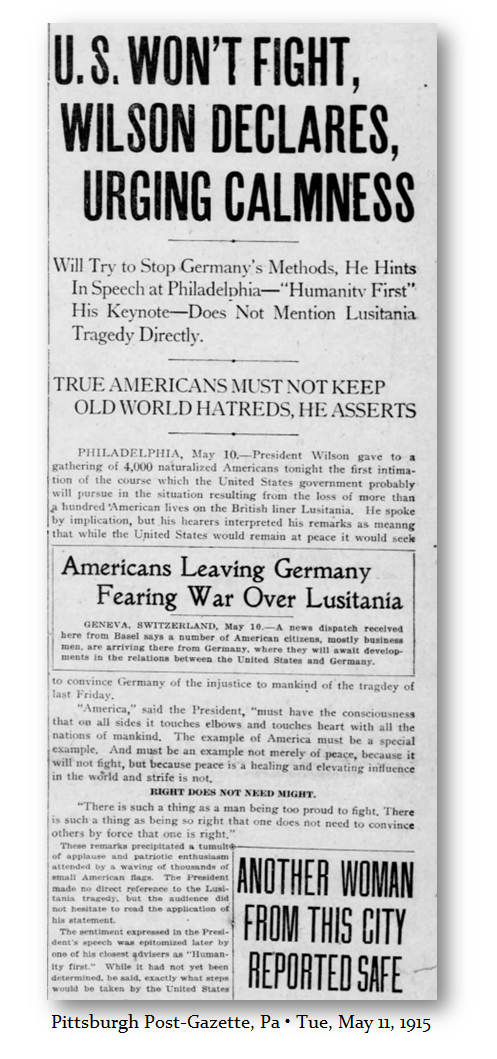
REPLY: In all analyses, you can never reduce anything to a single cause and effect. The sinking of the RMS Lusitania on May 7th, 1915, by a German U-boat was a major event during World War I, but it did not immediately cause the U.S. to enter the war. However, it significantly turned American public opinion against Germany and contributed to the U.S. eventually joining the conflict in 1917. Claiming that it was the unrestricted submarine warfare by Germany in 1917 that instigated the war downplays the role of the Lusitania and the likelihood of those in the Deep State who sought war back then, counter to President Wilson’s neutrality position.
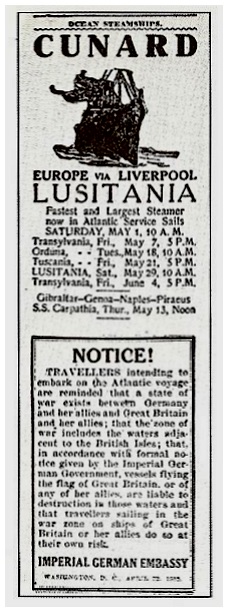
The Lusitania was a British passenger ship carrying 128 Americans (out of 1,198 total deaths). The attack provoked outrage in the U.S., but President Woodrow Wilson initially sought a diplomatic response rather than war. Germany argued the ship was carrying munitions (which was true, though it was primarily a passenger liner). The US was using civilians as cover for arms transfer to Britain when they pretended to be neutral. As shown here, the Germans even took an advertisement in the NY newspaper warning people not to sail on the Lusitania. Following international pressure, Germany temporarily halted unrestricted submarine warfare in 1915 to avoid further provoking the U.S.
Zimmermann Telegram & Final Push to War (1917):
The resumption of unrestricted submarine warfare in February 1917 (sinking U.S. ships) and the Zimmermann Telegram (a secret German proposal for Mexico to ally against the U.S.) were the final triggers for U.S. entry into WWI in April 1917.
The Lusitania was a significant factor in shifting U.S. opinion against Germany because it was carrying civilians. Still, it was not the sole reason for the United States’ entry into the war. The combination of continued submarine attacks and the Zimmermann Telegram ultimately led to the U.S. declaring war in 1917.
My main point about the Lusitania is that it was a Neocon quasi-false flag. After years of denying the German claims, the government lied as always to get us into every war. The CIA and Pentagon did not exist during the Lusitania incident. The relevant U.S. agencies were the State, Navy, and War Departments. These departments, particularly the State Department under William Jennings Bryan (1860–1925), were aware of and concerned about the British practice of carrying munitions on passenger ships.
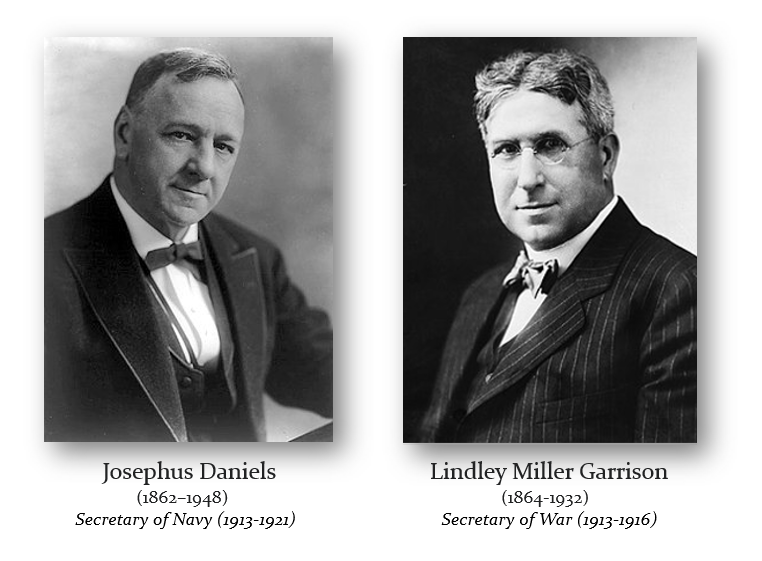
The two members of Wilson’s Cabinet who were in a position over the question of war were the Secretary of the Navy, Josephus Daniels (1862-1948), who was the last member of the cabinet to advocate for war in 1917, and the Secretary of War, Lindley Garrison (1764-1932), the Neocon who was replaced after the Lusitania. There is no evidence that Secretary of War Lindley Garrison authorized or had any direct involvement in the munitions shipment aboard the Lusitania. His department (War) was responsible for the Army, not naval shipping or maritime commerce.
The decision to load munitions on passenger liners like the Lusitania was a British Admiralty policy aimed at utilizing fast liners for vital war supplies while maintaining passenger service to generate revenue and improve public perception, thereby covering up their shipments. US covert involvement was limited to customs oversight and the controversial policy of allowing passengers on ships carrying munitions.
Garrison was a strong advocate for military preparednessbefore and after the sinking of the Lusitania. He advocated for building up the U.S. Army and National Guard to be ready for potential threats. His “Preparedness Movement” gained momentum after the Lusitania, much like Homeland Security was born from the WTC 911 attack. While Wilson pushed for neutrality and diplomatic responses even after the sinking, Garrison’s Neocon views clashed with Wilson and congressional leaders who felt his plans were too ambitious or militaristic. Garrison was compelled to resign in February 1916 primarily over disagreements with Wilson and Congress regarding the scale and control of military expansion. He had wanted a standing army of 140,000, which he called the Continental Army Plan, vs. strengthening the National Guard. The sinking of the Lusitania hardened attitudes towards Germany among many Americans.
While the sinking of the Lusitania caused massive outrage, shifted public opinion significantly against Germany, and led to demands for a strong diplomatic or even military response, it set in motion the calls to enter war and blamed the Germans as they hid the covert use of civilians to disguise the US violating its pretended neutrality position. By itself, it was not the final act to compel the US to enter the war. Secretary of War Garrison was pushing for a standing army. Garrison advocated for intervention using military force overseas, clashing with Wilson. This surfaced regarding Mexico. Garrison advocated for American intervention in the Mexican Revolution to restore order. In 1916, Garrison supported a plan for expanding the US military, which he referred to as the Continental Army Plan. Garrison’s proposal would establish a standing army of 140,000 and a national, volunteer reserve force of 400,000 men. Garrison encountered opposition from those who believed his plan went too far in establishing a large standing army. Allies in Congress convinced Wilson to back an alternative strategy which emphasized not Garrison’s national volunteer force, but a continued role for the states’ National Guard. Garrison resigned in February 1916 over these differences. Garrison’s public stance was that of a Neocon. He left office nearly a full year before the US actually declared war in April 1917.
While the U.S. government publicly downplayed the munitions cargo initially to maintain moral outrage against Germany, there’s no credible evidence, as always, that U.S. departments lied to President Wilson about its existence. Secretary Bryan claimed he actively warned Wilson because he believed munitions were present and made the ship a target. With the Germans taking out newspaper advertisements warning against sailing on the Lusitania, it is hard to imagine that there were no conversations, even at the Presidential level.
There was no specific Senate or House investigation focused solely on whether President Woodrow Wilson knew about the munitions aboard the RMS Lusitania before it was sunk in 1915. However, the issue was examined within broader contexts by other official U.S. bodies and touched upon in congressional hearings. Just as the investigations into whether FDR knew in advance about Pearl Harbor, no such committee will EVER admit the wrongdoing by the President that took the country into war.
Congress did not even launch a formal investigation specifically targeting Wilson’s foreknowledge of the Lusitania’s cargo. While there was significant public debate and congressional interest in the sinking and its role in pushing the U.S. toward war, no committee was empaneled with the primary purpose of investigating the President’s prior awareness of the munitions. They too, conspired to cover up the foreknowledge.
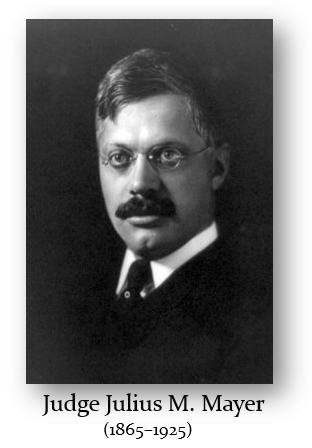
The Mayer Arbitration (1915) was formed shortly after the sinking. The U.S. government initiated an investigation led by federal judge Julius Mayer, who was from the Second Circuit in New York City. He had presided over cases dealing with the Titanic. While primarily focused on establishing facts for potential legal claims against Germany, the investigation confirmed the Lusitania was carrying small-arms ammunition, claiming that they were non-explosive rifle cartridges and artillery shell casings (shrapnel shells without explosive charges). This information became part of the official record, meaning the government (including the administration) knew about the munitions afterthe sinking, but the investigation didn’t address what Wilson knew beforehand.
In the US, there were 67 claims for compensation filed against Cunard, which were all heard together in 1918 before the United States District Court for the Southern District of New York. Judge Julius Mayer as well. In the Titanic case, he had ruled in favour of the shipping company. Mayer had a reputation for being pro-government in matters of national interest. The two sides agreed before the jury trial that no question would be raised regarding whether Lusitania had been armed or carrying troops or ammunition as part of the cover-up. Evidence produced by the British was presented only behind closed doors. The Defence of the Realm Act was invoked to protect British witnesses, ensuring that the truth would not be heard.
The decision was rendered on August 23rd, 1918, and Mayer’s judgement was that “the cause of the sinking was the illegal act of the Imperial German Government”, that two torpedoes had been involved, that the captain had acted properly, and emergency procedures had been up to the standard then expected. He ruled that further claims for compensation should be addressed to the German government (which eventually paid $2.5 million in 1925).
After WWI, this U.S.-German commission handled claims arising from the war, including those related to the Lusitania. Its findings (1923) explicitly stated that the presence of non-explosive munitions did not deprive the Lusitania’s passengers of their neutral rights or justify the attack without warning. Crucially, it found no evidence that the ship carried high explosives (like the German government claimed). Again, this established the nature of the cargo officially but didn’t investigate Wilson’s prior knowledge.
The Senate Foreign Relations Committee held hearings in 1916 on broaderissues of preparedness and neutrality, leading up to the war. While the Lusitania was discussed, the focus was not on Wilson’s foreknowledge of its specific cargo. Critics of the administration questioned why Americans were allowed to travel on belligerent ships carrying contraband. Still, the hearings did not yield evidence or conclusions regarding Wilson’s personal knowledge before May 7, 1915.
Only during the 1030s, the Senate Special Committee Investigating the Munitions Industry (Nye Committee) investigated the arms industry and its influence on U.S. entry into World War I. It extensively documented the shipment of war materials(including those on the Lusitania) by U.S. companies to the Allies, often facilitated by the State Department despite U.S. neutrality. While it highlighted Wilson’s administration’s general awareness of and involvement in the arms trade with the Allies, it did not specifically focus on whether Wilson knew the Lusitania specifically carried munitions on that voyage before it sailed.
The U.S. government, particularly the State Department and Customs officials, was generally aware that British liners, such as the Lusitania, sometimes carried small arms and non-explosive munitions under the guise of passenger service, exploiting loopholes in neutrality rules. The government did everything it could to claim that President Wilson had no credible evidence that he received specific, advance warning about the exact nature and quantity of the munitions loaded onto the Lusitania for its final voyage before it sailed from New York. This was even though the German Embassy in Washington did place newspaper ads warning passengers that ships flying the British flag in the war zone were subject to destruction, but this was a general warning, not specific intelligence about the Lusitania’s cargo.
Wilson’s public stance after the sinking focused relentlessly on the illegality of attacking a passenger vessel without warning and the loss of civilian life, deliberately downplaying the munitions issue to maintain the moral high ground against Germany. While the fact that the Lusitania carried munitions was established by U.S. investigations after the sinking, and the broader policy of allowing munitions shipments to the Allies was controversial and later scrutinized (notably by the Nye Committee), there was never a dedicated Senate or House investigation specifically targeting President Wilson’s personal foreknowledge of the Lusitania’s cargo before its fateful voyage. Historians generally agree he likely knew such ships could carry contraband, but lacked specific, timely intelligence about the Lusitania’s final manifest.
Wilson was acutely aware of the deep public divisions and his own desire to avoid war if possible. He pursued a diplomatic path. His demands to Germany were extreme, pushing the US and Germany to the brink of war. Germany, wanting to avoid US entry at that time, eventually offered concessions and temporarily scaled back unrestricted submarine warfare (though it resumed in 1917). It is UNLIKELY that Wilson deliberately sought a false flag to enter World War I. Nevertheless, nobody wanted to look too closely at the actors in the State Department and the War Department who were eager to take the US into war against Germany.
Wilson was president between March 4th, 1913, and March 4th, 1921. Newton D. Baker (1871-1937), who had played an essential role in Woodrow Wilson’s nomination in the Democratic National Convention of 1912, was appointed Secretary of War by President Wilson, replacing Garrison. He remained in the Cabinet to the end of Wilson’s term of office. Although he was, as he himself said, so much of a pacifist that “he would fight for peace,” he soon submitted to Congress a plan for universal military conscription. He efficiently presided over the mobilization of more than four million men during World War I.
The press was divided back then and not entirely under the control of the Neocons, as they are today, pushing for World War III. Congress, while angry, largely followed President Wilson’s lead in pursuing a diplomatic solution first. The event marked a significant step towards war, erasing the pretense of neutrality and laying the groundwork for intervention. However, the actual, decisive push for war came nearly two years later, primarily driven by the resumption of unrestricted submarine warfare and the Zimmermann Telegram in early 1917.
Posted originally on CTH on June 28, 2025 | Sundance
CTH has continually said that almost no one in Canada has any grasp of what is about to happen within their economy, specifically because only a handful of people realize what President Trump intends to do.
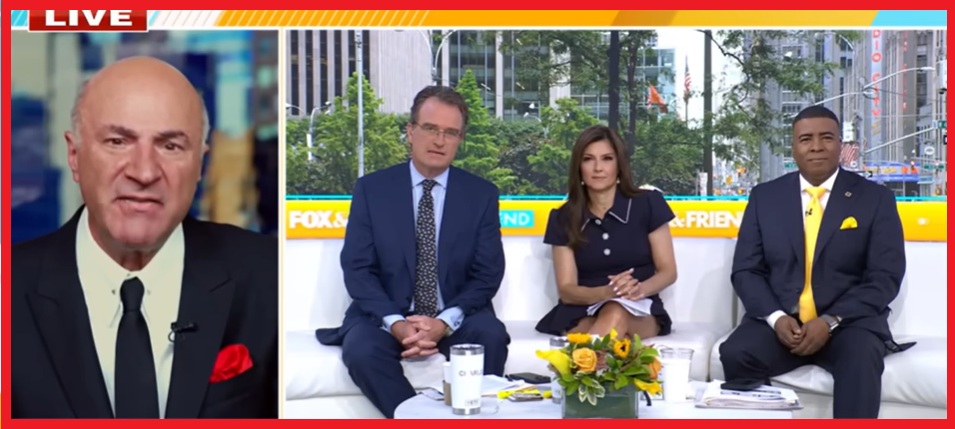
This interview with Kevin O’Leary is a case study in what I have been warning about. If you have any financial affiliation with O’Leary Ventures or ancillary investments that touch on a dependency therein, be forewarned.
O’Leary is only a few months away from exploding against President Trump in a manner that will make the Elon Musk statements about Epstein and Trump seem small by comparison. As yet another Canadian financial voice that just doesn’t get it, O’Leary has no idea the USMCA is about to end. And when it does, oh boy… he will go bananas.
Posted originally on Jun 26, 2025 by Martin Armstrong
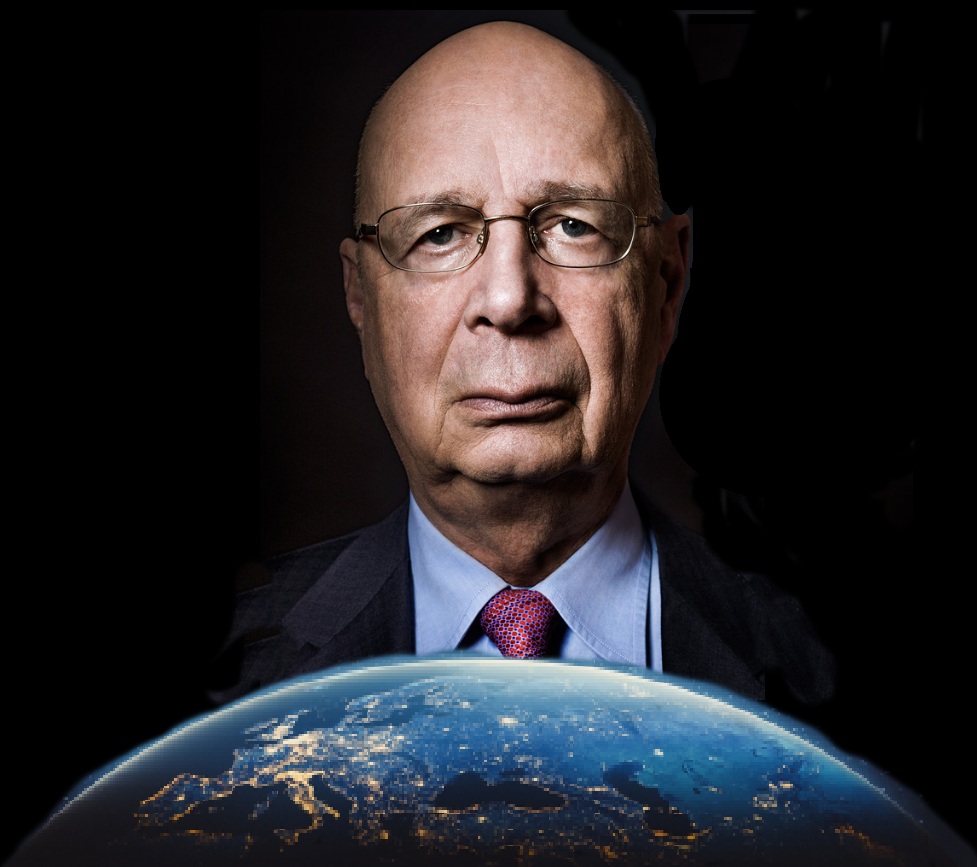
World Economic Forum founder Klaus Schwab stepped down from his chairman position at the organization on April 20, 2025, amid accusations of fraud. Our computer had forecast that the WEF would enter a declining trend with the 2024 ECM turning point. This staged coup happened about 37 years after the first Davos meeting (8.6 x 4.3). From our model’s perspective, this was right on time. Now, Schwab and the WEF are working to repair ties.
An anonymous whistleblower claimed that Klaus Schwab and his wife collaborated with USAID to steal tens of millions in funding. The whistleblower has always been anonymous, and it remains very suspicious that the very organization he created would turn on him after receiving an anonymous letter that they admitted may not have been credible. Something like this would never be acceptable in any court of law, especially if it’s anonymous. It would be the worst or the worst hearsay, where you cannot even point to who made the allegation.
Back in April, the WEF said its board unanimously supported the decision to initiate an independent investigation “following a whistleblower letter containing allegations against former Chairman Klaus Schwab. This decision was made after consultation with external legal counsel.”
Now, the WEF is attempting to repair its relationship with its founder ahead of the next Davos meeting. Bloomberg reported that the WEF would like to “normalize their relationship [with Klaus Schwab] in order to safeguard the forum and the legacy of the founder.”
Peter Brabeck-Letmathe has replaced Schwab for the time being, but is less of a commanding force. Schwab’s sudden departure has caused instability in the organization and its ongoing mission. Board members are concerned that support for the organization will begin to decline as this situation remains unresolved.
The World Economic Forum’s annual revenue in 2024 was 440 million francs ($543 million), with the majority of proceeds coming from member companies and fees. Yet, the number of people registered to attend the 2025 Davos event is on par if not slightly exceeding the number of participants from the year prior.
Schwab’s departure has damaged the Davos brand. There is a possibility that the organization is attempted to rebrand after Agenda 2030 failed. The WEF attempted to move away from its zero tolerance stance on ESG initiatives after they became widely unpopular among the big industry players and shifting governments. The brand has attempted to integrate the importance of digital transformation and AI to remain relevant as the tech gurus grow in power and popularity. Those who are familiar with Klaus Schwab know the phrase, “You will own nothing and be happy.” These words have been widely unpopular and caused a type of sinister chaos to surround the brand that was once respected as the high-brow institution of globalist elites.
European Central Bank President Christine Lagarde was slated to replace Schwab in 2027 when her term ends, and all reports claimed that he was prepared to remain in the chairman role for an additional two years to ensure Lagarde could take his place. What changed seemingly overnight that would cause the organization to discard Schwab before he was due to retire?
Schwab denies any misconduct and filed lawsuits against the whistleblowers, calling the accusations “calumnious” and “unfounded.” He believes “character assassination” was the premise of the claims.
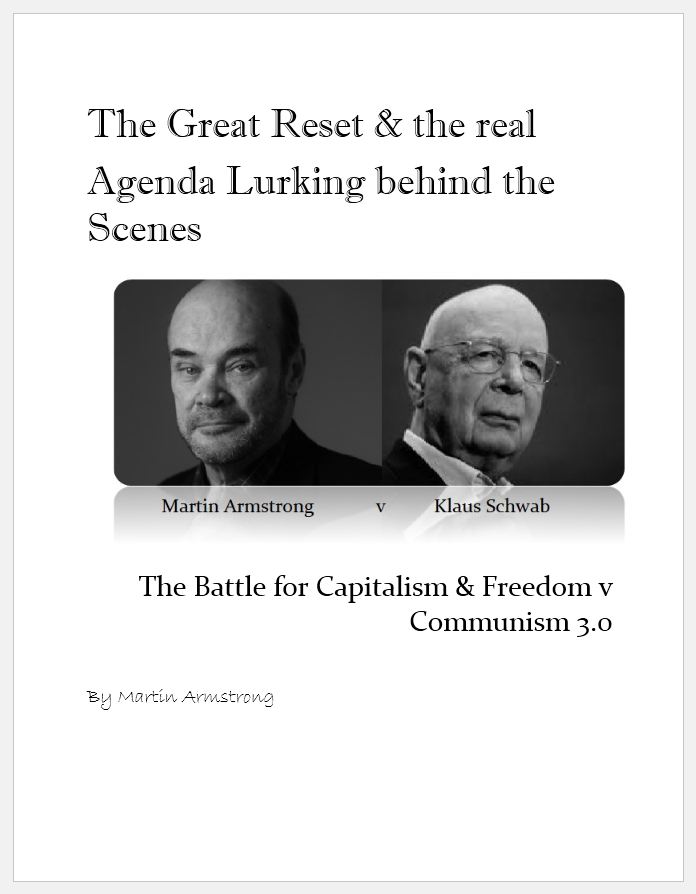
I am no fan of Klaus Schwab, as everyone knows. I disagree with his theories from start to finish. Nevertheless, something doesn’t smell right here. This appears to be an internal coup, perhaps to distract attention from the question of alleged funds for the WEF from USAID, or to try to salvage the failed Agenda 2030. Perhaps they will claim that no misconduct had occurred since DOGE did not raise concerns or there is a possibility that those behind the internal coup are concerned that Schwab’s counter lawsuit could uncover new corruption. The investigation into Schwab has not concluded, but after only three months, the WEF would like to wrap it up. It appears that the WEF does not want to welcome Schwab back; rather, they would like to ensure an amicable resolution to maintain both the brand’s reputation as well as the founder’s.
Posted originally on Jun 25, 2025 by Martin Armstrong
The UK government has warned that the nation must “actively prepare for the possibility of the UK coming under direct threat, potentially in a wartime scenario”, following a tense 12-day war between Iran and Israel, which threatened to spill over at any moment. The UK has also acknowledged, as has the US Department of Homeland Security, that domestic terrorism is likely because of the Iran-Israel War, but also war with Russia. The UK government said that “confrontation with those who are threatening security,” with Russia’s war in Ukraine described as “the most obvious and pressing example of this.” They added “Iranian hostile activity on British soil” is to be expected and that they will attempt to disrupt critical supply lines and energy infrastructure.
I have created this site to help people have fun in the kitchen. I write about enjoying life both in and out of my kitchen. Life is short! Make the most of it and enjoy!
This is a library of News Events not reported by the Main Stream Media documenting & connecting the dots on How the Obama Marxist Liberal agenda is destroying America






 Centinel2012