The Banking Crisis of All Times


Reposed from Armstrong Economics Blog Posted Apr 25, 2023 by Martin Armstrong
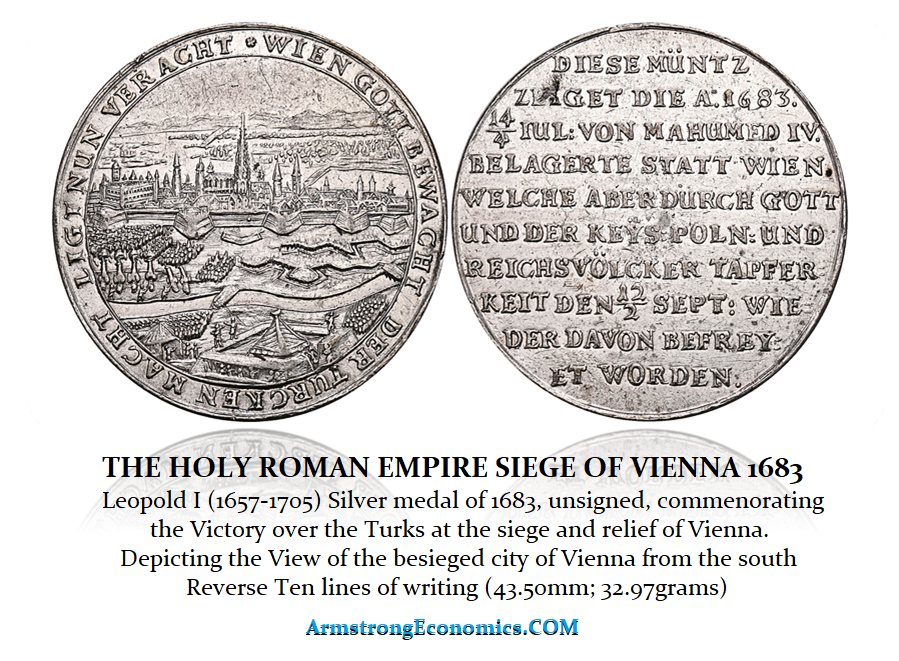
QUESTION: Mr. Armstrong, Your knowledge and database on financial crises is really unprecedented. I googled the first banking crisis and it brought up only the Crisis of 1763, which started in Amsterdam. Yet that list published in the WSJ which showed 1683 as the first panic and the siege of Vienna was most interesting. I know you have written about the sovereign defaults on the ancient central bank in Delos. My question is, was there any major financial banking crisis between antiquity and 1683? I figured if anyone would know, he had to be you.

PF
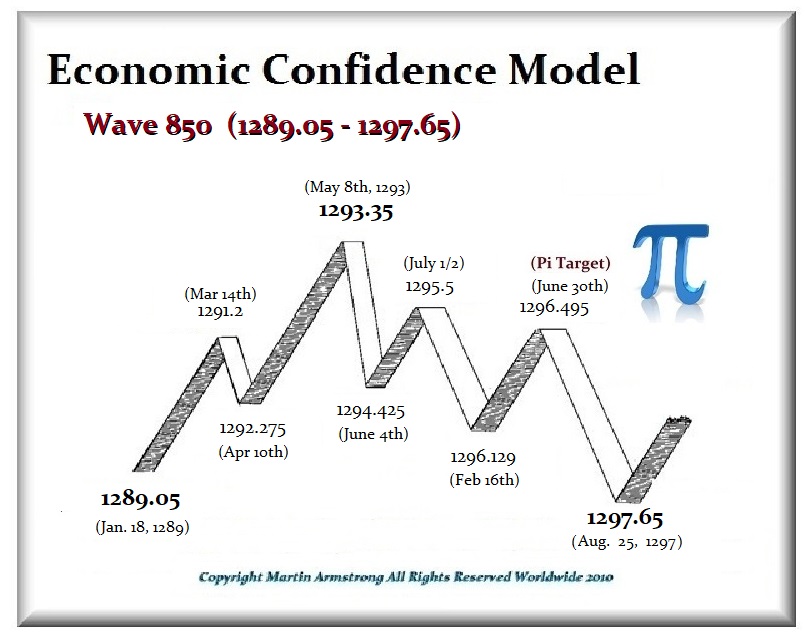
ANSWER: As the 13th century unfolded, the cost of endless Crusades burdened both the crowns of England and France. Throughout the remainder of the 13th century, a variety of Crusades were aimed not so much at toppling Muslim forces in the Holy Land but to combat any and all groups seen as enemies of the Christian faith. Edward began his reign in 1275 with heavy debts incurred from the Crusades.
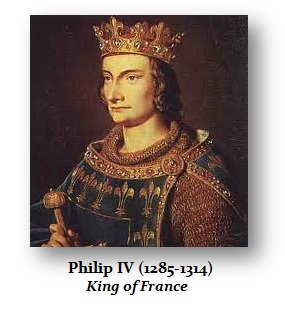
These endless wars resulted in the time of major sovereign defaults by Edward I of England and Philip IV of France. In 1275, Edward secured a financial monopoly and negotiated a grant of export duties on wool, woolfells, and hides that brought in an average of £10,000 a year. He then used this as collateral to borrow substantially from Italian bankers granting them the security of these customs revenues to fund his endless wars of aggression.

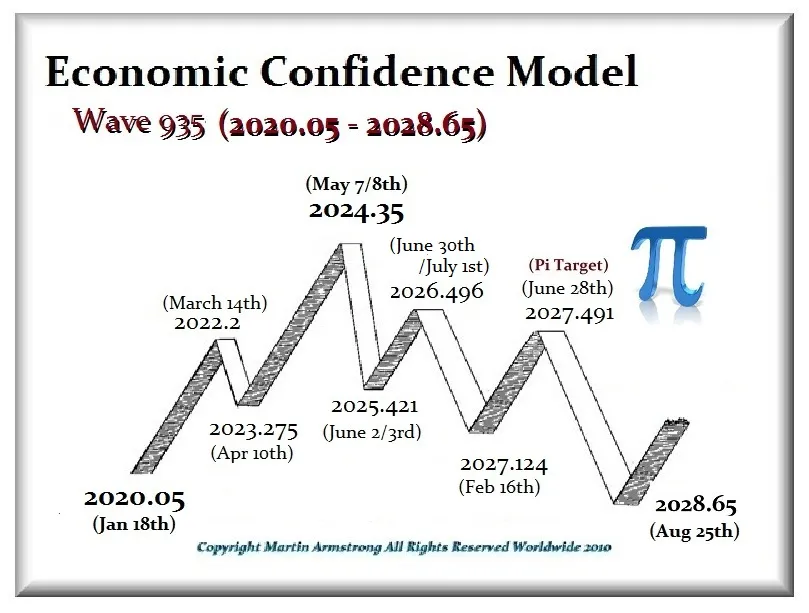
Edward imposed heavy taxes on the value of movable goods. At the beginning of this Wave 850, Edward defaulted on his loans from the English Jewish bankers, and then as 1290 began, to cover that default he expelled all of the Jews from England and confiscate all their property.

Moreover, this was the Edward Langshakes of the movie “Brave Heart” when in 1291 he attacked Scotland. As this 8.6-year Wave 850 peaked, Edward launched his very costly war against Philip IV (1295-1314) of France which lasted until the end of this 8.6-year wave came to an end in 1297.
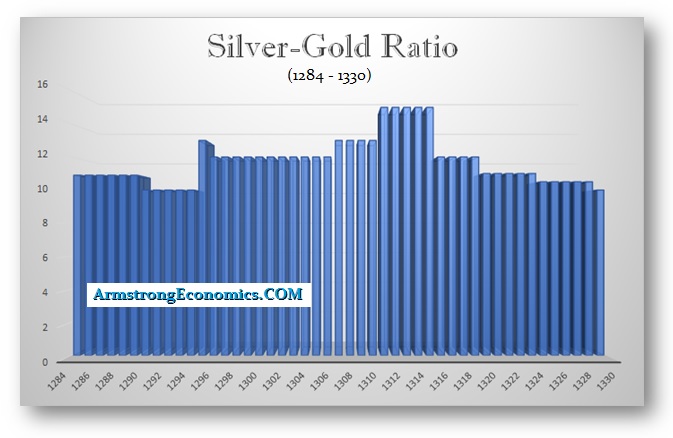
The Riccardi of Lucca was perhaps one of the major international merchant banking houses to emerge during the 13th century. The Riccardi established branches in Rome, Bordeaux, Paris, Flanders, London, York, and Dublin, Ireland. They engaged in trade with Edward I of England. Prior to 1272, the English kings were customers of the Italian merchant who had exotic imports as they were purchasing luxury goods and would use them to transfer money to Rome. With the outbreak of war against Philip IV in 1294, a major credit crunch and inflation erupted which impacted the entire international money markets throughout Europe at the time. The value of gold rose against silver from 10:1 to virtually 15:1, which was a monumental distortion of the European monetary system as a consequence of these endless wars.

Cash-strapped, Edward sought financial support from the Riccardi establishment but they refused to lend him any funds. In response, Edward seized all of Riccardi’s assets in England, effectively bankrupting them. The Riccardi had derived significant benefits in dealing with the English monarchy. They held contracts with special access to the English wool market. The Riccardi banking establishment was involved in about 50% of all the forward contracts with English wool producers, which were in effect futures contracts in the cash market. When Edward confiscated all the assets of the Riccardi, his action backfired. Nobody else would then deal with England in international money markets. This led Edward I to impose heavy levels of domestic taxation, which led to civil unrest. This led to a constitutional crisis of 1297.
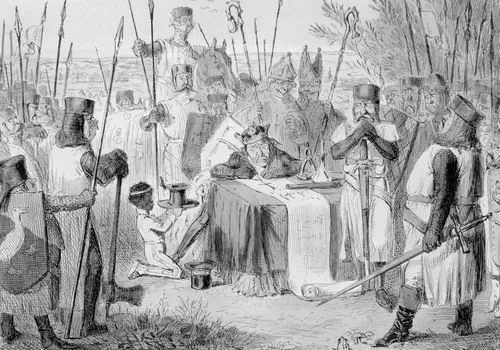
We all may know that Magna Carta established rights that were forced on King John on June 15th, 1215. After John’s death, the regency government of his young son, Henry III, reissued the document in 1216, but it removed some of its more radical content. This led to civil unrest and at the end of the war in 1217, it became part of the peace treaty when it acquired the name “Magna Carta.” Henry III was compelled to reissue the charter again in 1225 in exchange for a grant of new taxes. Edward I was his son who was then once more compelled to reaffirm the Magna Carta in 1297 at the end of the 8.6-year Wave 850. That is when Edward I was forced to confirm that the Magna Carta was England’s statute law. That is when it actually became England’s rule of law.
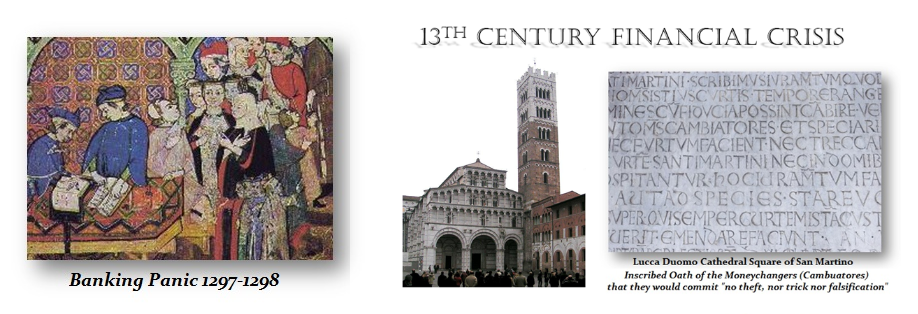
The Bonsignori bank was known as the Gran Tavola, which had become the most powerful of the Italian merchant banking firms throughout Europe between 1255 and 1298. The Gran Tavola was indeed the greatest bank of the 13th century with branches in Paris, Marseille, Genoa, Bologna, and Pisa in addition to the main office in Siena.
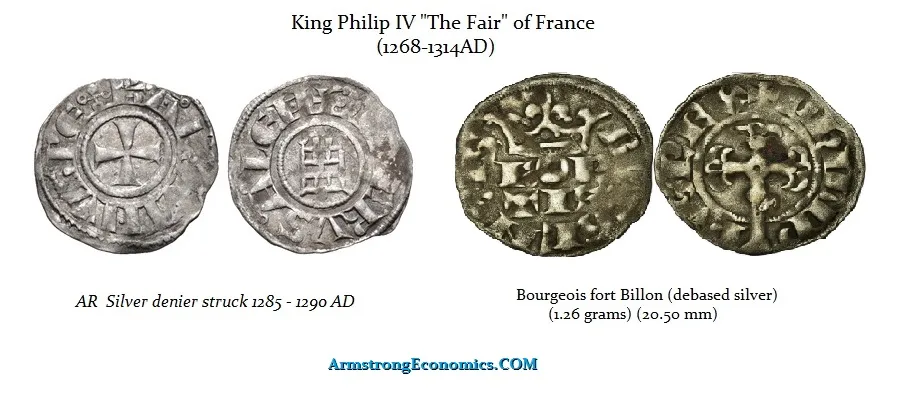
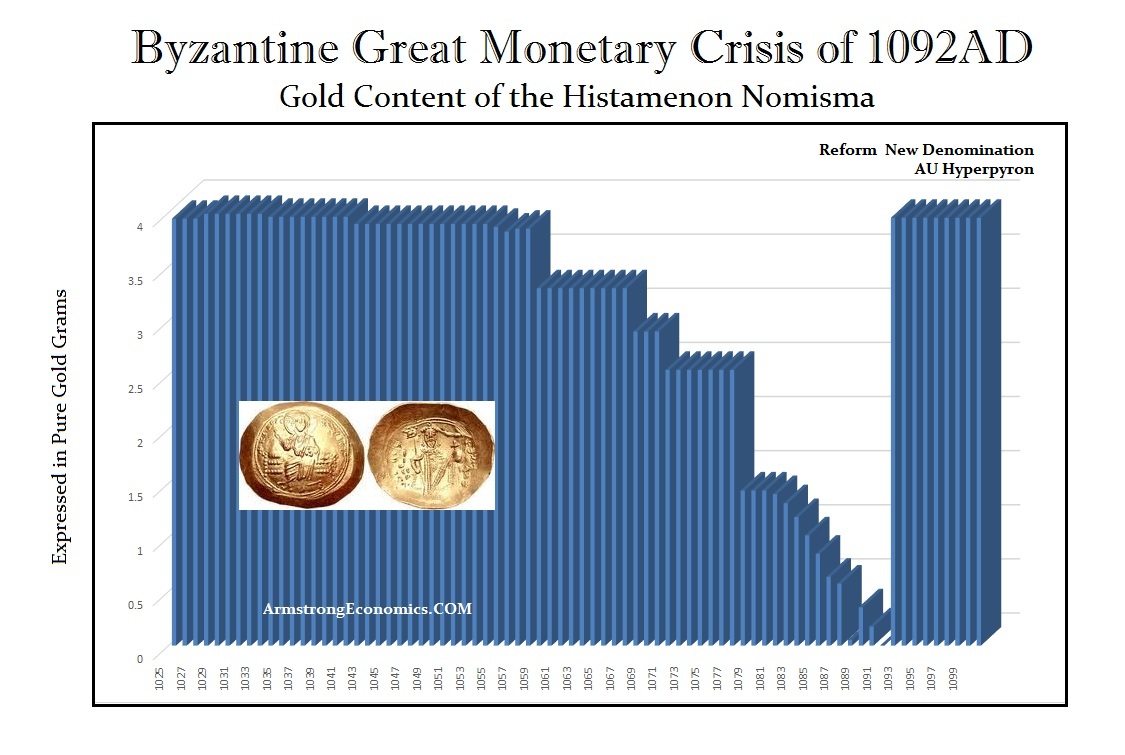
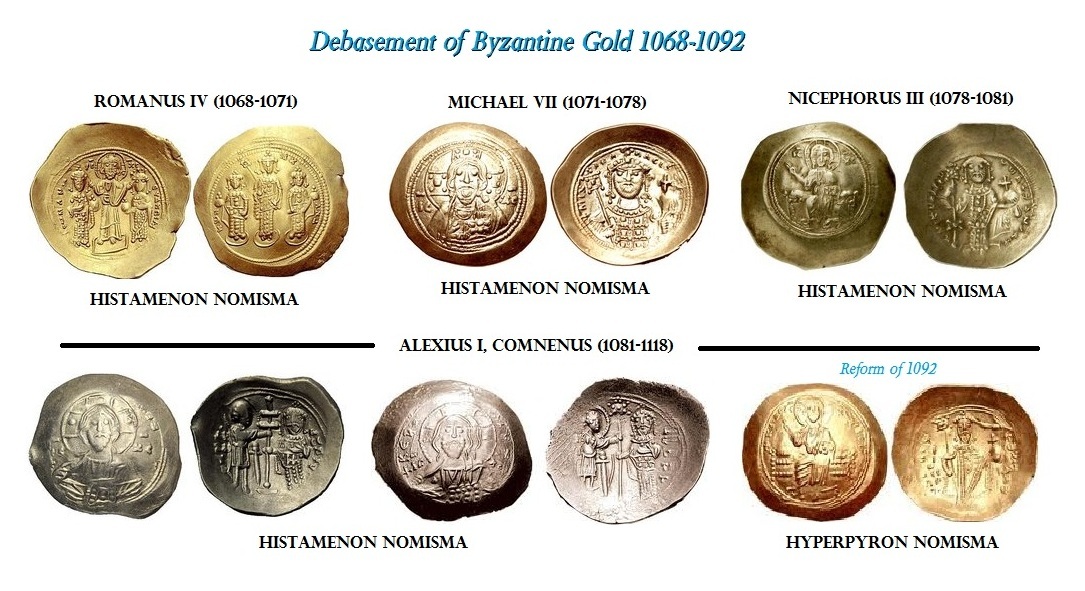
Philip IV of France was also strapped for funds. He chose the debasement of the coinage which was massive. Philip had no other course of action to meet the expenses of the war. He began as a massive debasement of the coinage. Silver began to migrate out of France.  This debasement only accelerated after 1298 when Philip IV confiscated all the assets Italian bank known as the Gran Tavola in France on claims that they owed him money, without netting anything with respect to his loans owed to them. This caused a major banking crisis in 1298 with the collapse of the institution which also held funds for the Papacy resulting in their loss of 80,000 gold florins. This was the first Banking Panic post-Dark Age. This confiscation of assets wiped out Siena and the city never again rose to the forefront of European commerce. By 1320, Siena was no longer a significant city in international commerce whatsoever which was a direct attack on the Papacy by Philip IV. This resulted in shifting the banking power to Florence.
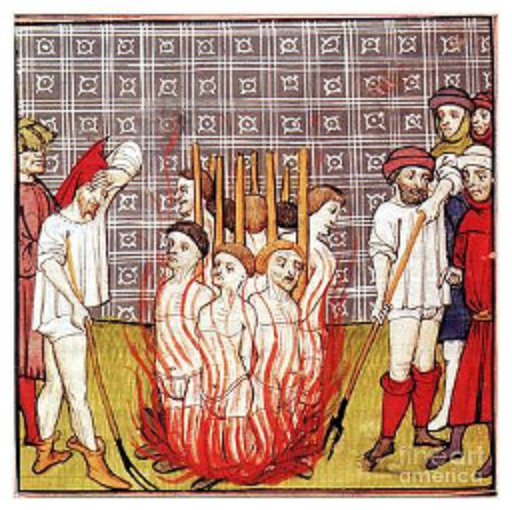
A full-blown financial panic unfolded as silver migrated overseas. People hoarded the old currency and by 1301 there was virtually no silver remaining in the open market in France. Currency depreciation let Philip cover the cost of the war but it destroyed the credit of France and that ultimately led to France seizing the Papacy and strip-mining all its assets moving the Church to Avignon where a French Pope was installed. They then seized all the assets of the  Knights Templar and burned all resistance alive. The Knights Templar were effectively an international transfer agent. If you were in France and needed to pay someone in Italy, you gave the money to the local office in France and they instructed the brank in Italy to pay. It was a 13th-century version of a wire transfer service. That is why the French crown seized the Knights and strip-mined all their wealth as well.

Obviously, this banking crisis of 1298 was far beyond anything most people would have read about in a financial crisis. This is what I mean when I warn that those in power will do WHATEVER it takes to retain power, and religion never means anything at the end of the day.

Categories: Banking Crisis
Tags: 12901301Banking CrisisCrusadesdebasementEdward IMagna CartaPhilip IVsilversovereign defaultswave 850

« Is Your Money Safe in a Regional Bank?

REGISTER FOR BLOG UPDATE ALERTS

Sending
BLOG CATEGORIES
PROMOTIONS

Institutional Service for Small Business

Instructional Videos

Socrates

Models and Methodologies

2019 World Economic Conferences

BLOG ARCHIVES

View All

©2023
Is Your Money Safe in a Regional Bank?


Armstrong Economics Blog/Banking Crisis Re-Posted Apr 25, 2023 by Martin Armstrong
People often ask if their money is safe in a regional bank. Yes—if you keep it under $250,000 to guarantee the FDIC insures those funds. Some clueless minds brainwashed into fighting the class warfare thought, “Oh well!” for people who had more than them in the bank and did not care if the Silicon Valley Bank or Signature Bank failed.

My phone did not stop ringing and the bankers wanted to know if they should cover ALL the deposits. I actually lost my voice, screaming, “YES YOU MUST COVER ALL THE DEPOSITS! ALL OF THEM!!!” Aside from the fact that no one deserves to lose their hard-earned money, the primary issue here is that failing to cover the deposits would have completely wiped out small businesses.

Small businesses comprise 70% of GDP and must be protected at all costs. They must park large sums in the bank to cover payroll to pay their employees and operational costs. Small businesses would come to a standstill and banks would fall like dominoes. Unemployment would spike and the entire economy would plummet. We would see a massive banking crisis if all small businesses went under. More banks will go broke, it is only a matter of time, but it is crucial that deposits are covered

What will Become Money Post-2032?


Armstrong Economics Blog/Ancient Economies Re-P osted Mar 29, 2023 by Martin Armstrong
QUESTION: Hello Martin,
Been reading your writings with keen interest for over 15 years now since while you were incarcerated.
My question is: The way you paint a picture of the past economies going back hundreds and thousands of years through the discovery of coinage hoards is brilliant. How will a future “Martin Armstrong” from say 500 to 1,000 years from now be able to utilize that methodology of discovering the history of this era when we’re largely a computer digital transaction society? (Especially if government-planned digital currency takes over?)
Thanks. Jerry S.

ANSWER: I know the crypto-people do not like my view that digital currency is entirely dependent upon the power grid and once money is in any official exchange, it will be subject to government regulation. Just look at Tik Tok. The government wants to ban it because they CANNOT get into the data and who is saying what. It has nothing to do with China. They are not interested if you paid the babysitter next door, but Congress is. They have backdoors into everything – not Tik Tok. That has become the hub for many threats to their form of society called the dreaded CONSERVATIVES.

Reading historical accounts of things would never provide the real picture. The coinage has been the breadcrumbs that lead to the truth. I can see the real level of debasement, and when put together with historical accounts, we can get a real picture of history. We must also respect that some periods are black holes and the coinage is what turns on the light.

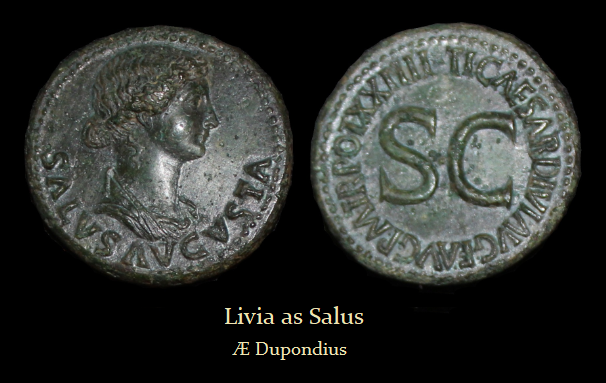
For example, it is the coinage that enables us to confirm much of history and I believe we will see the future follow the past. The wife of Augustus, Livia, the first empress of Rome, was a very powerful woman. The real power behind the thrown. I suggest watching the series – Domina. It is far better than any fictional story. It was his mother, Livia, who pushed him to be Emperor.

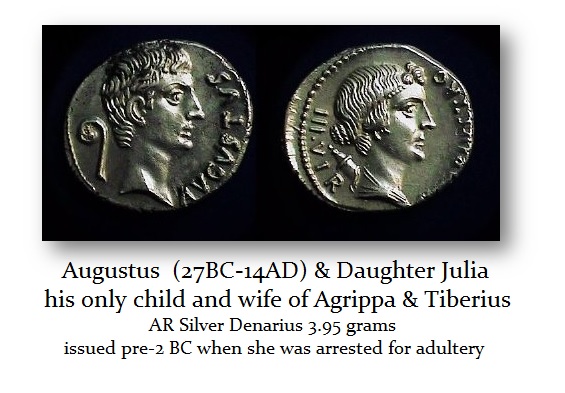
Livia was renowned for her intelligence but was also one of the most beautiful women in Rome. Tiberius was not her favorite – that was his brother Drusus. Tiberius had a son with his first wife Vipsania who was born in 14BC. Livia compelled Tiberius to marry Augustus’ daughter Julia as a way to the throne. Augustus was not fond of Tiberius for he was simply unsocial. His marriage to Julia was like a mixture of oil and water. She sought sexual parties and ignored Tiberius and was finally exiled by her father.

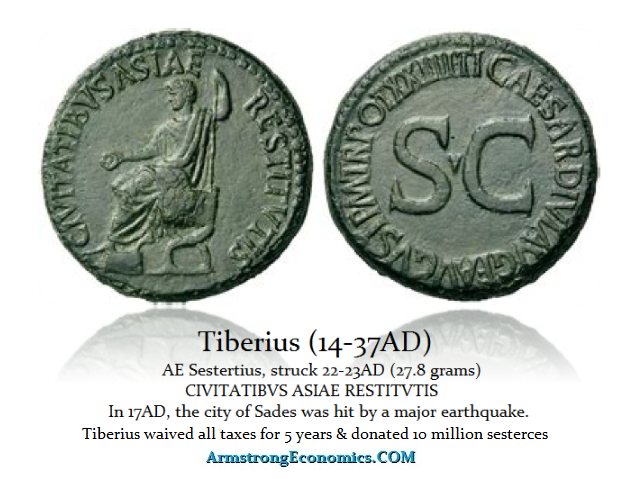
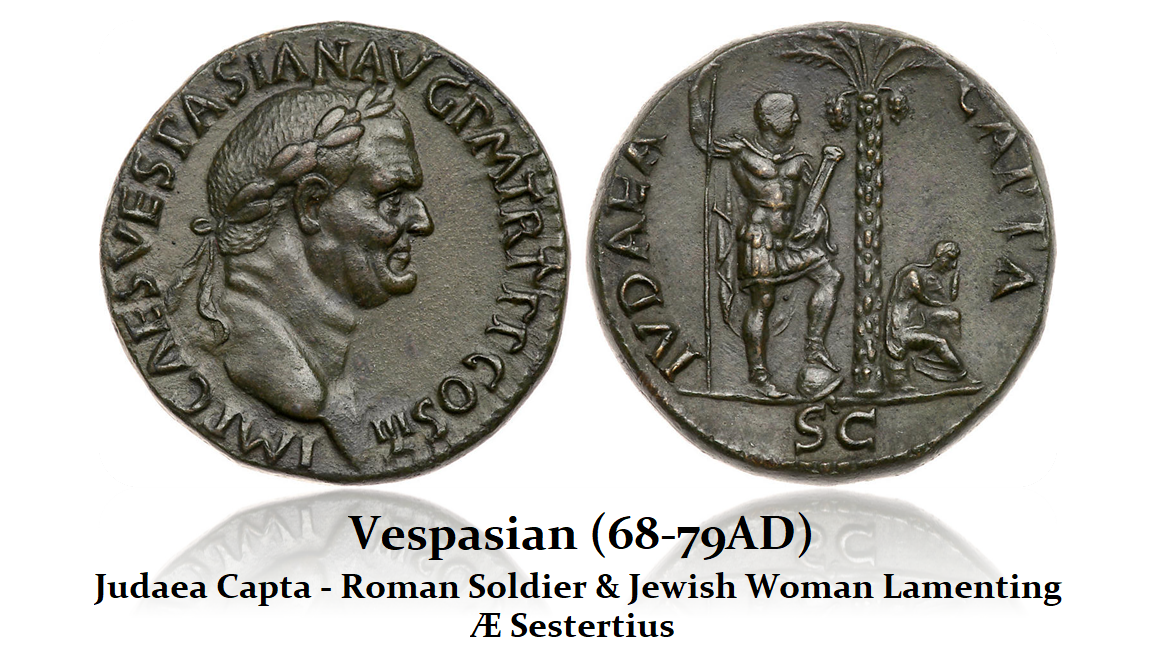
Frome the coinage, we can confirm that Tiberius responded to a major earthquake that destroyed much of Asia, modern-day Turkey. Tiberius issued coins for the aid of Asia. We also know that he waived all taxes for 5 years and donated 10 million sesterces for relief. What politicians would ever system taxes as a tool of relief today?

Augustus’ heir was to be Germanicus (15BC-19AD) who was the son of Nero Claudius Drusus, the younger brother of Tiberius, and Antonia, who was the daughter of Mark Antony and Augustus’ sister Octavia. He was married to Agrippina, Sr, who was the daughter of Agrippa and Augustus’ daughter Julia. Agrippina seems to have been the independent-minded woman who blamed Livia for the death of her husband.

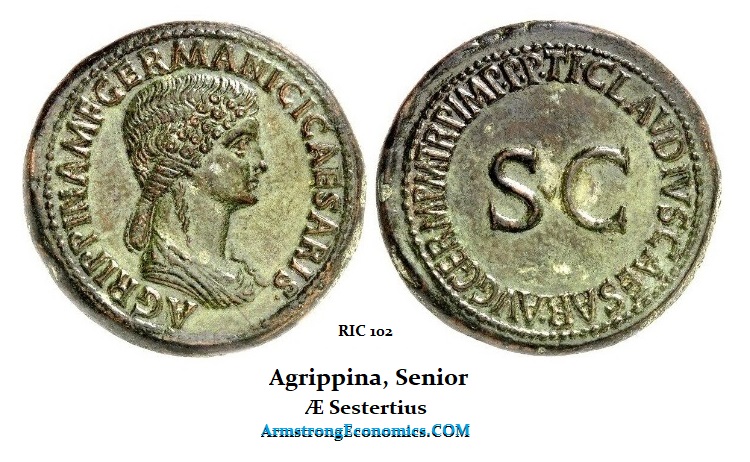
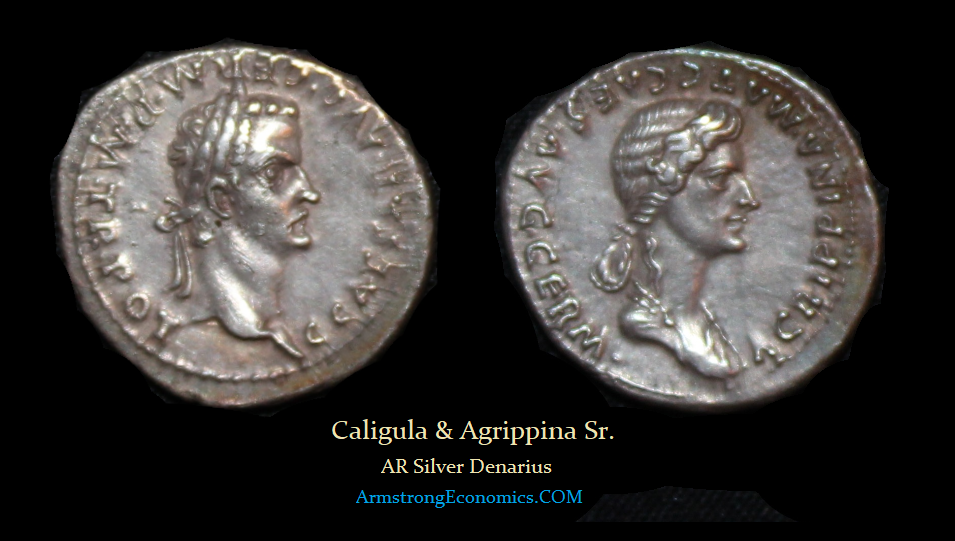
Agrippina, Sr. was such a disruption politically that Tiberius was compelled to banish her like her mother in 29AD where she eventually died of starvation in 33AD. Her son, Caligula, seems to have inherited her insanity, and her daughter Agrippina, Jr, as well. She is actually the first woman on Roman coinage displaying her name. Livia’s portrait would be used but always styled as some goddess.

Of course, her son Caligula has warranted films exclusively devoted to his. He is famous for insulting the Senators by making his horse a senator. Caligula was born in 12 AD. He was named as Tiberius’ heir in 37AD and it has been long suspected that Caligula smothered Tiberius to death to take the throne. He was notorious for his depravity and cruelty. He was assassinated by the Praetorian Guard on January 24th, 41AD.

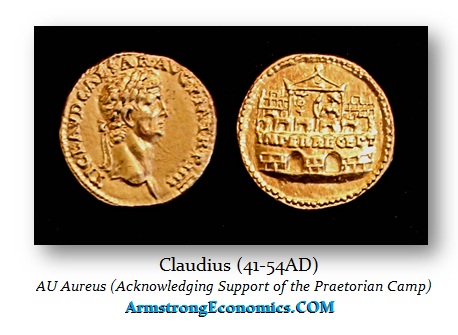
The Praetorian Guard needed an emperor or there was no point in them being the Praetorian Guard. They turned to Claudius and made him emperor. You can see from his coinage the image of the Praetorian Guard camp on the reverse announcing that he was made emperor by the Praetorians.

There is a great series of these events done years ago by the BBC. It was based on the book I Claudius and the series bares the same name – I. Cludius. That too is a worthwhile series that was produced decades ago.

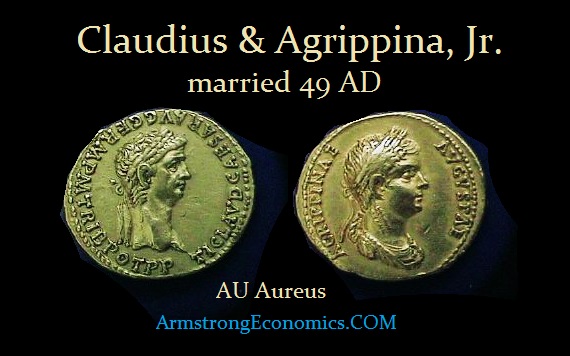
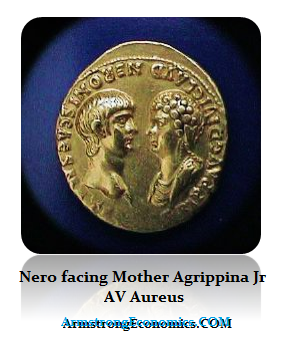
In fact, Agrippina Jr, sister of Caligula, was not only the mother of Nero who ordered her killed for her dominance, but she married he uncle Claudius to secure the throne for Nero. Once again, we find her portrait on coins alongside her son, Nero, which also reflected her dominance and effective rule of the empire. Some have likened her to Hillary Clinton for her cunning and effective rule behind the curtain.

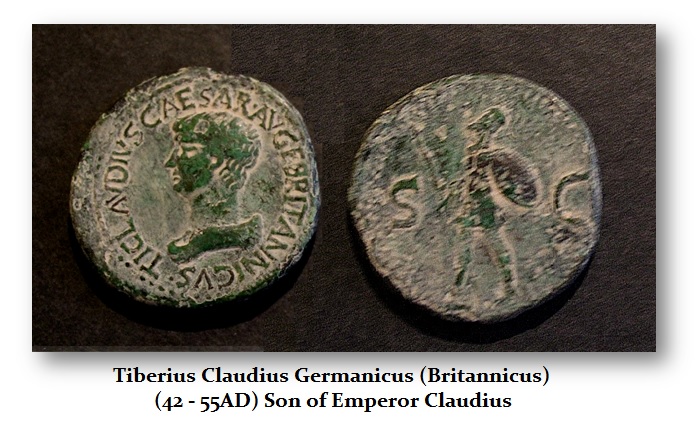
To ensure Nero would become Claudius’ heir, she poisoned Claudius’ son – Britanicus. It shows what a bad apple can do to the whole lot. Many have pointed to the fact that it was the dominance and cunning of the women that brought down the Julio-Claudian Dynasty.

Nevertheless, the coinage not merely confirms history, but also provides a window through time for us to see how human nature never changes, and as such, the future becomes merely a repetition of human contrivances.

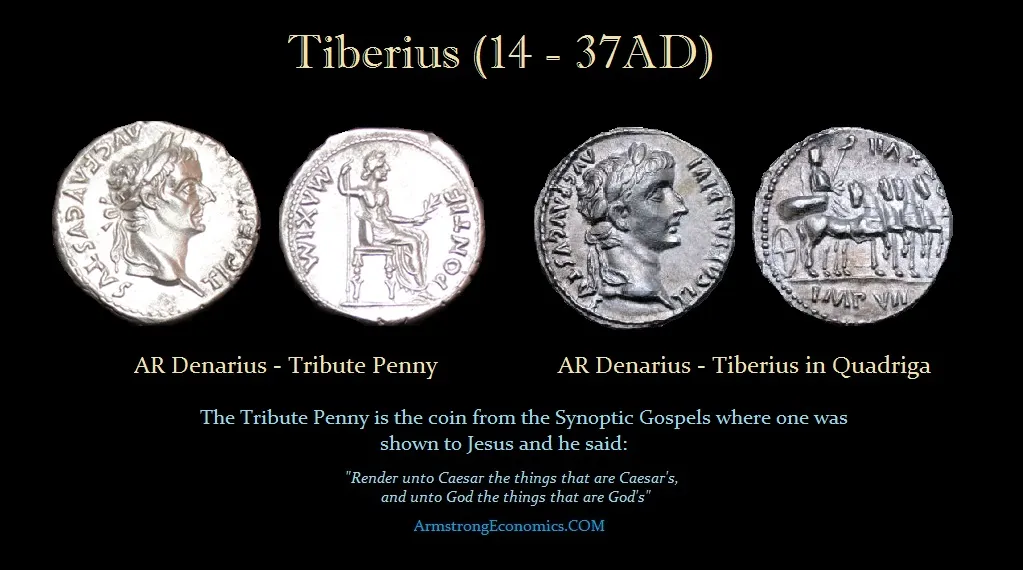
To answer the question if future historians will be able to do what I have done if the currency is eliminated and we have just electronic digital currency, I believe the answer lies in the past. We can see something rather astonishing right here during the reign of Tiberius (14-37AD).

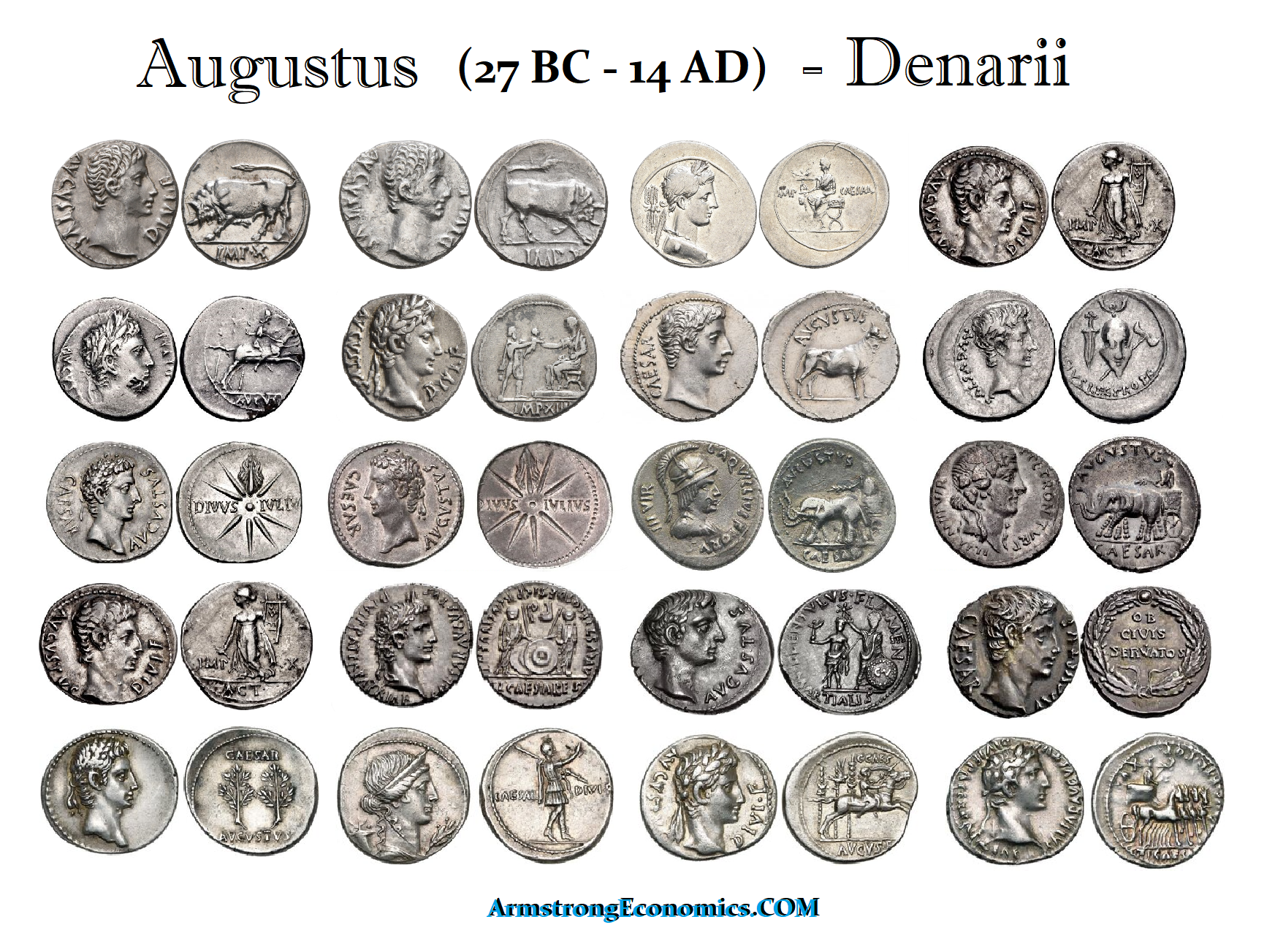
Augustus/Octavian (heir to Julius Caesar) became the first emperor of Rome following the defeat of Cleopatra and Mark Antony in 30 BC. He was granted the title Augustus in 27BC by the Senate for saving Rome from the proxy war of Cleopatra who used Mark Antony to try to conquer Rome. However, because he was the first emperor, it appears that he blanked the empire with coinage to justify his position as emperor, not king, which was really the same thing. There are over 500 different silver denarii types. I have never even heard of a collector assembling each type.

Against that backdrop, being indeed a reluctant emperor and forced into an unhappy marriage, it is understandable that being an unsocial workaholic, the circumstances most likely drove Tiberius deeper into seclusion. He rarely left Rome. In fact, he would not even attend the gladiator games. This is the extent of his coinage – two types. That’s it! Instead of the proliferation of coinage under Augustus, spending was curtailed and we can determine that from the coinage, not contemporary accounts. This led to a SHORTAGE of money, and in such a recession. That became the Financial Panic in 33AD.

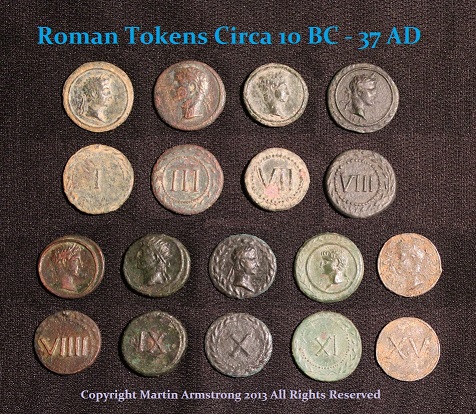
Because of the shortage of money, this is where we find the first time that the private sector began to issue its own coinage. Some have claimed they were some sort of token. But they are confined to this period of Tiberius where there was a Financial Panic and a shortage of coinage compared to the reign of Augustus.

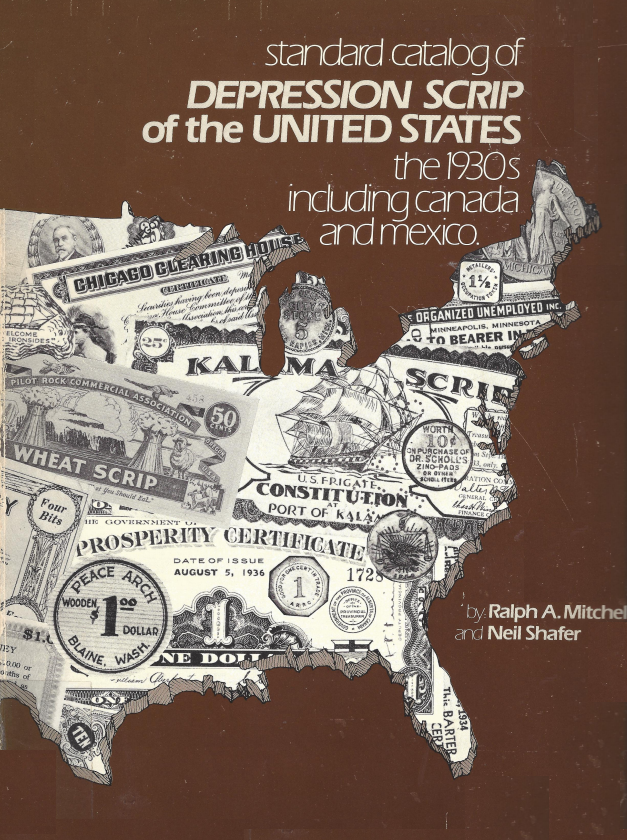
During the Great Depression, because there too the austerity measures of the government created a shortage of currency. Thus, over 200 cities in the United States began to issue their own currency for local use.

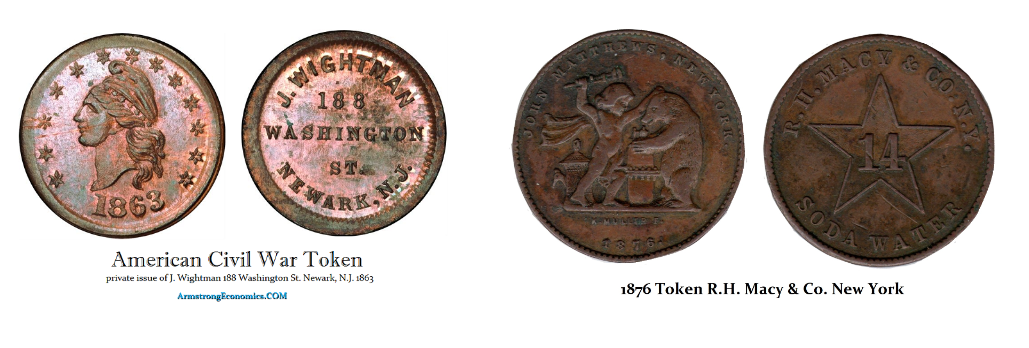
Likewise, during the Civil War, there was also a shortage of money There is a whole array of private coinage during that event. Then there was the hard time that followed the Panic of 1837, Again we have private coinage surfacing. The same again took place with the Panic of 1873.

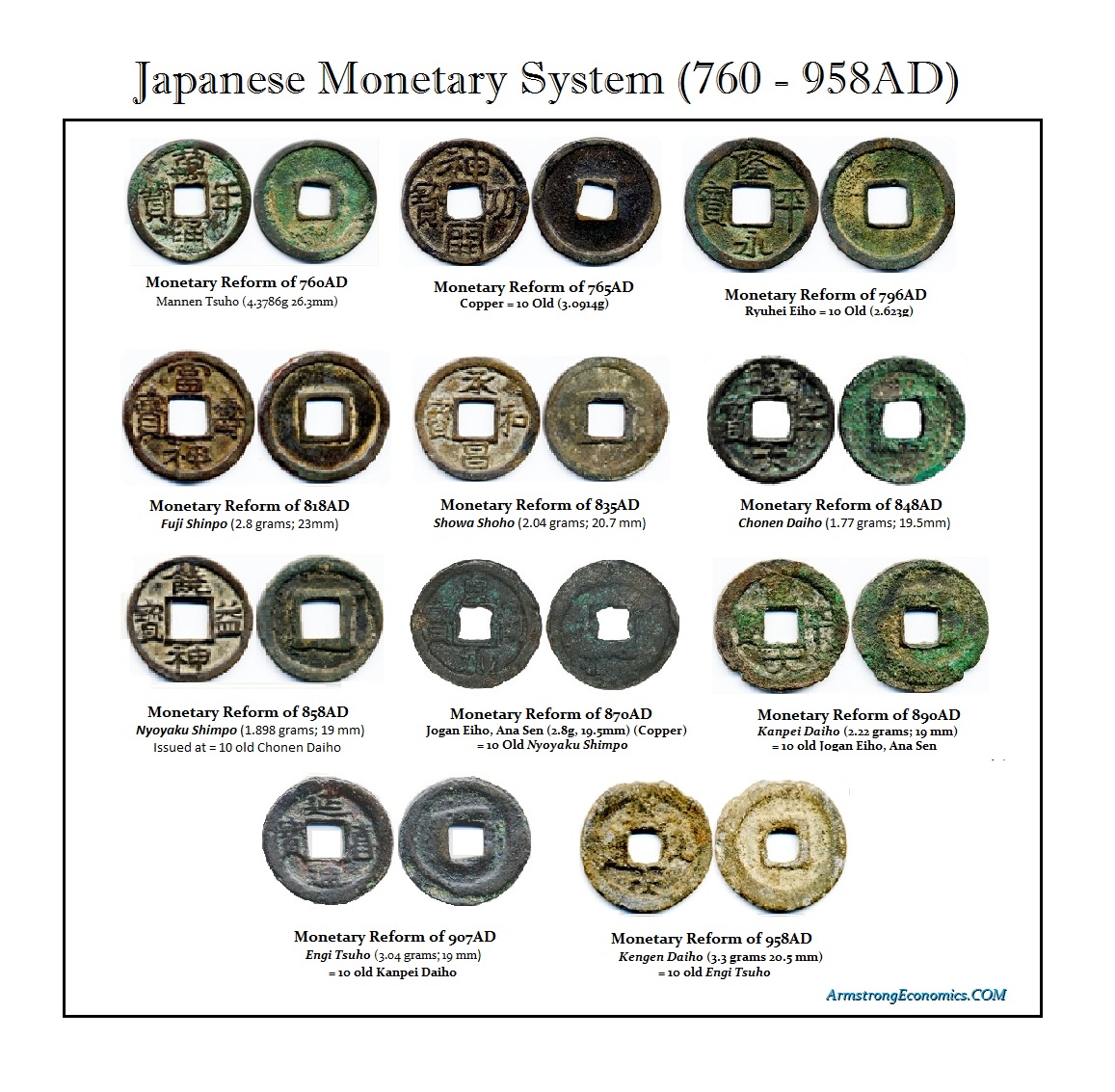
In Japan, because of the corruption of the government always devaluing the currency of the previous emperor, the Japanese finally just stopped accepting the coinage of their own government. The economy reverted to one of barter and they used the coinage of China. Japan lost the authority to even issue coinage for 600 years until the Meiji Era.

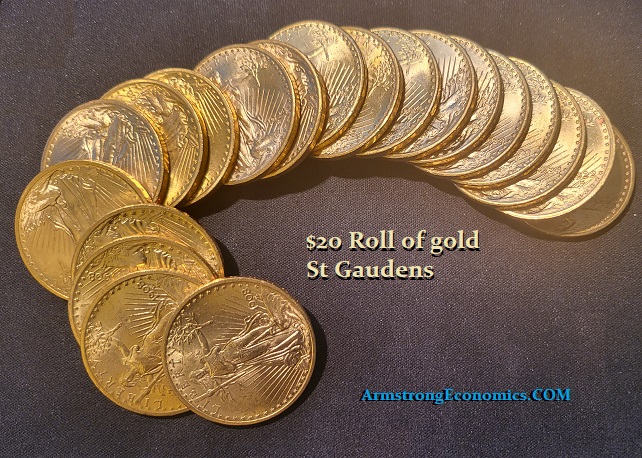
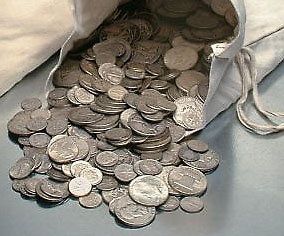
Cryptocurrency will fade with the collapse of governments. It will be too dependent on a unified power grid. If history is any guide, we will return to a barter system combined with perhaps old identifiable coinage that the average person will recognize. That is one reason why I do not recommend bars of silver or gold, but the old coinage. Bags of pre-1965 silver coins in the US or similar in Europe and Canada where the average person can look at a date and accept it whereas they cannot tell the difference between a var of silver or nickel.

Do not make the mistake of judging others by yourself. You may know was a bar of silver is, but that will not help you if the other person does not. There are videos on YouTube where people are offered a silver bar or a chocolate bar and they take the chocolate. Not everyone knows what you may know. Keep that in mind.

So at the end of the day, we will have to rebuild society from the ground up post-2032. A currency need not be backed by anything. Its value is ALWAYS based upon a belief system. The same is true with gold and silver. They had no utility value, only as jewelry from the outset. They were valued because at first, the kings reserved gold only for their adornment.

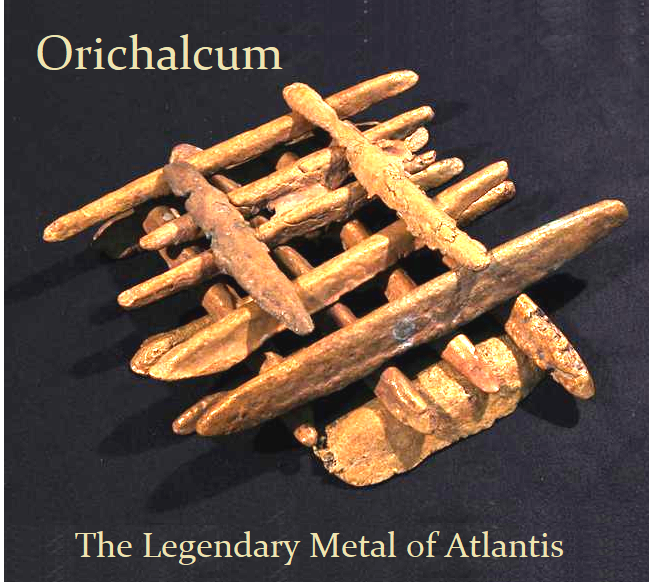
Orichalcum, brass, is the legendary metal mentioned in the story of Atlantis in the Critias of Plato. In fact, orichalcum was considered second only to gold in value and it held a greater value than even silver. It was said to have been mined in many parts of Atlantis in ancient times. These ingots of orichalcum were discovered in a shipwreck that had sunk 2,600 years ago, off the coast of Gela in southern Sicily. The ingots are an alloy consisting of 75–80% copper, 15–20% zinc, and smaller percentages of nickel, lead, and iron. In other words, they are brass. Because the color is closer to gold, this was highly prized.

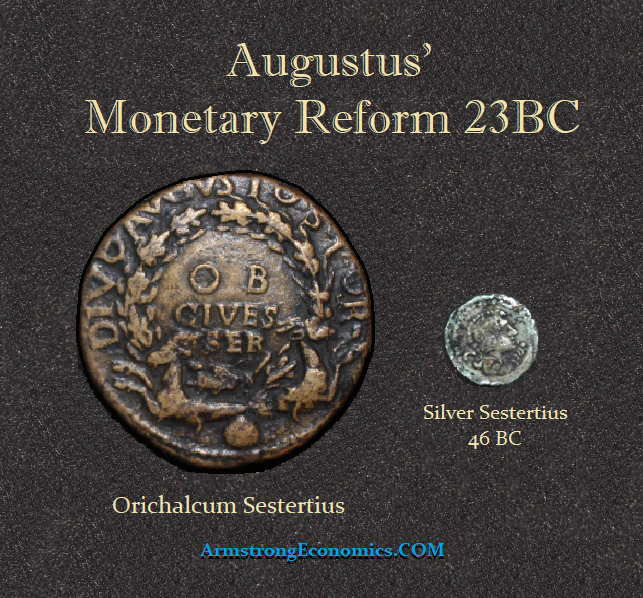
The Greeks rarely used orichalcum for coinage in the Hellenistic world. It was used experimentally by Romans under the reigns of Octavian and Mark Antony. Where we begin to see orichalcum used in the coinage consistently is dated to the monetary reform of Augustus (23 BC). It was then that he introduced sestertii and dupondii were struck in orichalcum (Cu-Zn alloy) rather than silver and bronze.  The sestertius of the Republican era was a tiny silver coin of about 0.7 grams. Later, the monetary reform Nero made during 63–64 AD,  introduced the use of orichalcum to the denomination of the assemis, and quadrantes.
Following the Civil War with the death of Nero, orichalcum was replaced in the coinage with bronze. It is highly likely that someone figured out how to make orichalcum and its premium just collapsed. Counterfeiters had long figured out how to mix wrap a coin in silver and strike it to make it appear it was silver, but also to use chemicals to cause the silver to appear on the surface. We cannot rule out that someone had figured out how to make brass and thus it lost its premium.

The value of any currency is entirely based on belief. Once the ancients figured out that orichalcum was just an alloy and could be made, then it no longer seems as more valuable than silver. Even cryptocurrency is worthless. Its entire valuation is simply based that others believe it has some value. Money at its most basic core during a financial crisis is predicated upon its utility value. Hence, in Japan, bags of rice became money. It is unlikely that even cryptocurrency will survive the transition post-2032. Precious metals ONLY in the form of some recognizable coin will be accepted like the Japanese accepted Chinese coins. Barter will return as it always has. That will most likely be in the form of food.

Interview: The Financial Collapse is GUARANTEED – What Now?


Armstrong Economics Blog/Armstrong in the Media Re-Posted Mar 25, 2023 by Martin Armstrong
Watch the video above or click here to watch my latest interview with Maria Zeee: “The Financial Collapse is GUARANTEED – What Now?”

Credit Suisse Banking Crisis


Armstrong Economics Blog/Banking Crisis Re-Posted Mar 24, 2023 by Martin Armstrong

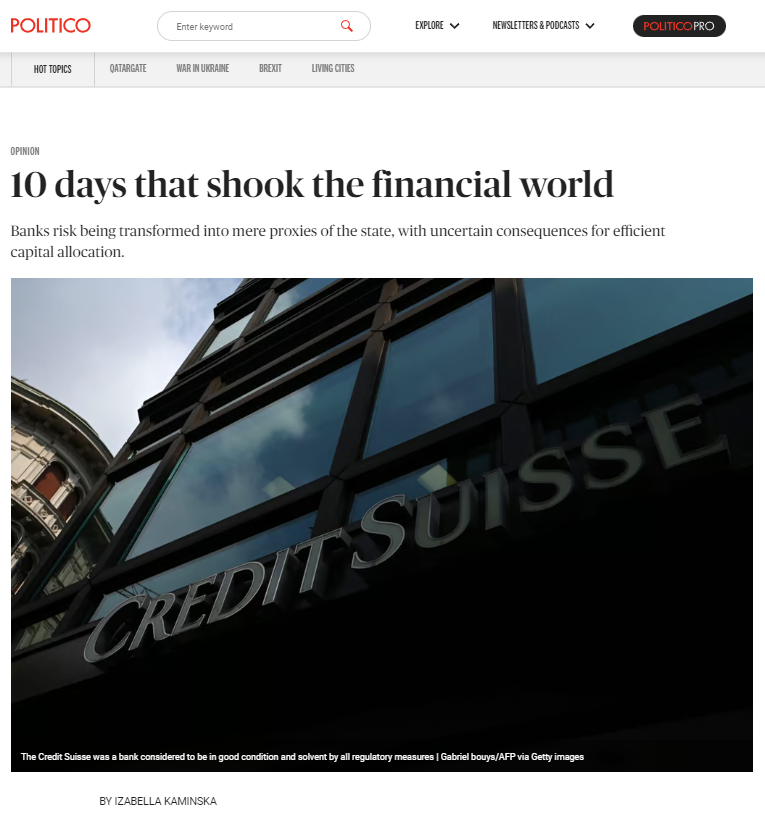
It is refreshing when you actually find a journalist who is honest and is not being included by the Neocons to put out their propaganda. Her review of Credit Suisse is a worthwhile read. Especially when this is not over yet and the winds of finance are now turning toward questioning Deutsche Bank.

Izabella Kaminska is senior finance editor at POLITICO Europe.

Over the span of 10 days, the global financial system was once again shaken.

The time frame between the collapse of Californian lender Silicon Valley Bank, America’s 16th largest bank, and that of the 167-year-old lender Credit Suisse was approximately just that — 10 days.

And as we witness the fallout, so far it appears contained. Stock markets are up, bank stocks seem stabilized and government bonds are in high demand. Officials reassure ad nauseam that the financial system remains strong and stable.

But the truth is, even if so, what happened in this period of time has changed the financial system forever — and worryingly, most people haven’t even noticed.

Governments and central banks would have you believe that in both cases, private sector solutions were found to resolve the failures. No taxpayer funds were used.

But that is likely not true.

In the United States, growing calls from the country’s top billionaires and hedge fund bosses to guarantee the full extent of customer deposits would, if acted on, deliver a backstop that must be underwritten by public funds. That’s the case even if costs are distributed among whatever healthy banks remain later. The sums involved are eye-watering — by some measures up to $17 trillion of unfunded liabilities.

If the rule is passed — and all indications are that it will be — this would finally make the implicit explicit: that the financial system was never really rescued following the 2008 financial crisis but merely put on life-support. And that has now failed, which means socialization of the losses beckons.

Over in Europe, things are potentially worse. This time, it wasn’t the storming of the Winter Palace Hotel in Gstadt that seized the means of financing but something far more mundane: an untidy bank resolution for Credit Suisse, which relies far too heavily for comfort on Swiss National Bank (SNB) guarantees.

As one former top British central banker told POLITICO, “They could have used bail-in; it would have worked; and banking would become part of a capitalist market economy” — a reference to the loss-absorbing processes regulators came up with after 2008 to ensure bank failures didn’t have to draw on public resources ever again. “The only stable equilibrium is one where bank resolution works, or socialism,” he added.

But the resolution didn’t work. And investors are belatedly realizing this.

Key to this reality is that Credit Suisse was a bank considered to be in good condition and solvent by all regulatory measures. As one bank analyst told POLITICO, going by the assets, you would never have seen the problem coming. Even the SNB and financial markets regulator FINMA said so as recently as last week.

The SVB Private logo is displayed on an ATM outside of a Silicon Valley Bank branch in Santa Monica, California | Patrick Fallon/AFP via Getty images

So were the regulators lying? Or is the accounting somehow fundamentally broken?

What we know for sure is that markets questioned the numbers, and this was evidenced by a run on the bank’s deposits, equity and bonds. And the discrepancy poses a big problem going forward, as it knocks trust in the accounting of all similarly assessed banks, which, thanks to international accounting standards, means pretty much all of them.

Credit Suisse’s sale to domestic rival UBS at cents on the dollar of what regulators claim the underlying assets are worth presents another problem too. If similar assets are lurking in UBS’ own balance sheet — and chances are that is the case, as the assets in question are probably government bonds — they might have to be written down to a similar degree. This is probably why UBS needed the guarantee from the SNB to be doubled to 100 billion Swiss francs to do the deal.

In light of this, Switzerland now faces an even larger issue: If UBS were to become stressed — and it very well could due to this discrepancy — there’s no private sector pathway for resolution left. The country now only has one major bank and, thus, only two possible pathways to deal with a failure — nationalization or acquisition by a foreign buyer with enough cash to keep the valuation of all the consolidated assets at a price that brings everything back to par. And there are few of those in the Western hemisphere.

With a full foreign acquisition off the table due to global discord, this leaves only an unthinkable solution for the home of Swiss private banking — the dawn of a type of finance more commonly seen in communist countries, where banks are directed by the state to allocate funds to activities they prioritize. Combined with a central bank digital currency, this would reduce banks to mere proxies of the state, with uncertain consequences for efficient capital allocation and inflation.

How things would unfold from then on is unclear. The only thing we can be sure of is that nothing in banking, or capitalism, may ever be the same again.

US National Debt – A Different Perspective


Armstrong Economics Blog/Uncategorized Re-Posted Mar 24, 2023 by Martin Armstrong

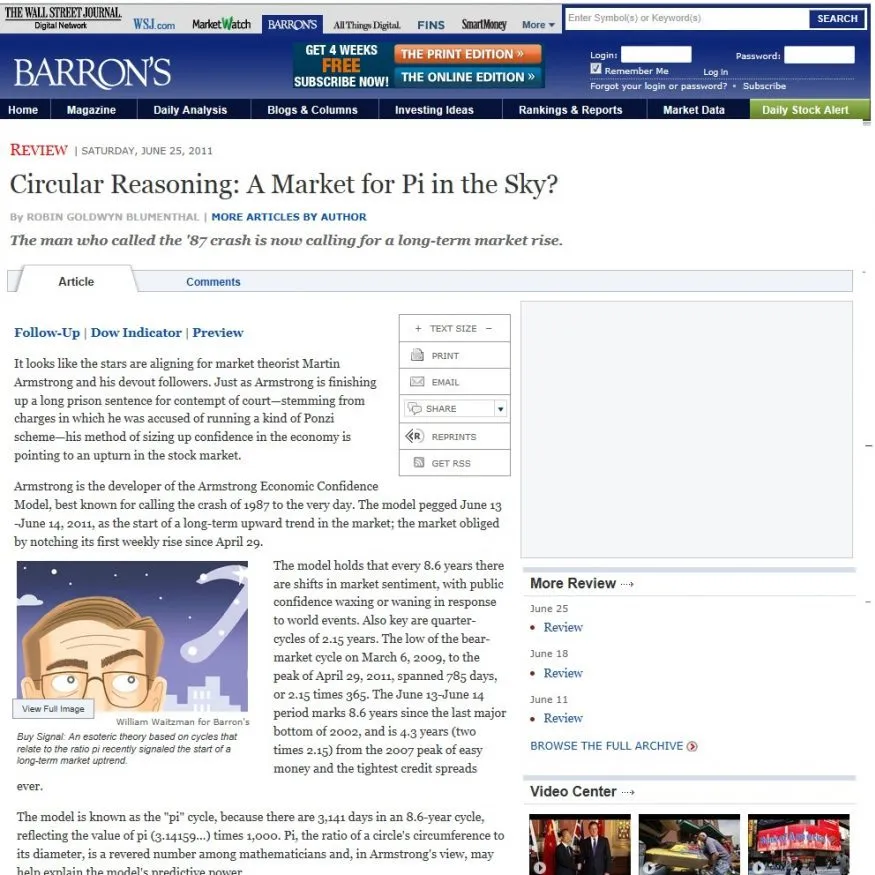
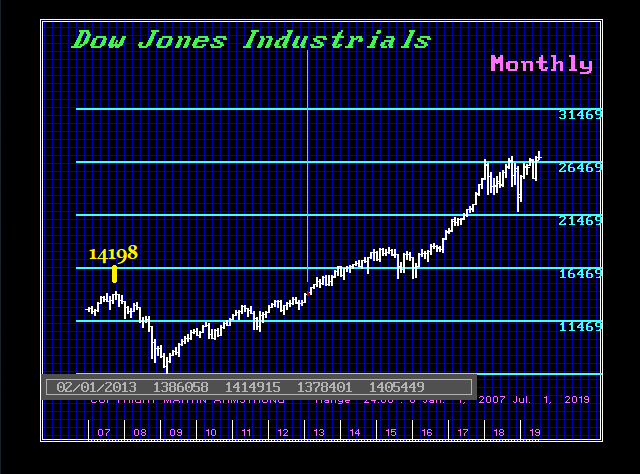
In 2010, Barron’s wrote a piece on me effectively laughing at my forecast that the share market would rally to new highs. What seems to inevitably unfold is this notion that whatever the event might be in motion, the mere thought of a reversal in trend appears impossible. When the press disagrees with Socrates, I know it will be the press who is wrong. And because they end up being wrong, of course, they cannot print a retraction so they will just pretend you do not exist rather than admit – Sorry, we were wrong. The Dow made that new high above 2007 by February 2013. That was 64 months from the October 2007 high.

I have been in the game for many years. With each event, it appears to be like Groundhog Day. They pop their heads out and declare they do not see their shadow, so the entire world will disintegrate and that is always based upon opinion. It is never backed by real analysis. Just the standard human trait of assuming whatever trend is in motion, will remain in motion.

Being an institutional adviser, I have never had that luxury. We have had to deal with some of the biggest portfolios in the world. They want accurate forecasting, and it has to be long-term – not day trading. They are not interested in the typical headlines of doom and gloom that the press love to print with every financial event simply to get readership. That is all they care about. It has been the financial version of the fake news.

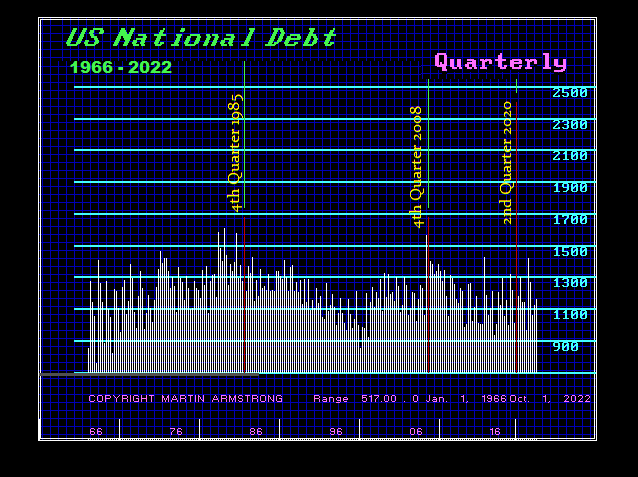
When we step back and look at this favorite fundamental that people beat to death to predict the end of the world, the national debt, and the collapse of the dollar. Little did they know that the increase in National Debt during the 2007-2009 Financial Crisis was supposed to bring down the sky and end the existence of the dollar. We can see the sharp rise in debt simply made a double top with the Financial Crisis of 1985.

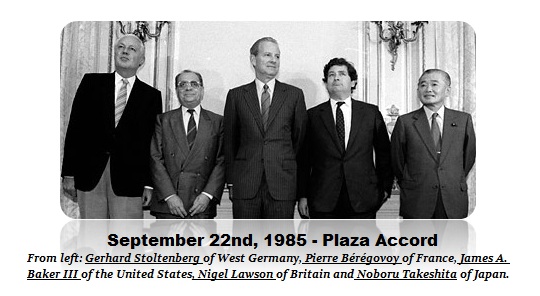
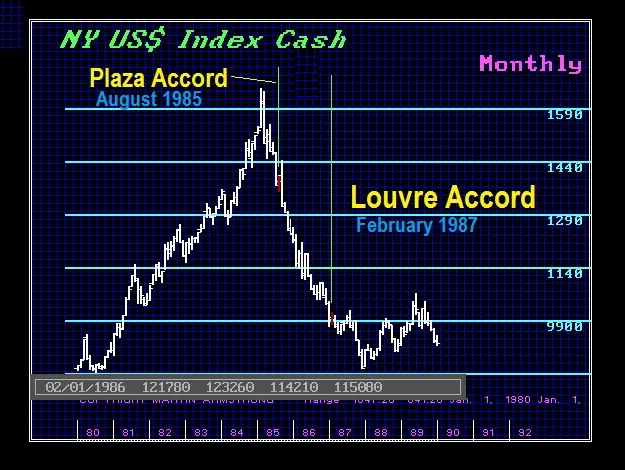
It was that previous 1985 Financial Crisis that set in motion the Plaza Accord which brought together the central banks creating what was then the G5 – now G20. Of course, like every government intervention, the side effect was the 1987 Crash and their attempt to reverse their directive at the Plaza Accord became the Louve Accord. When the traders saw that failed, the collapse in confidence led to the 1987 Crash.

It has always been a CONFIDENCE game as I pointed out with the 1933 Banking Holiday previously. In this case, the failure of the Louvre Accord which came out and said the dollar had fallen enough, once new lows in the dollar unfolded and the central banks could not stop the decline, led to financial panic by 1987 which manifested in the 1987 Crash.

This chart shows the quarterly change in the National Debt since 1966, Here you can see the 1985 and 2008 Financial Crises were on par. Neither one ended the dollar no less the world economy. So when I warned the share market would rally and make new highs and Barron’s laughed in 2010, I said the same thing after the 1987 Crash and people laughed.

In fact, on the very day of the low, I said this was it and that we would rally back to new highs by 1989. That was perfect and the market responded to the Economic Confidence Model (ECM) which has been published back in 1979. This was more than simply forecasting the 1987 Crash and the very day of the low. It clearly established that the ECM had revealed that there was a secret cycle behind the appearance of chaos even in economics.

Larry Edelson was actually a competitor at the time. But Larry respected that the forecast from the model was far beyond what people would ever expect. If we are ever going to advance as a society, we have to stop the bullshit and understand HOW markets trade and WHY. Larry did that. He understood that the model was something larger than just personal opinion.

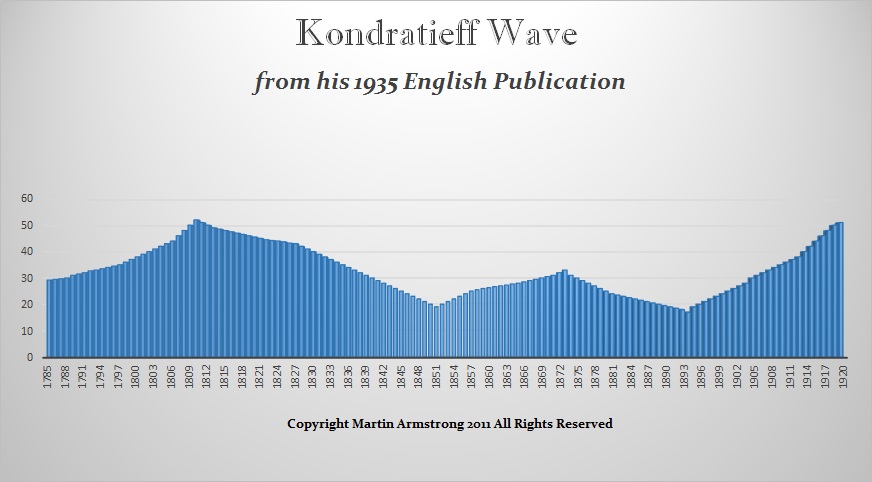
Even those claiming to be using the K-Wave cannot make real forecasts. The basis of Kondratieff’s argument came from his empirical study of the economic performance of the USA, England, France, and Germany between 1790 and 1920. Kondratieff took the wholesale price levels, interest rates, and production and consumption of coal, pig iron, and lead for each economy. He then sought to smooth the data using an averaging mathematical approach of nine years to eliminate the trend as well as shorter waves. Kondratieff thus arrived at his long-wave theory suggesting that the economic process was a process of continuous waves of boom and bust.

Kondratieff’s work was compelling and contributed greatly to the Austrian School of Economics that first began to develop the concept of a Business Cycle. The general central principle of the Austrian Business Cycle Theory is concerned with a period of sustained low-interest rates and excessive credit creation resulting in a volatile and unstable imbalance between saving and investment. Within this context, the theory supposes that the Business Cycle unfolds whereby low rates of interest tend to stimulate borrowing from the banking sector and thus then result in the expansion of the money supply that causes an unsustainable credit ­source boom which leads to a diminished opportunity for investment by competition.

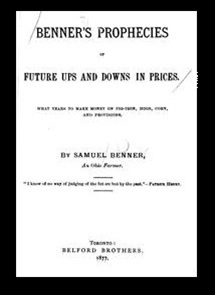
Benner

Here is a chart of the business cycle that was created by a farmer named Samuel Benner. Benner based his work on Sunspots, which actually incorporated solar maximum and minimum that today’s Climate Change zealots refuse to consider. Nevertheless, someone manipulated Brenner’s work and created a chart to try to influence society handing it in with a wild story to the Wall Street Journal published this cycle on February 2nd, 1932, when the market bottomed in July 1932. Still, nobody knew who had investigated this phenomenon in 1932.

WSJ1933

When I was doing my own research reading all the newspapers to understand how events unfolded, I came across this chart. I found it interesting that during the Great Depression people were reaching out and some began to embrace cyclical ideas. The problem with both Kondratiff and Brenner was that the period they used to develop their cycles was the 19th century because the real Industrial Revolution was unfolding and in the 1850s, 70% of the civil workforce were all in agriculture. Consequently, if you constructed a model based entirely upon one sector, it would work only as long as that sector was the top dog.

Being a historian buff, it quickly hit me that NOTHING remains constant and that the economy will ALWAYS evolve, mature, and then crash and burn. Where agriculture was 70% of the workforce in 18590, it fell to 40% by 1900, and then down to 3% by 1980.

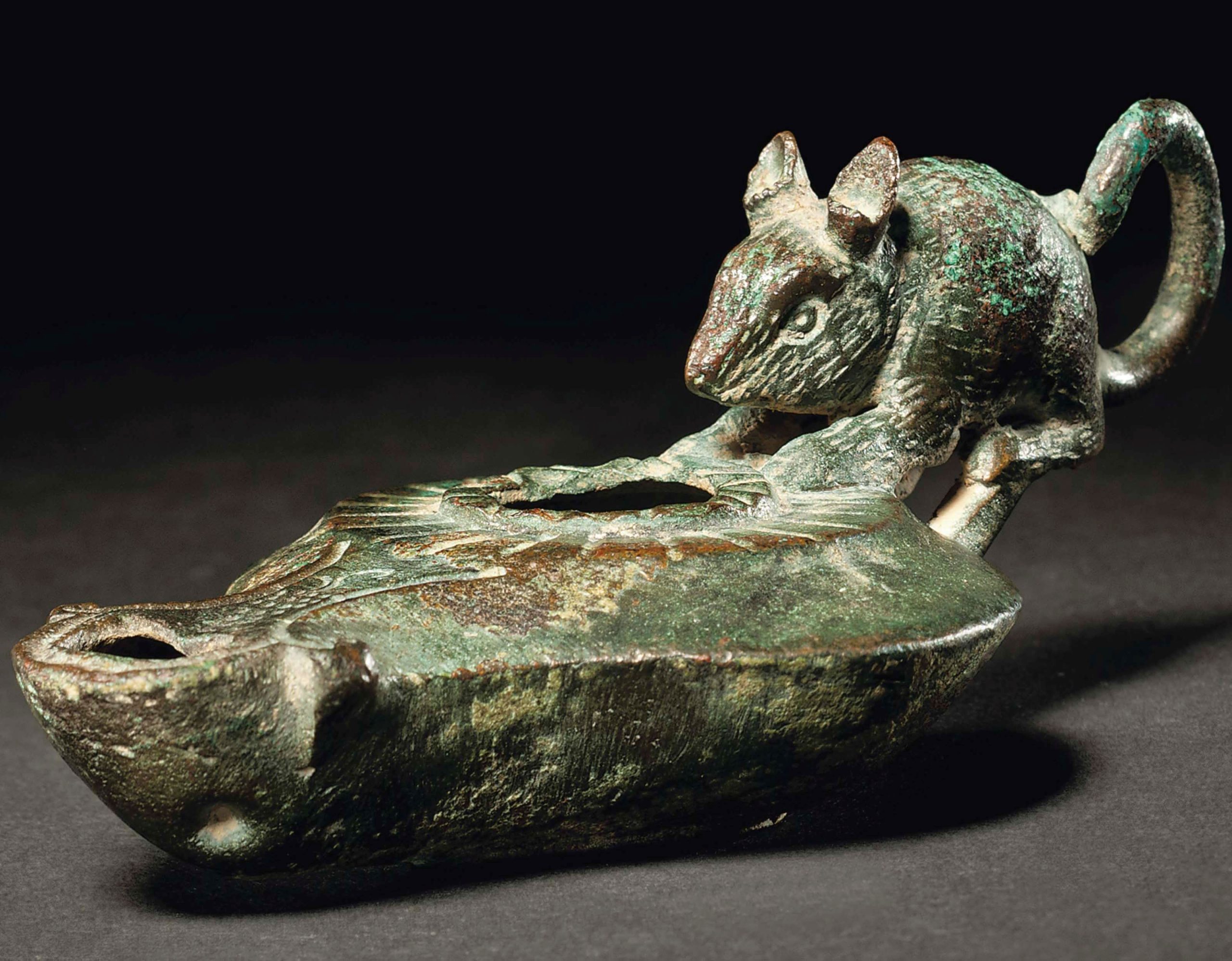
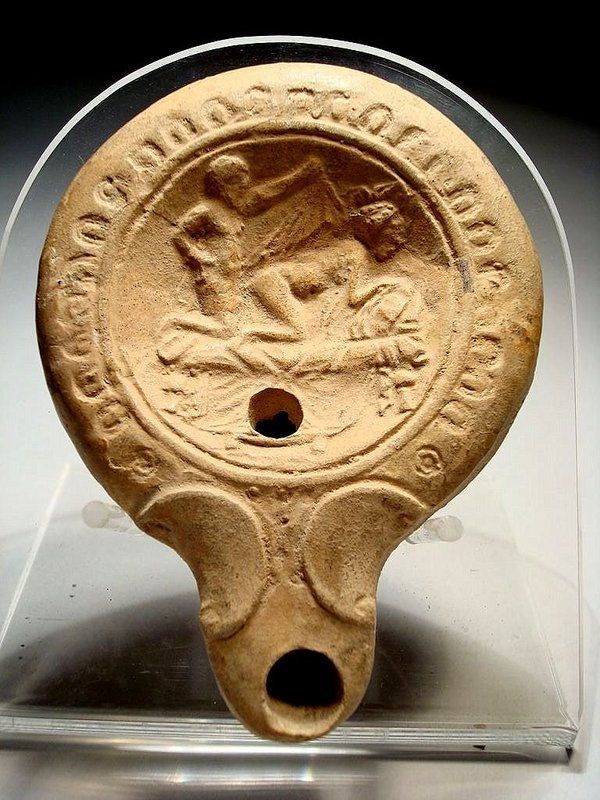
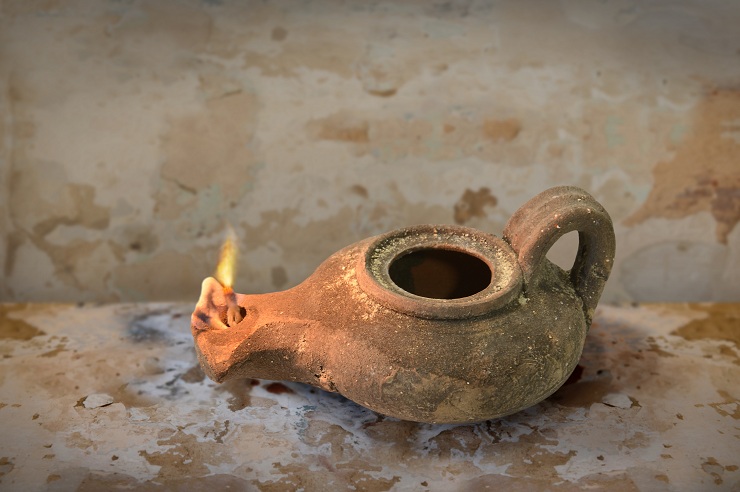
Just look at energy. The earliest lamps, dating to the Upper Paleolithic, were stones with depressions in which animal fats were burned as a source of light. In cultures closer to the sea, they began to use shells as lamps which they would burn at first animal fat. Clay lamps began to appear during the Bronze Age around the 16th century BC and the invention quickly spread throughout the Roman Empire. Initially, they took the form of a saucer with a floating wick.

We even find Roman oil lamps as luxury items crafted out of bronze. There are collectors of terracotta oil lamps for there is a vast variety of motifs. There is everything from dolphins, and various entities, to erotic oil lamps, which may have been used in brothels. The point is, if you constructed a model on oil, you would have surely accomplished similar results to Kondratief and Brenner.

Then of course, just as the energy moved from animal fats to vegetable oils, by the 19th century it returned to whale oil which was extracted from the blubber. Emerging industrial societies used whale oil in oil lamps and to make soap. However, during the 20th century, whale oil was even made into margarine.

Then the discovery of petroleum and the use of whale oils declined considerably from their peak in the 19th century into the 20th century. Ironically, it was fossil fuels that probably saved whales from extinction. Hence, now we are entering a period where they deliberately want to end fossil fuels and move to solar and wind power. Obviously, just a cursory review of energy reveals the problem of basing a model on the current energy source or major economic industry. Things change with time.

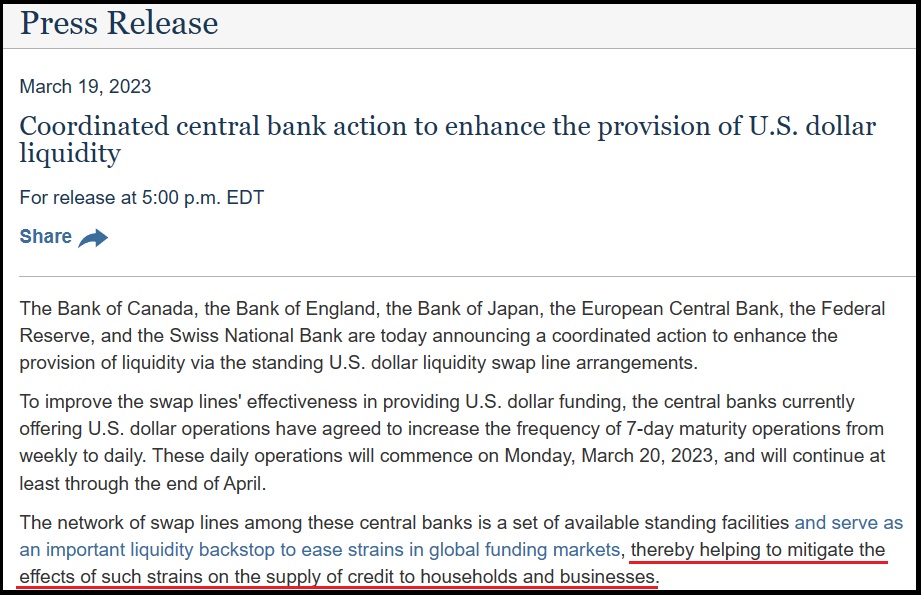
This Just In – Western Nation Central Banks Organize to Provide Daily Liquidity of Dollars in The Event of Contagion Bank Collapse


Posted originally on the CTH on March 19, 2023 | Sundance 

This is rather remarkable and tells us something about the current status of the “western” financial system.  The last sentence in today’s announcement from the FED is particularly laughable.   Check this out [Source]:

That last sentence is nonsense.   When was the last time the ‘central banks’ worried about the supply of credit to households and businesses?  Total and complete nonsense. What they are worried about is the need to have readily available dollars, faster, to backstop banks that are supposed to be holding deposits.

Nothing quite inspires ‘global banking confidence’ like the need to swap dollars rapidly, from country to country on a daily basis, because the amount of currency in bank, within any western nation, at any given time, might disappear.

Yesterday’s monologue from Neil Oliver, and the recent personal banking story that structures his comments, is standing as eerily prescient right now.  SEE BELOW:

.

“This just in.  Everything is fine… the liquidity of the Western banking system has never been stronger”… “Look over there folks, Trump indictment, nothing to see here folks… move along now”…

The Old Guy in the Corner of the Room


Armstrong Economics Blog/Interest Rates Re-Posted Mar 17, 2023 by Martin Armstrong

COMMENT: Marty, I hate to tell you but the reason you saw this coming was that you are old – like me. LOL. Do you realize that the 2007-2008 crisis was 16 years ago! Time flies, my friend. Most traders at these banks are under 35. That means that they have never seen anything like this and could not smell, taste, or see it coming. When we were youngsters, the old guy in the corner of the room would always say this is like 1929. Remember him? We are that guy today. I will buy you a Dewars when I get to Florida. The good news is we won’t have to endure this insanity much longer.

Cheers

ND

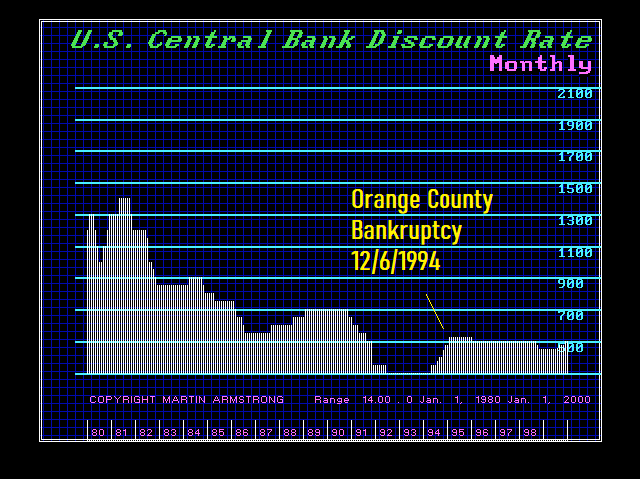
REPLY: I guess you are right. There has been a  cycle of events like this for centuries. Perhaps it requires a new generation of traders every 16 years or so who think they know everything. When I was advising Temple University’s portfolio and Merrill was trying to sell them the “new way” to make money by buying the long-term, selling the short-term, leveraging that to the moon and the spread would enhance your yield, the way to increase the yield on your portfolio. The chairman of Temple told them if I approved it the University would consider the proposal. I told them interest rates would rise and they would blow up. These two young kids selling this leverage deal told the University I was “too old” back in the 90s because I did not know the “new way” to make money. The chairman was older than me. The University told them to take a hike. On December 6th, 1994, Orange County California became the largest municipality in U.S. history ever to file for bankruptcy for they tried the “new way” to make money and blew up. That was in the courts for some time.

These people NEVER seem to ever understand when the trend will change especially in interest rates. They also position themselves based upon opinion and consensus but the consensus MUST be wrong for that is what flips the trend back and forth. Only fools invest money based on opinion and the consensus view and are quickly separated from their money. Without that loss, they never learn how how markets work and those that blame others are hopeless perpetual losers for they never learn anything.

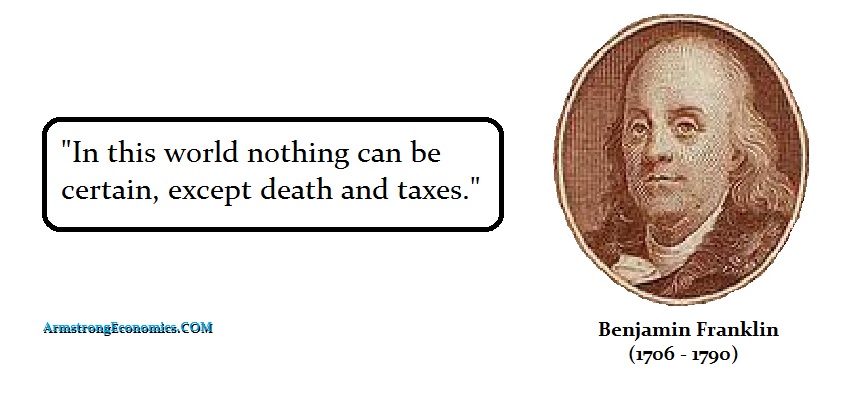
Even Ben Franklin said during the Financial Crisis: “In this world nothing can be certain, except death and taxes.” He uttered those words because of the financial panics. in his day. There was the Panic of 1791 which was followed by a massive real estate bubble that then burst during the next Panic of 1792.

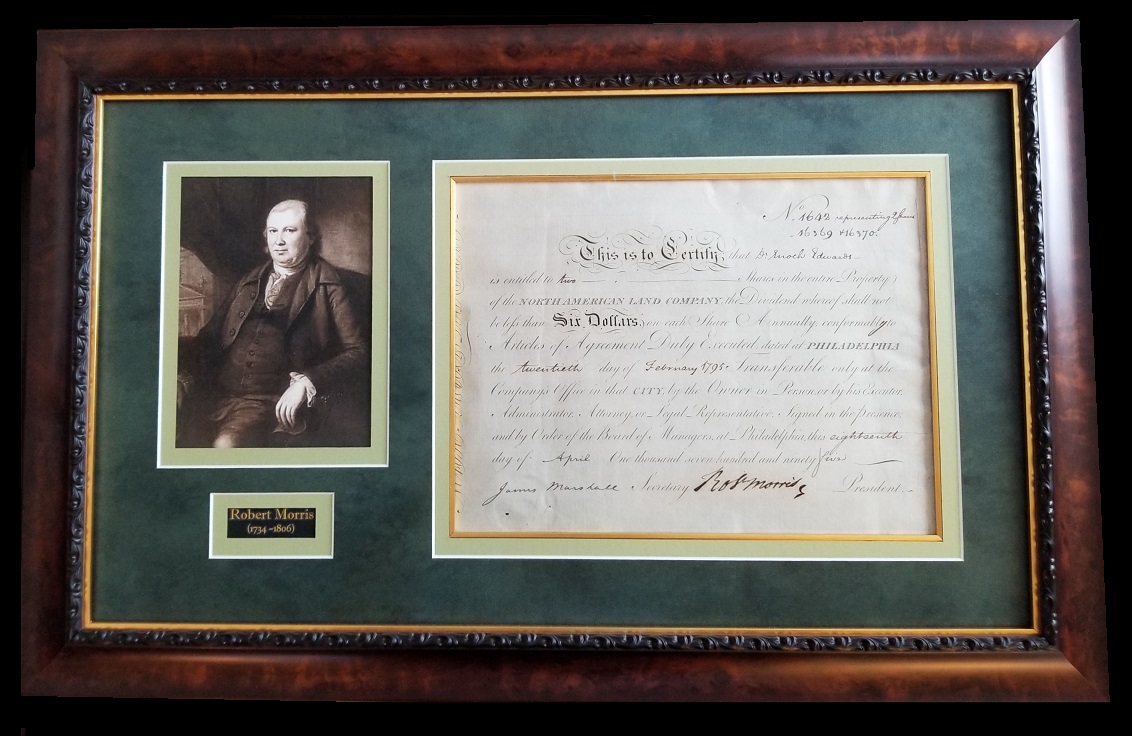
The Bank of North America had been the creation of Robert Morris (1734-1806) who got caught up in the whole real estate bubble. Morris had financed the American Revolution. He was a major patriot. Nevertheless, his bank went bust in the first Financial Panic over interest rates back then and he ended up in debtor’s prison thanks to the Panic of 1792. This is one of my favorite relics of the era.

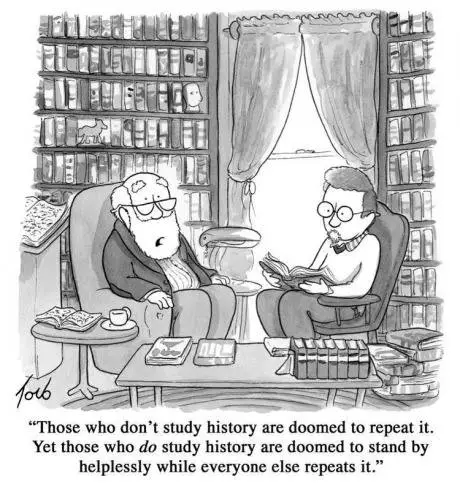
So banks have been failing over interest rate swings for hundreds of years. They don’t teach this risk management in university and the current risk models do little but snooze over the real risks for they ignore cycles. We NEVER learn from the past because people find history irrelevant or boring. You are right, we are the old guys in the corner of the room compelled to watch others repeat history over and over again.

Financial Crisis of 2023


Armstrong Economics Blog/Banking Crisis Re-Posted Mar 17, 2023 by Martin Armstrong

QUESTION #1: Marty, I think your warning about the collapse of leadership in government and the private sector rings true as Ken Griffin, the founder of hedge fund Citadel, said the rescue of Silicon Valley Bank shows the U.S. economic system is “breaking down before our eyes” because they bailed out the depositors. Yet Carl Icahn seems to agree with your saying that the U.S. economy is at a breaking point because of inflation. He said, “every hegemony has been destroyed by inflation.”

Very few so-called billionaires seem to understand what’s at stake. It makes me think they were just lucky in how they made their money. After Griffin’s comment, I would not be inclined to invest in Citadel. Then a group of banks is talking about depositing $20 to $30 billion to save Republic bank.

Is there any hope for the future when leadership is absent in these times of chaos?

UT

QUESTION #2: Thanks for everything you do. At the WEC, you warned about banks and even the big funds. The turning point was at the end of January here in 2023. Is it possible that this financial crisis will be the major factor even overpowering war when the ECM comes into play by April 10th?

CW

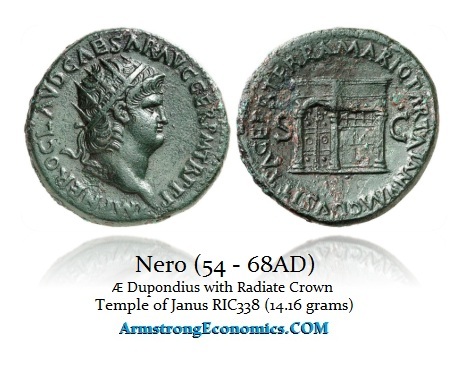
ANSWER: Anyone who does not understand that inflation is a natural occurrence when you get into a war is clearly not a student of history and has no business being the CEO of even the head local dog-catcher. The Roman deity Janus, after whom January is named, was the two face entity who looked at the past and the future. The doors to his temple would be closed when there was peace. That symbolized that nothing was at risk of changing. However, in times of war,  they would leave the doors open to symbolize the uncertainty of war that the spirits could flow in and out.

Only today, do we seem to no longer respect that the cost of war is both lives lost and inflation for those who survive. This Ukrainian Proxy War serves no purpose. Winning or losing will have ZERO impact on our national security or the future of the people. This is simply a grudge match instigated by the Neocons who perpetually love war as long as someone else is dying for their personal goals. To them, it is nothing more than watching a war on CNN and cheering as if it were a football game.

I have said that this war will undermine the entire US economy and that is now manifesting in the Financial Crisis of 2023 which will be far worse than any of these people expect. The lack of experience and the stupidity of those who remark that capitalism is collapsing because they are honoring the depositors is absurd. A depositor has NO WAY of understanding the financial status of a bank until it is too late. They receive no warning and yet there are those who say they should suffer the losses because that is capitalism.

Sorry, but that has NOTHING to do with capitalism. It is no different than FRAUD soliciting money with a false pretense. Investing in a hedge fund like Citadel is different from a bank. Depositors in a hedge fund know they are investing their money and they are getting a piece of that return. That is capitalism. Someone who has a bank account where their social security check is automatically deposited took on no such risk. Sorry – that is different that a hedge fund that goes bust.

The problem we have is that the ECM turning point is April 10th. Yet it is also the Pi Target from the fall of the USSR and the birth of even Ukraine. We just had Poland losing their mind and sending jets to Ukraine. That makes Poland a viable target for war. Poland is irresponsible given the fact that the Ukrainians slaughtered over 300,000 of them and has refused to ever apologize for their WWII Nazi involvement.

We have a problem here with the Financial Crisis simultaneously with important cyclical targets regarding war. Any personal interpretation I can offer is just a personal opinion. Both trends are colliding into April and this may be a two-prong panic of unprecedented significance.