Biden Harris Inflation Continues Crushing Middle Class – Only Donald Trump Has the Policies to Stop it


Posted originally on the CTH on September 22, 2024 | Sundance 

If there is one economic dynamic we have talked about on these pages more than the rest, its inflation.  {Background}

The root causes of inflation are two-fold, monetary policy and energy policy.  However, when combined they represent a predictable outcome.  Specifically predictable, when it comes to highly consumable goods that require a lot of industrial effort, labor, distribution and warehousing processes.  Thus, food inflation was/is worst.

Within all of the sectors most vulnerable to upward price pressure as a result of policy (monetary and energy), the main industry impacted by immediate and severe inflation is food, farming and agriculture.  Food, a highly consumable product with a thin supply chain, sees the results of inflation first and fastest.  Durable good inflation lags behind high-velocity consumable goods.

It was with this understanding CTH first warned in 2020 of what would happen coming out of the COVID Pandemic economic crisis.  We predicted and watched in 2020 as one-third of all food supplies were destroyed because 50% of the food supply chain (restaurants, cafeterias, schools, food trucks, essentially food away from home) was shuttered.
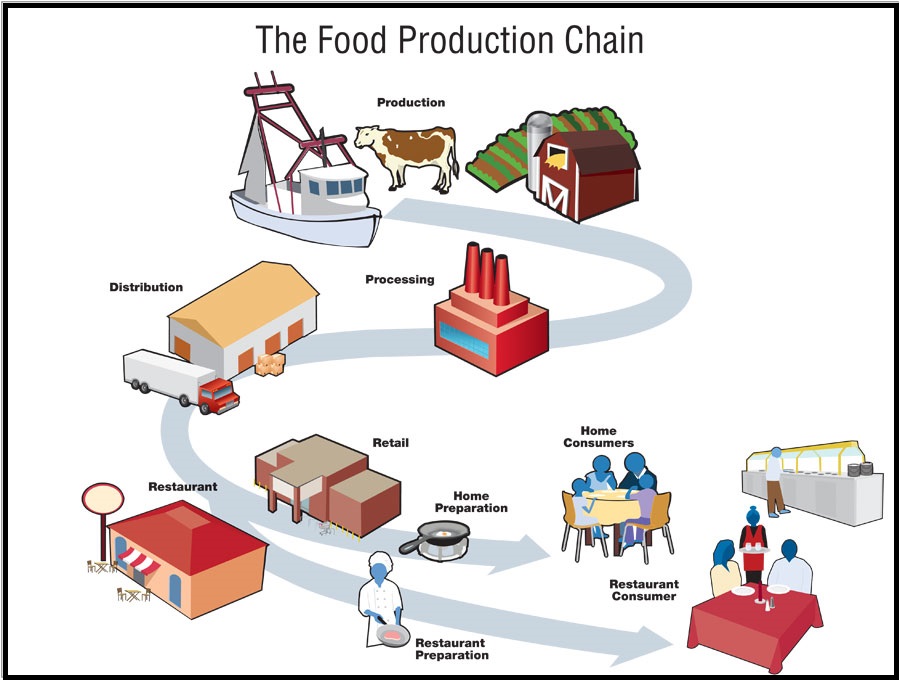
In the middle and latter part of 2020, the retail food supply chain (grocery stores), normally representing 50% of total caloric consumption, struggled to keep pace with massively increased demand on that side of the food supply.  The agricultural supply chain was completely screwed up in the USA when half of the normal food distribution (wholesale food away from home) was blocked from their business model.   The resulting impacts were entirely predictable for those who did not pretend.  We warned, and it happened exactly as we anticipated.

Then, making the predictive nature of food pricing more obvious, we watched as the Build Back Better or Green New Deal was thrust upon the entire western world dynamic.  This BBB/GND energy policy shift intentionally and purposefully exploded the cost of manufacturing and distributing food.  With massive and immediate increases in energy prices, the price of food skyrocketed quickly; because the impacts are fast in this sector.

Over the next several years the prices of food continued going up as the increased energy cost embedded within the agriculture sector.  Nothing about the price of food, or the ancillary processes within the industry, will change unless and until energy costs retreat.   In essence, with higher energy costs, food prices stay high; they are directly connected.

No other facet to food inflation is more substantial than the cost of energy to produce the product.  Farming and agriculture are energy dependent from fertilizer to farming equipment, fuel, processing, packaging, transportation, warehousing, storage, climate controls in distribution etc, everything is dependent on energy pricing.

High energy costs are why food prices (inflation) would always stay high, regardless of what happens in other sectors.  CTH talked about this at length long before the impacts came over the horizon.  We talked about preparing our families to offset this issue, but there is only so much you can do.

We are all currently feeling the intense increase in prices at the market, grocery store and supermarket, and the worst aspect to this dynamic is the reality that as long as energy prices remain high, food prices will never drop.  [NOTE: There is a smaller supply/demand impact; however, with most of the USA agricultural sector exporting food products (multinational corporations ie. Big Ag) the domestic USA supply is subject to globalized pricing.]

Bottom line.  As long as energy prices remain high, food prices will remain high.

The “great reset” per se’, was not a process that began after the pandemic. The pandemic was the beginning, ushering in the “great reset” by being the starting point of the mostly western, global energy shift.

Into this dynamic there is good news, one voice has clear eyes on the problem, and as a consequence, answers. President Donald Trump understands the nature of how the current price pressures that are crushing the middle-class can be reversed and removed. WATCH:

.

Many people have written with appreciation for the CTH forecasts delivered in the fall of 2021.  I am thankful to have been of benefit to those who could take proactive measures to avoid the economic issues we faced in 2022 and beyond.  However, that financial pain has not subsided.   There’s only so much a person/family can do to offset rising energy costs.

I know just about every reader on these pages can relate to how financial fear can eat at you from the inside.  The life game of trying to figure out how to get from one week to the next, keep a roof over your head and keep the kids/grandkids safe and fed is fraught with trepidation.  I get it. Believe me, I get it….  But you just gotta keep going; whatever it takes.

Our heels are over the cliff, it’s already rough for most working families and people on fixed incomes.  We need MAGAnomics more now than any other moments in our lifetime.  This is why I was saying in 2023 we needed to focus at home; keep building that bunker safe and secure.

Then look to help/assist the neighbors, then the community, etc.  But start by being proactive at home and do not isolate.  Fear, worry, trepidation, foreboding etc, is worse when internalized.  Do not swallow it – reach out to a loving God, pray, release it, and then embrace the central purpose in life, fellowship.

Be patient, be respectful, be kind and caring. Don’t look for trouble. But when the time comes to fight, drop the niceties and fight for your family with insane ferocity.
Stagflation Begins


Posted originally on Sep 10, 2024 By Martin Armstrong 

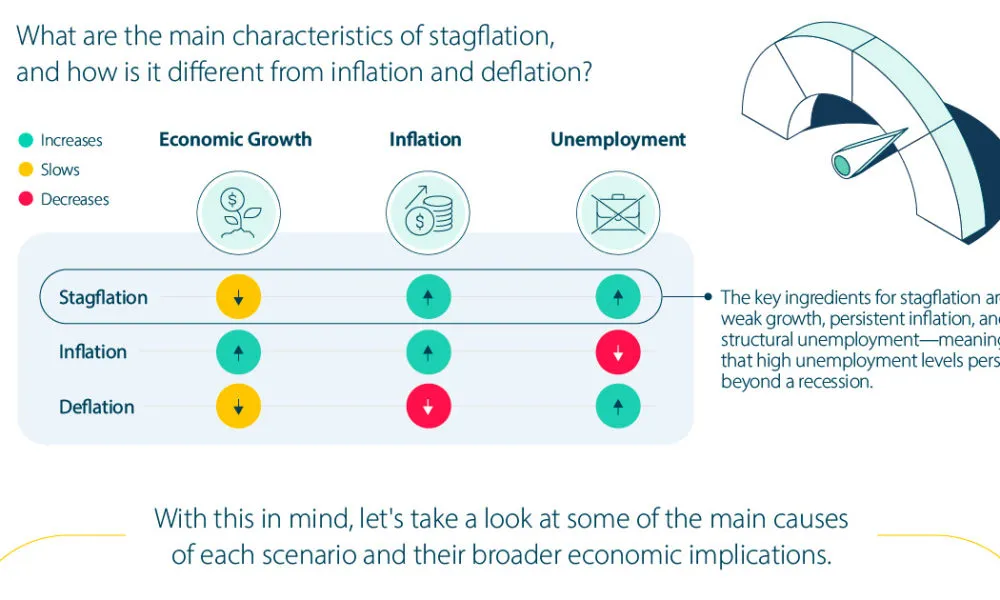
STAGFLATION

Nine of the 12 Federal Reserve districts reported a decline in economic activity in August, up five districts from the July Beige Book report. Our system has warned that we are entering a period of stagflation, where inflation remains high but GDP declines. Now, the Fed is reporting that two-thirds of the US economy is experiencing “flat or declining activity.”

The US economy advanced 3% during the last quarter, leading many to believe that the economy is recovering since Q2 posted a measly 1.4% advancement. Consumer spending, amounting to 70% of GDP, rose 2.9% last quarter as well, but people are spending on essentials. They fail to calculate TAXES into the equation when producing these reports and then dismiss essentials such as food and shelter as “volatile” aspects that somehow are not factored in the core figures.

StagflationInflationUnemployment

Some people have a very hard time understanding that we are in a massive deflationary spiral; they think that rising prices simply means it is inflation and not deflation. Then, they mistake stagflation for deflation and wonder why people are spending more on less. They only see prices, not disposable income, and certainly not economic growth and unemployment.

The latest jobs report revealed that manufacturing is continuing to decline – shedding 24,000 jobs in July alone. On the other hand, the public sector grew by an additional 24,000, but those are 24,000 positions that will not contribute to GDP. Instead, growing government is simply growing the national debt but that figure no longer matters since it has long been unsustainable.

If you really look at it, objectively, interest rates always rise during boom periods, and they decline during recessions and depressions. We are looking at increased inflation into 2028 caused by shortages and war. But you’re looking at declining economic growth, so that ends up being more like the 1970s. The inflation rate will be higher than economic growth and we often see stagflation during times of war. We are beginning to see this come into play on the district level, but soon, it will be undeniable that the US has entered a period of contraction.

Categories:INFLATION

US Consumer Sentiment Reaches 6-Month Low


Posted originally on May 21, 2024 By Martin Armstrong 

American Consumer

Consumer sentiment is continuing its decline amongst Americans. The University of Michigan’s survey monthly survey revealed sentiment fell to a six-month low of 67.4 in May, down from 77.2 in April. Inflation is the primary reason for the loss in confidence, followed by interest rates and geopolitical issues.

Incoming data would lead one to believe inflation is waning from historic highs above 9%, but the average consumer realizes that prices are nowhere near pre-pandemic levels. Taxes are also rising among all income levels, yet this is never accounted for when measuring inflation or the cost of living.

Shelter costs are one of the main factors driving up the cost of living for the average American and are the primary source of pay drain.

The Labor Department’s April jobs report failed to meet expectations, while the unemployment rate rose to 3.9% from 3.8% in March. This does not account for the nearly 8 million new arrivals who are unable to work and rely on US taxes for survival. Then we have Biden signing countless legislation to curb America’s gig economy which has made it increasingly difficult for the working class. All of those under the table jobs will be long done once we move to a cashless society.

The Federal Reserve has repeatedly stated that there is simply no evidence to suggest that lowering interest rates could help stabilize prices. The Fed has been issuing the same message after each Federal Open Market Committee — they’re hopeful but do not see the results yet, or in other words, please don’t lose full confidence in our economy just yet despite the clear issues we face now and will face going forward.

Stagflation in the 1970s (video)


Posted May 19, 2024 By Martin Armstrong 

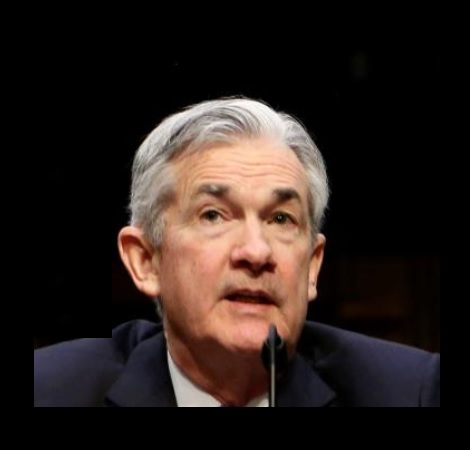
Jerome Powell on Stagflation


well

Posted originally on May 2, 2024 By Martin Armstrong 

Powell Jerome

“I don’t see the ‘stag’ or the ‘-flation’,” Fed Chairman Jerome Powell said during his Wednesday address.

Powell believed inflation would be “transitory.” He believed that the economy would come down for a “soft landing.” He believed we would enter the year and see numerous cuts due to waning inflation coming closer to the fictional 2% target. Yet again, Chairman Jerome Powell has missed the mark on stagflation.

If you really look at it, objectively, interest rates always rise during boom periods, and they decline during recessions and depressions. We will see increased inflation, probably into 2028 caused by shortages and war. But you’re looking at a declining economic growth, so that ends up being more like the economy of the 1970s, and you’re looking at what we call “Stagflation” where the inflation rate will be higher than economic growth.

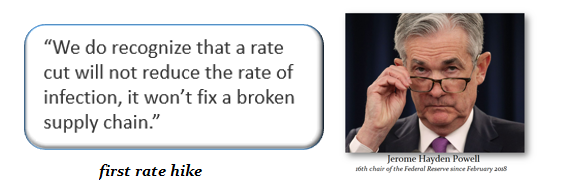
Powell Rate Hike

Chair Jerome Powell said officials are prepared to hike again if price pressures return. He indicated that they were now considering when to cut rates as inflation subsides to their fictional and arbitrary 2% goal. Rate cuts are only sustainable once you see the economy decline. The events that unfold around May 7, primarily regarding war, will highlight what we need to know.

Inflation rising above economic growth is STAGFLATION, which is precisely what the economy experiences during war. Inflation will rise faster than GDP, causing the purchasing power of the USD to decline.

STAGFLATION

One major factor that is never included in the inflation numbers is TAXATION. Their theory is that taxes are the citizens’ obligation and not part of our cost of living. Yet, those at the top are seeing half or more of their wealth siphoned by Washington. We already know that the jobs reports are grossly distorted. To calculate GDP, they include total personal income and government spending. In March, we saw the public sector multiply, which only causes more of a burden on the taxpayer. The ADP that was released today indicated a spike in hospitality among the private sector, but we tend to see that before the summer months in the US. The public sector contributes absolutely nothing to GDP.

WAR WILL LEAD TO STAGFLATION. Of course, the Fed cannot come out and say that they see a looming escalation of war on the horizon, and Washington certainly would not come out and say to prepare for war. Socrates is impartial to bias and was correct about this inflationary trend into 2024. We are poised for a directional change in Q3 of 2025, implying an escalation in the war cycle post-2024.

The True Story of Hyperinflation


Amstrong Economics Blog/Cryptocurrency Re-Posted Jun 12, 2023 by Martin Armstrong

QUESTION: Dear Mr. Armstrong,
could you please explain what happens in technical terms from a capital flow perspective, when confidence is lost and hyperinflation starts to begin?
For example Turkey. When Erdogan was elected i think you wrote that ever since the lira started dropping. So confidence in politics is key. Do you think one day we will see hyperinflation in Turkey?
And another example, is Yugoslavia: what caused the hyperinflation (in technical terms/capital flow perspective)? Are foreign investors getting rid of the dinars? Too many dinars than suddenly rushed back into Yugoslavia causing hyperinflation?
Regards,
Magdalena Š.

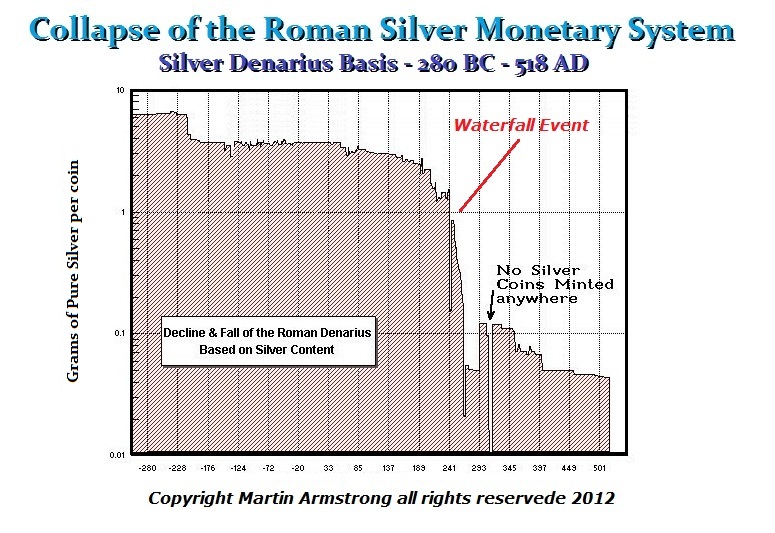
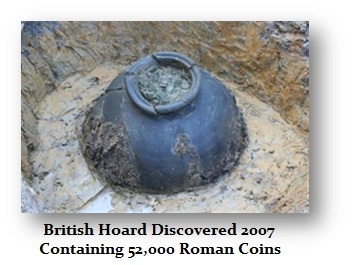
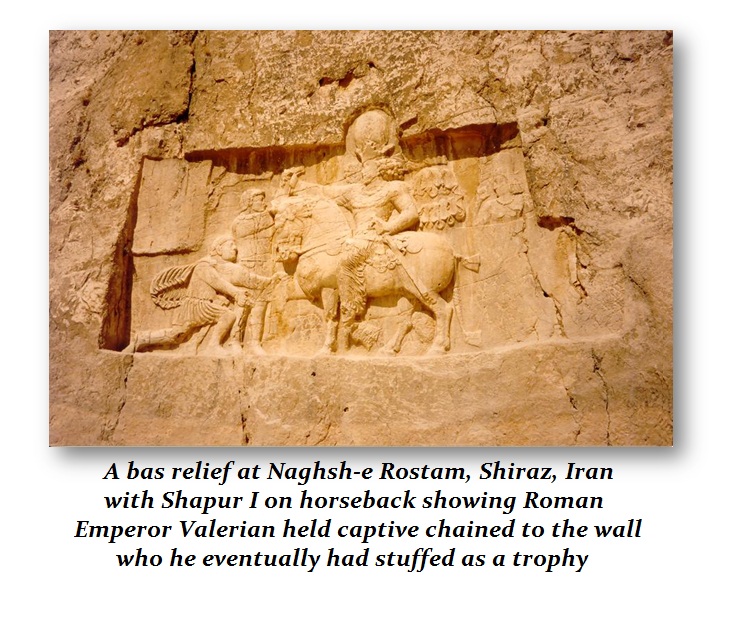
ANSWER: The misnomer about hyperinflation is that it is caused by printing money. It is a RESPONSE to the collapse in the confidence of the government.  If we look at the 3rd century, this is where we find the greatest number of hoards of ancient coins. What began this was the capture of Valerian I by the Persians in 260AD.

Valerian was the first Roman Emperor to be captured and Rome was unable to recuse him. That shook the confidence of the Roman people, but it also was a signal to the barbarian tribes in the North that if the Persians could do it, they could as well. Within 10 years, Emperor Aurelian constructed the great wall around Rome. Never before did Romans have such a defensive wall. That had a powerful army.

There was a trend toward debasing the silver coinage which began with Nero to try to fund the rebuilding of Rome after the Great Fire. But that did not undermine the confidence in the Roman Monetary System any more than our perpetual deficit spending since World War II.

However, a spark is ignited and suddenly that trend turns into what I have called a Waterfall event in the purchasing power of the currency. Such an event has taken various forms. However, the end result is the collapse in the confidence of the government and as a result, that is when you get that waterfall event.

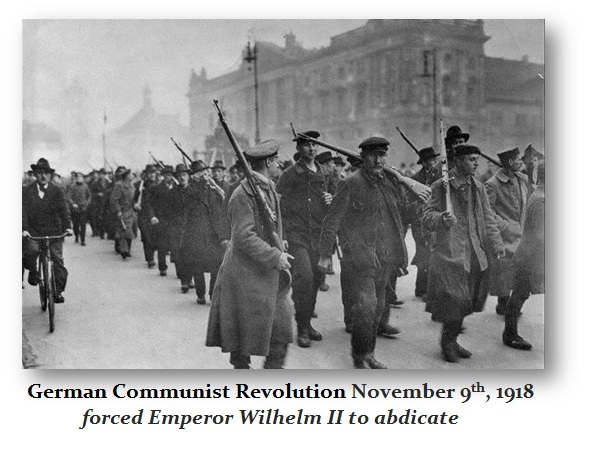
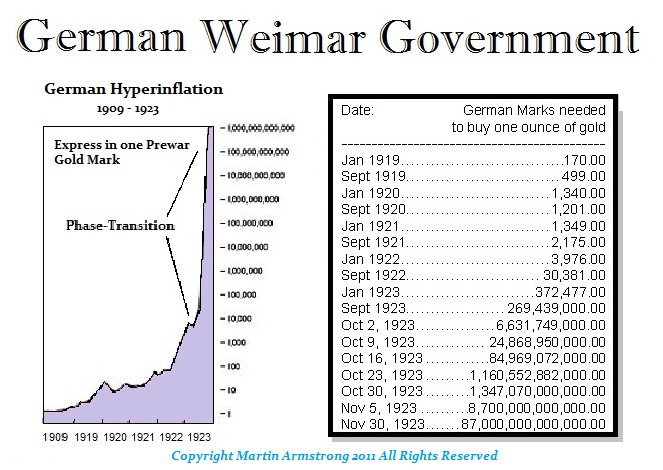
In the case of Germany, Yugoslavia, Hungary, etc, there was a 1918 Revolution where communists seized power and the emperor of Germany lost power. In that case, they actually asked Russia to take Germany after their revolution in 1917. This was the beginning of the Weimar Republic.

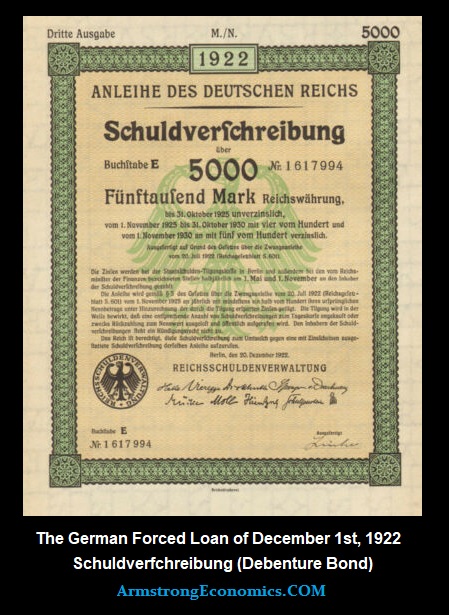
Germany was saddled with reparation payments demanded by France. First, you had a communist revolution and people with capital began to flee to other places in Europe or certainly move their money out of German banks. It was this drain of wealth that forced the Weimar Republic to print money to try to make their reparation payments. Then in December 1922, they seized 10% of everyone’s assets and handed them a bond.

Here you can see that after that December 1922 confiscation, hyperinflation simply took over. It was NOT the printing of money that caused the hyperinflation it was the collapse of confidence FIRST which then compels the government to expand the money supply lacking taxation revenues etc.

I suspect the spark this time may be the Digital Currency and the proposed cancellation of paper currency. This is why people are moving to anything tangible from real estate, gold, silver, ancient coins, and even equities. With DIGITAL CURRENCY they will have capital controls and prevent you from even moving money outside of your country.

The precise day of the ECM was the announcement of the IMF Digital Currency which they intend to replace the US dollar as the reserve currency. This may be timed with the turning point in 2024. It is unlikely that they would cancel paper currencies before the 2024 election. This is all being

Ground Reports – What is Your Experience With Prices of “Processed Goods” at Stores?


Posted originally on the CTH on May 13, 2023 | Sundance 

Recently I went to the supermarket to pick up some general provisions.  Given the nature of previously predicted food price increases, and proactive measures to mitigate the predictable prices, I haven’t needed to purchase basic foodstuffs in a while.   Yikes!  The prices… Wow.

Since we originally warned in ’21 about the waves of food price inflation that were coming, the prices have more than tripled on many food commodities.  That part is not as surprising in current review; however, the prices of processed foodstuffs is, well, quite frankly astounding.

I am left to wonder how working-class people are able to afford the jaw dropping price increases in highly processed food products like condiments (mayo, ketchup, mustard, etc), and even coffee and milk.  I knew the processing costs would drive those prices, but the scale is just astounding.

Beyond the foodstuff, what was truly stunning was the current price of non-food items at the store.  Items like chemical cleaners, soaps, aluminum foil, trash bags, Styrofoam products, ziploc bags, paper goods, etc.   I mean seriously, $8 for a box of trash bags, good grief.

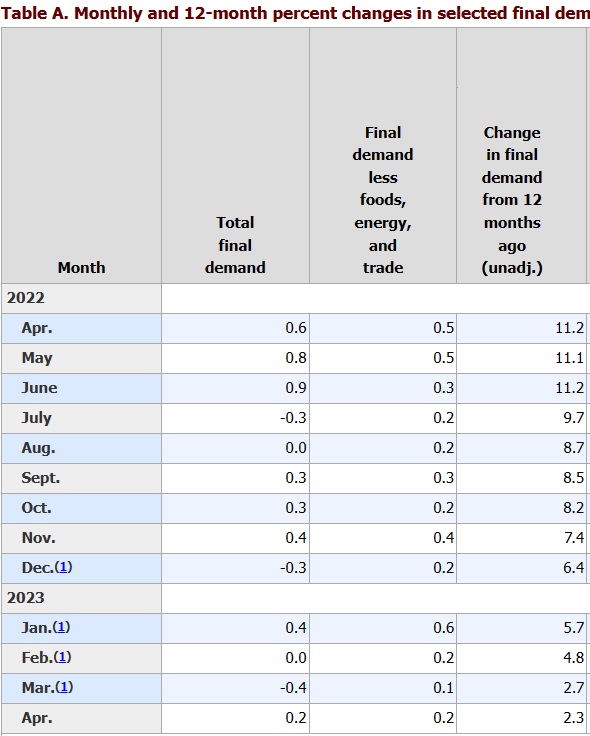
After a review of the non-food item prices, I went back to the recent BLS report [DATA HERE] to look at the producer price index to see if the data reflected the scale of the processing cost that I was reviewing across a broad spectrum of goods.

Are consumers getting gouged by manufacturers who are taking advantage of the price shock inside the ongoing inflation?

Or are the processing costs, mostly driven by energy price increases, really that big a factor in the end product as it is generated?

In the topline final demand Producer Price Index [Table A above] you can see how we are cycling through the second wave of inflation that hit in the spring of 2022.  The rate of price increase is lower, but the prices are still rising.  That means the prior massive price increase is now baked into the product, and the current price will never decline. Instead, it will just increase at a slower rate than before.

However, that’s not the full story… and that is not the data I was most curious about.

The intermediate product costs are really where the story is found.

Table B [DATA HERE] Tells us a remarkable story.

Raw materials (unprocessed goods) are essentially in a deflationary status [-19.2% in April].  Meaning demand for the raw material has dropped well below the available supply.  However, look at how much of the deflationary price is consumed in the processing of the raw materials.

A full 16% is consumed by processing cost increases [energy, physical plant, transit, production costs etc]. That is remarkable.

A random example might be citric acid.  The price of the citrus base drops 19.2%, but the processing of the base into the intermediate good phase chews up 16% of the drop in raw material price and exits processing only 3.2% lower in price than a year prior.

Another example might be found in plastics.  The petroleum base, and/or a combination of each material additive, might be 19.2% lower than prior year, but processing negates the lower raw material price, and exits into intermediate essentially even -.04, and then toward the ending +2.3% final demand change in the rate of price increase.

The PPI data is essentially showing the flow of costs of production as reflected in the impact during processing.  We can assume mostly increases in energy, transport and distribution costs to bring the raw material forward to final good status.

Key takeaway, the demand side of the raw material is diminished.  There is less raw material demand.  However, processing costs are continuing to drive the final production price of goods that head into the hands of wholesalers who then bring the product to market.

The outcome of this are the prices of processed goods as noted in the products on the shelves.

QUESTION: Are you noticing rather remarkable price increases in non-food goods during your store visits?

Gold & the Dow Rally Together? OMG


Armstrong Economics Blog/Dow Jones Re-Posted Apr 14, 2023 by Martin Armstrong

COMMENT: Well, the goldbugs are wrong again. This claim that the stock market must crash and only gold will rise is as you say sophistry. It looks like gold and the Dow are rallying together. I can see how they are just promoting a cult-like agenda.

Thanks for being objective

MH

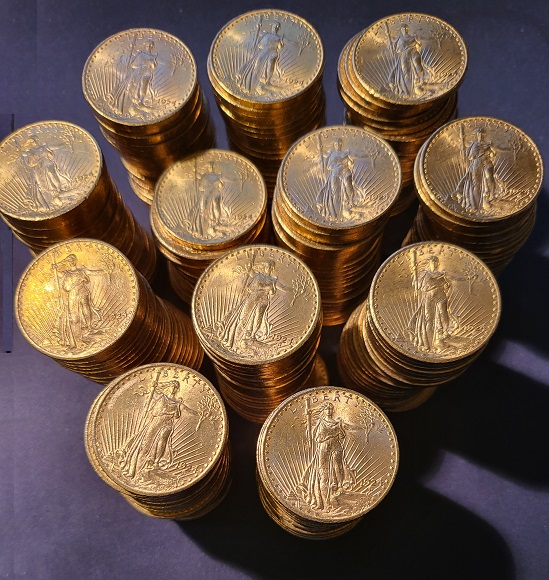
REPLY: We became the biggest institutional adviser because there was never an agenda. Everything goes up, and everything comes down. There is an old saying among actual traders – NEVER marry the trade. I buy gold personally. I just bought a hoard of $20 gold pieces all uncirculated and all dated 1924. I do not regard it as a trade, just a stash for the long-term. It will go up and go down. Do not pretend that something only goes in one direction.

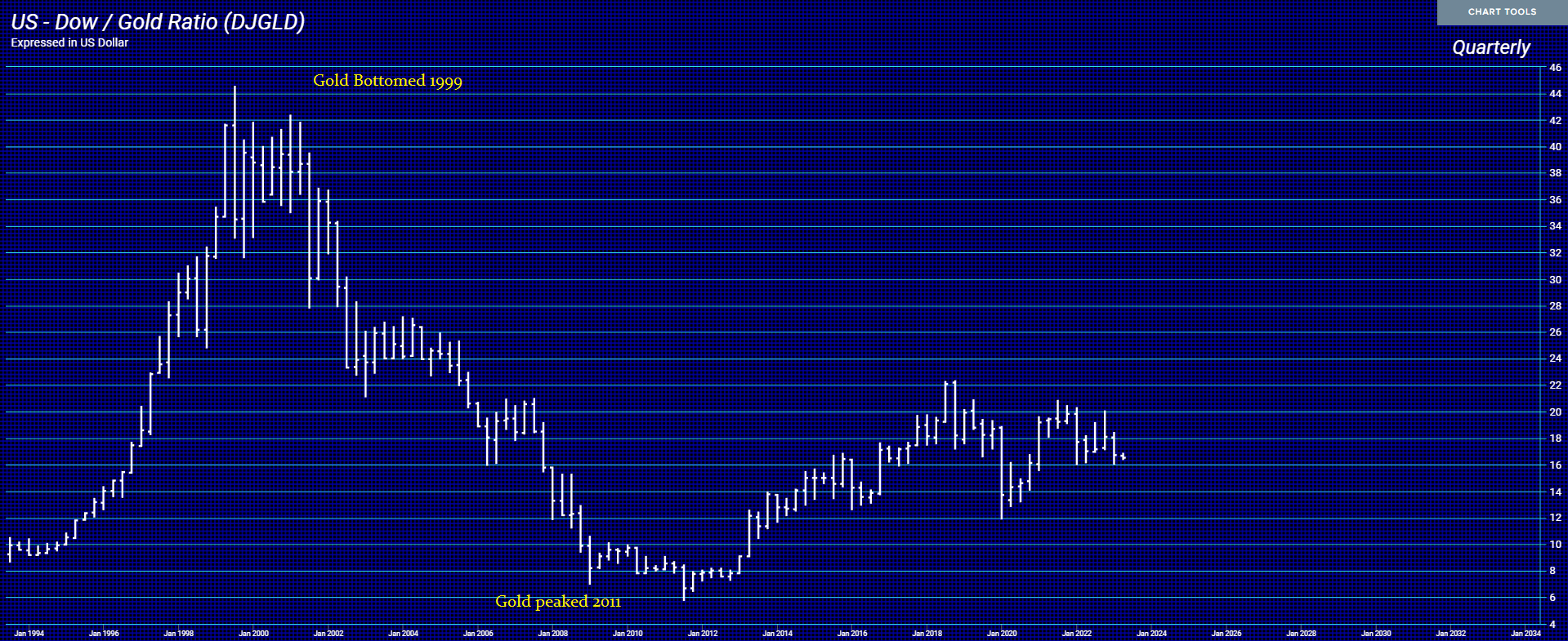
Here is a chart from Socrates on the Quarterly Level of the Dow/Gold Ratio. Anyone who only forecasts a single direction is NOT an analyst – they are a promoter like a used car salesman. No matter what we look at, there is a time to buy and a time to sell. EVERY market functions that was.

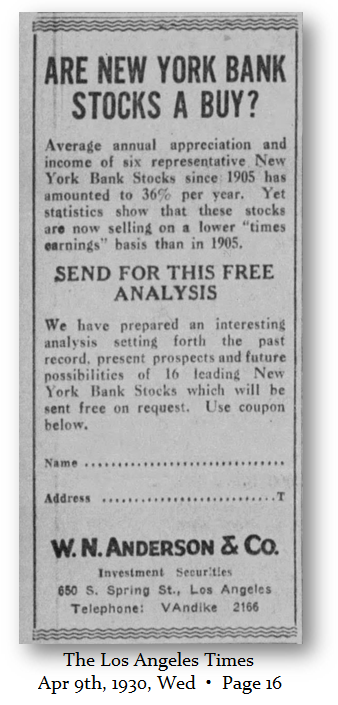
Here is an advertisement from April 9th, 1930 pitching Bank Stocks. Brokers were telling people to buy all the way down, average in, but it took 26 years for the Dow to reach the 1929 high again. Anyone selling any product will ALWAYS tell you to BUY. That is their business. It is up to you to come to terms with how ALL markets really move. Hence, there is always a TIME TO BUY just as there is a TIME TO SELL.

FIAT – What is it Really!


Armstrong Economics Blog/Foreign Exchange Re-Posted Apr 2, 2023 by Martin Armstrong

QUESTION: Governments create their own sovereign fiat currency, to facilitate trade, among other reasons. So counterfeit is punishable, in some countries, by death, & at minimum, incarceration. Currency is supposed to be sacrosanct, created under the most exacting conditions. So what to do when your own gov’t engages in what is essentially officially endorsed counterfeit? I mean, the “money” has become almost meaningless, unless you’re on the receiving end. For non-insiders like me…buy PM.

HS

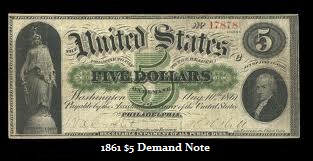
ANSWER: I have trouble with this misinformation always about the only money is gold and paper dollars are worthless fiats, which have rebuilt the world many times over since 1861 and the introduction of the paper dollar.

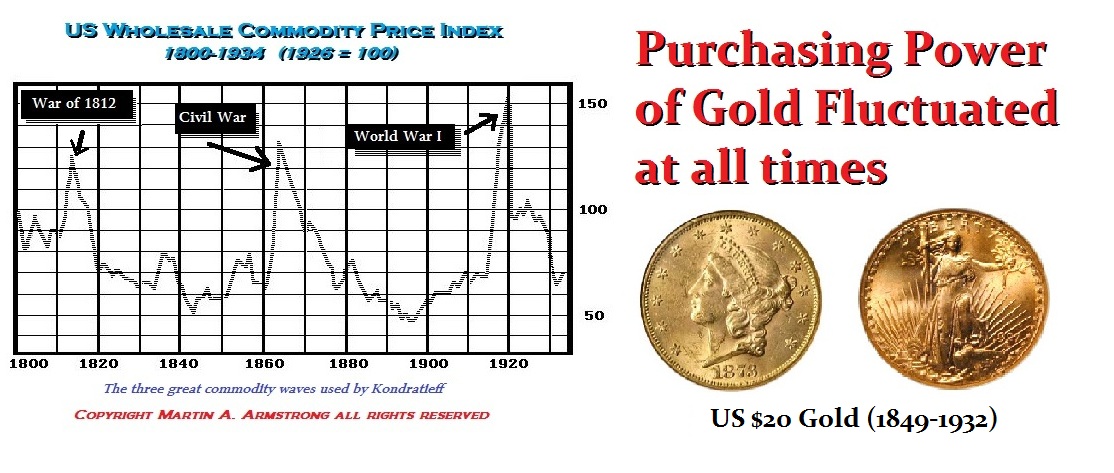
The propaganda of the goldbugs which has led so many to lose so much has been this nonsense that gold is the hedge against inflation. When the gold coin was money during the 19th century, it rose and fell in purchasing power no different than any paper currency. These people sell fiction like a used car salesman just to sell their product.  It honestly does not matter what money is. It always is just a derivative of barter. I give you this for that. You will accept paper money because you know that others will accept it from you. A woman tried to spend a $20 gold coin at Walmart and they refused to accept it because they did not know what it was. She then took them to the back and exchanged them for $20 bills.

Try going to Starbucks and spending a $20 gold coin and asking for change. Unless the salesperson knows what it is, they will refuse.MONEY has always been nothing more than a belief system. That’s all!

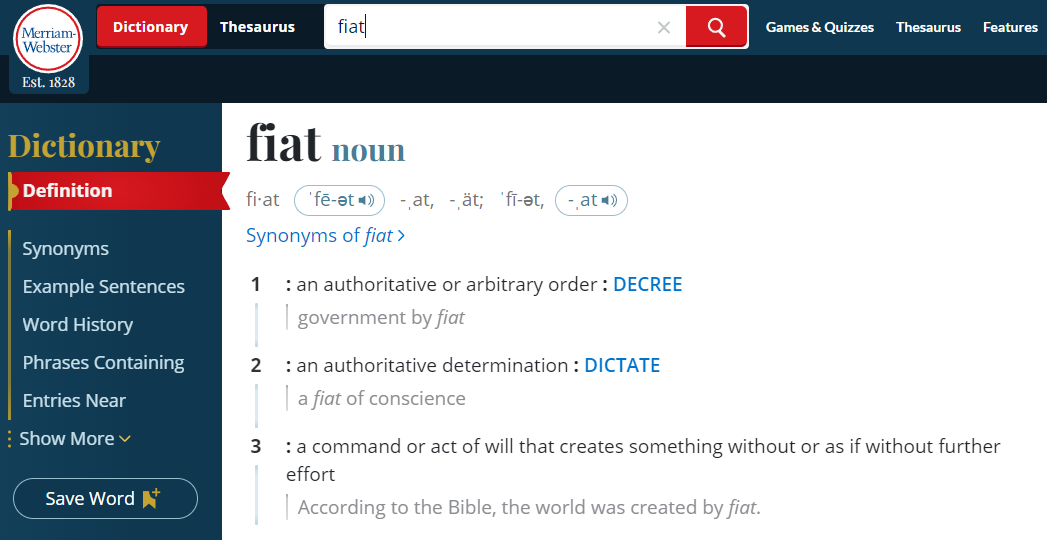
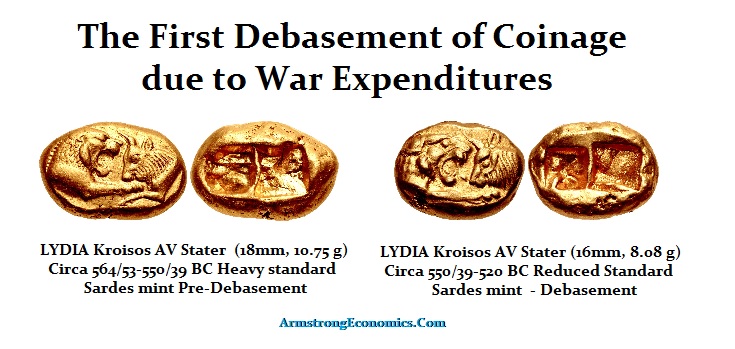
FIAT simply means by arbitrary decree. Just because a currency is gold or even silver, does NOT make its value intrinsic. Governments have debased their coinage and reduced the weight declaring its value shall be whatever they say. I have written about how Japan did that and eventually, the people refused to accept Japanese coins and they stopped minting them for 600 years.

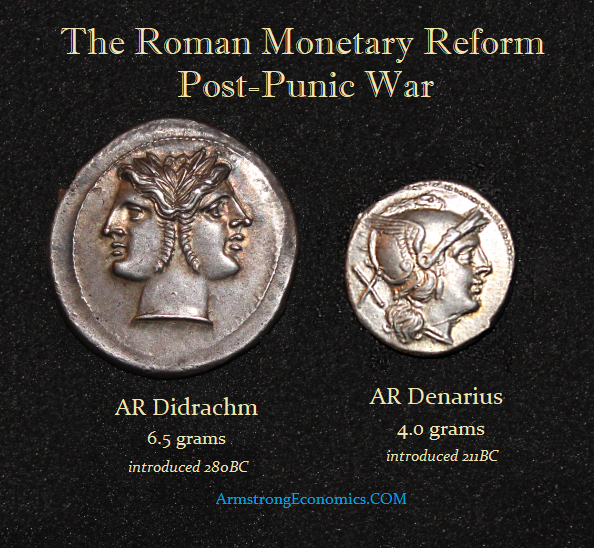
The Romans reduced the weight of their silver coinage from 6.5 grams to 4 grams and only because they defeated the Greeks, the Roman monetary system became standard.

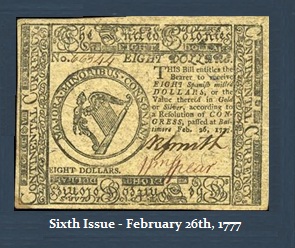
During the American Revolution, people accepted the Continental Currency. Money has always simply been predicated upon what people will accept.

Gold has no value whatsoever unless the other person also believes it has value. Gold or silver has no value intrinsically any more than a paper dollar or a bag of rice unless there is an unspoken agreement among people that it is a valuable medium of exchange.

This is the truth. All else is propaganda. Money has been many things throughout thousands of years from seashells to cattle and even slave girls.

StPatrick-tokens

Saint Patrick in the 5th Century AD upon his arrival in Ireland, found that MONEY was expressed in human slave girls. He wrote in his Confession, “I think that I have given away to them no less than the price of fifteen humans.” This passage shows something very important. First, MONEY is not defined as the Medium of Exchange exclusively. It also serves the purpose of a Unit of Account. This becomes the true function of MONEY even more so than what it is. MONEY is a language of value.

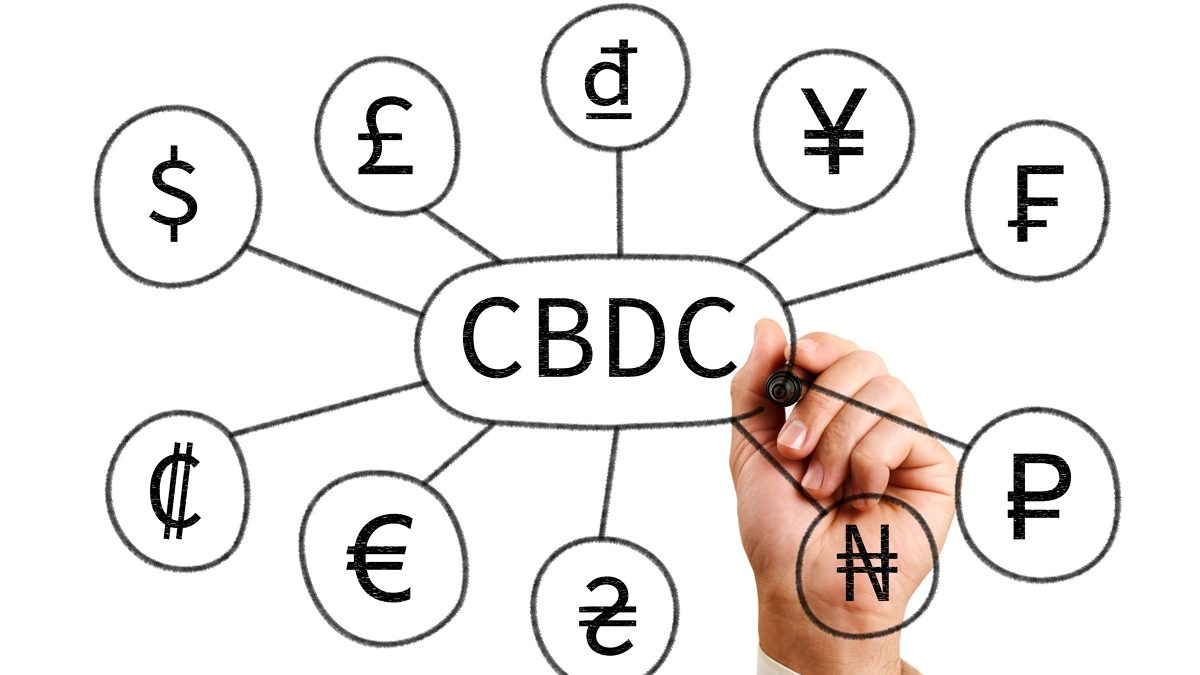
FIAT is when the government dictates what something is and that will be Digital Central Bank Currency. But if everyone accepts it, then it becomes the medium of exchange.