Italian Prime Minister Giuseppe Conte Resigns After Pressure from Nationalist Matteo Salvini…


Italy is one of the key economies within the EU. In the past several years, driven by both economic challenges and unfettered immigration challenges, the populist revolt has gained ground. Interior Minister Matteo Salvini, a nationalist-minded politician, has won the hearts of Italian voters.  Matteo Salvini is a proud Italian populist.

Several months ago Matteo Salvini challenged current Prime Minister Giuseppe Conte to hold a snap election; and followed-up with continued pressure on the Italian government by advancing populist positions of economic patriotism, sovereignty and tougher immigration rules.

Amid a revolt against globalism writ large, it was not accidental that Nancy Pelosi traveled to Italy recently with a coalition of U.S. leftist politicians to organize a strategy to fend-off Salvini and assist Prime Minister Conte. Pelosi is an opportunist. Part of the plan for Conte to hold power was a shift within his party (Five Star Movement or 5sM) to form an alliance with the Italian left-wing Democratic Party (Pelosi’s ideological allies).

To pull off their plan, Conte and the Democratic Party would align; Conte would then resign and hold the snap election where 5sM and the far-left Democratic party would re-elect him. This approach would strategically counter the 36 percent of support currently held by Matteo Salvini (the League). Today Giuseppe Conte resigned.

(Wall Street Journal) […] Prime Minister Giuseppe Conte announced his resignation in a speech to the Senate on Tuesday, blaming far-right Interior Minister Matteo Salvini for causing a political crisis as Italy looks to draw up a challenging budget to keep its parlous finances on track.

[…] Leaders of 5 Star are exploring the only plausible alternative to snap elections the League would likely win: a new coalition government with their longstanding foes, the mainstream center-left Democratic Party. Talks in coming days could show whether such a coalition is possible or early elections are needed.

Italy’s power struggle is a symptom of Europe’s continuing political upheaval after a decade of crises including the economic depression in the periphery of the eurozone and the pressures of rising immigration from poor and war-torn parts of Africa and the Middle East.

[…] The political upheaval has gone further in Italy than in most other EU countries. In March 2018 elections, Italy’s mainstream parties suffered a heavy defeat. In a country tired of economic stagnation and ineffectual political incumbents, one in three Italians backed 5 Star, while the League won 17% of the vote. Since then, however, 5 Star has struggled in government and its support has halved, while Mr. Salvini’s tough stance on immigration has helped double support for the League.

If Italy holds early elections, Mr. Salvini could become the first leader of a major EU nation who comes from a self-described populist party to the right of Europe’s mainstream conservatives. Mr. Salvini, an avowed admirer of Russian President Vladimir Putin, has challenged the EU’s rules on fiscal discipline, accusing Germany and France of hypocritically breaking the rules while imposing austerity on Italy. Some League officials have advocated Italy’s exit from the euro, although Mr. Salvini says it isn’t on his agenda. (read more)

.

In the background of all of this we have: (1) Italy’s involvement in “spygate” and the U.S. intelligence operations in/around Joseph Mifsud (Malta).  (2) The pending Brexit at the end of October, a threat to Pelosi’s ideological group.  (3) The possible defeat of Canadian Prime Minister Justin Trudeau, another threat to Pelosi’s ideological group; and (4) the economics of Trump’s trade strategy, more threats to Pelosi’s scheme team.

Speaker Nancy Pelosi is traveling the world in an attempt to block rising nationalism, and the consequences of economic trade deals therein, wherever possible.  Her domestic political interests in the 2020 election are predicated on stopping the deglobalization process underway by President Trump.

The Rising Tensions: Kashmir – Hong Kong – Korea


The War Cycle is by far on schedule. We have tensions rising almost everywhere. In Asia, we have the Kashmir Crisis as hundreds of people took the streets in Srinagar, the main Indian city, to protest New Delhi’s decision to lift the special status of the territory.

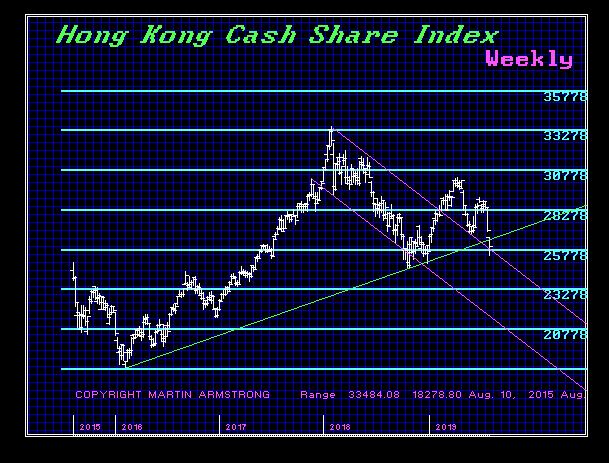
In Hong Kong, there are fears that China will send in troops and take military action, which would trigger an international crisis as fear in Asia as a whole will rise sharply over the future of economic stability. This could send the yuan crashing and even force the break of the Hong Kong peg. The Hong Kong share market peaked in January 2018. It has not made new highs in 2019 and remains at risk of breaking the 2018 low of 24540.43. That gives way and capital is showing its concern for the future of Hong Kong.

In South Korea, the high in the share market remains that of November 2017. We are trading below the 2017 low. A closing at year-end below that warns of lower lows into 2020. Here, the concern is the economic pressure on North Korea. North Korea holds a Tree Planting Day every March. The question is whether it could help regreen a largely deforested nation whose people face food shortages, deadly natural disasters, and bitterly cold winters. These economic pressures will eventually push the Supreme Leader into perhaps an attack on South Korea or face an overthrow himself.

We have a serious crisis building in Asia on three fronts. Then there is the chaos of Europe. The Democrats are complete idiots for claiming if Britain exits the EU, they will block any trade deal to punish Britain in support of Brussels. Instead of helping to solve the crisis, they are encouraging the EU not to renegotiate. The Democrats are basically saying — screw the Irish.

Right now, I am working from Asia in the middle of a real crisis with a front-row seat.


Asia 2019 Crisis


COMMENT: when you showed FX and stock markets of Asia in Rome, the computer did forecast quite some panic cycles for this summer – here we go !

JO

REPLY: I know. That’s why I am here.

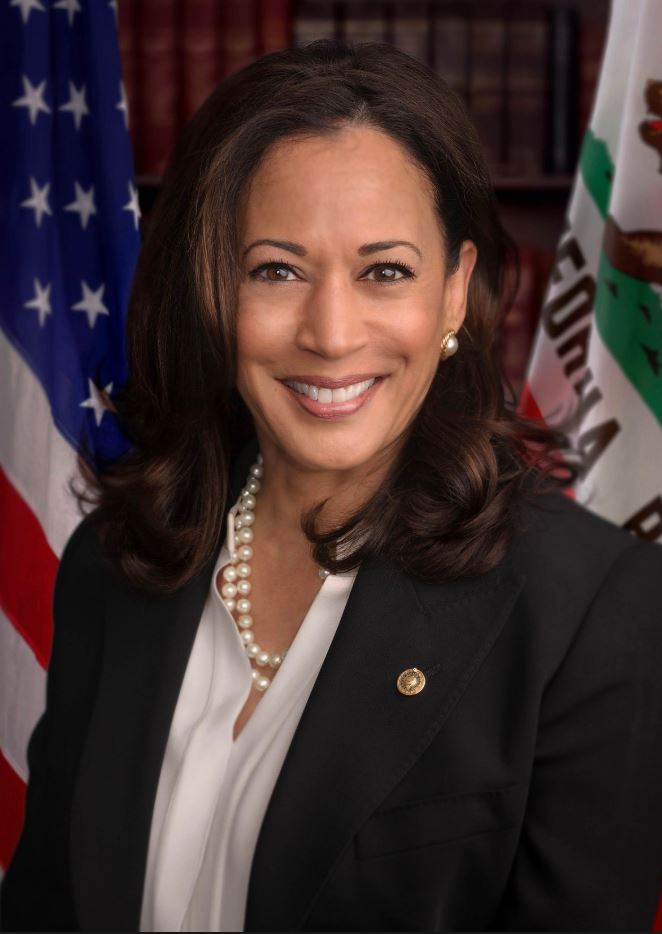
Kamala Harris – Medicare for All


QUESTION: Marty, what do you make of Harris’s Medicare-for-all plan joining Bernie Sanders? Is this just another way the destroy the society?

HY

ANSWER: There is a HUGE problem nobody seems willing to address. People compare US healthcare costs to those of places like Britain. The problem is that we have a private system and in Britain, the doctors work for the government. Harris’s plan is sort of a hybrid and it would be phased in over 10 years making it another government disaster. All we need to do is look at the VA hospitals. Government is simply incapable of managing anything and then misconduct and mismanagement are exempted from exposure when it is politically important for an election.

Unlike Sanders’, Harris’s plan would include a substantive role for private insurers, which would still be able to offer plans under a tightly regulated system, similar to the way that private insurers currently do through Medicare Advantage.

Additionally, it would transition Americans from the existing system to Medicare-for-all in 10 years, instead of four. And finally, it would use a slightly different payment mechanism: Harris backs several of the methods Sanders has suggested, including higher capital gains taxes, but would only impose taxes on households making $100,000 or more. Sanders’ plan, meanwhile, would impose taxes on households making $29,000 or more.

Healthcare is pricing itself out of the economy. We cannot create a hybrid system leaving private doctors yet 100% coverage under the current system. The VA hospitals prove government cannot be trusted with management. That means we have to create a system that is private yet not uncontrollable.

I would encourage private Medicare-for-all hospitals by treating them as a public utility and to create an incentive for existing hospitals to convert eliminating private insurance entirely. We do that by making them TAX-FREE and all procedures would be priced at a fixed rate with a standard profit margin. No more $500 for a $50 brace.

There are doctors who have been in private practice who have left and gone to the VA because it has become so insane. Many foreign immigrants come into the USA to get lucrative jobs as doctors with a medical degree. Then there are young people who want to become doctors because of the money rather than to help people. Nevertheless, there are a lot of people who want to help people and they would switch over in a heartbeat if we created a viable system.

I have had friends who had local private practices who have effectively been forced to join hospital groups. We have an explosion of Urgent Care centers created which compete against private practices. I have had discussions with those in hospital groups who have said decades ago that they would take that over private practices. That has been the trend.

We can encourage existing groups to switch to a Medicare-for-all system by making them TAX-FREE provided they agree to control over pricing as is the case in public utilities