Trump v the Federal Reserve


QUESTION: Mr. Armstrong; A spectacular call. You gave the day and the market bottomed within 100 points of your number. You always nail it. I find it curious how they blamed Trump and the Fed. Can Trump fire the head of the Fed? I really think he seriously needs to attend your WEC. He would have seen this move coming.

Congrats!

FG

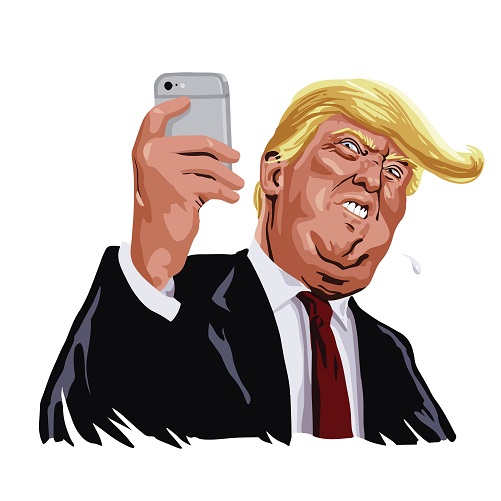
ANSWER: No. President Trump’s comments about firing Federal Reserve Chairman Jerome Powell are really off the wall. The problem is he has the classic TV talking heads view that stocks will crash with higher interest rates. Trump’s frustration with the central bank chief intensified following the interest-rate increase and months of stock-market losses. He is oblivious to the real crisis which is the low-interest rates are destroying the pension funds.

Meanwhile, the media blames Trump for his tweets and the talking heads attribute the decline to interest rates. Powell cannot publicly state why rates have to rise or he would create a real debt panic. Trump is clueless as is Capitol Hill with the monumental crisis in global debt.

For now, the news will bash the stocks when down, and when investors/traders see there can be no flight to bonds as quality, the real panic will begin. I wish I could reverse this mess, but reality states Trump’s handlers are rooting for the Deep State and would never let me near him.

The Democrats want the stocks to crash for they can blame Trump and try to win the losers to vote for their team. The shame here is this is not about running the nation or the economy to benefit all, it is just about winning the 2020 election. Since the ECM turns in January 2020 rather than the elections in November 2020, this is indicating that we may have a psychological shift prior to the elections.

December 25th & Holidays


QUESTION: Hi Marty. I was wondering if you knew about the ancient Roman

holidays? I was wondering if they had a big commercialized Holiday
like Christmas but pagan Roman? I figure since you fund a lot of
research you might have the best answer.
N
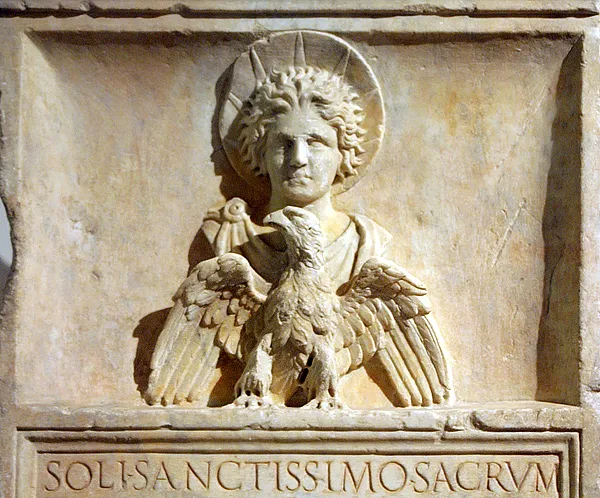
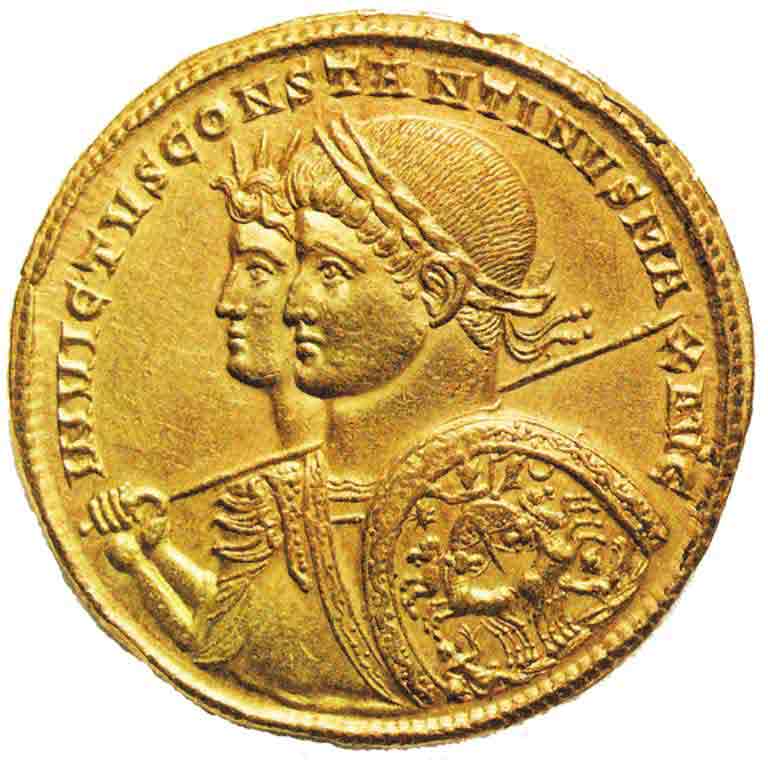
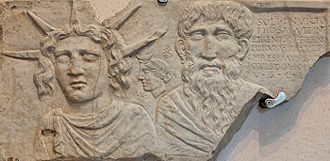
ANSWER: Yes, it was December 25th which was the feast of the sun god Sol. Here is a gold medallion of Constantine with Sol. Nobody knew the say Christ was born, so with most holidays, they rapidly lose their meaning. We have Veteran’s Day and Labor Day but they are just party days for most people. They lose their original meaning. That was the case with Sol. You could not remove a holiday that was always celebrated so they made it Christmas. The connection between Sol and Christ was that both were seen as supreme. Sol was names Sol Invictus meaning invincible for he appeared every day to give warmth and life..
As far as exchanging gifts or small figurines known as sigillaria, took place on the Holiday of  Saturnalia which was the feast of Saturn celebrated on December 17th. The two holidays became merged in December 25th with the commercial aspect of gift giving. The image of Sol became the Statue of Liberty.

EU Demand a 37.5% Reduction in CO2 Output from Cars by 2030


The EU has shocked the auto industry and came out based upon this new round of forecasts that humans will be extinct by 2050. Cars must now become considerably more climate-friendly by 2030. The carbon dioxide emissions of new cars must fall by 37.5% compared to 2021. The negotiators of the EU member states and the European Parliament agreed on this compromise on in Brussels last week.

With regard to light commercial vehicles, a CO2 reduction of 31% was agreed upon. For both vehicle classes, however, they also imposed a reduction of 15% must be achieved by 2025 as the first stage. This agreement actually comes as a surprise to many. The requirements are far more drastic than the car industry and the German government originally wanted. Naturally, Germany was not looking for such a reduction and were hoping to cap it at 30%. But all the extinction forecasts led the alarmist to demand 40% so the 37.5% was a compromise that was substantially above the level German expected.


MAGAnomics: Mastercard Releases First Tabulated Holiday Sales Report With Whopping 5.1% Increase


As CTH anticipated the first tabulated holiday sales report via Mastercard® shows the results of a very strong consumer confidence level.  The first report highlights a very strong 5.1% increase in holiday purchases:

“Wall Street is running around like a chicken with its head cut off, while Mr. and Mrs. Main Street are happy with their jobs, enjoying their best wage increases in a decade”…

~ Craig Johnson, president of Customer Growth Partners

(Via Wall Street Journal)  Shoppers delivered the strongest holiday sales increase for U.S. retailers in six years, according to early data.

Total U.S. retail sales, excluding automobiles, rose 5.1% between Nov. 1 and Dec. 24 from a year earlier, according to Mastercard SpendingPulse, which tracks both online and in-store spending with all forms of payment. Overall, U.S. consumers spent over $850 billion this holiday season, according to Mastercard.

[…] Retailers entered the holidays with momentum as online sales jumped 26.4% from a year earlier between the Wednesday before Thanksgiving through Black Friday.

[…] Sales at department stores fell 1.3% in the period tracked by Mastercard, in part due to store closings. Stores that mainly sell apparel, however, experienced robust sales, growing 7.9% during the same period. Overall, sales from bricks-and-mortar stores rose 3.3%.  (read more)

It will be interesting to see how the fourth quarter GDP growth is impacted by strong consumer sales.  Generally consumer sales make up two-thirds of GDP calculations; however, there was a strong front-loading of imported inventory at the end of the 3rd quarter (Sept).

The preliminary data suggests Main Street is indeed benefiting from a strong domestic economy.  Low unemployment, lower taxes and higher wages equals more disposable income.  That foundation likely fueled the increase in consumer spending throughout the holidays.

Wall Street is being impacted by their multinational reliance which is heavily weighted toward global investments.  Main Street is driven by the actual U.S.A. checkbook economic factors.  This is the modern disconnect.  After decades of Wall Street companies investing overseas, and generating investment products that are fundamentally detached from the U.S. economy, they do not benefit from a strong U.S. economy.  However, Main Street directly gains from internal U.S. economic growth.

It is likely retail stocks with a heavy weight on the U.S. consumer market will see a resurgence in stock market value.  Last year’s 2017 holiday sales were approximately $598 billion as measured by Consumer Growth Partners.  This year’s holiday sales look to be around $850 billion, as measured by the same data firm.

There really is a big disconnect between Wall Street and Main Street.

If you understand the basic elements behind the new dimension in American economics, you already understand how three decades of DC legislative, monetary and regulatory policy was structured to benefit Wall Street and not Main Street. The intentional shift in monetary policy is what created the distance between two entirely divergent economic engines.

REMEMBER […] there had to be a point where the value of the second economy (Wall Street) surpassed the value of the first economy (Main Street).

Investments, and the bets therein, needed to expand outside of the USA. hence, globalist investing.

However, a second more consequential aspect happened simultaneously. The politicians became more valuable to the Wall Street team than the Main Street team; and Wall Street had deeper pockets because their economy was now larger.

As a consequence Wall Street started funding political candidates and asking for legislation that benefited their interests.

When Main Street was purchasing the legislative influence the outcomes were -generally speaking- beneficial to Main Street, and by direct attachment those outcomes also benefited the average American inside the real economy.

When Wall Street began purchasing the legislative influence, the outcomes therein became beneficial to Wall Street. Those benefits are detached from improving the livelihoods of main street Americans because the benefits are “global”. Global financial interests, multinational investment interests -and corporations therein- became the primary filter through which the DC legislative outcomes were considered.

There is a natural disconnect. (more)

As an outcome of national financial policy blending commercial banking with institutional investment banking something happened on Wall Street that few understand. If we take the time to understand what happened we can understand why the Stock Market grew and what risks exist today as the monetary policy is reversed to benefit Main Street.

President Trump and Treasury Secretary Mnuchin have already begun assembling and delivering a new banking system.

Instead of attempting to put Glass-Stegal regulations back into massive banking systems, the Trump administration is creating a parallel financial system of less-regulated small commercial banks, credit unions and traditional lenders who can operate to the benefit of Main Street without the burdensome regulation of the mega-banks and multinationals. This really is one of the more brilliant solutions to work around a uniquely American economic problem.

♦ When U.S. banks were allowed to merge their investment divisions with their commercial banking operations (the removal of Glass Stegal) something changed on Wall Street.

Companies who are evaluated based on their financial results, profits and losses, remained in their traditional role as traded stocks on the U.S. Stock Market and were evaluated accordingly. However, over time investment instruments -which are secondary to actual company results- created a sub-set within Wall Street that detached from actual bottom line company results.

The resulting secondary financial market system was essentially ‘investment markets’. Both ordinary company stocks and the investment market stocks operate on the same stock exchanges. But the underlying valuation is tied to entirely different metrics.

Financial products were developed (as investment instruments) that are essentially wagers or bets on the outcomes of actual companies traded on Wall Street. Those bets/wagers form the hedge markets and are [essentially] people trading on expectations of performance. The “derivatives market” is the ‘betting system’.

♦Ford Motor Company (only chosen as a commonly known entity) has a stock valuation based on their actual company performance in the market of manufacturing and consumer purchasing of their product. However, there can be thousands of financial instruments wagering on the actual outcome of their performance.

There are two initial bets on these outcomes that form the basis for Hedge-fund activity. Bet ‘A’ that Ford hits a profit number, or bet ‘B’ that they don’t. There are financial instruments created to place each wager. [The wagers form the derivatives] But it doesn’t stop there.

Additionally, more financial products are created that bet on the outcomes of the A/B bets. A secondary financial product might find two sides betting on both A outcome and B outcome.

Party C bets the “A” bet is accurate, and party D bets against the A bet. Party E bets the “B” bet is accurate, and party F bets against the B. If it stopped there we would only have six total participants. But it doesn’t stop there, it goes on and on and on…

The outcome of the bets forms the basis for the tenuous investment markets. The important part to understand is that the investment funds are not necessarily attached to the original company stock, they are now attached to the outcome of bet(s). Hence an inherent disconnect is created.

Subsequently, if the actual stock doesn’t meet it’s expected P-n-L outcome (if the company actually doesn’t do well), and if the financial investment was betting against the outcome, the value of the investment actually goes up. The company performance and the investment bets on the outcome of that performance are two entirely different aspects of the stock market. [Hence two metrics.]

♦Understanding the disconnect between an actual company on the stock market, and the bets for and against that company stock, helps to understand what can happen when fiscal policy is geared toward the underlying company (Main Street MAGAnomics), and not toward the bets therein (Investment Class).

The U.S. stock markets’ overall value can increase with Main Street policy, and yet the investment class can simultaneously decrease in value even though the company(ies) in the stock market is/are doing better. This detachment is critical to understand because the ‘real economy’ is based on the company, the ‘paper economy’ is based on the financial investment instruments betting on the company.

Trillions can be lost in investment instruments, and yet the overall stock market -as valued by company operations/profits- can increase.

Conversely, there are now classes of companies on the U.S. stock exchange that never make a dime in profit, yet the value of the company increases. This dynamic is possible because the financial investment bets are not connected to the bottom line profit. (Examples include Tesla Motors, Amazon and a host of internet stocks like Facebook and Twitter.) It is this investment group of companies that stands to lose the most if/when the underlying system of betting on them stops or slows.

Specifically due to most recent U.S. monetary policy, modern multinational banks, including all of the investment products therein, are more closely attached to this investment system on Wall Street. It stands to reason they are at greater risk of financial losses overall with a shift in monetary/fiscal policy.

That financial and economic risk is the basic reason behind Trump and Mnuchin putting a protective, secondary and parallel, banking system in place for Main Street.

Big multinational banks can suffer big losses from their investments, and yet the Main Street economy can continue growing, and have access to capital, uninterrupted.

Bottom Line: U.S. companies who have actual connection to a growing U.S. economy can succeed; based on the advantages of the new economic environment and MAGA policy, specifically in the areas of manufacturing, trade and the ancillary consumer benefactors.

Meanwhile U.S. investment assets (multinational investment portfolios) that are disconnected from the actual results of those benefiting U.S. companies, and as a consequence also disconnected from the U.S. economic expansion, can simultaneously drop in value even though the U.S. economy is thriving.

Advertisements

The FBI and DOJ Were Working to Protect Hillary Clinton a Lot Longer Than Generally Discussed…


Arguably the biggest story of 2018 is how much we have learned about institutional political corruption within the U.S. Department of Justice (DOJ) and Federal Bureau of Investigation (FBI).  With that level of new knowledge in mind, some earlier stories about the DOJ and FBI take on an entirely different light.

Here’s one from late 2016 – You might not know the name Marc Turi but if you are familiar with the Benghazi Brief, or more specifically with Operation Zero Footprint, you’ll likely know the issues.

.

Marc Turi was the guy who constructed the covert weapons shipments into Libya to overthrown Mouamar Gaddaffi (2011) and send weapons to the Libyan Transitional National Government supported by Secretary of State Hillary Clinton.

Mustafa Abdel JalilDuring the original phase of the Libyan uprising, early February 2011, the first defector from the official Gaddaffi regime was a foreign justice minister named Mustafa Abdel Jalil.

Jalil became the international face of the anti-Gaddaffi elements within the Libyan government. However, Jalil was an extremist Brotherhood member and somewhat of a patsy. When we were outlining his ideology, and the extremists who were behind him, almost no-one was paying attention.

Following Jalil’s moves was ultimately what enabled CTH to construct the Benghazi Briefso accurately – because during the shell game Mustafa Jalil was the pea.

Justice Minister Mustafa Jalil (pictured above) formed a loose coalition of extremist forces within Eastern Libya; however, behind Jalil were Muslim Brotherhood members who were released from the Cairo prisons by Egyptian Muslim Brotherhood head Mohammed Morsi.

When Morsi opened the prisons and released the Brotherhood, the key person released was Mohammed al-Zawahiri.

Mohammed al-Zawahiri is the brother of al-Qaeda’s #2 guy Ayman al-Zawahiri who was/is running al-Qaeda from Afghanistan.

Mohammed Al ZawahiriAyman-Al-Zawahiri11

[left Mohammed al-Zawahiri (Egypt) – right Ayman al Zawahiri (Afghanistan)]

You might remember when the U.S. Cairo Egyptian embassy protest began on the morning of September 11th 2012 (before the Benghazi attack), it was Mohammed al-Zawahiri who was talking to CNN’s Nic Robertson about the release of the Blind Sheik (pictured below). This video has been scrubbed almost everywhere because it entirely undercuts the White House narrative on the origin of the Cairo Protests.

https://videopress.com/embed/6dthGNHv?hd=0&autoPlay=0&permalink=0&loop=0.

cairo protest 2cairo protest 1

After his release from jail, Mohammed al-Zawahiri crossed the border into Eastern Libya (Benghazi) and coordinated with Mustafa Abdel Jalil. This was the origin of the crisis started by Hillary Clinton, Leon Panetta, Susan Rice, Samantha Power and President Obama .

Jalil, the patsy, was presenting a sympathetic moderate appearance toward Western media and Western politicians like France’s Sarkozy and the U.S. Hillary Clinton.  However, Zawahiri and Jalil’s goal, openly stated after Libyan victory, was to get the U.S. and NATO allies to be the air force of al-Qaeda against their adversary President Gaddaffi.

Not only did Sarkozy, Clinton and eventually Obama, fulfill the request, they ended up shipping weapons (via CIA/Panetta) directly to Eastern Libya, to Zawahiri and Jalil.

The Muslim Brotherhood, via Mohammed Zawahiri, almost immediately directed many of those CIA weapons from Libya to his al-Qaeda brother in Afghanistan and to their ideological brothers in Syria who later identified themselves as ISIS.

Within weeks, U.S. aircraft operating in Afghanistan began seeing surface to air missiles used against them for the first time in a decade. Ultimately, this is the biggest issue with the weapons shipments and the reason no one in the Obama administration ever wanted to discuss the program.

benghazi 1Sarkosy with Clinton - whatz weeth you americanz nowMustafa-Abdel-Jalil-POTUS

Under the code name “Zero Footprint” Marc Turi originally drew up the plan to coordinate the flow of weapons from the U.S. through the intermediary of Qatar into Libya. Those U.S. weapons ended up in Libya and Syria being used by the enemies of the U.S., specifically al-Qaeda.  [All Citations within The Benghazi Brief]

In February of 2012 Asst. Secretary of State Andrew Shapiro admitted the State Department had been attempting to relocate and buy-back those weapons since August of 2011. However, on September 11th 2012, while those efforts were still ongoing, the attacks in Benghazi against the U.S. State Department Ambassador Chris Stevens took place, and four Americans were killed.

In 2014 the DOJ filed charges against Marc Turi essentially for non registered weapons shipments. Turi’s defense was that the weapons were unregistered because the State Department and the CIA needed covert cover. Elements within the CIA confirmed the basic outline for Turi’s assertion.

In 2015 Turi provided Fox News with documents and email exchanges he had with high-level members of Congress as well as military, and State Department employees to back up his claim that the Obama administration authorized in 2011, at the height of the Arab Spring, a covert weapons program that spun out of control.

Marc Turi’s legal defense team said if the DOJ was going to prosecute him for the arms shipments, his defense would necessarily reveal how Secretary of State Hillary Clinton was actually the driver of the entire program.

The DOJ tried to claim “national security” issues and keep the aspects relating to the U.S. State Department and Secretary Clinton under wraps during the pre-trial motions. However, in October of 2016 a federal judge ruled the defense was allowed to use the documented evidence Turi possessed to defend himself.

The case was slated to begin trial on November 8th, 2016; ironically the same day as the U.S. presidential election.  As a direct consequence of the October ruling, the DOJ announced they were dropping all the charges. The motive was transparently to protect Hillary Clinton:

[…] Federal prosecutors faced a Wednesday deadline to turn over discovery documents to the legal team of American Marc Turi, who had been charged with selling weapons to Libyan rebels. Late Tuesday, an announcement came that the government was dropping the case, which was set to go to trial on Nov. 8 – the day American voters choose between Clinton and GOP nominee Donald Trump. The move may avert a release of potentially explosive documents.

“I am glad this horrific five-year ordeal is over and I am pleased to be able to move on with my life,” Turi told Fox News in a statement. “The American public has the right to know that an injustice was committed against an innocent American.” (read more)

When all of this information originally surfaced in 2016 we knew the DOJ and FBI were bad, but we had no idea the level of corruption within both institutions.   Today, in 2018 we have an solid understanding of how politicized the DOJ and FBI were during the latter years of the Obama administration.

In hindsight, all of these political maneuvers to defend Hillary Clinton from scrutiny make a lot more sense.   Loretta Lynch, Sally Yates, James Comey and Andrew McCabe were part of a highly political apparatus within government working primarily toward political goals.

This Pandora’s box is open now; everyone can see it; it cannot be closed.   No-one will ever look at the DOJ and FBI the same way.   Both organizations are still in denial.  Even with Trump officials they still think they can simply cover-up their history and get away with it.

Perhaps they are right.  Perhaps they will all get away with it…. however, no-one will ever look at the DOJ and FBI the same way.

President Trump and First Lady Melania Deliver a White House Christmas Message…


U.S. President Donald Trump and First Lady Melania Trump deliver their Christmas holiday message from the White House.

.

Advertisements

President Trump Participates in Christmas Call To Military….


Earlier today President Donald Trump participated in a Christmas call to service members stationed at remote sites worldwide thanking them for their service to our Nation.

The participants were units from all five branches of the Armed Forces: •Army – Task Force Talon, Anderson Air Force Base, Guam; •Marine Corps – Marine Attack Squadron 223, Sheik Isa Airbase, Bahrain; •Navy – Naval Forces Central Command, Manama, Bahrain; •Air Force – 379th Air Expeditionary Wing, Al Udied Air Base, Qatar; •Coast Guard – Coast Guard District 7, Juneau, Alaska.

Geographical Morality versus Universal Morality


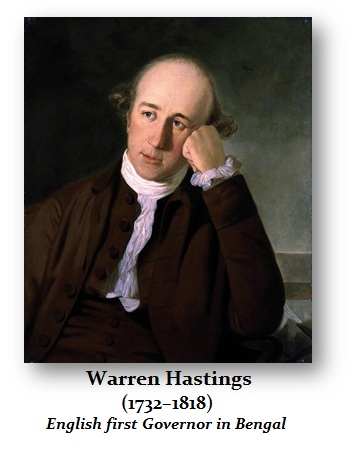
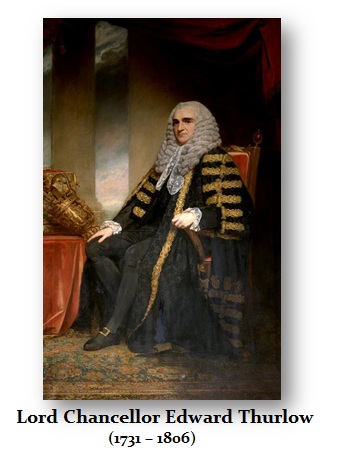
There has always been a question in law that was originally argued as the conflict of laws known as “geographical morality” versus “universal morality” that emerged in one of the longest running trials in British history. The case involved an East India Company corruption which was brought against Warren Hastings (1732-1818)between 1787 and 1795. Hastings had been governor of the company which, by the late 18th century, ruled large parts of India in Bengal. One of the charges against him was that he had received “considerable presents, for brokerage and bribes for the sale of office”, which Lord Chancellor Edward Thurlow, the judge, described as “the most odious and disgraceful species of corruption that could be charged”.

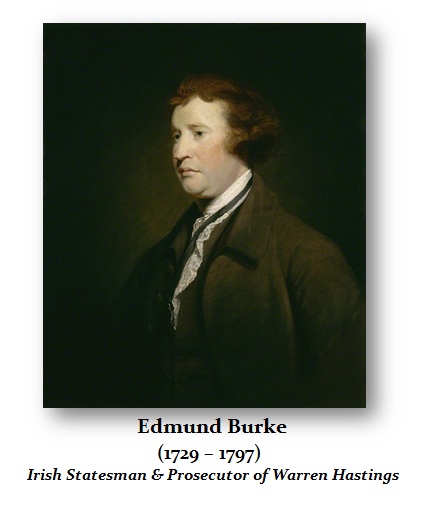
Nevertheless, Thurlow also objected to what he saw as a new doctrine introduced by Hastings’ chief prosecutor, Edmund Burke (1729-1797). Indeed, Burke argued that if a gift passed from an inferior to his superior in office, that was sufficient to be counted as a bribe. I mention this because the charges against Michael Cohen are similar whereby nobody has ever been prosecuted under such a theory before that the payment to someone to remain silent exceeds the $2700 limit on campaign contributions. In the case of Hastings, Thurlowthought a corrupt motive still had to be shown and Hastings was acquitted.

The most interesting aspect of this trial was a question never reached. Hastings’ trial raised the fascinating question about what Burke called “geographical morality” meaning a morality that was place-specific rather than universal. Hastings had argued that “actions in Asia do not bear the same moral qualities which the same actions would bear in Europe”. He could not, therefore, be judged on the same moral standards imposed in England. His acquittal thus left the idea of universal moralityup in the air.

Today, most countries respect the rule of law, except that of the United States because prosecutors and judges have absolute immunity even if they falsely accuse someone and demand the death penalty. They are the only people who can kill someone and remain above the law. The case of Mark Rich who fled to Switzerland could not be extradited to the USA because the crimes he was changed within New York were not recognized as crimes in Switzerland. This was the classic example of “geographical morality” versus “universal morality” where you cannot be charged with a crime in one country because you are a citizen when the act was not a crime where it took place.

German Hyperinflation & the Dawes Plan


The German Hyperinflation was by NO MEANS about inflation created by an increase in the money supply under the Quantity Theory of Money (QTM). Today, Angela Merkel has forcefully imposed Austerity upon the whole of Europe because she really does not understand what even caused the hyperinflation. It was at the Palace of Versailles outside Paris when Germany signed the Treaty of Versailles on June 28th, 1919 with the Allies, officially ending World War I. AT that time, the English economist John Maynard Keynes attended the peace conference. However, Keynes left in protest of the treaty becoming the first outspoken critic of what would prove to be the most punitive agreement that only set the stage for World War II and the rise of Adolf Hitler in 1933.

John Maynard Keynes wrote in his The Economic Consequences of the Peace, which he published in December 1919, that the harsh war reparation payments and other harsh terms that they were to impose on Germany by the treaty would lead to the financial collapse of the country. Keynes further warned that this Treaty would result in serious economic and political repercussions on Europe and the world as a whole. The political trend at the time refused to listen. This was all about punishing Germany.

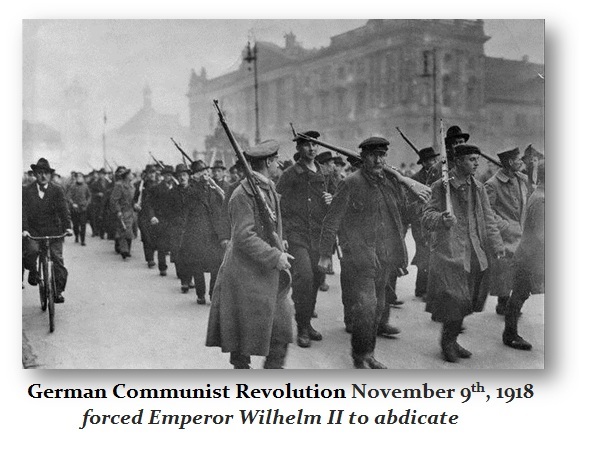
We must also understand that wars are created by politicians – not the people. Prior to the Treaty of Versailles signed in June 1919there was the German Communist Revolution which began the Weimar Republic. It was this 1918 German Communist Revolution which was inspired by the 1917 Russian Revolution that resulted in the overthrown of the monarchy in Germany ending the Emperors and the king of Prussia. The revolutionary period lasted from November 1918 until the adoption in August 1919. But what also seems to be omitted from many accounts taught in school, is the simple fact that the German government interfered in the Russian Revolution and was instrumental in creating the Russian Revolution.

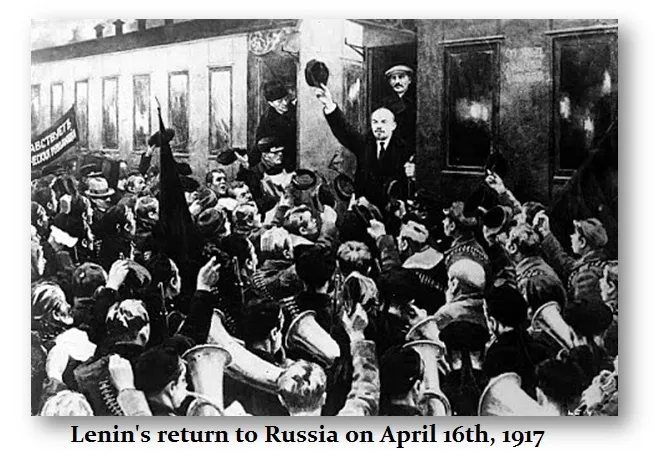
The German Emperor Wilhelm II Imperial Government actually feared that Russia would enter World War I. The rising communist movement in Russia was anti-war. Germany saw a chance for victory in Europe if it kept Russia out of the war. Hence, Germany supported the Communist anti-war sentiment of the Bolsheviks in Russia. Germany permitted Vladimir Lenin (1870-1924) to travel in a sealed train wagon from his place of exile in Switzerland through Germany, Sweden, and Finland to Petrograd. Since the start of the February Revolution in Russia, Lenin was trying to figure out a way to get back into Russia. Germany aided his return assuming he was anti-war and would thus keep Russia out of World War I. Lenin returned to Russian on April 16th, 1917. Within months of arriving, Lenin led the October Revolution in Russia and the Bolsheviks seized power and indeed Russia withdrew from the world war. According to Leon Trotsky, the October Revolution would not have succeeded without Lenin.

With the success of the October Revolution in Russia and the Dream of a new Marxist Utopia, the Germans entered into a civil war and invited Lenin to please take Germany. Clearly, the scheme of the Imperial German government had backfired. It not only was instrumental in creating the Soviet Union by turning over Russia’s socialist transformation decisively into the hands of the Bolsheviks, its plan led to the overthrow of its own hold on power. This is all recorded in contemporary newspapers (see New York Times Nov 11, 1918).

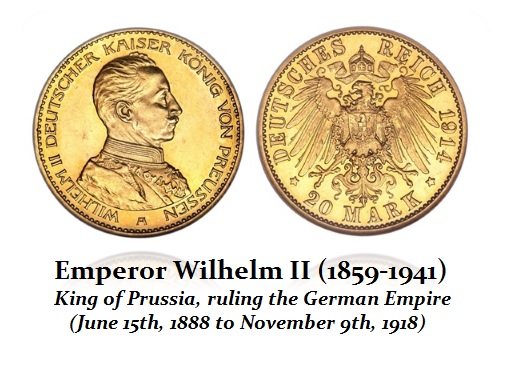
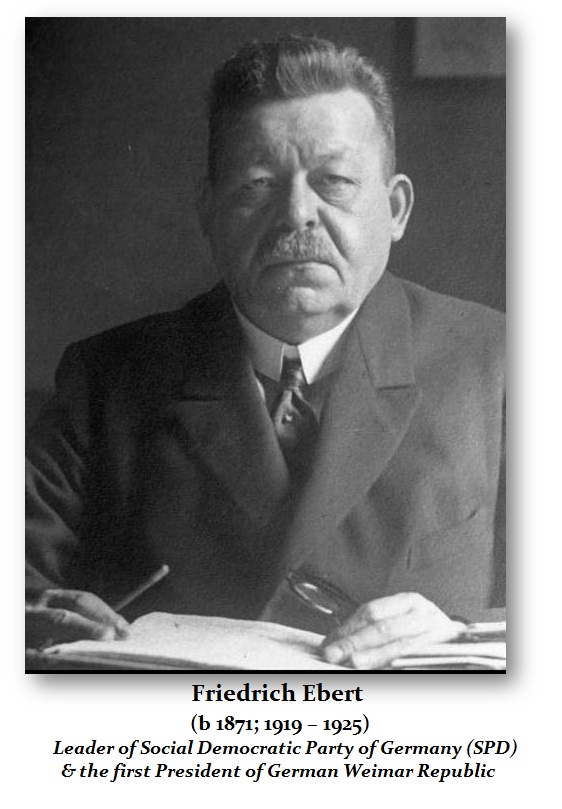
The Prussian Emperor Wilhelm II (1859-1941) found himself in the midst of troubling economic and social disorder. A series of mutinies by German sailors and soldiers undermined Wilhelm II’s government and he lost the support of his military which enabled the German people to revolt. Wilhelm II was forced to abdicate on November 9th, 1918. The very following day, a provisional government was announced composed of the Social Democratic Party (SDP) and the Independent Social Democratic Party of Germany (USDP). To this day, the SDP has remained as a major part against all opposition. Then in December 1918, German elections were held for a National Assembly with the goal of creating a new parliamentary constitution. On February 6th, 1919, the National Assembly met in the town of Weimar and formed the Weimar Coalition. They also elected SDP leader Friedrich Ebert (1871-1925) as President of the Weimar Republic who served from 1919 until 1925.

It was Friedrich Ebert who had to deal with the Treaty of Versailles. When the terms became known on May 7th, 1919, the German people rose in protest. Ebert himself did denounce the treaty as “unrealizable and unbearable” yet he understood that Germany was not allowed to negotiate nor reject the treaty. Ebert even asked Hindenburg if the army could put up a defense if the Allies renewed hostilities. Hindenburg said that the army was not capable of resuming the war even on a limited scale. Ebert then advised the National Assembly to approve the treaty, which it did by a large majority on July 9th, 1919.

The Treaty of Versailles commanded Germany to reduce its military, take responsibility for the World War I, relinquish some of its territories and pay exorbitant reparations to the Allies. It also prevented Germany from joining the League of Nations at that time. Thus, the treaty punished the German people for the sins of its government. Indeed, the military created World War I for it is generally accepted that Wilhelm II was largely just a ceremonial figurehead. During the Sarajevo crisis with the assassination of the Archduke Franz Ferdinand of Austria on June 28th, 1914, he was Wilhelm’s friend and he offered to support Austria-Hungary in crushing the opposition who assassinated the Archduke. Wilhelm went on his annual cruise of the North Sea July 6th, 1914. Wilhelm returned to Berlin on the 28th of July that year and eagerly read a copy of the Serbian reply. Wilhelm wrote his comment on it:

“A brilliant solution—and in barely 48 hours! This is more than could have been expected. A great moral victory for Vienna; but with it every pretext for war falls to the ground, and [the Ambassador] Giesl had better have stayed quietly at Belgrade. On this document, I should never have given orders for mobilization.”

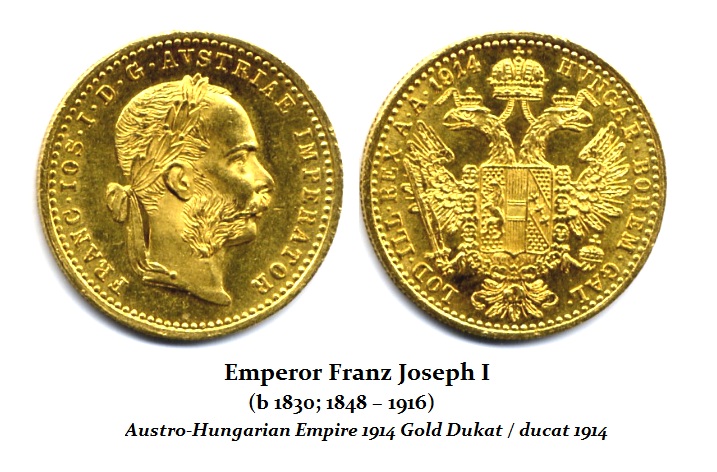
Wilhelm did not know at the time that the military had convinced the Emperor of the Austro-Hungarian Empire, Franz Joseph I (b 1830; 1848 – 1916), to sign a declaration of war against Serbia. As a direct consequence, Russia began a general mobilization to attack Austria in defense of Serbia. Wilhelm wrote a lengthy commentary containing his observations:

“… For I no longer have any doubt that England, Russia and France have agreed among themselves—knowing that our treaty obligations compel us to support Austria—to use the Austro-Serb conflict as a pretext for waging a war of annihilation against us … Our dilemma over keeping faith with the old and honourable Emperor has been exploited to create a situation which gives England the excuse she has been seeking to annihilate us with a spurious appearance of justice on the pretext that she is helping France and maintaining the well-known Balance of Power in Europe.”

In school, I remember being taught that World War I was the result of treaties among governments which then force one to come to the aid of another. Clearly, the Treaty of Versailles set the stage for World War II by its very crushing terms that nobody would be able to meet. The Treaty of Versailles set out a plan for reparations to be paid by Germany requiring to them to pay 20 billion gold marks, as an interim measure, with the final amount to be decided upon at later date. In 1921, the London Schedule of Payments set the German reparation figure at 132 billion gold marks divided into various classes, of which only 50 billion gold marks were required to be paid.

Meanwhile, the industrialists of Germany’s Ruhr Valley lost their factories in Lorraine. Germany had seized Lorraine back in 1870 and now this was to also part of the demands be returned to France. There was also an occupation of the Ruhr industrial area by France and Belgium. The Germans affected by the Treaty and the seizure of their property by France and Belgium now demanded hundreds of millions of marks as compensation from the German government and they paid the Ruhr Valley industrialists for their losses. This also contributed to the German Hyperinflation crisis and it effectively reduced the ability of the German economy to recover.

While the narrow neo-classical economic theory, hyperinflation is rooted in a deterioration of the monetary base, there is little attention paid to the collapse in public confidence that there is a store of value that the currency will be able to command later. Hence, people do not save and the velocity of money increases as people attempt to spend it as fast as they get it. There is a perceived risk of holding currency which rises dramatically at the core. Interest rates rise because they are the premiums people expect in the future when loans are repaid to make a profit. The hyperinflation that was set in motion by the Treaty of V was not limited to Germany. We also saw hyperinflations that I defined as a sharp and sudden doubling in prices (50% decline in the purchasing power of a currency) is less than three months in Austria and Hungary as well during this same period. In the case of Austria, hyperinflation began in October 1921 and continued into September 1922. In Hungary, the hyperinflation unfolded between March 1923 and February 1924. Philip Cagan’s (1956) The Monetary Dynamics of Hyperinflation widely accepted a definition which defines it as a price-level increase of at least 50% per month. However, even Cagan had to make exceptions because this cannot be defined precisely as some percent that is crossed will result definitively in hyperinflation. Therefore, the accepted definition remains rather vague and ill-defined.

In the case of Austria. here there was a separate treaty known as the Treaty of St. Germain which declared that the Austro-Hungarian Empire was to be dissolved. Under article 177 Austria, along with the other Central Powers, accepted responsibility for starting the war. The new Republic of Austria was to then consist of most of the German-speaking Danubian and Alpine provinces in former Cisleithania. Hungary was now split and Austria was commanded to recognize the independence of Hungary, Czechoslovakia, Poland, and the Kingdom of Slovenes, Croats, and Serbs. The Treaty of St. Germain also included ‘war reparations’ of vast sums of money that could also never economically be paid.

In the case of the Austrian Hyperinflation, the foreign-exchange value of the Austrian crown reflected the catastrophic depreciation of this event. In January 1919 one dollar could buy 16.1 crowns on the Vienna foreign-exchange market; by May 1923, a dollar traded for 70,800 crowns. According to the provisions of the Treaty of St. Germain, the newly created Republic of Austria had to overstamp the old paper money of the former Austro-Hungarian Empire still circulating in its territory, then had to replace the overstamped banknotes with new ones, and finally had to introduce an entirely new currency. To complete the first step, the circulating banknotes had to be overstamped with the inscription DEUTSCHÖSTERREICH, and new banknotes were also issued with this feature. Later, still under the name Oesterreichisch-ungarische Bank, banknotes were printed using the German-language clichés on both sides yet still displayed the DEUTSCHÖSTERREICH inscription. From 1920 onward, a new stamp appeared on banknotes: “Ausgegeben nach dem 4. Oktober 1920”. Next, in 1922 a new series of Krone banknotes was introduced with a completely new design to complete the second step. This series contained 1 Krone, 2, 10, 20, 100, 1000, 5000, 50 000, 100 000 and 500 000 Kronen, later 10 000 Kronen (1 000 000 Kronen was planned but not issued). Finally, in 1925, as the third step was to issue a new series of Austrian Schilling banknotes.

During this period, the printing presses worked night and day churning out the currency. At the meeting of the Verein für Sozialpolitik (Society for Social Policy) in 1925, Austrian economist Ludwig von Mises told the audience:

During the first five years after World War I, coal was scarce in Europe. France sought coal for its steelmakers from Germany. But the Germans needed coal for home heating and for their own steel industry, having lost many of their steel plants in Lorraine to the French. As a means of protecting their own growing German steel industry, the German coal producers—whose directors also sat on the boards of the German state railways and German steel companies—began to leverage high costs though shipping rates on coal exports to France.[3]

In early 1923, Germany defaulted on its war reparations payments and German coal producers refused to ship any more coal across the border. In response to this, French and Belgian troops occupied the Ruhr River valley inside the borders of Germany in order to compel the German government to continue to ship coal and coke in the quantities demanded by the Versailles Treaty, which, Germany which characterized as onerous under its post war condition (60% of what Germany had been shipping into the same area before the war began).[4]

This occupation by the French military of the Ruhr, the centre of the German coal and steel industries outraged the German people. They passively resisted the occupation, and the economy suffered, contributing further to the German hyperinflation.

Hyperinflation thus unfolded in Germany because those with money saw what Lenin had done in Russia and sent whatever wealth they had to other places, particularly the United States.  They got their wealth out through using foreign coins, but also collectibles such as stamps and coins in particular. By the end of World War II, most German rare stamps and coins were actually in the United States and were slowly making their way back to Germany during the 1960s and 1970s.

The Weimar Republic then just printed money to pay reparation payments and the entire system collapsed.

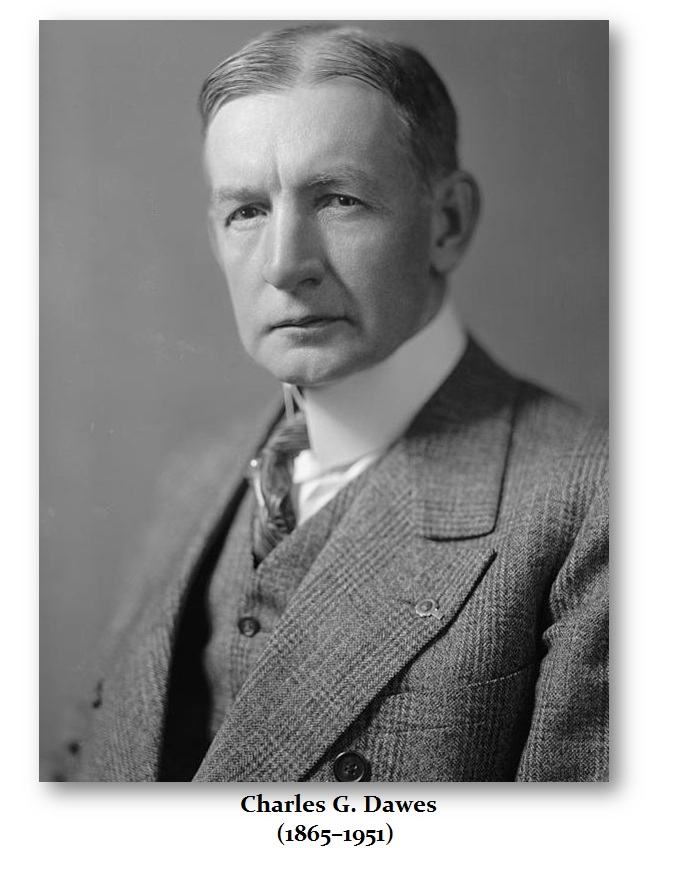
The Dawes Plan (as proposed by the Dawes Committee, chaired by Charles G. Dawes) was an initial plan in 1924 to resolve the World War I reparations that Germany had to pay, which had strained diplomacy following World War I and the Treaty of Versailles.

The Dawes plan provided for an end to the Allied occupation, and a staggered payment plan for Germany’s payment of war reparations. Because the Plan resolved a serious international crisis, Dawes shared the Nobel Peace Prize in 1925 for his work.

It was an interim measure and proved unworkable. The Young Plan was adopted in 1929 to replace it.