Posted originally on Sep 18, 2025 by Martin Armstrong |
The Federal Open Market Committee voted to lower rates by 25 bps at the September meeting, citing “that downside risks to employment have risen.” I reported in December 2024 that the computer had forecast a decline in employment during the incoming Trump Administration.
Based on the most recent data, the unemployment rate stands at 4.1%, while the measure of discouraged and underemployed workers remains steady at 7.7%. Per usual, the Bureau of Labor Statistics revised its calculations for previous months. August’s growth whittled down to 78,000, and September’s calculation came in at 223,000, marking a total decline of 112,000 reported jobs in those two months.
Unemployment began to rise during the Biden Administration. In fact, not a single job in the private sector was created during the Biden Administration. People blame Trump’s deportation and DOGE efforts for a declining workforce, but that is certainly not the problem. Data indicates that citizens are beginning to rapidly fill roles once taken by migrants. Tariffs are not the problem either, as companies are not hiring for the short term.
Workforce softness often leads to lower rates as the Fed mistakenly believes that cheaper borrowing costs will ignite business investment, consumer spending, and strengthen businesses to the point that they need additional employees. Borrowing costs are not the reason why companies are not hiring. CONFIDENCE is the problem, as businesses do not foresee expansion in the near-term, as consumers are grappling with massive debt and an increased cost of living.
The number of unemployed Americans now outnumbers available job openings. Data from July show 7.24 million unemployed Americans compared to 7.18 million job openings, marking the first time that the unemployed have outnumbered the number of available jobs since April 2021. Companies are outsourcing work to places like India or places where humans work with automated AI. Rising wages and regulations, topped with inflation and ever-rising taxes, have created an unfavorable business environment.
Companies are not looking to expand when they are working to stay afloat. Businesses are not eager to take on additional debt, albeit at a lower rate, if they do not see a decent ROI in the future.
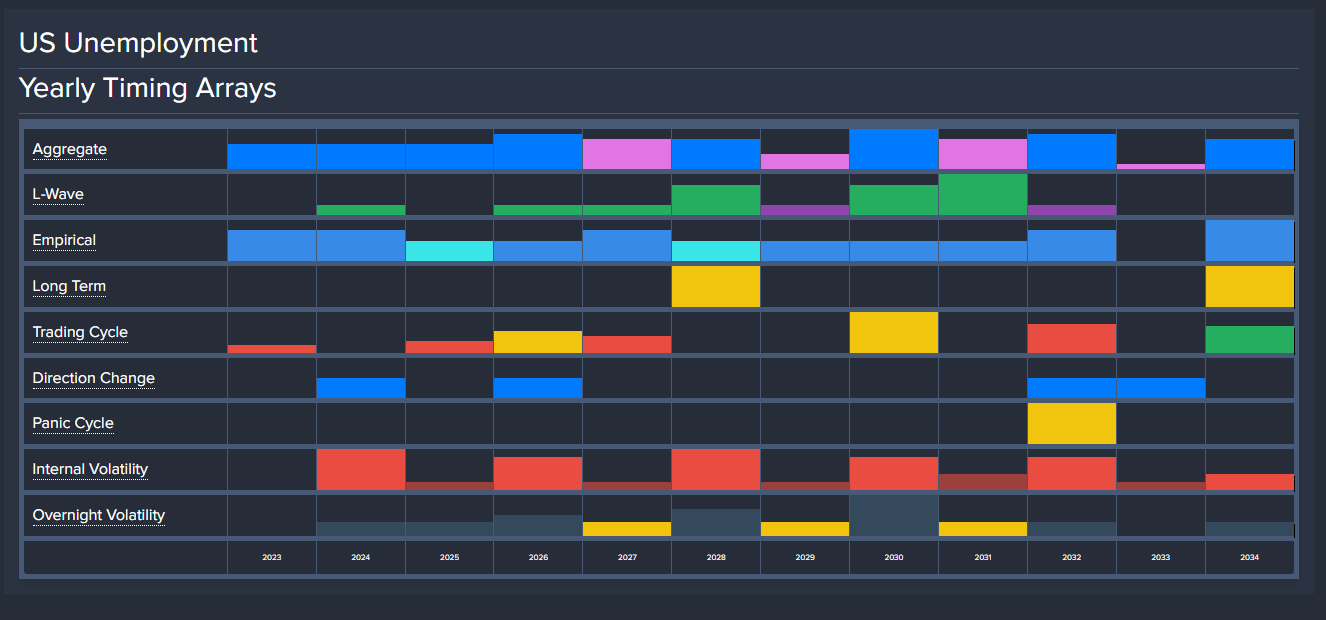
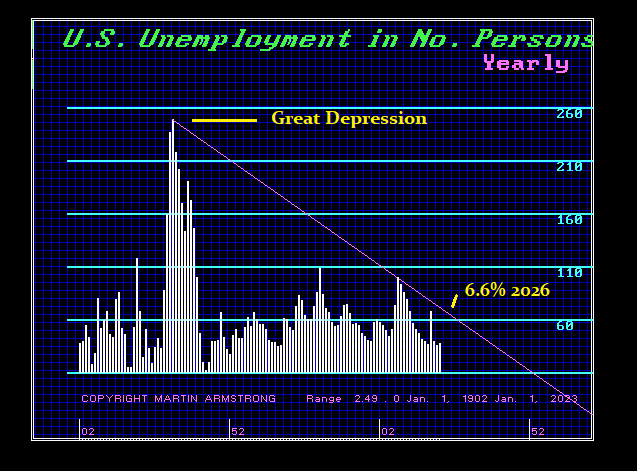
We have a Directional Change in 2026, which is an important near-term turning point. Look forward, and we see 2032 as a Panic Cycle with Directional Changes. The 2029/2030 period looks to be dominated by turmoil. Based on the model, unemployment will spike in the next year to nearly 7%. We are nowhere near Great Depression levels, but there will be a notable uptick in unemployment, coinciding with Panic Cycles globally in nearly every market.
Posted originally on Sep 18, 2025 by Martin Armstrong |
The average French pensioner receives a larger payout than working-aged adults. France has one of the highest replacement rate packages of any OECD nation at around 74% of average earnings. The French government spends an astounding 14% of GDP on the unsustainable pension system.
The average pension in France is around €1,626 gross per month, and pensioners earn around 2% more than the working adults propping up those pensions. The average American pensioner earns about a sixth less than working adults, UK retirees earn about a fifth less, while Australians earn around a third less than their working counterparts, according to Fortune. The amount demanded by retirees has increased proportionally over recent years, as have taxes on the working public, who now pay 8.55% of their income into the pension system.
Widespread pension reform protests took place in 2023 when we saw protesters attempt to burn down the BlackRock office in Paris after the retirement age was raised from 62 to 64. “The meaning of this action is quite simple. We went to the headquarters of BlackRock to tell them: the money of workers, for our pensions, they are taking it,” a protestor told a CNN affiliate. The protest was organized and the message was clear. The Parisians are not allowing government mismanagement to change their retirement plans. They have been promised an easy retirement and paid into the system. The government has been unable to fulfill its promises and the people perceive any reforms as an unfair betrayal.
The deficit for pensions is estimated to grow to €15 billion by 2035 and then to around €30 billion a couple of years later. The European Union requires member states to maintain a budget deficit below 3% but only 17 of the 27 members have met that target. French Economy Minister Eric Lombard is eager to lower the public deficit, aiming for 5.4% of GDP in 2025, followed by 3% in 2029.
France is facing a fiscal crisis of its own making. The government has consistently failed to address the core structural issues, instead relying on higher taxes and superficial spending cuts, which only serve to undermine economic growth. The public deficit, now surpassing 5.6% of GDP, is spiraling out of control, and the government’s projections to bring it under the EU’s arbitrary 3% threshold by 2029 are nothing more than wishful thinking. History has shown that governments never truly cut spending—they merely shift the burden through taxation, stifling private sector expansion.
This is why politicians want war with Russia as a diversion. They desperately need an excuse in the face of a crumbling monetary system. No one is buying government debt. The solution is to rob the pension funds to eliminate the need to issue bonds to cover expenses. That move will only undermine confidence in the EU and result in further civil unrest. Negative interest rates have robbed savers of income since 2014, but the world refuses to move away from Keynesian economics.
France and the rest of the Western world have a growing aging population paired with a massive decline in birth rates. These nations attempted to open borders to compensate for the lack of workers, but instead, the public became saddled with more debt as they were forced to pay for the newcomers.
Nothing is more inflationary than war, and Macron is eager to send off French troops to Ukraine as he closely aligns with Brussels to spur on the next major war. Confidence will decline, capital will flee, and interest expenditures will continue to rise. France risks a debt crisis that will only accelerate the collapse of the EU’s financial system. As I’ve warned before, the trend is clear: governments refuse to reform until they are left with no choice. The question is not if, but when, France will face the reckoning of its fiscal mismanagement.
I have created this site to help people have fun in the kitchen. I write about enjoying life both in and out of my kitchen. Life is short! Make the most of it and enjoy!
This is a library of News Events not reported by the Main Stream Media documenting & connecting the dots on How the Obama Marxist Liberal agenda is destroying America