U.S. Senator Rand Paul supports the removal of John Bolton as National Security Advisor due to an abject difference of foreign policy with Bolton. Also, Senator Lindsey Graham cautiously supports the removal of John Bolton from a concessionary position that Trump is correct, and the endless foreign intervention needs to have some conclusion.
Beyond the orange-man-bad democrats, and their new found political love for Bolton (their former nemesis), interestingly the strongest DC and media voices against Bolton’s removal are foreign policy voices primarily concerned about supporting Israel (Ted Cruz, Mark Levin etc).
.
So far today CTH notes no-one is mentioning Bolton’s failed policy on Venezuela. That policy/effort was all John Bolton; ….and that brings another point into the picture.
Can you imagine what interventionist policy Bolton was starting to formulate surrounding Hong Kong?
Typical war-hawks like John Bolton, and those within the ‘industrial military‘ circle, do not value the more forceful use of economic strategy to accomplish national security objectives. The economic approach is easily President Trump’s preferred weapon; and right now the biggest geopolitical confrontation is the U.S. -v- China.
Hong Kong is a part of the geopolitical dynamic; but it is a part President Trump is able to carve out from the larger issue. No doubt the Bolton approach would have been to send troops in/around Hong Kong, eventually drawing a conflict with Beijing. A person like Bolton would be exactly the wrong person in the game of economic chess. In my opinion Trump’s China trade strategy is much better off without Bolton mucking it up.
Here’s Graham:
.
With Bolton gone, might we see Tom Bossert re-enter the administration?
This afternoon President Donald trump delivers remarks at the 2019 National Historically Black Colleges and Universities Conference at the Renaissance Washington, D.C. Downtown Hotel. Anticipated start time is 2:15pm EDT.
UPDATE: Video and Transcript
.
[Transcript] THE PRESIDENT: Thank you. It’s a great honor to be here with you. And Ja’Ron, you’re a special person — a great friend of my daughter and my son-in-law. And he’s done an incredible job.
And it’s really wonderful to be with the unbelievable leaders of our nation’s Historically Black Colleges and Universities. It was a very important trip for me to be here with you today. A couple of people aren’t happy because I had to cancel them out, but that’s okay. We don’t mind.
I’m truly honored to be here today to celebrate the vital and cherished role of the HBCUs in American life. Together, we will ensure that HBCUs continue to thrive and prosper and flourish for the countless generations to come. For more than — (applause) — it’s true. We’re doing it. And you know we’re doing it. We’ve done a lot, and we’re going to do a lot more.
For more than 180 years, HBCUs have strengthened our country and called America to greatness. Your institutions have been pillars of excellence in higher education and the engines of advancement for African American citizens. They’ve been incredible, the job they’ve done. (Applause.)
You have shaped American leaders, trained American legends, pioneered American innovations, empowered American workers, built American communities, and you’ve made all of America very proud of you and the job you’ve done, and all of those great students that have learned so much from your wisdom. Thank you very much.
This nation owes a profound and enduring debt of gratitude to its HBCUs. (Applause.) So true. And that is why we gather to pay tribute to this remarkable legacy and to renew our commitment to protecting, promoting and supporting HBCUs like never before. And I think you’ve seen that. You’ve seen this administration’s commitment bigger and better and stronger than any previous administration, by far. So that’s very important.
My administration is determined to fight for you and the noble institutions you represent each and every day.
We’re grateful to be joined this afternoon by a tireless supporter of HBCUs, Secretary Betsy DeVos, who is in the audience some place. (Applause.) Betsy, thank you. Thank you, Betsy. Thank you.
I also want to recognize our terrific executive director of the White House HBCUs initiative, Johnathan Holifield. (Applause.) Where is Johnathan? (Applause.)
And I want to tell you, Evander Holyfield is a friend of mine and he could fight. (Laughter.) You always knew when went in the ring with Evander, he may be 50 pounds lighter, but you knew it was going to be a tough night out there for you. But he was something.
I just spoke with my Board of Advisors for HBCUs. And let me thank our amazing Chairman, Johnny Taylor. Johnny, thank you very much. (Applause.) Great job, Johnny.
And also, our Board member here today — and we have a few of them:
Aminta Breaux. (Applause.) Aminta, thank you. Thank you. Thank you very much.
Phyllis Dawkins. (Applause.) Phyllis, thank you. Great job, Phyllis.
Rodney Ellis. (Applause.) Rodney, thank you. Thank you very much, Rodney.
Ronald Johnson. (Applause.) Thanks, Ronald. Thank you.
Harold Martin. (Applause.) Thank you, Harold, very much.
Bernard Milano. (Applause.) Connie Rath and Billy Hawkins. (Applause.) Thank you. Thank you all.
And, Billy, I will always remember the Talladega Marching Band in my inaugural parade. That was something. You topped them all. That was a great — that’s a great group. Thank you very much. They were fantastic.
This afternoon, we are also thrilled to be joined by more than 40 students who were selected as the 2019 White House HBCU Competitiveness Scholars. Would you please stand so that we can congratulate you and applaud? Where are you? (Applause.) See, that’s what it’s all about, when you get right down to it, isn’t it?
The inspiring tradition of HBCUs dates back to the Civil War era, when pastors, abolitionists, and men and women who had escaped slavery founded many of the first colleges and universities for African Americans. That’s a long time ago.
In 1861, a free African American woman, Mary Peake, taught 20 students under an oak tree near a Union base in Virginia. That tree still stands tall and mighty on the campus of Hampton University. (Applause.) Good school.
In the face of immense hardship and painful injustice, your schools rose to the very pinnacle of academia, becoming many of America’s finest and most acclaimed institutions of higher learning. Tremendous respect everybody has for the work that many of you have done — almost everybody in this room has done. I can tell you.
HBCU graduates have improved and uplifted every feature of American society. From your halls came great Americans like Booker T. Washington, Rosa Parks, Ida B. Wells, Supreme Court Justice Thurgood Marshall, NASA mathematician Katherine Johnson, acclaimed inventor Lonnie Johnson, Air Force General Daniel James Jr., NFL Hall-of-Famer Jerry Rice, and legendary Coach Eddie Robinson. Eddie Robinson was a good coach. (Applause.) I think Eddie Robinson won more games than anybody, didn’t he? (Laughter.) Is that true? Is that true? I think so.
And we are — by the way, have Scott Turner, speaking about good football players. Where is Scott? He’s leading such a great charge with the Opportunity Zones. (Applause.) Thank you, Scott. He’s a great, great gentleman. He works so hard. He goes — he’s all over the place. I say, “Where’s Scott today?” He’s in about six cities at one time. (Laughter.) And the Opportunity Zones have really caught on. Been incredible. Thank you, Scott.
During World War II, Tuskegee University trained the young Americans who would become the legendary Tuskegee Airmen. That was great group of people.
Reverend Martin Luther King, Jr. graduated from Morehouse College. (Applause.) That’s great.
And African American students helped plan the Montgomery Bus Boycott in the basement of another HBCU, Alabama State University. (Applause.)
Our Historically Black Colleges and Universities have always challenged our nation to be better and braver, to do what is right, to dream bigger, aim higher, and always be bolder in pursuit of what is just, decent, and true.
HBCUs represent only 3 percent of America’s higher education institutions. You get graduates — 80 percent — think of that: 80 percent of African American judges, 40 percent African American engineers, and more than 50 percent of African American doctors. That’s an incredible statement. From 3 percent overall to 50 percent and more for doctors. (Applause.) That’s an incredible statistic. It’s an incredible achievement.
My administration is deeply devoted to advancing this amazing legacy of success, commitment, and contribution to our nation. You have never stopped working to improve this country, and you deserve a government — you have to just keep going. You really do deserve a government that never stops working for you. And you never stop working for it. You’re amazing people in this room. Incredible people. And I congratulate you for it. (Applause.)
That is why, in my first weeks in office, I took action to make HBCUs a top priority once again. I signed an executive order to move the federal HBCU initiative to the White House, right where it belongs. (Applause.)
Over the past two and a half years, we have listened and learned from you, and we have taken very, very major action. I think you know that. I signed legislation to increase federal funding for HBCUs by a record 13 percent. That was the highest ever done. (Applause.)
When members of the Thurgood Marshall College Fund asked us to lift the ban on Pell Grants for summer classes, I included that change in my budget, and we worked with Congress and we got it done. (Applause.) And, you know, we had a little opposition to getting that done, I must tell you. But we got it done.
In the fall of 2017, we met with leaders of HBCUs devastated by Hurricane Katrina: Dillard University, Southern University at New Orleans, Tougaloo College, Xavier University of Louisiana.
And less than a year later, my administration took action to fully forgive their disaster loans, so these colleges could get out of debt and back to their critical mission of educating our nation’s future leaders — and truly great leaders they will be. So, congratulations. (Applause.)
Last year, my administration also worked with UNCF and key members of Congress to provide capital finance loan deferment to 13 HBCUs that presented rigorous plans for growth. In total, over the last two and a half years, through the Capital Financing Program, we have provided more than $500 million in loans to HBCUs. (Applause.) At a very good interest rate, I might add. (Laughter.)
Right here in our nation’s capital, we delivered an additional grant of $15 million to the only federally chartered HBCU — a great school, with a great reputation, that was already mentioned once today: Howard University. It really is; it’s a great school. (Applause.)
I signed a farm bill that included more than $100 million for scholarships, research, and centers of excellence at Historically Black Colleges and Universities that are land-grant institutions. One hundred million dollars. (Applause.)
And thanks to Secretary DeVos leadership and her work with many of you, we’ve also made unprecedented progress to reduce unnecessary regulatory burdens so that your institutions are free to innovate and offer more flexible ops — you know, options for the students. And you’re doing that. You’re doing a lot of great options. I looked at some before. They’ve got a lot of really great options, and that’s what you need.
Today, I’m thrilled to announce another major action we’re taking to protect HBCUs. Previously, federal law restricted more than 40 faith-based HBCUs and seminaries from fully accessing federal support for capital improvement projects. This meant that your faith-based institutions, which have made such extraordinary contributions to America, were unfairly punished for their religious beliefs. Did we know that? Did everybody know that? Because it was — it was hap- — that was not good.
This week, our Department of Justice has published an opinion declaring such discriminatory restrictions as unconstitutional. (Applause.) It was a big step. And from now on, faith-based HBCUs will enjoy equal access to federal support. (Applause.)
When I came into office, I directed the entire federal government to develop a strategy to support Historically Black Colleges and Universities. Today, 32 federal departments and agencies have released statements of priority that are helping your institutions receive resources and support that you deserve.
To give just a few examples, NASA is expanding outreach to HBCU students who want to become scientists, engineers, and even astronauts. I don’t know about the astronaut. I don’t want to be an astronaut. How about you? Does anybody want to be an astronaut over there? (Laughter.) Huh? I don’t see too many hands going up. (Laughter.) I see one. There’s one brave person over there. That’s pretty great though. But what we’ve done there is terrific. And for those that do want to be an astronaut and those other wonderful things, it’s now possible.
The Departments of Labor and Education are working with HBCUs to increase apprenticeship opportunities. Our federal budget also prioritizes HBCUs in our plan to give more students access to state-of-the-art training in high-demand fields, such as science, technology, engineering, and math. We want to help each student have the experience they need to get a tremendous job, enjoy a rewarding career, and join our great national effort to rebuild America, which is what we’re doing. (Applause.)
The fierce dedication to strengthening HBCUs is a core part of my administration’s unwavering focus on the project of national renewal.
We are working every day to make decisive decisions so that we can really avoid many of the failures of the past. There have been so many failures. It just didn’t work. And a lot of that has been our government’s fault; they didn’t allow it to work. We are fixing decades of mistakes made by politicians in both parties who put the needs of other countries before our own country, and who put special interests before the interests of everyday, hardworking people.
Past leaders spent trillions of dollars in the Middle East, but they let our citizens suffer, our middle class languish, and our neighborhoods fall into total disrepair. And they didn’t take care of our — you know, our colleges. I mean, our colleges at different levels. They didn’t take care of a lot of things.
The Washington establishment enacted ruinous trade policies that devastated millions of hardworking families and inflicted deep economic pain on many African American communities. Both leaders in both parties let China and other nations loot our jobs, raid our factories, and shatter the dreams of our citizens. China would take out of our country more than $500 billion a year for many years and steal our intellectual property. Things are much different today.
More than half a million African Americans lost good-paying manufacturing jobs after a twin disasters of NAFTA and China’s entrance into the WTO. That’s the World Trade Organization. That was when it all began to happen. These were not good deals. You’re going to all make better deals than that. You have to promise me, when you’re up here someday — one of you or two of you or three of you, at different times, of course. (Laughter.) You’ll be up here. We don’t do any tries over here, right? But you’ll be at different times, but you’ll do much better than the past.
But under this administration, the era of economic surrender is over. We are bringing back our jobs, we’re bringing back our wealth, and we are bringing back our dignity. The stock market is getting ready, it seems, to hit the 118th day. We have had 118 records, where we hit the highest point. And three weeks ago, they were saying, “Recession, recession.” They were hoping for a recession because maybe that would hurt our chances of doing all of the things that we’re doing.
But we’re getting ready, it looks like, to hit another great milestone, another great all-time stock market record, which to me means jobs, more than anything else. Forget about stock prices; it means jobs.
After years of building up other countries, we are finally building up our country, standing up for our workers, and fighting for our forgotten communities.
The first and highest duty of government is to take care of its own citizens. African Americans built this nation through generations of blood, sweat, and tears. And you, like all of our citizens, are entitled to a government that puts your needs, your interests, and your families first. (Applause.)
The first agenda and the America First agenda is about the sacred bonds of love and loyalty that unite all Americans. That is why we’re joining forces with HCBUs to invest in the workforce of the future. Our Pledge to the American Worker has already secured commitments for 13 million employment and training opportunities for American citizens. It’s been an incredible success. We are getting people off of the sidelines and back into the game. Last month alone, nearly 600,000 Americans entered the labor force. You read that just the other day.
To unleash small business creation and produce millions of jobs, we passed massive tax cuts and launched a historic regulatory reduction campaign. We cut more regulations than any President in history, even though they’ve been there for, in many cases, a lot longer than I have.
Thanks to these pro-American trade, tax, and regulatory policies, the economy is booming and wages are rising, and our country is very much respected again. Last month, the unemployment rate for African Americans hit yet another all-time, historic low. In the history of our country, it’s the lowest number we’ve ever had. (Applause.)
And this is very exciting, especially for the folks in the room and those young folks over there that are so great and so smart: African American youth unemployment has reached the lowest rate ever recorded in the history of our country. (Applause.)
So, in other words, it’s a good time to be looking for a job, right? You picked the right time.
For the first time ever, most new hires are minorities and predominantly women. So, that’s a big statement. Most are minorities and women.
The African American poverty rate also reached a new record low in the history of our country. The lowest poverty rate. We are — (applause) — that’s something. I don’t know, when I’m on that debate stage with whoever I’m on, these are pretty good numbers to, you know. (Laughter.) Who is going to beat these numbers? Please tell me. (Laughter.)
We’re working hard to ensure economic opportunity extends to all Americans, including those who have been released from prison. With employers and educational centers like HBCUs, we are supporting Second Chance hiring policies so that former inmates get a new shot at life. (Applause.) And we’re very proud of this. I have to say that it’s never been like this before. There’s never been anything where you get out of prison and they weren’t able to find jobs. They had that stigma and they weren’t able to find a job. Nobody would hire them.
And today — and a lot of it has to do with the fact that the employment numbers are just about record low for country. And it’s been incredible. The success has been incredible, and the quality has been incredible. So many employers are saying, “I wish I knew about this. I would have started it years ago.” So it’s been an incredible time. And there’s never been a time like it, as far as people getting out of prison and getting a real shot at life. So we’re very proud of that.
This is just one more way that we live by those two simple and really crucial rules: Buy American and hire American. (Applause.) For this reason, we’re also pursuing immigration reforms to protect jobs and wages for American workers, especially those who have been left behind.
We’re fighting to give every parent of every student access to school choice, because no American child deserves to be trapped in a failing school. (Applause.)
To remedy unfair sentencing laws that disproportionately hurt African Americans, last year I proudly signed groundbreaking criminal justice reform into law, a bipartisan FIRST STEP Act. So we signed that just recently. (Applause.) They were never able to get it, and we got it.
We’ve taken historic action to confront the opioid crisis. And last year, our nation saw the first decline in drug overdose deaths in more than 30 years.
My administration — that’s a big thing. It’s such a problem for our country and such a problem for countries all over the world. It’s a tremendous problem, the drug problem.
My administration has also launched an unprecedented campaign to spur investment and revitalization in our country’s most underserved communities.
Under this vital initiative, America’s governors have designated nearly 9,000 communities as Opportunity Zones. And that’s where Scott has been so incredible. About half of all of the HBCUs are located in these Opportunity Zones.
Scott, come up here for a second. Will you just come up? This guy is so unbelievable. (Applause.) He’s so unbelievable, the job he’s doing. I only ask, do you sleep? But they ask me that question too, “Do you sleep?” He sleeps, I think, maybe less than I do. Come up, up Scott. He doesn’t need stairs. (Applause.)
MR. TURNER: Well, thank you, Mr. President. And very briefly, Opportunity Zones — this initiative called Opportunity Zone is really unprecedented in our nation’s history. You take private capital and you partner it with public investment to bring about real revitalization and transformation in our communities.
And it’s unique because it’s not just economic development; it’s community development. See, poverty, it has no favorite. Poverty is in the black community. It’s in the white community. It’s urban. It’s rural. It’s tribal. It’s suburban.
We’ve been to 38 cities in the last 15 weeks, and I’ve seen some of the worst cities in our country, from coast to coast, tip to tip, and even in the Heartland. And one thing I’ve learned is that poverty does not care…
what you look like. It doesn’t care where you come from. But I’ve had the old saying that I like to teach my son: We fight fire with fire.
The name of this council is the White House Opportunity and Revitalization Council. “Revitalize” means to imbue with new life. It means to reinvigorate, to reenergize. Revitalization also has no color. Revitalization has no party, ladies and gentlemen. Revitalization starts in the heart of every man and every woman.
And our goal here, our mission — and thank President Trump and his administration for the courage and the vision for this — our mission is, yes, it’s job creation, it’s new businesses, it’s housing, but it is the eradication of poverty in our nation — a systemic problem that has crippled this nation for a long time.
And we’re here, and we need all of you. We spoke to the HBCU Conference yesterday. We need everyone in this room, one, to pray for our leadership, to pray for what we’re doing, and number two, see how you can get involved to bring about revitalization where you live. Doesn’t matter black, white, Democrat, Republican — it doesn’t matter. Revitalization starts in the heart.
I’m grateful to steward this council, and I’m going to try to reach as many people as we can. Because at the end of the day, long after all of us have gone to glory, this has to have a generational impact. And history will tell the story — (applause) — of revitalization. God bless you. (Applause.)
THE PRESIDENT: Thank you, Scott. Is he great? He is something. What a job you’re doing, Scott. Thank you very much. What a job.
I know that each and every one of you shares the same commitment to improving our communities and building a future of limitless opportunity.
For nearly two centuries, America’s Historically Black Colleges and Universities have done exactly that. You have empowered millions of students to thrive in their careers, start a business, own a home, and raise proud, strong, and loving families.
That is your magnificent legacy, and that is the mission we are determined to help you carry on. We’re right by your side.
So together with Historically Black Colleges and Universities, we will power this nation to new heights. Heights like nobody would’ve imagined.
We will reward hard work and innovation in every field.
We will champion freedom, justice, equality, and opportunity for all.
We will pursue greatness together, as communities, as citizens, and as one United States of America.
Every day of my presidency, we’ll strive to give every child, of every background and every race, religion, color, and creed, the best chance to reach that beautiful American Dream.
As we do, I pledge that we will always support the institutions which help make these goals possible: our nation’s wonderful HBCUs. We will never let you down and we will never stop fighting for you.
And I just want to thank everybody for being here today. It’s a great honor.
God bless you. And God bless America. Thank you very much. Thank you. (Applause.)
Secretary of State Mike Pompeo and Secretary of Treasury Steven Mnuchin hold a press conference to discuss terror related issues and national security. The Press Conference relates to This Executive Order.
UPDATE: Video and Transcript Added
.
[Transcript] – SECRETARY MNUCHIN: Hello, everybody. So, Secretary Pompeo and I are here today to talk about the President’s new executive order. And after that, we’d be happy to take a few questions.
So, today, the President signed a new executive order which underscores his decisive leadership in fighting global terrorism. This administration has intensified our counterterrorism sanctions effort. We’ve designated more than 230 individuals and entities in 2018, the most designation of any year in the last 15 years.
The new executive order, “Modernizing Sanctions to Combat Terrorism,” which was signed today, greatly enhances our ability to identify, sanction, and deter perpetrators of terrorism worldwide.
Among other provisions, the EO allows the U.S. government to better target terrorist group leaders; provides new tools to pursue individuals who participate in terrorist training; authorizes secondary sanctions on foreign financial institutions that have knowingly conducted or facilitated significant financial transactions with sanctioned persons; and targets those actors for, or on behalf of, a Specially Designated Global Terrorist.
Utilizing this new executive order, today, Treasury sanctioned over two dozen individuals and entities from 11 terrorist groups. Specifically, we have leaders, operatives, and financiers from over 11 terror organizations, including Iran’s Qods Forces, Hamas, ISIS, al Qaeda, and their affiliates.
The government has taken more action than we ever have before. The U.S. is — Treasury is enhancing our efforts to deny terrorists access to the U.S. financial system. We will continue to make sure that the security of the United States and to protect innocent people from becoming victims of terrorist attacks.
SECRETARY POMPEO: Thank you, Steven. Today’s executive order marks the most significant update to counterterrorism sanctions authority since September of 2001. It significantly expands authorities to target terrorists and those who finance their activities.
Specifically, today’s action amends Executive Order 13224 by adding clauses that allow the Departments of State and Treasury to first directly target leaders of terrorist groups and their associated entities without having to tie terrorist leaders to specific acts.
Second, it more effectively and efficiently targets individuals and entities who participate in terrorist training, and provides new authorities to impose sanctions on foreign financial institutions that knowingly do business with terrorists.
The Trump administration has already used existing sanctions authorities more aggressively than any administration before us. And now we’re immediately putting these new authorities to good use, as Secretary Mnuchin said.
Today, the Department of State announces the designation of 12 terrorist leaders. They include: ISIS Wali of Iraq and former amir of improvised explosive devices; four senior members of Hizballah’s Jihad Council; and leaders from Hamas, Palestinian-Islamic Jihad, ISIS-Philippines, ISIS-West Africa, and TTP in Pakistan.
Further, we’re announcing the designation of Hurras al-Din, an al Qaeda-affiliated jihadist group in Syria, as a Specially Designated Global Terrorist Entity.
As these actions show, today’s executive order by President Trump adds further muscle to U.S. counterterrorism efforts. It will help us to ensure that the deadly attacks of September 11 that occurred 18 years ago this week are never repeated on American soil. Never.
At this time, Secretary Mnuchin and I are happy to take a couple of questions on this topic.
Yes, sir.
Q Did John Bolton fire — get fired, or did he quit? And did he leave the White House because he disagreed with you in particular over talks with the Taliban?
SECRETARY POMPEO: So, last night, the President asked for Ambassador Bolton’s resignation. As I understand it, it was received this morning.
Q Was it because of this disagreement?
Q Secretary Pompeo, about Syria —
SECRETARY POMPEO: Go ahead. Yes, ma’am. In the back.
Q Go ahead.
Q Was it because of this disagreement?
SECRETARY POMPEO: I’ll leave it to the President to talk about the reasons he made the decision.
But I would say this: The President is entitled to the staff that he wants at any moment. This is a staff person who works directly for the President of the United States, and he should have people that he trusts and values and whose efforts and judgments benefit him in delivering American foreign policy. That’s what, as Cabinet members, Secretary Mnuchin and I try and do each and every day. And when the President makes a decision like this, he’s well within his rights to do so.
Q Secretary Pompeo, can you describe your working relationship with John Bolton as it was today?
SECRETARY POMPEO: Sure.
Q And also, does his departure make it easier for you to do your job and for the administration to accomplish the President’s foreign policy agenda?
SECRETARY POMPEO: Look, I don’t talk about the inner workings of how this all goes. We all give our candid opinions. There were many times Ambassador Bolton and I disagreed; that’s to be sure. But that’s true for lots of people with whom I interact.
My mission is always to make sure, as I run the Department of State, is to deliver America’s diplomacy and to work with a team — whether it’s at Treasury or the President’s staff — to make sure we get good outcomes.
I know everyone has talked about this for an awfully long time. There were definitely places that Ambassador Bolton and I had different views about how we should proceed.
Q With John Bolton out of the picture, is it now possible to see some less hawkish Iran policy? And does this open the path for the President to meet with Rouhani?
SECRETARY MNUCHIN: I would say Secretary Pompeo and myself and the President are completely aligned on our maximum pressure campaign. I think you know we’ve done more sanctions on Iran than anybody. And it’s absolutely working.
Now, the President has made clear he is happy to take a meeting with no preconditions, but we are maintaining the maximum pressure campaign.
Yeah, go ahead. Go ahead.
Q So, Secretary Pompeo, for clarity on this, can you foresee a meeting between President Trump and the Iranian leader later this month surrounding the United Nations?
SECRETARY POMPEO: Sure.
Q Would the President support that, and do you support that actively?
SECRETARY POMPEO: The President has made very clear he is prepared to meet with no preconditions.
Q Just to follow up quickly on the original guidance for this briefing: Bolton was on the guidance to be here, so were you two blindsided by what occurred today, that he’s no longer with the administration? Was it news to you today? Because last night you were told he would be here today.
SECRETARY POMPEO: Yeah. I’m never surprised.
(Laughter.)
Q Well, let me ask it this way —
SECRETARY POMPEO: And I don’t mean that on just this issue. And I think Secretary Mnuchin would say the same thing. We work very closely with the President of the United States. I think we have a pretty good understanding of how he’s thinking about things — I think you’d agree, Steven — at nearly all times.
And so, you know, our mission says not to talk about these inner workings and the palace intrigue that I know you are so curious about —
Q Well, I’m just curious —
SECRETARY POMPEO: — but rather to talk about the things that matter to American foreign policy.
SECRETARY MNUCHIN: I would just add that people who knew should know, and don’t get into, you know, the administrative things if a notice went out. Because yesterday, the three of us were (inaudible).
Q Secretary Pompeo, thank you very much. I appreciate it.
SECRETARY POMPEO: Yes, ma’am.
Q Secretary Pompeo, a question about Syria. We reported on Syria and the refugee camps last night. Our David Muir was there. And he talked about how these refugee camps — ISIS fighters are blending in. There’s children dancing around the ISIS flag. Are you concerned about these refugee camps becoming a breeding ground — a training ground for terrorists, for ISIS fighters?
SECRETARY POMPEO: So there’s a long history of just exactly what you’re describing: camps in Iraq, camps other places where prisoners were detained and extremist elements breeding in those places.
But we’ve been working diligently on this. We have conducted enormous operations against ISIS, even after the fall of the caliphate, as recently as the last handful of days. We are very focused on this.
The success that we had moving down the Euphrates River Valley that our Department of Defense led with the SDF forces was truly remarkable. We will not take our eye off the ball, ensuring that whether it’s ISIS or other radical Islamic extremist groups continue to be under pressure from the United States of America. And that was — just to close it up, and that would include in these camps that you’re referring to.
Yes, go ahead.
Q The White House says that National Security Advisor Bolton’s foreign policy was not aligned with the President’s philosophy. How was it out of alignment?
SECRETARY POMPEO: Well, I’ll leave that to the White House to talk about. Other than to say, I think President Trump — I watched his campaign. I’ve now worked with him first as CIA Director and now as Secretary of State. Someone asked, “Would the policy be different absent any individual being here?”
These have been the President’s policies. We give him our best wisdom. We share with him our understanding. When I was intelligence director, we did our best to make sure that he had the facts and data available so he could make good decisions. But I don’t think any leader around the world should make any assumption that because some one of us departs, that President Trump’s foreign policy will change in a material way.
SECRETARY MNUCHIN: The one thing I would just say to follow up, because the President has been very clear on this: The President’s view of the Iraq War and Ambassador Bolton’s was very different. And the President has made that clear.
Yeah. Go ahead.
Q Mr. Secretary —
SECRETARY POMPEO: Sure. Way in the back. Yes, ma’am.
Q On Venezuela. Thank you so much, Mr. Secretary.
Q Are you no longer planning to impose tariffs on Mexico if they don’t continue with the immigration plan?
SECRETARY POMPEO: So we’re looking forward to our meeting with Foreign Minister Ebrard here in just a little bit. We’re going to talk about the progress that’s been made, which has been substantial and real and material, and has made America more secure.
But at the same time, we know there is still work to do and we’re going to talk about how best we can jointly deliver that. We are deeply appreciative of what the President of Mexico and the Foreign Minister have done to increase the capacity to deter migration into the United States. And you can see the numbers have improved substantially. But we also know, A, it needs to be sustained, and, B, we’ve still got real work to do.
Go ahead, Steven.
SECRETARY MNUCHIN: Yeah. You, yes.
Q Can I?
SECRETARY MNUCHIN: Yes.
Q On Venezuela, we know that Ambassador Bolton was trying to keep up the pressure in Venezuela (inaudible). And we know that Ambassador Bolton and President Trump disagreed on many things regarding to Venezuela. What can we expect now with the departure of Ambassador Bolton?
SECRETARY MNUCHIN: I think you know that the Treasury Department and the State Department have been incredibly active on sanctions. Everything we do in is consultation with the State Department. Again, we have a massive sanctions program that’s working.
But I would just add, we are concerned about the people there and what’s going on, the humanitarian crisis. And I know the Secretary has worked with their neighbors extensively.
Go ahead.
Q Is this national security team a mess?
SECRETARY MNUCHIN: Absolutely not. That’s the most ridiculous question I’ve ever heard of. So —
Q Well, you’ve had three national security advisors in three years. Three national security advisors in three years.
SECRETARY MNUCHIN: Let me just say, the national security team, which is what you asked, consists of the National Security Advisor, the Secretary of Defense, the Secretary of State, myself, the Chief of Staff, and many others. So —
Q Can you disagree with the President without the risk of being fired?
Q What is the way forward in Afghanistan now with (inaudible)?
SECRETARY POMPEO: I’m sorry. I’m sorry. We’ll take one more. Yes ma’am. In the red.
Q Thank you, sir.
SECRETARY POMPEO: Yes.
Q There were reports this week that the CIA had to pull a top Russian asset out because of concerns that his identity could be exposed. Under which administration was this source burned?. And is there currently an investigation into how his identity got leaked to the media?
SECRETARY POMPEO: Yeah, I’ve seen that reporting. The reporting is materially inaccurate. And you should know, as the former CIA Director, I don’t talk about things like this very often. It is only the occasions when there is something that I think puts people at risk, or the reporting is so egregious as to create enormous risk to the United States of America that I even comment in the way that I just did.
And I won’t say anything more about it. I know the CIA put out a statement. Suffice to say that the reporting there is factually wrong.
Petsche and his cohorts are progressives which mean they want to follow President Obama and fundamentally change America (Brecksville) into something other than what it is. There is something fundamentally wrong with this thinking. For example why is just about everybody in the world trying to get in our country if it is the hell hole that the progressive claim it is? And closer to home in Brecksville the survey that was done a few years ago in Brecksville indicated the citizens of Brecksville were overwhelmingly satisfied with the way the city was being run. So why is a major and fundamental change needed in the country and the city of Brecksville?
The answer appears to be personal gain as shown by the corruption in the progressive movement in general and what appears to be a looming corruption in Petsche and by extension his followers and their connections to USA Roofing, inc. and Greenfield Solar Corp. These two connection are only the ones we know about, how many other do we not know about?
From the Canada Free Press we have On Destroying America
To survive what may be coming, you have to be strong, well anchored, and assured in the midst of craziness and deception everywhere. We are lied to, deceived, and manipulated constantly to believe what isn’t so. Any weakness will declare itself quickly.
Our country is being dismantled, systematically, methodically. It has been going on for a long time, with patience and stealth, since at least the sixties and it is happening from within. Almost everything the Left needs to finish is now in place.
A recent Washington Times op-ed listed a set of conditions that are needed to destroy a nation. Anyone who reads the conditions and compares them with what is now happening and yet disagrees is either not looking or doesn’t want to see. I have added some that I felt were omitted or needed to be included. Some will overlap.
The first condition is to destroy the religion that holds the country together...Christianity. Churches have been decimated by liberal theology…ministers, priests and lay persons preaching their own gospel, counting money instead of souls saved.
The destruction of the nuclear family that produces stable children, wholesale abortion…avowed Communist presidential candidates insisting on exporting abortion around the world, demeaning life, redefining marriage…welfare to a point where the father is no longer needed with whole generations of broken families dependent on the government.
Selling maleness as toxic. They are actively feminizing the male population, making us less able to defend ourselves. They turned the finest military in the world into what was labeled a ‘social experiment’. But, in reality it was not an experiment at all. It was their way to knowingly destroy it.
Our education system has been decimated. Marxist teachers and professors are everywhere. Young people are being bombarded constantly with secular socialist propaganda, teaching the young to be non-judgmental. Accept every form of degeneracy. Children come home from school questioning their grandparent’s values because many of their parents are already on board. They are no longer taught Washington, Jefferson, Adams, Lincoln, Judeo-Christian values. Instead they are taught Malcolm X, Lenin, Mao and the transsexual that reads to them at the local library. Government schools have virtually eliminated parental authority.
Tribalism…divide and conquer
Tribalism…divide and conquer. When Obama became president he set out to divide the races, and so he did. He convinced many minorities that they were being oppressed and the police are their enemy. And it continues.
Immigrate as many people of other cultures as possible, legal or illegal. Dilute the American culture. Make it less acceptable or even a minority.
Make government bigger. Take over health care. Make individual health care dependent on adhering to government policies. Make the hard sell on global warming, or should I now say climate change. Blame every natural catastrophe on it. Give the government what they want…more power. Their science is as bankrupt as their morals.
Disrespect the nation’s symbols. Express contempt for the Constitution. Show disrespect for our national anthem. Burn our flags or raise flags of other nations.
Fill the government with traitors, ruin the great reputations of great institutions such as the FBI, and the CIA, and treat these people as rock stars. And use the media as the cheerleader.
Make everything political…speech, football, food, where you live, what you drive…shame conservatives at every turn
Make everything political...speech, football, food, where you live, what you drive…shame conservatives at every turn. The Bolsheviks were very successful at this game.
Take over high tech, the internet, the news media, entertainment. Control all opposition opinion.
Take control over a major political party. And so they have. Would anyone have thought every Democrat presidential candidate would adhere to or be sympathetic toward socialism? Years ago it was called liberalism to make it more palatable, but now we have ‘graduated’ to full on calling it socialism or democratic socialism. They’re getting more candid. The final step will be the real intention all along…Communism.
Create a new social order and standard of behavior. This new standard includes largely the elimination of the freedom of speech. Watch what you say and report those who don’t conform. I can remember several generations back when common sense was common. No longer. Criminals are treated as victims. White people are labeled as oppressors and must apologize for it. Deranged people who need help are ignored, treated as normal, or just doing their thing. And they are everywhere, creating chaos, as designed and expected.
Take away guns, the ability to defend yourself and your family, the most basic of rights. I put this last to point out the three powers that stand in the way of those who would take our country and our freedoms from us…patriots and people of faith, the 2nd Amendment, President Trump.
Again, be strong in your beliefs. There are forces out to destroy this nation, our culture and society. It is like a cancer that is metastasizing. They will succeed, if we let them. They have accomplished much because too many of us have fallen asleep. Liberals taught us to question authority. It is now time to question theirs.
Only YOU can save Canada Free Press (CFP) from Social Media Suppression. Tweet, Post, Forward, Subscribe or Bookmark us
Ray DiLorenzo is a career pilot having retired after 22 years as a contract fire pilot with the California Department of Forestry (Cal-Fire). He is presently affiliated with Stand Up America founded by Maj. Gen. Paul E. Vallely (Ret).
COMMENT: Chicago is at it again. The new mayor, Lorie Lightfoot, is proposing a sales tax for high end professional services such as accounting, legal and investment banking. Can you imagine how fast the business district will be vacant!
VL
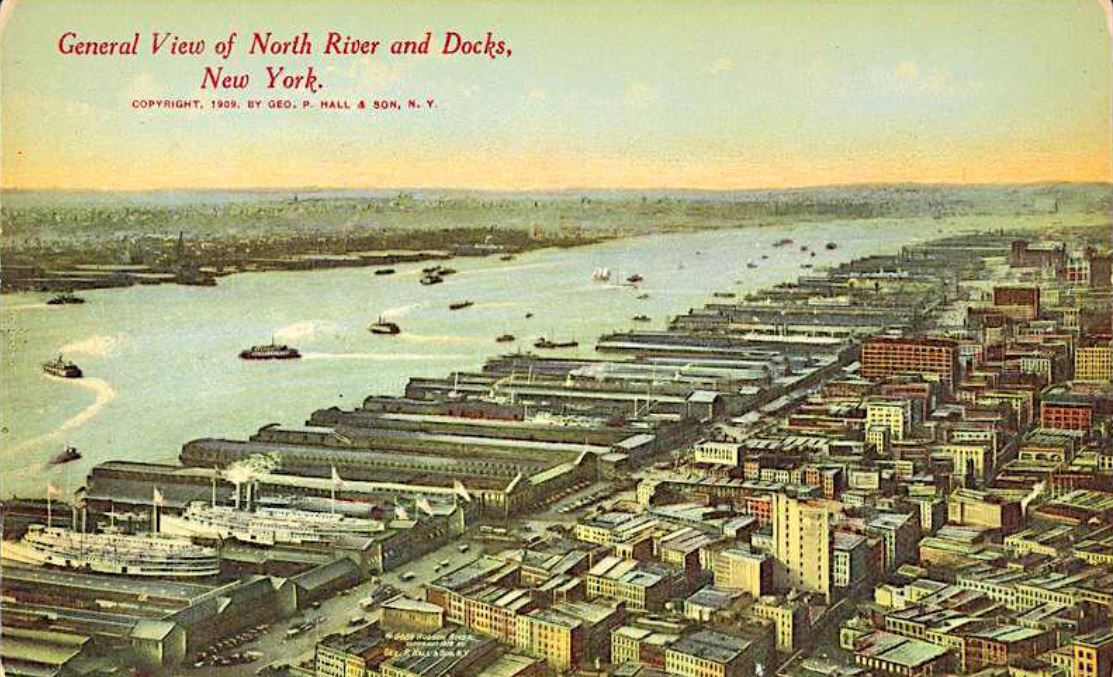
REPLY: Chicago is rather doomed. The teachers wanted to put a tax on all trading in Chicago to pay for their pensions. These people have no concept of competition. Here is a postcard from 1909 showing that New York City was once the biggest port in America. There is NOTHING left because of the unions and corruption. Shipping simply left.
These people have no clue how the economy works. You cannot extort people. They will simply leave
QUESTION: In George Gilder’s book “Life after Google” he states:
“AI cannot compete with the human intelligence that connects symbols and objects. AI cannot do without the human minds that provide it with symbols systems and language; programs it; structures the information it absorbs in training, whether word patterns or pixels; provides and formulates the big data in which it finds numerical correlations; and sets up the goals and reward schemes and target sequences that allow it to iterate, optimize, and converge on a solution. Consisting of inputs cascading through complex set of algorithms to produce outputs. AI cannot think at all.”
As someone who has developed Socrates I was wondering what your thoughts are as to the future of AI?
CSK
ANSWER: George Gilder is not a programmer. His comment is just skimming the surface. There is no complex set of algorithms that will stand the test of time. A computer cannot think, which is correct. That does not mean it is impossible to beat humans. Even Big Blue defeated the best chess player. A computer can analyze every possible strategy and select the best one whereas a human cannot.
When I designed Socrates, I fully understood that there could be no fixed algorithm that would work because the world was all connected and moving dynamically. After all, no empire ever lasted. Everything rises and then falls.
Feeding everything into the system and designing it to investigate, as I would in the human world, allows AI to make decisions based upon those investigations. It does mimic my thinking process, but it is not a biological entity so it has no soul and cannot think.
I taught it language and how to speak back in the 1980s because it would come up with conclusions that baffled me. I had to devise a way to communicate with it to understand how it reached certain conclusions.
A number of people have asked me to comment on Bloom’s speech on the floor of the European Parliament. He is incorrect in attributing the insolvency of the European banks to fractional banking. They have blown themselves up because of derivative exposure, not actual lending.
The US banks survived and have prospered BECAUSE of TARP. The US government bought the toxic financial waste they created so the bankers got away with it again. In Europe, the design of the euro was to deny creating a national European debt, therefore there could be no bailout because that would mean the money would flow from one country to the another to bail out their banks. Hence, European banks still have the tonic financial waste on their books from 2007.
The central banks are ARTIFICIALLY manipulating interest rates down to try to save the banks, but this Quantitative Easing has not only failed, it has set the stage for the next financial disaster — the collapse of government pensions and private pension funds. These funds are regulated and it is mandated that they have government debt for that is “risk free,” so they claim.
The bankers sell the government debt so the politicians cannot let the bankers fail for they also fund their elections. This entire mess is not going to be held off much longer. We will be looking at this in great detail at the WEC in Orlando (Oct. 25-26).
The Beijing/Wall Street lobbyist Robert Zoellick has taken an attack posture on behalf of his U.S. corporate clients and their investments in China.
White House director of trade policy Peter Navarro appears on FOX Business’ Lou Dobbs to rebuke Zoellick and Beijing claims about Trump’s trade policy:
While traveling aboard Air-Force-One, President Trump held a briefing with officials on the aftermath of Hurricane Dorian, and allowed the traveling press pool to participate. [Video and Transcript Below]
.
[Transcript] THE PRESIDENT: So we were going to take a helicopter to Emerald Isle in North Carolina, which was hit very, very hard. Atlantic Beach was hit very hard. Certain areas were really hit. The Governor is with me. Roy, thank you very much for being here.
GOVERNOR COOPER: Sure, Mr. President.
THE PRESIDENT: The Governor was standing in the rain for a long time, along with a lot of talented people that have really helped us a lot. Lindsey, I’m glad you’re here with us, and we appreciate it very much. And Kevin is here someplace.
ACTING SECRETARY MCALEENAN: I’m behind you.
THE PRESIDENT: Where’s — hello, Kevin. Thank you. Thank you for being here.
We have a big rally tonight for Dan Bishop. I was going to go from Emerald Isle right back into the rally, but now we’ll be very early for our rally. That’s the one thing. But it was, I guess, Roy, they say very dangerous flying conditions. I said, “Let’s do it anyway.” They said, “Sir, we’d rather not.” So, I said, “Okay, I’ll take your word for it.” The greatest pilots in the world.
We will be spending a little time. We’re going to be given a presentation as to what’s happening in North Carolina and a little bit about a couple of the other places. I just spoke to Governor Henry McMaster, and they’re in great shape in South Carolina. They’ve done a really good job.
Roy, maybe I could ask you to say a few words —
GOVERNOR COOPER: Yes, sir.
THE PRESIDENT: — and what you need from the federal government.
GOVERNOR COOPER: Yes, sir. First, Mr. President, thank you for coming to North Carolina. We’ve enjoyed our working relationship probably too much. With FEMA, we’re glad to have Mr. Gaynor here with us. And, of course, we’ve had the FEMA team embedded with us at our Emergency Operations Center in Raleigh.
This is the third hurricane that has crossed the coast of North Carolina in less than three years. So this is something that we take very seriously. The widespread damage of Dorian did not approach the damage that we had from Florence and Matthew, but it was still significant in some parts.
We’ve had three deaths in North Carolina related to the storm. Two of them were people who fell off ladders while they were trying to get their house boarded up for the storm. And the other death happened post-storm, with a chainsaw accident with cleanup. We still have about 3,500 people without power, but we had a couple of hundred thousand at one point.
THE PRESIDENT: Right. They’ve done a great job.
GOVERNOR COOPER: One of the hard-hit areas is Ocracoke Island, which they said it’s the worst that they had ever seen. I talked to a man who had a house built in the 1870s, and they had never seen it that bad.
The power is still out there. We’re providing food, resources, working with all of our federal and local partners to provide help there.
The place that you were going to go, Emerald Isle, as the storm approached, it had an EF2 tornado hit an RV park. I toured it on Saturday. The damage was significant. Many homes absolutely destroyed. We had issued an evacuation order, and therefore, most of the people were gone. The few people who were there survived and are lucky that they are alive. And they — I’m sure they appreciated the fact that you had planned to go and see. And I know we have local government officials here who were ready.
We have a nuclear power plant at Brunswick which had to be powered down as the storm him. Today it’s powered back up, and we think everything is okay with that. We still have about 20 road closures. We don’t have anything approaching the last two storms, but we still have some there. We’ve got 125 National Guard activated now, down from 577.
What we would request, Mr. President, is an expedited disaster declaration for both debris removal and for emergency protective measures. And we’ve got joint preliminary damage assessments going on right now with state, FEMA, local, trying to determine the extent of the damage.
And the other thing that I’d like to mention is that Hurricane Florence hit this state badly, and you were here for that, but —
THE PRESIDENT: That’s right.
GOVERNOR COOPER: — less than a year ago. And we have a number of people who were — are not in their homes yet that were affected by Dorian. So any help that you can give us with HUD publishing the Federal Register for the CDBG-DR money for Hurricane Florence —
THE PRESIDENT: Right. We will do that.
GOVERNOR COOPER: — we would appreciate. We’ve had a good relationship with Secretary Carson, but there’s a couple of things that would be helpful, I think, long term with CDBG-DR money, which would, one, be a universal application for all disaster survivors that would work with FEMA, would work with SBA, that would work with HUD. I think that would slim things down and make it a lot easier.
THE PRESIDENT: We’ll look into that.
GOVERNOR COOPER: And also, maybe codifying the CDBG-DR money instead of the Federal Register. And I know there’s legislation in both the House and the Senate for that.
I have with me my Secretary of Public Safety Erik Hooks, who is behind you there. We’re grateful for his work and our local partners we have here too, Mr. President.
THE PRESIDENT: Good. We’ll you’ve done a great job. Thank you very much, Roy.
GOVERNOR COOPER: Thank you, sir.
THE PRESIDENT: Erik, would you like to say something?
MR. HOOKS: Yes, sir, Mr. President. From my aspect, I’d like to emphasize the partnerships that we have all throughout the Department of Homeland of Security, the Coast Guard, FEMA. They’re always at the table. And they’re at the table when things are relatively peaceful.
So when a tragedy in our all-hazards approach hits us, we’re ready and we’re partnered, and those relationships are strong.
THE PRESIDENT: Thank you very much.
GOVERNOR COOPER: Mr. President, if I could add one more thing. The Admiral is here and we were in communication throughout the storm. But the Coast Guard did amazing work, both during Florence and during Dorian. They helped us rescue a man from Ocracoke Island and helped to bring him off, and worked closely with our National Guard. We’re grateful for our Coast Guard and our relationship with them.
THE PRESIDENT: They’ve been so incredible. I’ve always said, for the last three or four years, there’s no brand that has gone up more than the United States Coast Guard. In Texas, they saved thousands and thousands of lives. They’ve done a job like I’ve never seen. Then you went to Florida. Then you went to Puerto Rico. Then you went back here. And the job you’ve done in the Bahamas has been incredible. So please extend my wishes to everybody, Admiral.
Would you like to say something?
ADMIRAL SMITH: No — Mr. President and Governor Cooper, I just — the Coast Guard was just glad to be part of the team. We have a great relationship with the state, with our federal partners, local partners, and we were happy to be part of the team.
As you know, as this storm came up, we flowed in resources —
THE PRESIDENT: Yeah.
ADMIRAL SMITH: — and were ready to respond. And then the focus was providing response when needed, and then opening the ports as quickly as possible. We did that, and I think it went about as well could be expected, sir.
THE PRESIDENT: You’ve done a fantastic job. How are the new Coast Guard cutters?
ADMIRAL SMITH: They’re doing great, sir. We had to flow them out of the region, but we flowed them back in. And they were the first to get offshore to provide response.
THE PRESIDENT: But they’re great. They’re both great.
THE PRESIDENT: We got them. We got them. They were getting very old. Now you have brand new beauties, right?
ADMIRAL SMITH: Yes, sir, Mr. President.
THE PRESIDENT: That’s very good.
ADMIRAL SMITH: We’re in good shape, sir.
THE PRESIDENT: Kevin, would you guys like to say something?
ACTING SECRETARY MCALEENAN: Absolutely. Thank you, Mr. President. As you know, we’re here in support of our state partners. And Governor Cooper and his team, Commissioner Hook, have been outstanding throughout the effort.
I’d like Administrator — Acting Administrator Pete Gaynor to give you a little bit of sense of the preparations that we had in place in the initial response, and, of course, we’re doing the joint naval assessments now.
THE PRESIDENT: Good. Pete?
ACTING ADMINISTRATOR GAYNOR: Yes, sir. As soon as we realized that Dorian bypassed U.S. Virgin Islands and Puerto Rico and was not going to touch land again, (inaudible) and the NRCC, the National Response Coordination Center, which you visited the other day, was big storm, big response. And we had staff, material, equipment from Miami to Fort A.P. Hill, Virginia, making sure that we could provide all the governors, to include Governor Cooper, whatever they needed from not only FEMA but from the federal family.
And, again, it takes partnerships to make it all happen. And when it works well, it’s a great thing to see. So I thank everyone here that is part of the federal team.
THE PRESIDENT: And I have to say, Ron DeSantis and Brian Kemp and — Henry has been fantastic in South Carolina. Henry McMaster and yourself. The governors have really done a fantastic job. They’ve worked. Whether it’s Republican, Democrat, doesn’t matter. In this case, we’re talking about one that’s on the other side, and the relationship was perfect, right? We have a really good relationship.
And we’re working to get it all together. I want to say that FEMA, first responders, law enforcement has been incredible. Really on the ball. And they were ready in Puerto Rico. Everybody thought it was going to hit Puerto Rico, and we were all set. And, fortunately, it missed Puerto Rico. What it did to the Bahamas is incredible. And the government of the Bahamas has asked us to help. And we have a lot of assets over there, right now, trying to help. That’s really a life-saving mission, when you get right down to it. But the Coast Guard and FEMA and all of you have done a fantastic job.
Would you like to say anything in front of the camera?
ACTING SECRETARY MCALEENAN: No, sir.
THE PRESIDENT: Okay. Lindsey Graham, please?
SENATOR GRAHAM: Well, I want to thank you for calling Henry. To my friends in North Carolina, I used to be a reservist at Seymour Johnson. You all have been hit really hard. And, unfortunately, our delegations in South Carolina and North Carolina are getting pretty good at turning the funds around. And Kevin and Nancy work well together.
So we got to fund the government entirely by the end of the month. But I promise you, we’ll do everything we can to get the money flowing. And being your neighbor, I’m really sorry. I know it’s been really hard up here.
So, thank you, Mr. President.
THE PRESIDENT: Well, thanks. You’ve done a great job. Thank you, Lindsey, very much.
And, Leader, what do you think? You’re working, I know, with the Democrats, and we’re getting things approved rapidly. How’s it going?
HOUSE MINORITY LEADER MCCARTHY: Yeah. I think it’s working well. The only thing, I do want to credit and thank all of you for how well everybody has worked together. The coordination, knowing how this storm would change course, the modeling continuing to go, and just the preparation. I know you saved a lot of lives by the preparation you do.
Our responsibility, Lindsey and others, is making sure the resources are there. And there was — as we talked to FEMA ahead of time, there was enough money. And if there’s more needed, we’ll continue to work towards it.
THE PRESIDENT: Thank you very much, Kevin. And, Admiral, thank you for keeping me in touch. He was with me all the way. No matter where I went, the Admiral was right there. And you let us know. And we were able to do a lot of good by being there. So, thank you.
Would you have anything to say, Admiral?
ADMIRAL SCHULTZ: Just, with regard to the Bahamas — because much of the attention has shifted there now, Mr. President — USAID, the Agency for International Development, their Office of Foreign Disaster Assistance, has been the coordinating lead working directly with the government of the Bahamas, responding to their request for the most acute humanitarian needs of the Bahamian people.
And as you’ve talked about, it’s a very concentrated area of the Bahamas that was affected. The rest of the Bahamas, almost the size of the state of California, is unaffected and open for business. So, Bahamians are helping Bahamians, evacuating people to other sections of the Bahamas that have not been affected. And not only the United States, but foreign governments and non-governmental organizations are all also there in force, providing the humanitarian aid that’s needed.
THE PRESIDENT: So, people are unaware of the fact, for the most part, that the Bahamas is a much bigger place than people would understand, than most people would understand. So you’re actually moving large numbers of people into safer areas and areas that weren’t affected in the Bahamas by the hurricane.
ADMIRAL SCHULTZ: Right, sir. The government of the Bahamas is actually doing that, assisted by others, moving people from the most affected islands, generally the Abaco island which was really damaged —
THE PRESIDENT: Right.
ADMIRAL SCHULTZ: — toward Nassau, which is an area of the Bahamas that was relatively undamaged that has the resources to help those folks out.
THE PRESIDENT: That’s great. They’ve really done a great job. Thank you very much.
So, we have now people standing on line, trying to get into the arena. And I will tell you that they are soaking wet, because Roy and everybody just walked under the plane, and you folks were wet. It is bad weather out there. But we have a tremendous crowd, and we’re going to be there in a little while. We’re going over a little bit earlier than anticipated.
So, I hope you’re going to be able to join us, and we’ll have some fun. It’s going to be a good rally.
Yes.
SENATOR GRAHAM: Mr. President, I forgot to mention one thing. The budget agreement that you helped negotiate with the House and the Senate — no agreement is perfect, but if we had not done the budget deal, we’d go back into sequestration. You would not be having new ships.
THE PRESIDENT: It’s true.
SENATOR GRAHAM: The biggest winners were the DHS and the military as a whole. So in times like this, I appreciate what you did on the budget because sequestration would have been devastating.
THE PRESIDENT: And I think it’s really important to say, Mexico has passed it, Canada has passed it. The USMCA is vital for our country, the economics of our country. You have two countries that have gone through the process fully. And we’re waiting for an approval from the House. I think the Senate will approve it rapidly. So we hope they can get that moving. It’s a great thing for us.
The farmers — even the unions are really liking it a lot. And we’re going to make certain little changes. But Bob Lighthizer is dealing with Nancy Pelosi. I think they’re getting along very well. Steve Mnuchin is involved. And hopefully they can get a vote on that very quickly — the USMCA. Very important. Thank you.
Okay. Thank you, folks. Thank you all very much. Thank you.
I have created this site to help people have fun in the kitchen. I write about enjoying life both in and out of my kitchen. Life is short! Make the most of it and enjoy!
This is a library of News Events not reported by the Main Stream Media documenting & connecting the dots on How the Obama Marxist Liberal agenda is destroying America





 Centinel2012