
Category ECM Model
Home Depot Cuts Forecasts, Target Earnings Suffer – Watch Comparable Same Store Sales, Now We Are Cycling Sales Value of Inflation
Posted originally on the CTH on May 18, 2023 | Sundance
Those of you who are keen financially minded individuals will note exactly what is happening in these recent reports, HOME DEPT HERE – TARGET HERE. Those of you who are retail investors in the stock market might also see the bigger picture.

Home Depot and Target essentially share the same customer base or market audience. They service a larger segment of the American middle class. Both companies are reporting negative financial outcomes as a result of low comparable sales, or same store sales comparisons, to last year. This should not be a surprise, yet Wall Street is seemingly caught off guard.
Right now, we are on the tail end of the massive inflation cycle that took place in 2021 through 2022. Current inflation, as measured by the rate of price increase over the same period last year, is lower.
Now we are starting to see companies reporting sales comparable without the benefit of massive inflation to assist.
Example – when inflation is running at 10%, a company can report 8% sales growth, and everyone smiles. However, the sales growth was created by the inflation. The actual unit sales of goods have declined; the store is reporting higher sales because the prices are higher. When the sales cycle through to lower inflationary comparisons, the drop in unit sales shows up as drops in topline sales. This is the cause of both Target and Home Depot now reporting lower than expected comparable sales versus last year.
In real terms, this is why using sales data as a measure of economic growth is less valuable during periods of high inflation. Significant inflation hides the diminished sales of units, which should be the true measure of sales growth. I have been tracking unit sales as a measure of economic activity, and the truth is that unit sales have been declining since the fourth quarter of 2021.
Inflation was hiding the recession, and as the rate of price increase diminishes, the sales contraction will show the recession. This is what Target and Home Depot are reporting, and we can all expect to see the same over the next 90 days. Retail stocks will drop as the earnings and sales reports are revised down due to lower inflation.
Wall Street Journal – Target sales suffered in the most recent quarter as shoppers stopped splurging as frequently on trendy clothes, home goods and other items that make up the bulk of the retailer’s annual revenue.
Comparable sales, those from stores and digital channels operating for at least 12 months, came in flat for the quarter ended April 29 compared with the same period last year. That is slightly lower than the previous quarter’s 0.7% rise and lower than analysts’ expectations for a 0.2% sales rise in the most recent quarter, according to estimates from FactSet.
Sales of food and beverage, beauty and home essentials such as detergent rose, while demand for apparel, home goods and items such as toys and electronics fell sharply in the most recent quarter as shoppers further pulled back on discretionary spending, said Target executives on a call with analysts Wednesday. The latter discretionary categories make up around 54% of Target’s annual sales, according to financial filings. (read more)

Reuters – Home Depot Inc (HD.N) on Tuesday cut its annual sales forecast and projected a steeper-than-expected decline in profit, stoking fears about inflation-wary consumers trimming discretionary spending as a big earnings week for U.S. retailers rolls out.
Shares of the largest U.S. home improvement chain, which also blamed a wet start to Spring and falling lumber prices for a first-quarter sales miss, tumbled about 4%, while those of smaller rival Lowe’s Cos Inc (LOW.N) dropped nearly 3%.
[…] Demand was weak for discretionary items like patio furniture and grills, as well as appliances, flooring, kitchen and bath, said William Bastek, executive vice president of merchandising at Home Depot.
[…] Home Depot now expects fiscal 2023 comparable sales to fall between 2% and 5%, compared to its prior outlook for nearly flat sales. (read more)
Next up…. Walmart

The Hate & Great Divide – Tearing Apart Even Families
Armstrong Economics Blog/Great Divide Re-Posted May 6, 2023 by Martin Armstrong

COMMENT #1: I see you are not a 100% diehard Republican or a Democrat. Not sure what that makes you. Perhaps you should run for president.
LR
COMMENT #2: The more I have looked into everything, the more I see your point. The majority of people think linearly. Everything is just a straight line. It seems hopeless to ever get humanity to advance and see the world of cycles.
PV
COMMENT #3: You are as biased as Tucker. Your day is coming too.
HN
COMMENT #4: These are trying times. I and my son no longer talk. He voted for Biden and I for Trump. He refuses to relent and we no longer have respect for one another. Never thought this would come to that.
WH
REPLY: First, I am sure you are being sarcastic. I think they would assassinate me before my hand ever got close to the book to swear in. I don’t have the passion to rule from the White House. I believe in cycles, not the authoritarian rule. The country is too deeply divided. I am middle of the road. I believe in individual freedom of speech, religion, and rights. Our company is like the UN. We have offices around the world with different races, creeds, and ethnic backgrounds. We all get along and we all respect each other. Our staff is there because they are qualified – not to fill some slot to pretend we are diversified.

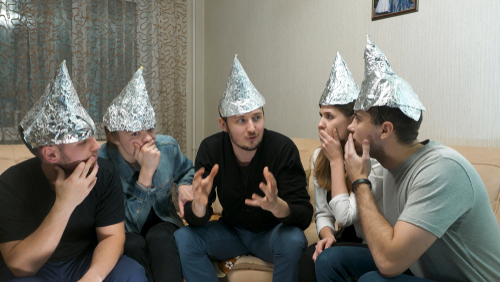
One of my partners before he died out of the blue asked me to make sure that everything went to his second wife. He no longer was on speaking terms with his children. I have witnessed this many times. I remember growing up my father had a client who left everything to the woman who was his caretaker. When he dies, the kids ransacked the house punching holes in the wall and looking for hoards of cash they thought he had. The justice was, they had to pay for all the damage for he left them with nothing. Many have written in about how this Great Divide has divided their families.
It is not as uncommon as one might think. As some have said, you have a 50% chance they kids may be like your wife and if you split because you did not get along, then I suppose it makes sense. Another friend cannot speak with his children for they thought COVID was real and called their father a conspiracy nut. They refuse to admit they were wrong and just will no longer speak to their father.
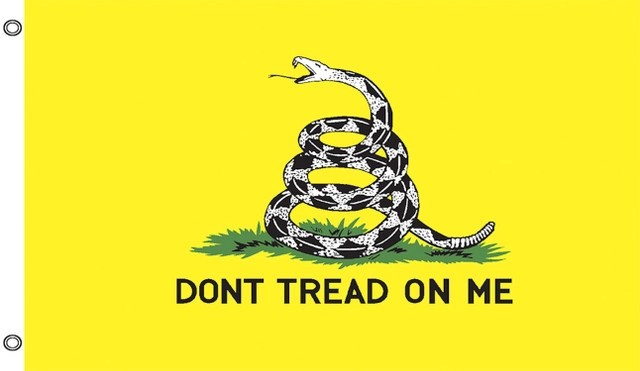
When you try to tell people how to live and follow some rules arbitrarily created, you will infringe upon freedom. That is why there MUST be a separation of religion from state. Once any religion seeks to control the state, freedom ends. We have gone through so many upheavals in history outlawing drinking to outright religious wars that became gun battles on the streets in the United States. Even the Civil War was inspired by religion.
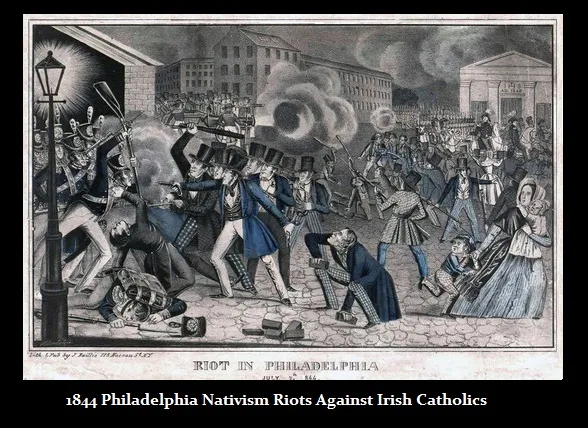
There were gun battles between Protestants and Catholics bringing the old hatred from England to America. Attacks on Muslims today is simply how history unfolds. Whoever the press demonizes, transforms into prejudice and then violence. The Muslims were demonized because of the Terrorists and we will see similar violence against Russians in the not-to-distant future. They locked up all the Japanese during WWII.
This is a video I would show at conferences over the decades. This illustrates the complexity of cyclical behavior.
There is such hidden complexity that it is impossible to regulate society and create whatever people dream of. To Marx, it was to eliminate the business cycle and he blamed the rich. Confiscating all the assets from people did not terminate the business cycle. Keynes followed Marx and tried to create a government to also eliminate the business cycle.
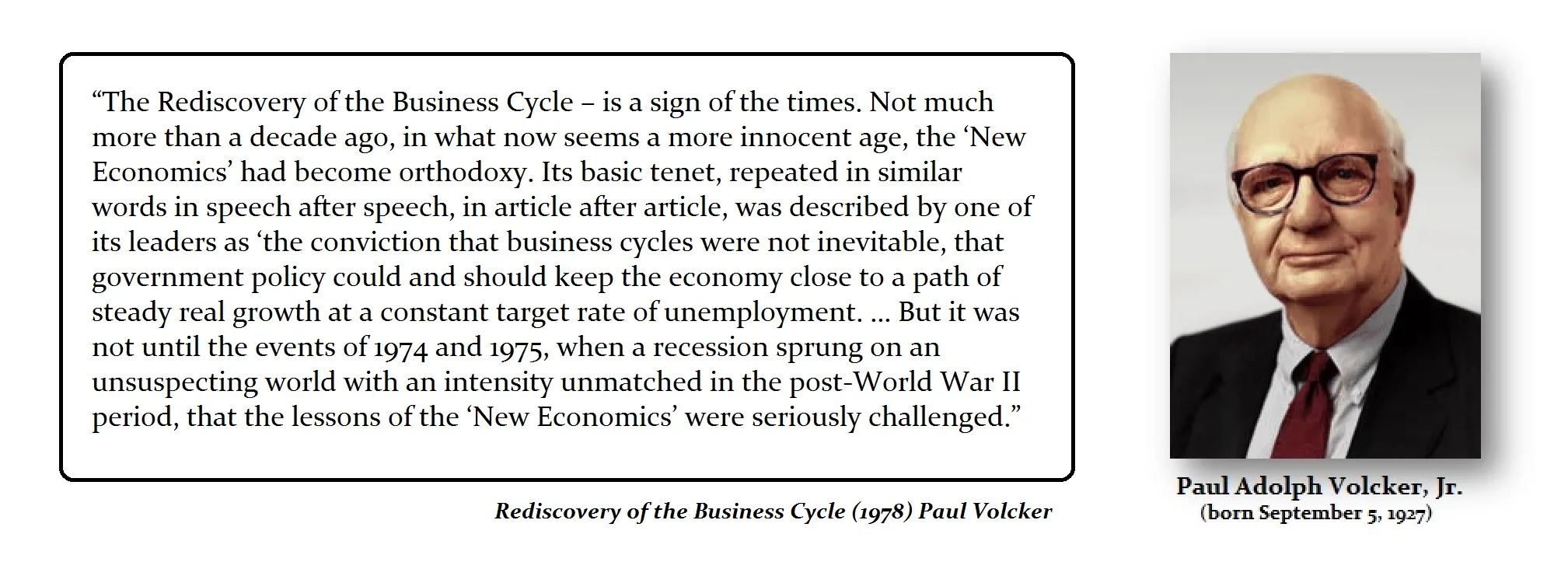
All I can hope is that we move toward a realistic form of government and STOP this leftist idea of authoritarian rule to create some utopia that is just impossible. The fools like Bill Gates who tries to reduce the entire world to CO2 illustrate for as smart as people think they are, they are still very primitive and have never tried to discover the true nature of the world in which they live.

I know a lot of people who hate me read this blog just to see what I have said now. Don’t worry, I have no interest in ruling the world. I am just waiting for Scotty to beam me up. The government tried to kill me once but I survived and woke from a coma. I’m sure they will try again when they no longer want to listen to the forecasts.
For you see, just as you hate me, I am not fond of the world you are trying to advocate. So go ahead – vote for Biden and let’s get WWIII over with ASAP. This is all part of the cycle and you are fulfilling your role in bringing this American experiment to an end. Somehow you lost the meaning of freedom. You just hate anyone who does not comply with your ideas.
INTERVIEW – WORLD WAR 3 IS WHAT “THEY” WANT AND ARE ON TRACK TO GET IT
Why Does the ECM Work On So Many Things?
Armstrong Economics Blog/Uncategorized Re-Posted Apr 17, 2023 by Martin Armstrong
COMMENT #1: Hi Martin, corn also turned nicely on the ECM:
JB
COMMENT #2: Hello Marty, I just want to point out that the Japanese yen broke really hard on the 10th. Not sure if this will prove to be a precursor of what is to come.
Thanks from Tokyo, your old home ground.
AS
COMMENT #3: Well the ECM also marked the reversal in trend in the 30-year bond. It peaked at 134 and fell to 130 by the end of the week. That was just remarkable.
Colin
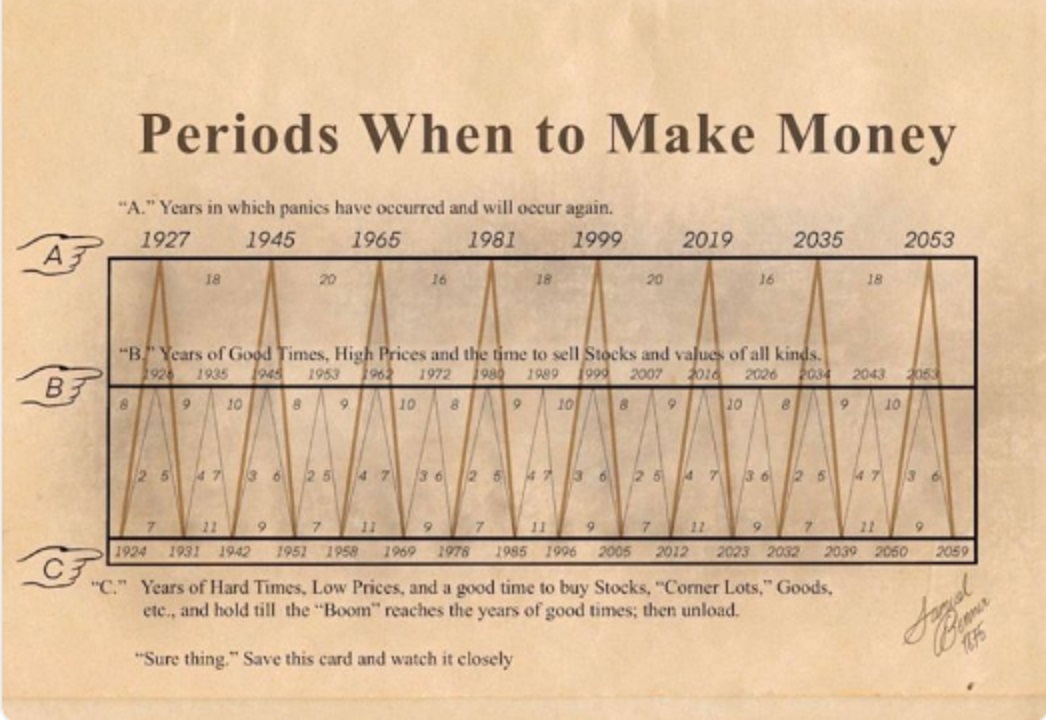
COMMENT #4: Martin; is this chart real that people are sending around claiming it was Benner’s work?
Mat
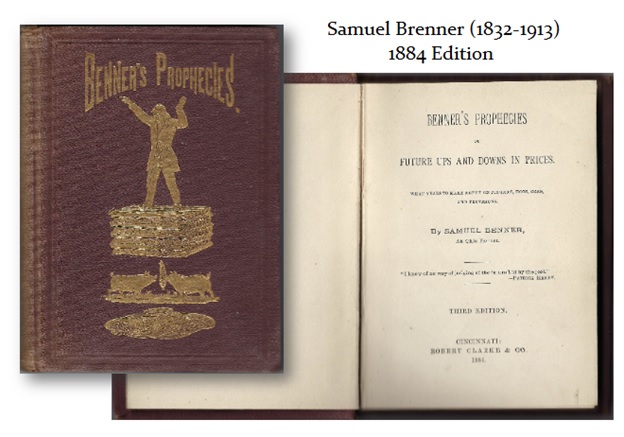
ANSWER: As far as this chart of Brenner’s Cycle being real, the answer is no Someone has made it up and signed his name. They have at least extended his cycle correctly. The last time someone tried that they skewed the cycle to make it look like it forecast the Depression 1932 low.
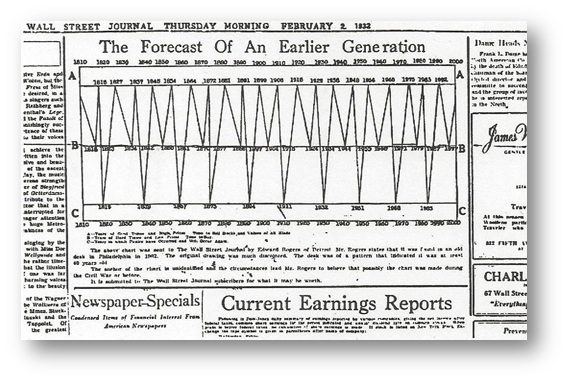
When the WSJ published it, it showed 1932 instead of 1931. Brenner did not extend this out in this manner. What is important to understand is that Brenner was a farmer and farmers understand the cycles in nature. Economists and governments pretend they can smooth out the cycle and eliminate the booms and busts.
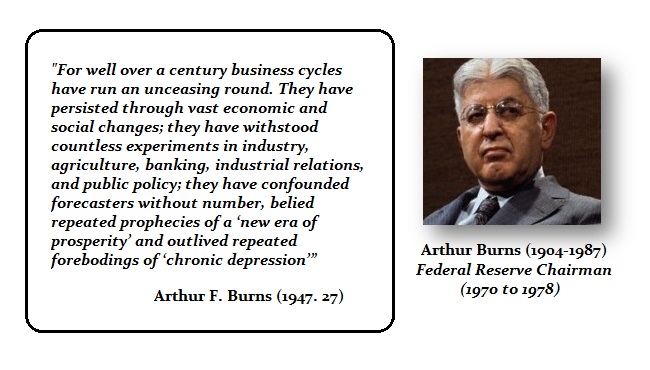
The business cycle always wins as both former chairmen of the Federal Reserve conceded – Arthur Burns and Paul Volcker.

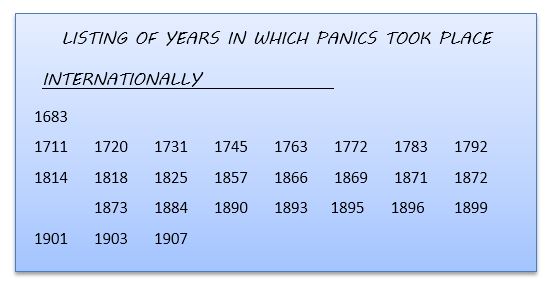
Back during the 19th century when Brenner was observing the business cycle, it was still based on commodities. Kondratieff took the same data. I believe the reason WHY the Economic Confidence Model has been so accurate is that it was based on a list of Panics – not one sector of the economy. Therefore, the ECM incorporates weather as Brenner and Kondratieff did by using the commodity sector. Yet just that the ECM was derived from financial panics, it was not based on any one specific type so it strangely seems to have incorporated the whole gambit.
Furthermore, all previous cyclical analysis was based on just a single market like stocks. They have failed because they could not account for the external influence of a contagion. The fact that this list began with the Turks’ siege of Vienna, means that the list was also influenced by war and from an international perspective.
This is a fascinating subject that I will explore in far more detail in my coming book.
Greg Hunter Interview of Martin Armstrong
Gold & the Dow Rally Together? OMG
Armstrong Economics Blog/Dow Jones Re-Posted Apr 14, 2023 by Martin Armstrong
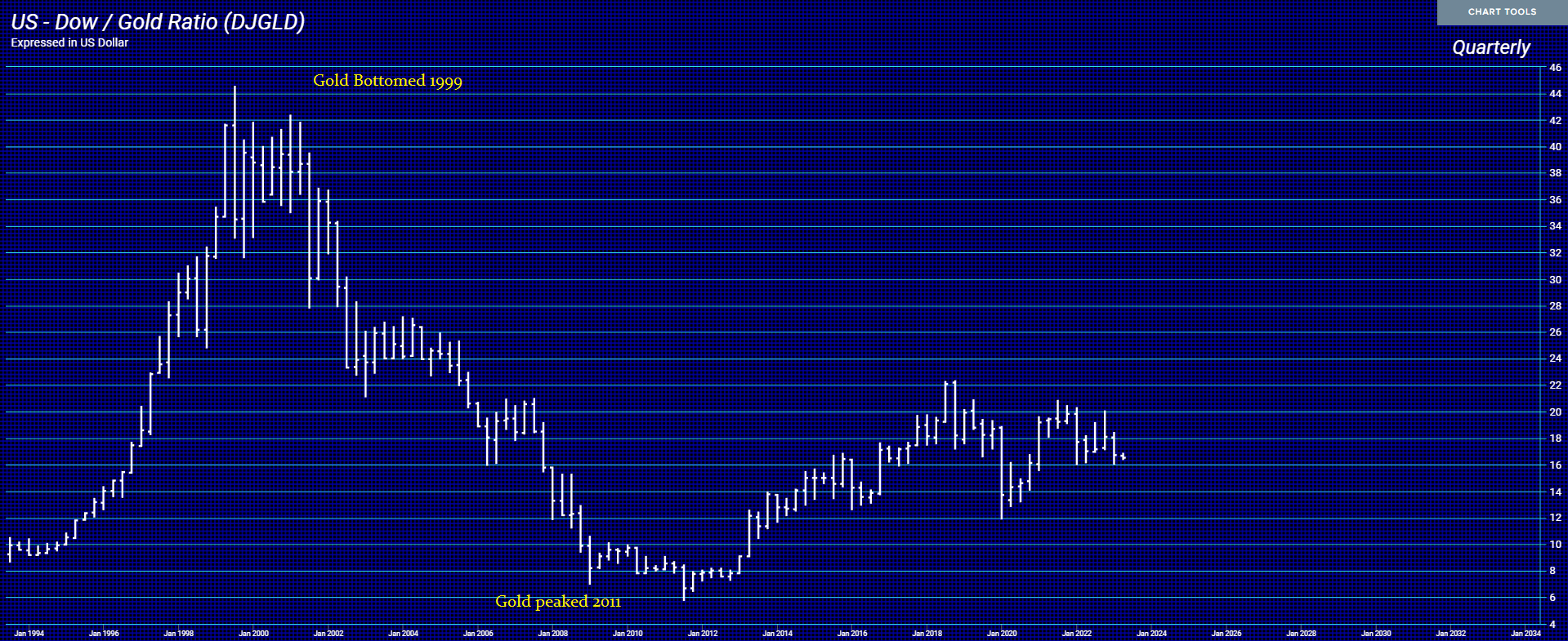
COMMENT: Well, the goldbugs are wrong again. This claim that the stock market must crash and only gold will rise is as you say sophistry. It looks like gold and the Dow are rallying together. I can see how they are just promoting a cult-like agenda.
Thanks for being objective
MH
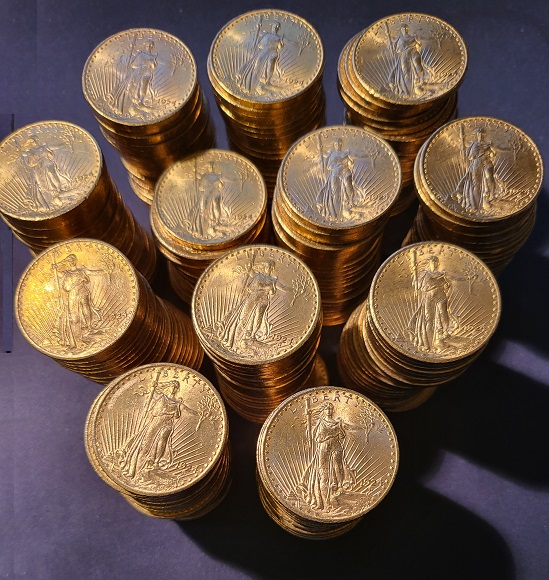
REPLY: We became the biggest institutional adviser because there was never an agenda. Everything goes up, and everything comes down. There is an old saying among actual traders – NEVER marry the trade. I buy gold personally. I just bought a hoard of $20 gold pieces all uncirculated and all dated 1924. I do not regard it as a trade, just a stash for the long-term. It will go up and go down. Do not pretend that something only goes in one direction.
Here is a chart from Socrates on the Quarterly Level of the Dow/Gold Ratio. Anyone who only forecasts a single direction is NOT an analyst – they are a promoter like a used car salesman. No matter what we look at, there is a time to buy and a time to sell. EVERY market functions that was.
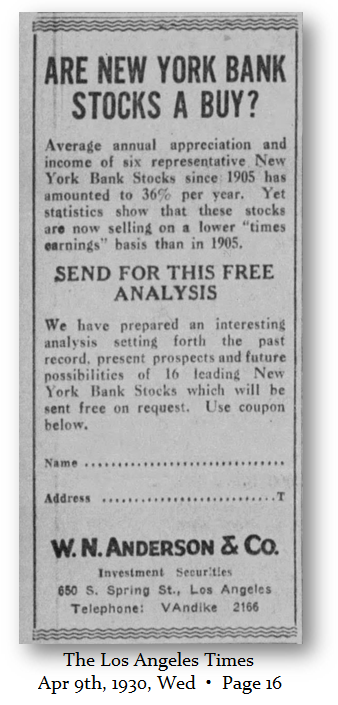
Here is an advertisement from April 9th, 1930 pitching Bank Stocks. Brokers were telling people to buy all the way down, average in, but it took 26 years for the Dow to reach the 1929 high again. Anyone selling any product will ALWAYS tell you to BUY. That is their business. It is up to you to come to terms with how ALL markets really move. Hence, there is always a TIME TO BUY just as there is a TIME TO SELL.
The 6th Wave – Do We Ever Learn?
Armstrong Economics Blog/ECM Re-Posted Apr 4, 2023 by Martin Armstrong
QUESTION:
Hi,
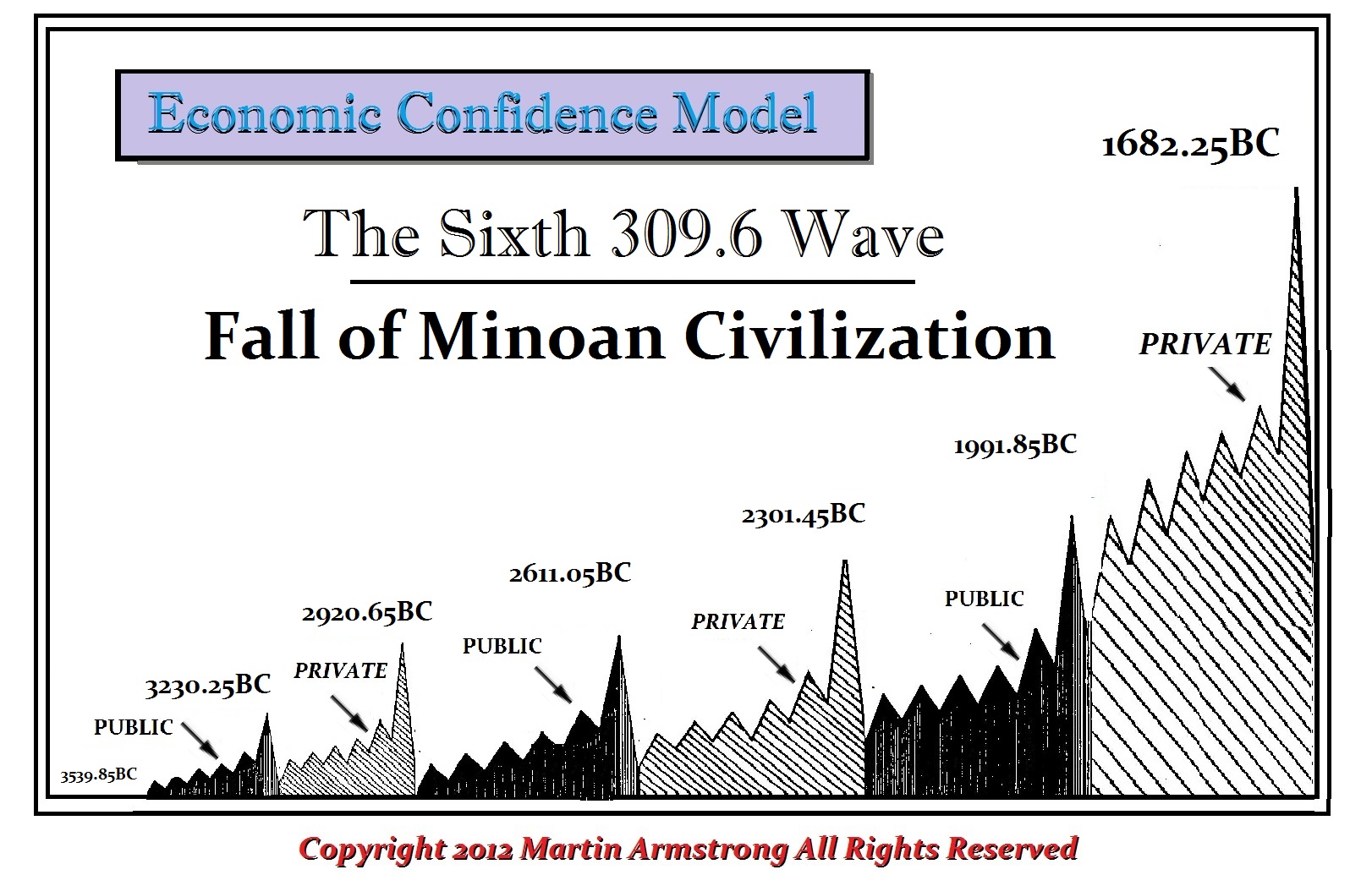
Have you come across a period in history that at the end of the sixth wave, after the political system dies, during the next six waves, human mankind learned from its past errors and corrected it?
ANSWER: Actually, the answer is NO. The fall of the Minoan Civilization brought in a dark age with the invasion of the Sea Peoples from the North who were driven south by climate and conquered all the civilizations during the Bronze Age except for Egypt. Reliefs show the Egyptians in heated battles against the Sea Peoples.
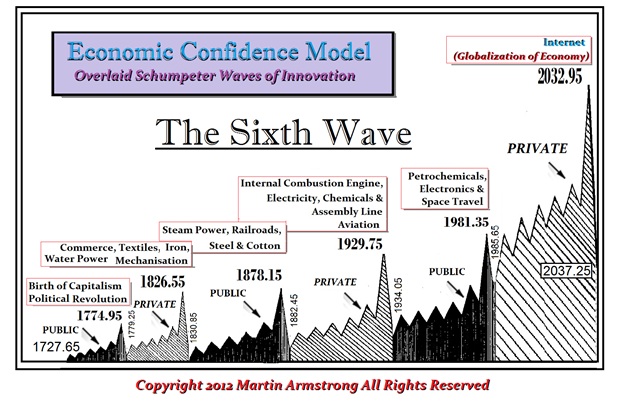
Everything in this universe is fractal. It is a repetitive pattern of self-referral. You have children and they are a blend of both parents’ DNA – self-referral. Thus, what makes 2032 extremely important, is that it is the Sixth Wave since the last upheaval of the overthrow of the Monarchy.
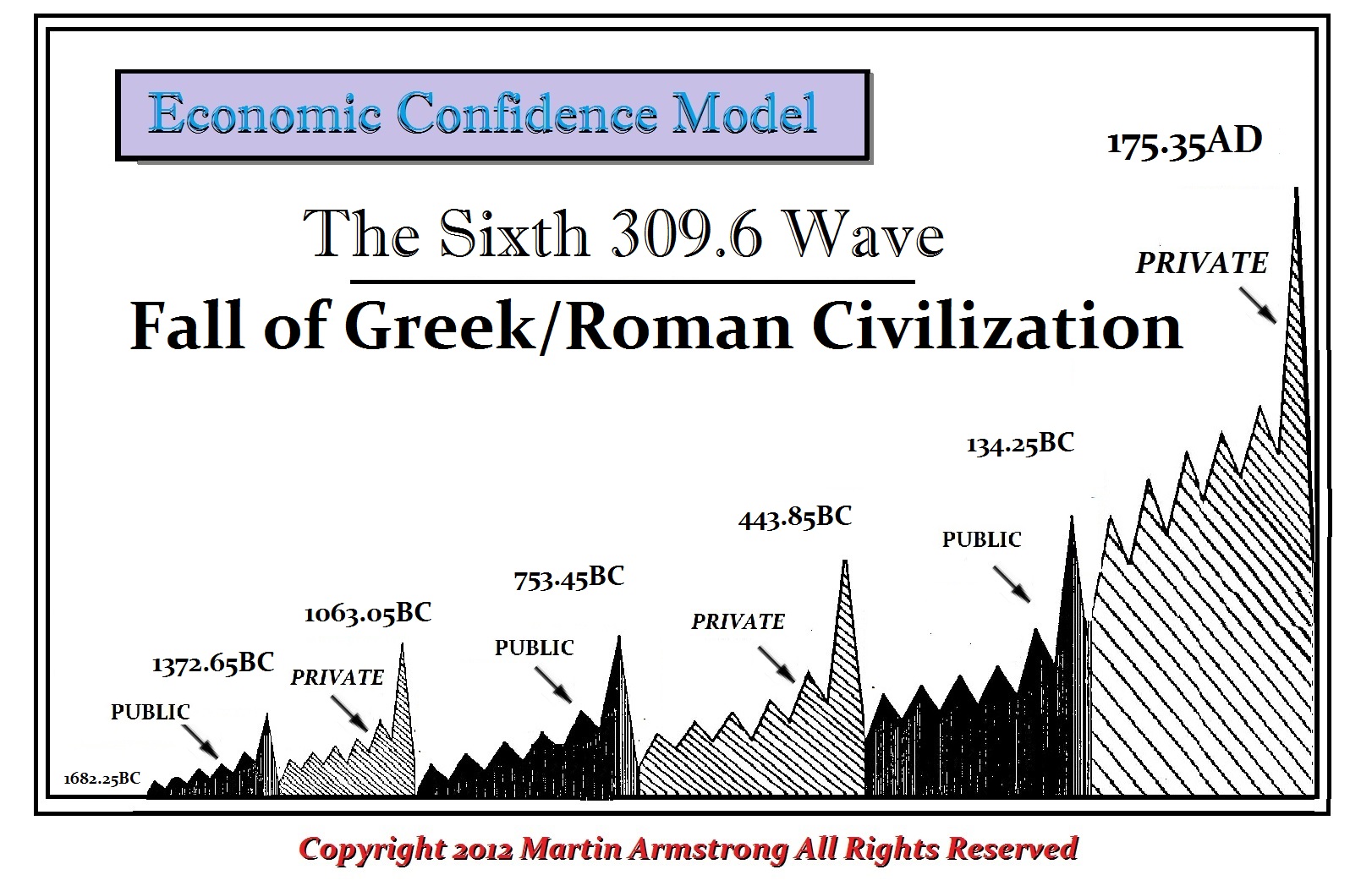
The Roman Empire peaked with the reign of Marcus Aurelius (161-180AD). We know from Chinese documents that he had even sent an ambassador to China which was the first contact.
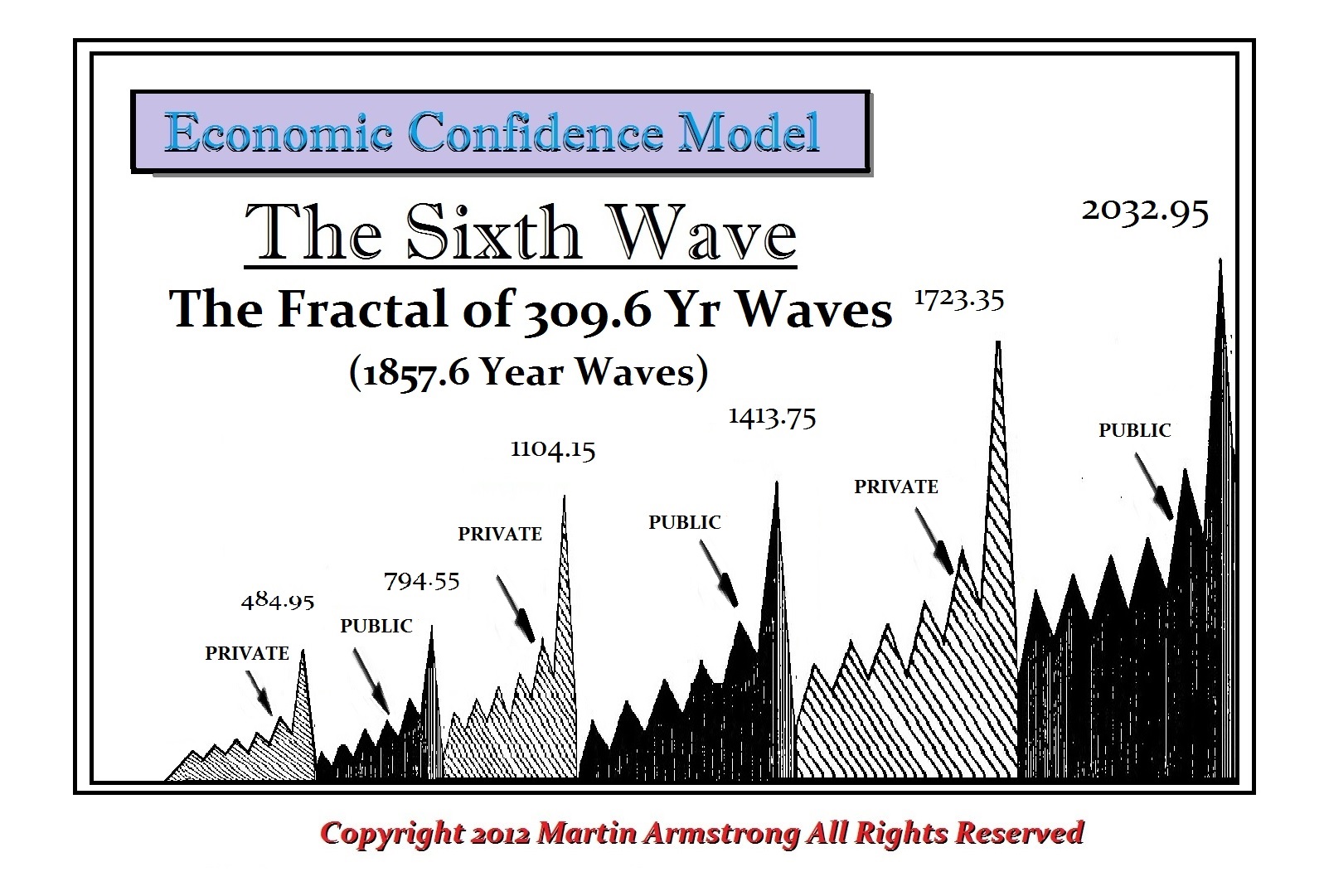
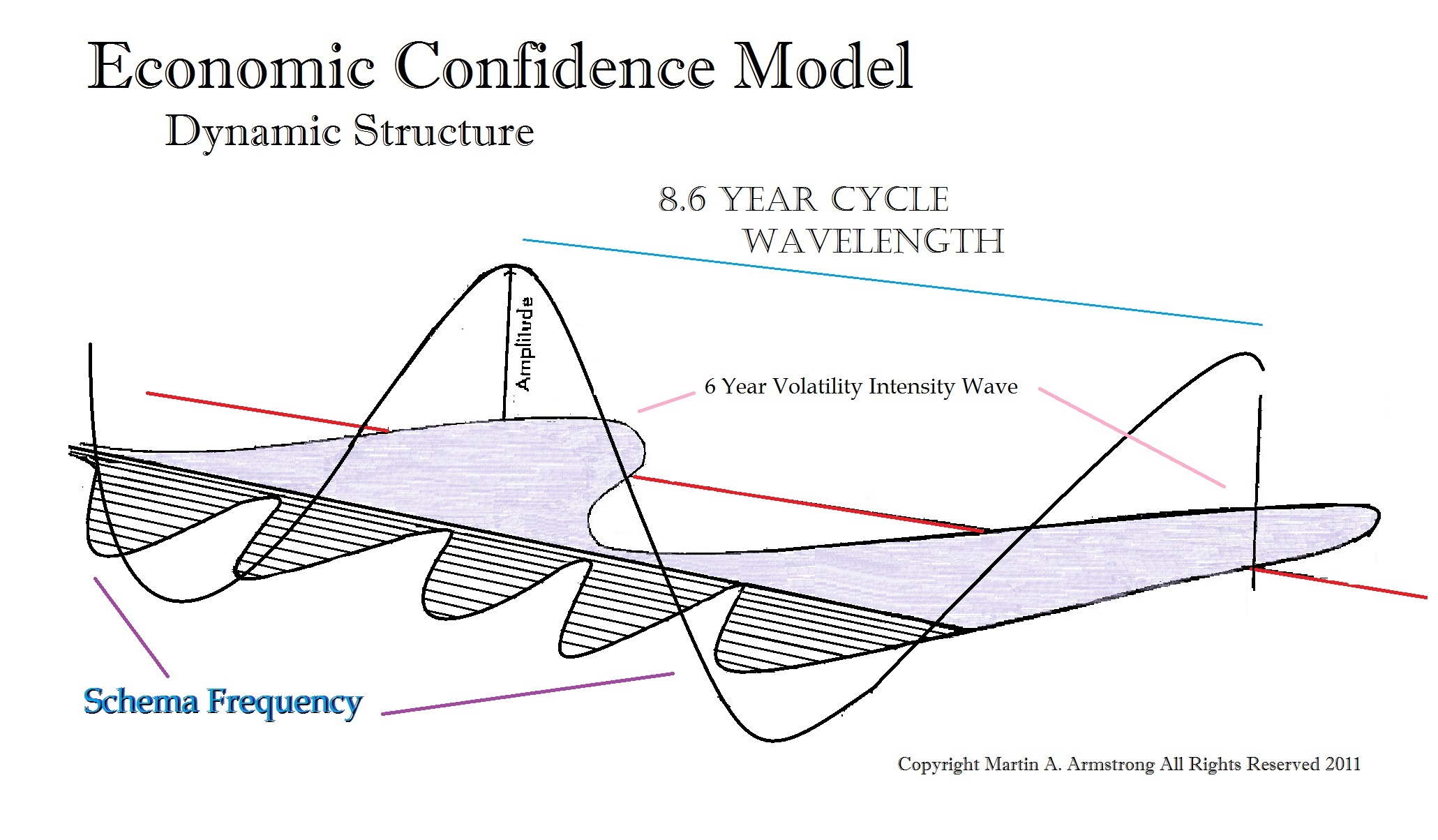
However, 6 of the 51.6 waves (which are 6 of the 8.6-year) in turn build in a fractal manner into a 309.6-year wave and then we have 6 waves of that which form 1857.6. There are then 6 waves of that building into 11,145.6-year waves. About 11,600 years ago (9,600 BC) was an abrupt period of global warming which accelerated the glacial retreat that was the beginning of the Holocene geological epoch. That is when we begin to find the domestication of sheep and evidence of settlements such as Jericho dating back to 9,600 BC. That wave was the Mesolithic era which refers to the final period of hunter-gatherer cultures in Europe and Western Asia. This was between the end of the Last Glacial Maximum and the Neolithic Revolution. This is also why in back-testing the ECM, it became very clear that it incorporates nature and the swings back and forth on climate change.

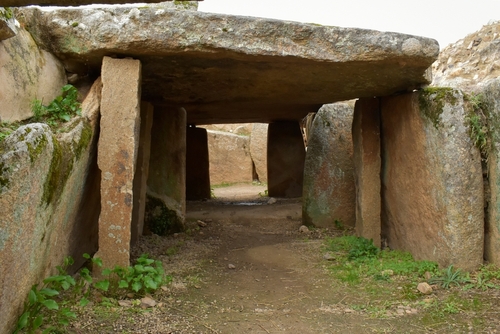
There is the period of the Megalithic Monuments in Europe. We do not know why these Neolithic and Copper Age creators were motivated to expend such energy in their creation. Some of these structures appear to have been graves. The sheer weight of the stones shows a very determined culture whose motives are lost to the haze of the period we refer to as prehistory.
Recent studies have implied that these megalithic monuments across Europe originated in northwest France, and the practice of building them spread along the continent’s coastlines in several migratory waves. They first appeared during the second half of the fifth millennium BC. That was about 4300 years before the invention of coinage.
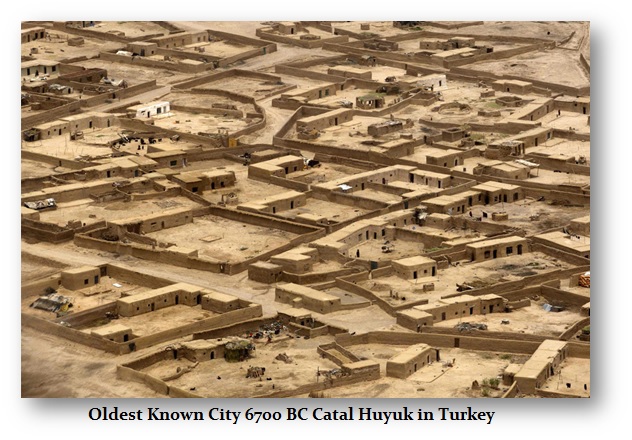
The oldest known city dates back to 6700BC, Catal Huyuk, located in modern Turkey. I have studied the economy of this period. It has all the trappings of modern-day civilization. There are houses with murals on the walls. This confirmed that there was an artist trade. There were a lot of female deities found so there was some artistic trade that carved these out of marble as well as clay. There was no indication of money being used so it was most likely a barter-based society with some people making tools and others growing crops.
Food was money in the shape of olives, dates, seeds, or animals and we also know that financing, lending for interest, dates back to c. 5000 BC, if not even earlier. The fall of Rome prompted the return of the Sin of Usury – denial of interest. Much of the blame for the fall of Rome was attributed to corruption of that sort. Capitalism is born with the Protestant Reformation which allowed Christians to earn money from interest. Martin Luther was funded by Christians who wanted to get into the banking field which had been restricted to the Jews.
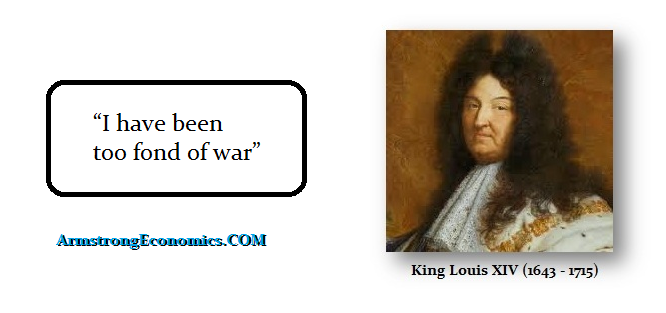
What we do see at these events is typically it is a knee-jerk reaction to whatever was in place, the reaction is in the opposite direction. We have gone through a revolution against Monarchy. That led to Republicanism. This time perhaps we move toward Democracy. We should have the right to vote – do we go to war – Yes or No! Some Neocons should not make that decision and then we are imprisoned and called a traitor if you do not die on some battlefield that they decide should take place. This is not any different than Monarchy where King Louis XIV (1643-1715) lamented on his deathbed – “I have been too fond of war.” These people play a sport with the common people as the pawns on the chessboard.
Are Brenner & Kondratieff Waves Valid in Commodities?
Armstrong Economics Blog/Understanding Cycles Re-Posted Mar 25, 2023 by Martin Armstrong
QUESTION: Hello Martin,
I have been reading you since your handwritten and from memory letters were getting out from your incarceration. You are truly an amazing man sir.
I realize that both the Kondratieff and the Brenner cycles are mostly just coincidental to market cycles today but my question is are both the Kondratieff and the Brenner cycles still accurate for agriculture goods and the farm economy to this day?
Thank you for your consideration of this question as well as for all the good you have done for mankind.
Thank you.
Respectfully,
Mark
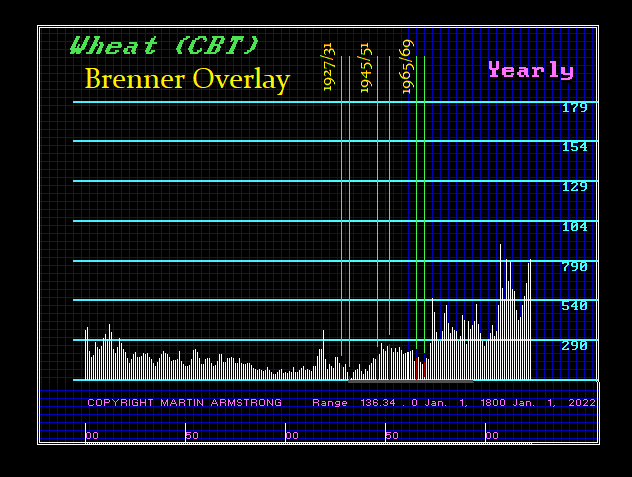

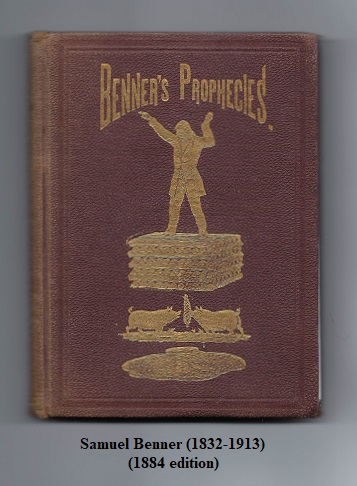
ANSWER: I think your question is very important. I have in my library Brenner’s actual publication. They are very rare, to say the least. Overlaying Brenner onto Wheat, we can see that during the 20th century, they did not work. The question then became why?
People are far too often confused when observing a market. They think that that instrument itself possesses some inherent trading character all by itself. I have often said that when I went to Economics class, the professor said there is no definable business cycle because everything is random. Then I went to Physics class and was told that nothing is random. I came to the conclusion that it was the economics professor who was wrong.
In Physics, we have two separate principles that are far too often confused as the same. The Uncertainty Principle was articulated by the German physicist Werner Heisenberg (1901-1976). It states that the position and the velocity of an object cannot both be measured exactly at the same time, even in theory. The very concepts of exact position and exact velocity together, in fact, have no meaning in nature. Effectively, if we increase the precision in measuring one quantity, we are forced to lose precision in measuring the other.
The Uncertainty Principle has been frequently confused with the Observer Effect whereby the disturbance of an observed system by the act of observation takes place as the result of utilizing instruments that alter the state of what is being measured. To put this in common terms, let’s say you take a gauge to test the tire pressure on your car. The very act of measuring the air pressure results in some air escaping. Hence, the act of observing changes the actual pressure in the tire even minutely.
This is one of the most fascinating aspects of Physics. Here is my favorite cartoon explaining an important aspect of cyclical analysis as well.
So what does this have to do with analysis in markets? What are we actually observing? The innate object be it gold, wheat, or the stock market. If a tree falls in a forest and nobody is around, does it make a sound? That all depends on your definition of a sound. If you define “sound” as requiring it to be heard by a person or animal, the answer is no. Yet is that the proper definition?
This brings us to Kondratieff and Benner waves. Were they actually measuring commodities, or were they measuring the cyclical interference of climate, war, and 70% of the GDP being confined to agriculture? We clearly have a problem with the human interpretation of an observation. We are then confined by our own prejudices formed in life. If we have NEVER read about war or experienced war, then is it possible to look at the 19th century and realize that there was an interference in the market behavior by war?
This is why fundamental analysis always fails. Claims that this is the guy who forecasts whatever based upon his opinion or fundamental analysis is simply nothing more than a broken clock is also correct twice a day. The vast array of fundamentals that are taking place simultaneously can never be sorted out by any human being. It depends upon the experience of the observer. I have often explained that people focus only domestically and often on whatever the Federal Reserve wants us to do. They do not see that in turn the Federal Reserve is influenced by international events. Thus, those who focus domestically, are blind to global trends. This is primarily why I developed Socrates for it is humanly impossible to monitor absolutely everything. No human being can do this and then it is impossible to sort out the fundamentals in advance – only hindsight. Many have ignored the fundamental approach and turned to Technical Analysis. Then the third branch is cyclical analysis focused on TIME.

Cyclical Analysis must also incorporate physics to achieve accuracy. Otherwise, someone who then identifies some cycle of 25 units and says see, it worked 5 times in a row, will lose the house for that relationship will change. This is the question of the Kondratieff and Brenner cycles. Kondratief saw broad cyclical trends throughout history. But they were averages and he did not seek a definitive time frequency. Brenner focused on sunspots and agriculture for he was a farmer and saw the cyclical patterns unfolding before him.
However, the complexity of the market and economic behavior is much like the double-slit realization. A single particle moving through a single slit produces a linear output. But when a second slit is introduced, then cyclical waves emerge. This illustrates the complexity. Each market is like a separate particle in that cartoon. By itself with a single slit, the outcome tends to be linear as expected. But adding that second slit produces complexity and cyclical wave interference. Thus, in analysis, we must consider the entire global basket of particles to approach the cyclical waves and interference.
There are so many layers to price activity each displaying a unique frequency. This once again comes down to human interpretation and can the analyst even see the complexity. Our arrays are the best shot at accurate cyclical forecasting and there are 72 models inside that – not a simple one-time frequency of a linear cycle. It is the computer that projects the outcome, not any human interpretation. Then you have to have a database that is unprecedented to back-test the entire analysis. Without recreating the monetary system of the world, it would be impossible for the computer to forecast war, the collapse of communism, or the 1929-style even in Tokyo in 1989.
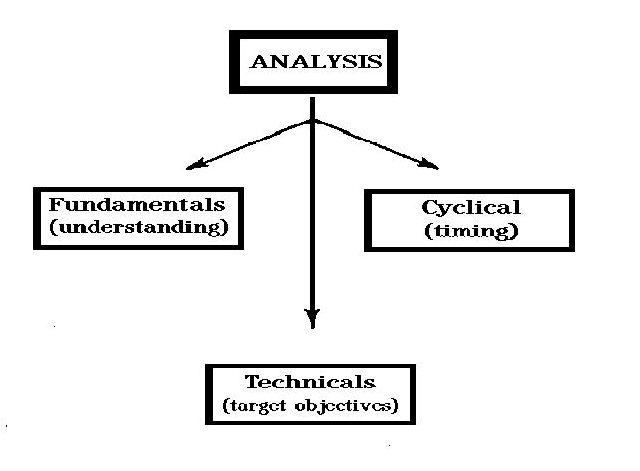
Fundamental analysis can ONLY be used to explain AFTER the fact – not to forecast the future. Consequently, the Kondratieff and Brenner cyclical waves are not accurate in trying to predict the economy or the next great crash in markets. We must respect that they observed the top layer of cyclical activity, but behind that mask was climate change coming out of the last ice age, the wave of innovation that brought the Industrial Revolution which diminished the commodity influence, and war.
It is not that their work was wrong. They were the leaders in cyclical analysis and pointed the way. It simply required more exploration to understand the complexity and wave interference from the impact of everything, everywhere. The analysis of Benner failed during the 20th century because what he was observing was the complexity of the times and one really needed to sort out each and every component that produced the wave structure during the 19th century to be able to accurately forecast the 20th century.
Brenner & Kondratieff Waves v Economic Confidence Model
Armstrong Economics Blog/Understanding Cycles Re-Posted Mar 25, 2023 by Martin Armstrong
COMMENT: Marty, I began following you in 1985. That is when everyone was using the Kondratieff Wave and admitted it averaged 45 to 60 years. They were all predicting another Great Depression. You were the only one right back then as well. I remember your advertisement in the Economist saying a new Private Wave was beginning. The ECM has called every turn ever since and even to the very day.
Now the Brenner Chart is floating around all because it points to 2023. The 1999 turning point which was supposed to be the high, was not just off from the stock market and the 2000 Dot-Com Bubble, but 1999 was low in gold. The 2019 target was also off for it was 2020 which was a low.
I think both the Kondratieff and the Brenner cycles have caused more harm than good in furthering cyclical analysis. You are right. They were commodity based not economic-based.
I just wanted to share my observations because people need to understand the difference.
Jeff
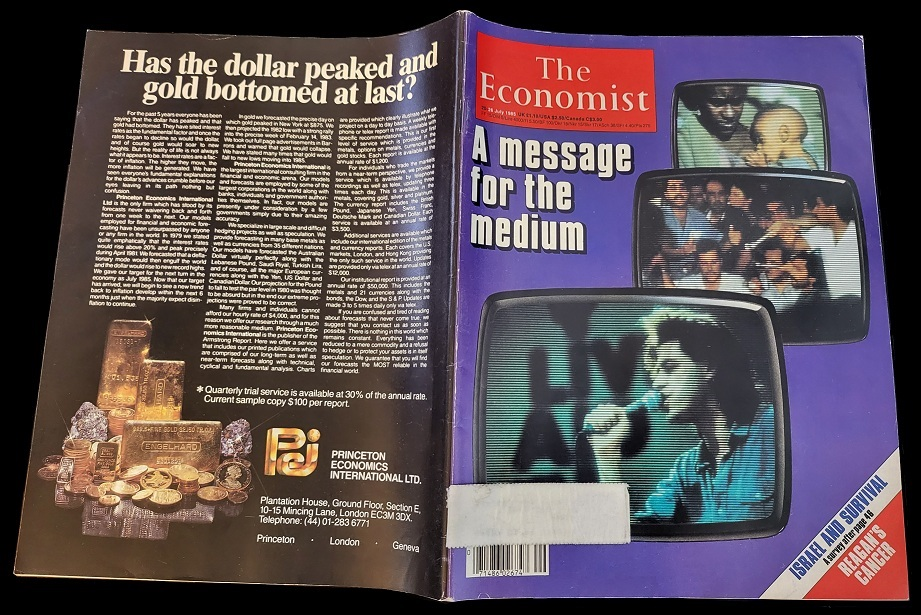
REPLY: Oh yes. I remember 1985. It was high in the dollar and the British pound hit nearly par dropping from $240. Yes, we took the back cover of the Economist for 3 weeks during July 1985 to announce the start of inflation and the Private Wave. I was shocked that people held on to those advertisements and we would get letters even 2 years later.
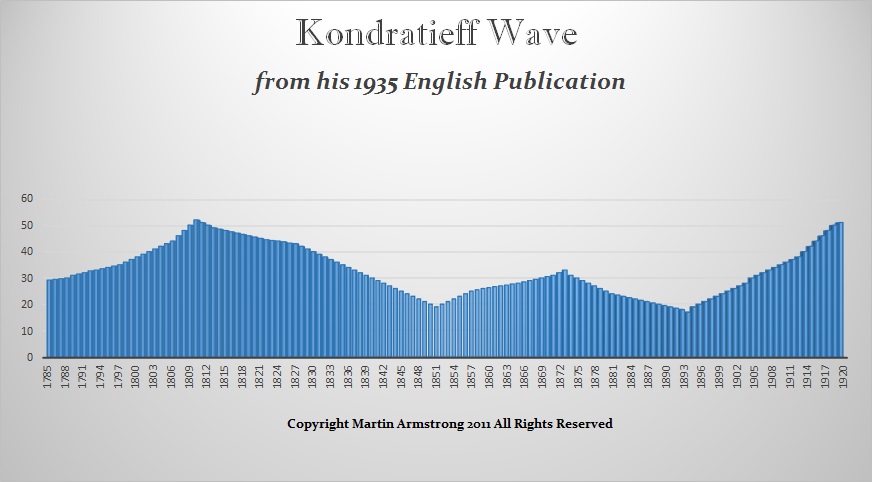
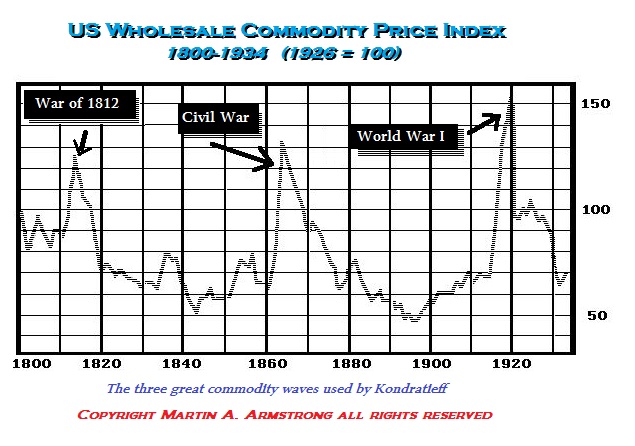
The Kondratieff and Benner cycles were constructed during the 19th century. You cannot create a model on Wheat and then try to use it to trade Copper. Sometimes it will line up, and other times it will not.
Both Kondratieff and Brenner waves were not just based on commodities/sunspots, but they were in turn influenced by war and climate, unbeknownst to either. Kondratieff and Brenner followed agriculture/commodity prices when agriculture accounted for 70% of the GDP pre-20th century. That only began to decline from 1850 forward, dropping to 40% by 1900 as the Industrial Revolution emerged with the invention of the steam engine. Then there was climate change. The Little Ice Age bottomed in the 1600s.
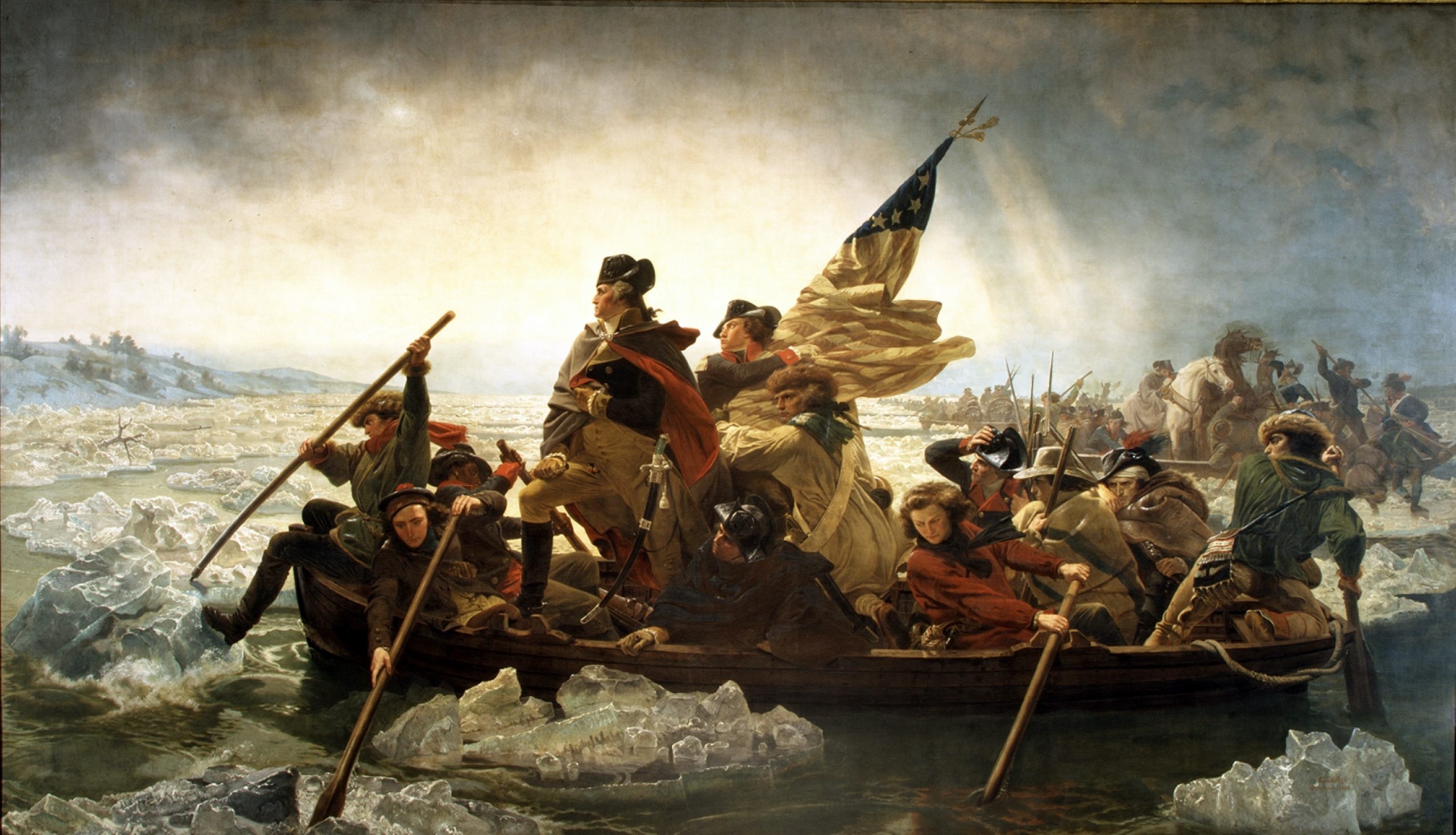
Then there was the volatility in weather that also impacted the commodity prices. This too has contributed to the inaccuracy of both waves. During the late 18th to early 19th century, it was still very cold and the ground would freeze down a couple of feet preventing winter crops. The ground froze to a depth of 2 feet according to John Adams. When John Adams set out to travel to Philadelphia, it was bitterly cold and there was a foot or more of snow that covered the landscape that had blanketed Massachusetts from one end of the province to the other. Beneath the snow, after weeks of severe cold, the ground was frozen solid to a depth of two feet. I grew up near the Delaware River. NEVER in my lifetime did I ever see the river frozen as you see in paintings of Washington crossing the Delaware River. In a letter to his wife, John Adams wrote:
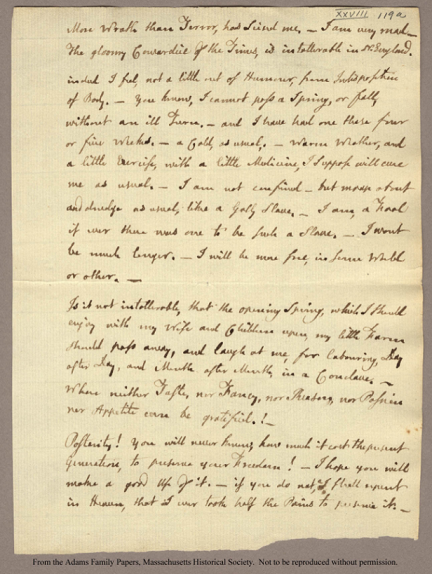
“Indeed I feel not a little out of Humour, from Indisposition of Body. You know, I cannot pass a Spring, or fall, without an ill Turn — and I have had one these four or five Weeks — a Cold, as usual. Warm Weather, and a little Exercise, with a little Medicine, I suppose will cure me as usual. … Posterity! You will never know, how much it cost the present Generation, to preserve your Freedom! I hope you will make a good Use of it. If you do not, I shall repent in Heaven, that I ever took half the Pains to preserve it.”
On September 8, 1816, Jefferson described the weather in a letter to Albert Gallatin:
“We have had the most extraordinary year of drought and cold ever known in the history of America. In June, instead of 3¾ inches, our average of rain for that month, we had only 1/3 of an inch; in August, instead of 9 1/6 inches our average, we had only 8/10 of an inch; and it still continues. The summer too has been as cold as a moderate winter. In every state North of this there has been frost in every month of the year; in this state we had none in June and July but those of August killed much corn over the mountains. The crop of corn through the Atlantic states will probably be less than 1/3 of an ordinary one, that of tobacco still less, and of mean quality.”
Obviously, the Kondratieff and Brenner Waves did not understand the external forces. The climate was impacting the food supply, there were also wars. This is why their waves have not been consistent. If we extend the K-Wave 54 years from the commodity high in 1919, that brings us to 1973 which missed the end of Bretton Woods in 1971 by 2 years, but it was near the OPEC Oil crisis, which was imposed in retaliation for helping Israel in war. The Dow Jones Industrials peaked in January 1973 and crashed into December 1974. The Brenner wave did not bottom until 1978.
Another 54 years from there will bring us to 2027 while the Brenner Wave targeted 2019 and projects the low in 2023. Wheat peaked in March 0f 2022. So you can see if any of these targets were to actually work on time, it tends to be more of a coincidence rather than an accurate forecast. So I can see what you say that they have perhaps led some to think cyclical research is snake oil. It is so important to understand that you cannot create a model on potatoes and then use it to trade the Dow. We must understand the nature of markets to comprehend what we are really looking at in the first place.
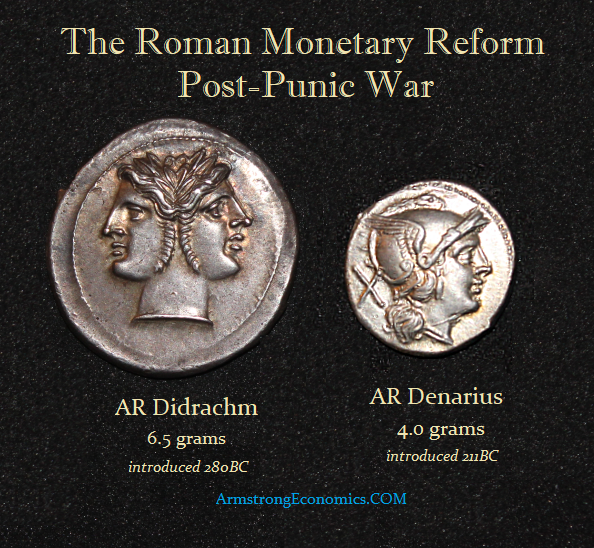
There is a cycle of industrialization as well. Rome began as an agrarian society and moved toward trade, which brought them into conflict with Carthage. We see this cycle even in their coinage. The first silver coins of Rome were struck using the monetary system that was Greek in origin from the days of Athens and Alexander the Great. Only after the Second Punic War did Rome create its own monetary unit which was a debasement (reduction in weight) from 6.5 grams to 4 grams. That reflected both the inflation due to war, but also the rise of Rome whereby they no longer cared about complying with the Greek standard but set out to establish the Roman standard. To this day, many denominations still retain derivatives of the word “denarius” such as in the Iraqi Dinar or the French denier. The Germans called it the pfennig and the English adopted that as the penny.
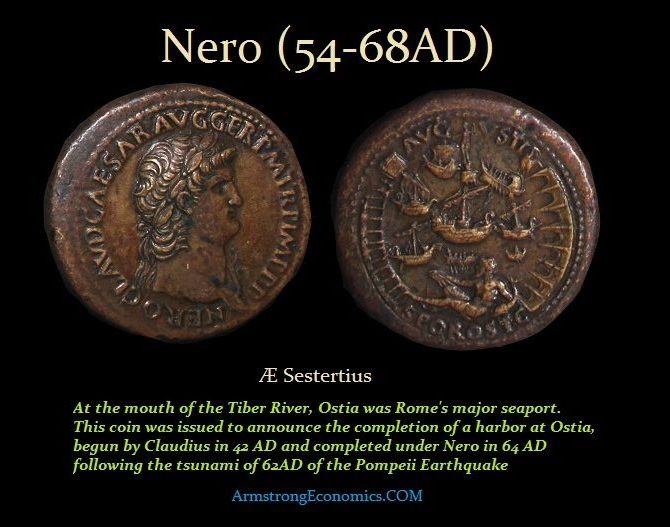
Rome itself became more like New York and grain was imported from Egypt. As agriculture became more of an import, Rome blossomed like New York in the arts and culture. It built the massive port of Ostia which was celebrated on the coinage of Nero (54-68AD) securing the food supply.
The shift toward industrialization in the Roman Empire also resulted in a decline in birth rates for children as we see in modern times. Large families were needed in an agrarian society, but not so much in a developed society – hence the family laws of Augustus. We see the same patterns repeat throughout history.
The first known Clean Air Act occurred in 535 AD by Emperor Justinian in Constantinople. He proclaimed the importance of clean air as a birthright. “By the law of nature these things are common to mankind—the air, running water, the sea.” Even Cicero wrote about pollution in the ancient city of Rome. This went hand and hand with developed societies and urbanization.
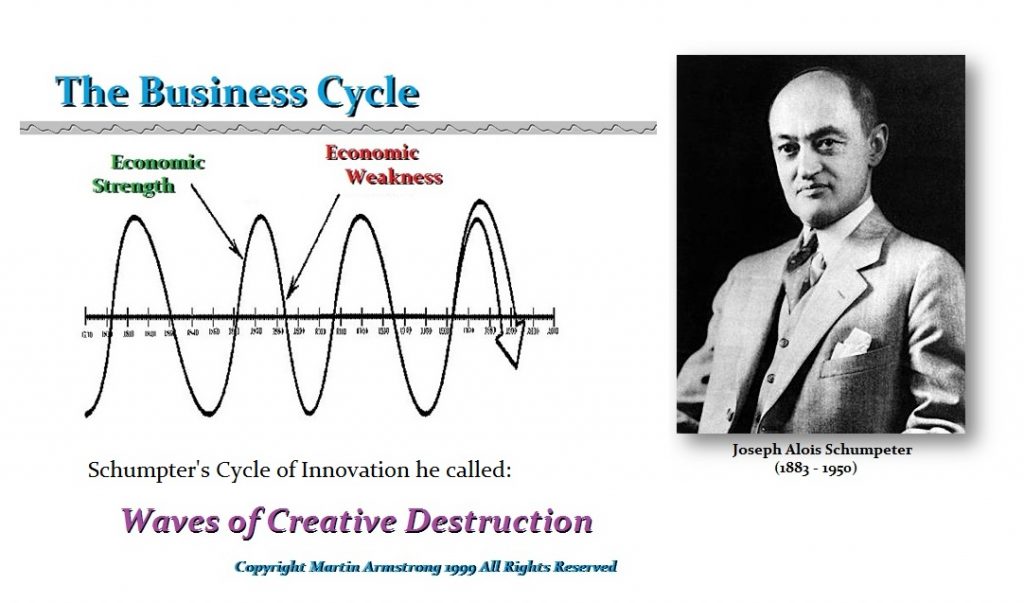
Joseph Mois Schumpeter (1883-1950) was an Austrian economist, educated in Vienna. He taught at Czernowitz, Graz and Bonn. In 1932, he moved to Harvard where he taught until his death. Among Schumpeter’s writings is Theory of Economic Development (1912), Business Cycles (1939), Capitalism, Socialism and Democracy (1942), and History of Economic Analysis (1954).
Schumpeter developed a theory of trade cycles and growth; he argued that abnormal profit was the entrepreneur’s reward for innovation. He predicted, however, that the scope for innovation would be declining in the course of capitalist development as competitive market structures were replaced by monopolies. He believed that capitalism would gradually evolve into socialism. Like Malthus, he could not look into the future and see all the technological advancements that would constantly create waves of new innovation.
In 1939, it was actually Schumpeter who suggested naming the cycles “Kondratieff waves” in his honor. To explain the Kondratieff Wave, Schumpeter called them waves of innovation that result in waves of creative destruction. Each wave of some new innovation destroys the last. Cars wiped out horses & buggies. The internet is wiping out local stores, and the post office, as technology has introduced streaming that has wiped out VCRs and DVDs, and even movie theaters. The cryptocurrency advocates promote the end of central banks and paper currency.
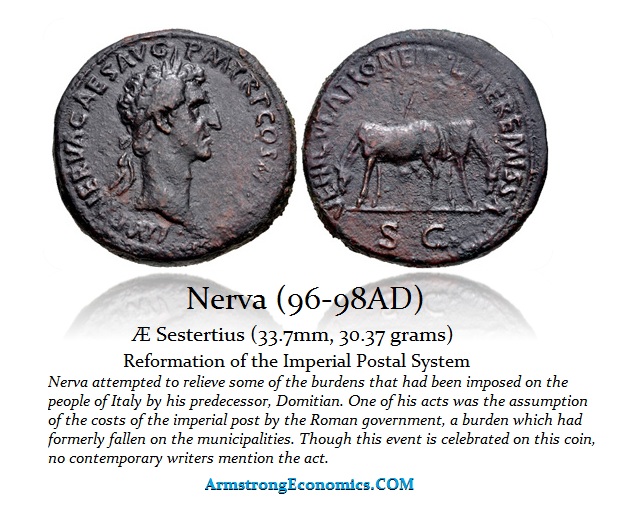
There has always been a cycle of innovation. That was one of Joseph Schumpeter’s main theories to explain the business cycle. For example, first, there was the Canal Bubble that peaked during the Panic of 1825. There was the invention of the telegraph followed by the telephone. The ancient Romans had invented the first version of the Pony Express and could get a letter from Britain to Rome in about 7 days. That too was celebrated on the coinage of Emperor Nerva (96-98AD).
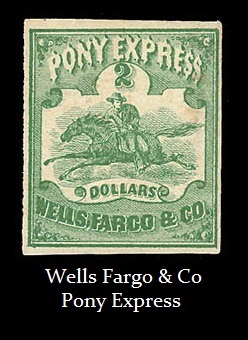
This age of communication with the Pony Express and stagecoach travel was followed by the invention of the steam engine. That gave birth to the railroad boom which lasted from the 1860s and peaked in 1907. It was on May 10th, 1869, when the Union Pacific and Central Pacific railroad lines joined 1776 miles of rail at Promontory Summit, Utah Territory connecting the East and West by rail. The Railroad Barrons became famous millionaires and that innovation boom peaked initially with the Panic of 1893, but the final rally in the railroads peaked in 1907. Thereafter, the combustion engine took over for the next wave of innovation giving birth to the automobile took over and peaked in 1929, tractors, and air travel.
On January 1, 1914, the world’s inaugural scheduled flight with a paying passenger hopped across the bay separating Tampa and St. Petersburg, Florida. Planes were used during World War I, but after the war, there were thousands of unemployed pilots and a surplus of aircraft along with an appreciation for the future significance of this new technology.
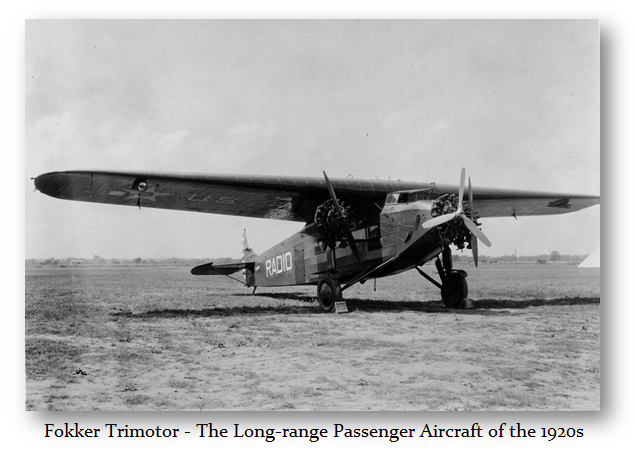
It was after World War I that civilian airliners began to emerge. The Fokker Trimotor built in Europe by the Dutch with an 8-12 passenger capacity was the most popular airliner in the 1920s. It had a range of about 600 miles. World War II was coming into play when the USA built Douglas DC-3 with a capacity of 28 passengers. It had a range of nearly 1500 miles. The DC-3 made its maiden commercial flight in 1936 between New York and Chicago and thus the airline stocks were the big innovation for the rally into 1937.
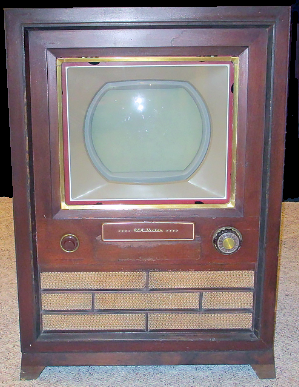
It was 1938 when televisions first began to be commercially available. It would be after World War II when this became the next real innovation boom. It was 1954 when color RCA TV C-100 systems were sold across America. By 1960, there were four debates between John F. Kennedy and Richard Nixon that were broadcast and changed the manner in which presidents would campaign. By 1969, Neil Armstrong walked on the moon for the first time as millions of American viewers watched live on network TV.
Of course, we have the internet boom in 2000, etc., and there is a clear cycle of innovation that Kondratieff and Brenner could not see before even the invention of the combustion engine that led to tractors changing agriculture forever. There is a difference between when something is invented and when it becomes commercially viable.
For example, the FAX machine was actually invented by the Scottish inventor Alexander Bain (1811–1877) who was famous for being the first to patent the electric clock and was also involved in installing the telegraph lines between Edinburgh and Glasgow in Scotland. He could see in his mind’s eye that the Morse Code of dots and dashes invented several years earlier by Samuel Morse, could take an image and transmit it by reducing it to a binary image. He envisioned the first fax machine. In 1846, he was able to reproduce graphic signs in laboratory experiments. He applied and received a British patent #9745 on May 27, 1843, for his “Electric Printing Telegraph”, but it took more than 100 years to actually become usable. We have embarked on the next wave of innovation that includes quantum computers and Artificial Intelligence.

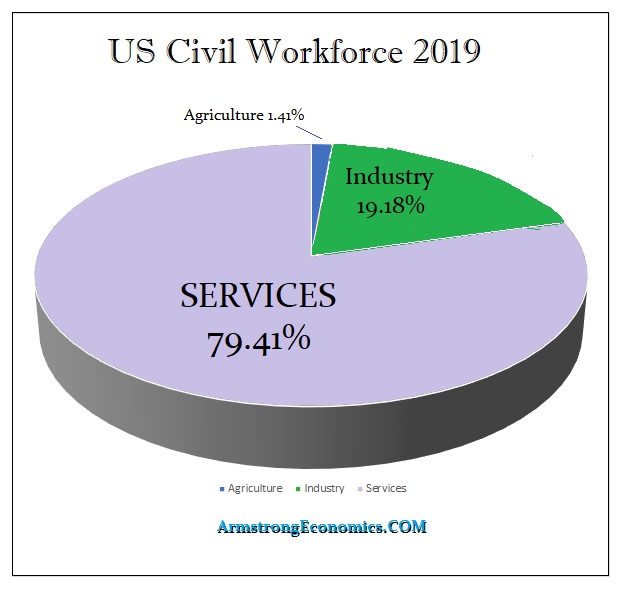
Consequently, when you are looking at long-term cycles, a few hundred years is not enough data. If Kondratieff were alive today and based his study on just the current system, he would be focusing on services rather than commodity-based economies. Agriculture has fallen to just 1.41% of the civil workforce.
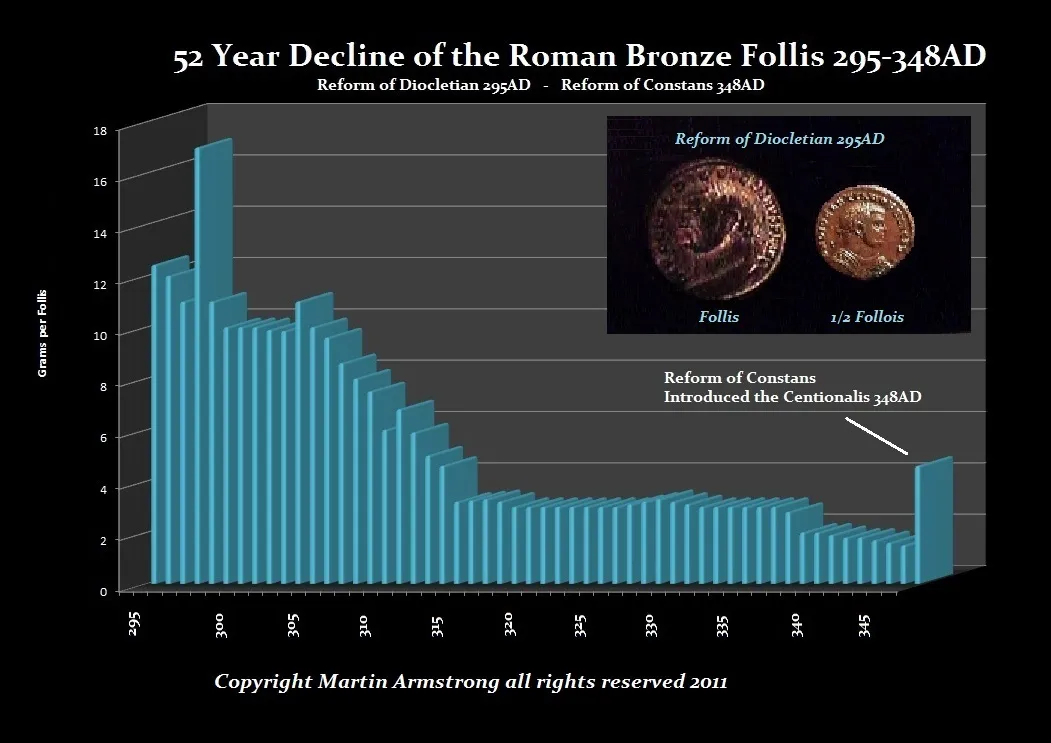
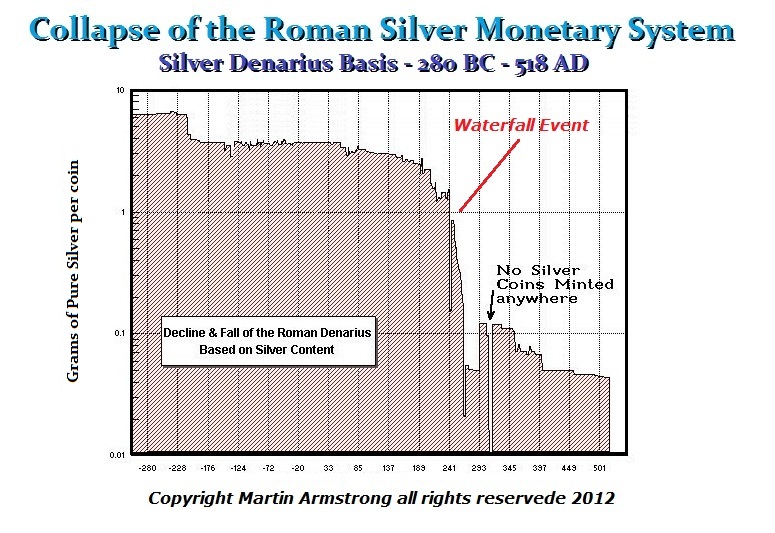
It is simply vital to grasp the very nature of the data that you are intending to use to create models, which is itself in its own cycle of innovation. This is why the Economic Confidence Model is totally different. It is NOT panic on any single sector. It is based on the boom and bust movement irrespective of the sector and it embraces the entire world, not a single economy. Back-testing revealed that not only did the Roman Monetary System collapse in just 8.6 years, but this cyclical frequency appears throughout the ancient monetary systems globally.
 Centinel2012