Posted originally on the CTH on September 8, 2023 | Sundance
Tonight President Trump is holding a rally in Rapid City, South Dakota and it is widely anticipated that Governor Kristi Noem will endorse him for the 2024 nomination. Livestream Links Below. President Trump’s scheduled remarks will happen sometime around 7 to 8pm Eastern.
Earlier GM cut 5,000 salaried workers and several hundred hourly jobs. Ford previously announced it would cut a total of 3,000 salaried and contract jobs, mostly in North America and India. Now, today, Chrysler parent company Stellantis announces 3,500 auto sector job cuts.
Stellantis owns the Jeep, Ram, Chrysler, Dodge and Fiat brands. Apparently, there is something in the U.S. economy that’s happening despite the great pretending….
Biden in Michigan, speaking to auto-workers, 2020
WASHINGTON, April 25 (Reuters) – Chrysler-parent Stellantis NV (STLAM.MI) wants to cut approximately 3,500 hourly U.S. jobs and is offering voluntary exit packages, according to a United Auto Workers union letter made public Tuesday.
The automaker is looking to reduce its hourly workforce offering incentive packages that include $50,000 payments for workers hired before 2007, UAW Local 1264 said in a letter dated Monday posted on its Facebook page.
Stellantis spokeswoman Jodi Tinson declined to comment. A person briefed on the matter said the figure might be lower than the figure cited in the UAW letter.
In late February, Stellantis indefinitely halted operations at an assembly plant in Illinois, citing rising costs of electric vehicle production.
The action impacted about 1,350 workers at the Belvidere, Illinois, plant that built the Jeep Cherokee SUV and resulted in indefinite layoffs. The automaker has warned it may not resume operations as it considers other options. (read more)
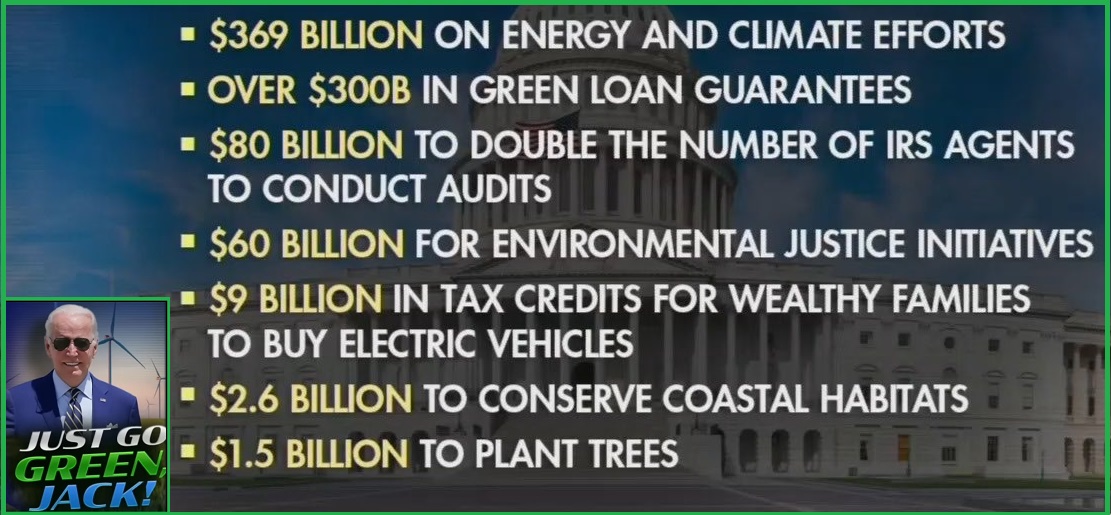
The Investment Recovery Act (IRA), aka “the green new deal” multitrillion spending bill, was supposed to enhance autoworkers. Funny how the exact opposite happens.
Incentive Package for Retirement: $50,000 for seniority members hired prior to the 2007 agreement.
Voluntary Termination of Employment Program: guaranteed lumpsum benefit payment and is applicable to employees with at least 1 year seniority.
.
Overall govt spending and regulatory controls drove inflation for these past two years. The ‘demand side’ was blamed, despite the lack of demand. I will be proven right when history is concluded with this. Interest rates were raised by central banks in an effort to support the policies that are driving ‘supply side’ inflation, not demand side.
Energy policy was/is crushing the consumer by driving up the cost of all goods and services. To support the overall goal of changing global energy resource and development (a false and controlled global operation), central banks raised interest rates. Various western economies, including our own, have been pushed deeper into a state of contraction by central banks crushing consumer demand, and eliminating investment via increased borrowing costs.
In short, the goal was/is to lower energy consumption by shrinking the economic activity. This, according to the BBB plan, was needed at the same time as energy development was reduced.
These economic outcomes are not organic, they are all being controlled by collective western government agreement.
Posted originally on the CTH on February 27, 2023 | Sundance
Florida Governor Ron DeSantis and former Vice President Mike Pence will be skipping CPAC 2023 this year as President Donald Trump delivers the keynote speech.
DeSantis and Pence will avoid the uncomfortable results of the grassroots straw poll outcome, which – given the nature of their political interests – could potentially be embarrassing for the people who are organizing their ‘stop Trump’ campaign.
(Jax4) – CPAC, which is billed as the largest and most influential gathering of conservatives in the world, begins Wednesday.
Governor Ron DeSantis, who spoke at the event last year has other plans, and former vice president Mike Pence has turned down an invitation. (more)
After spending the weekend with billionaire donors and republicans molded purchased by the Sea Island (Big Club) influence, DeSantis will be traveling the country promoting his Rupert Murdoch funded book with stops in Texas and California. The governor is also expected in Iowa, New Hampshire, Pennsylvania and Georgia, according to Jacksonville News4.
The Florida governor will finish the week back in his home state as The Club for Growth is hosting DeSantis and a half-dozen presidential prospects at a closed-door retreat next weekend with GOPe top donors {Link}. Donald Trump is not invited. The meeting, organized by the multinational corporate interests of CfG, is about how to coordinate multiple candidate efforts to defeat Trump.
Additionally, details are surfacing of additional attendees at last weekend’s ritzy “influencers” event at the Four Seasons Resort in Palm Beach, hosted by DeSantis handler Christina Pushaw. According to news reports in addition to the previously recruited social media group, Laura Ingraham, Ann Coulter and Chaya Raichik (Libs of TikTok) were in attendance doing panel discussions. {link}
COMMENT: Good Morning Mr. Armstrong, a long-time reader and client of Socrates and your conferences. I just read your entry for Belarus drafting 18 to 60-year-olds. I had a feeling that eventually, that would take place here in the states. I can tell you without a doubt, I will never comply. My family has served in WWII and Vietnam. We have given enough. I absolutely despise our government. I am wondering if this is part of the continued collapse of the government. With such low recruitment levels and the political fallout from the past few years, they must realize people will not be forced to serve. Especially those with the means to defend themselves. Is this a main component of civil unrest here with separatist movements? Just curious if you can elaborate on what you think will happen when they institute a draft here. All the Best.
J
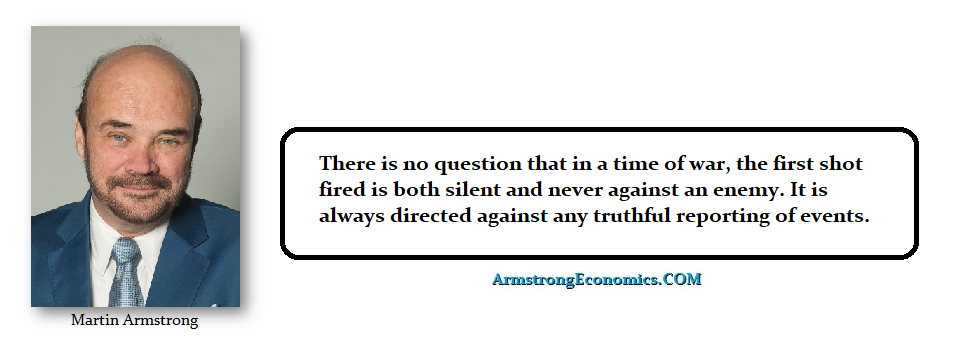
REPLY: My family has fought in every war since the American Revolution. My cousin still has the musket on his wall from the American Revolution. I lost half of my high school friends to Vietnam and my father and his three brothers were all in World War II and my grandfathers on both sides of the family were in World War I. There is no question that in a time of war, the first shot fired is both silent and never against an enemy. It is always against any truthful reporting of events.
The Defense Casualty Analysis System (DCAS) Extract Files contain records of 58,220 U.S. military fatal casualties of the Vietnam War. The government propaganda site, Wikipedia also directed by the Deep State, has low-balled the casualties claiming in total, all US and allied military deaths reached 282,000. We claim that is a victory for the VC lost 444,000 to possibly 666,000. The civilians who died have been low-balled with estimates of 405,000 up to 627,000. Just turn to Britannica and you get:
“In 1995 Vietnam released its official estimate of the number of people killed during the Vietnam War: as many as 2,000,000 civilians on both sides and some 1,100,000 North Vietnamese and Viet Cong fighters.”
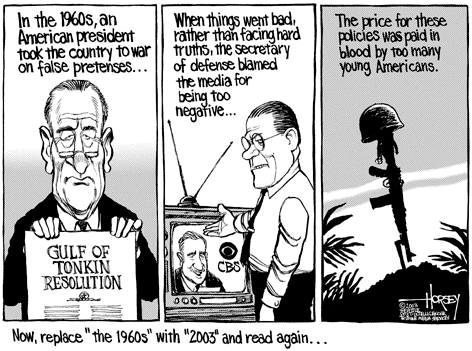
President Lydon Johnson knew there was no reason to enter Vietnam. He knew we could not get out easily. Still, he committed the country to war because the Neocons wanted it.
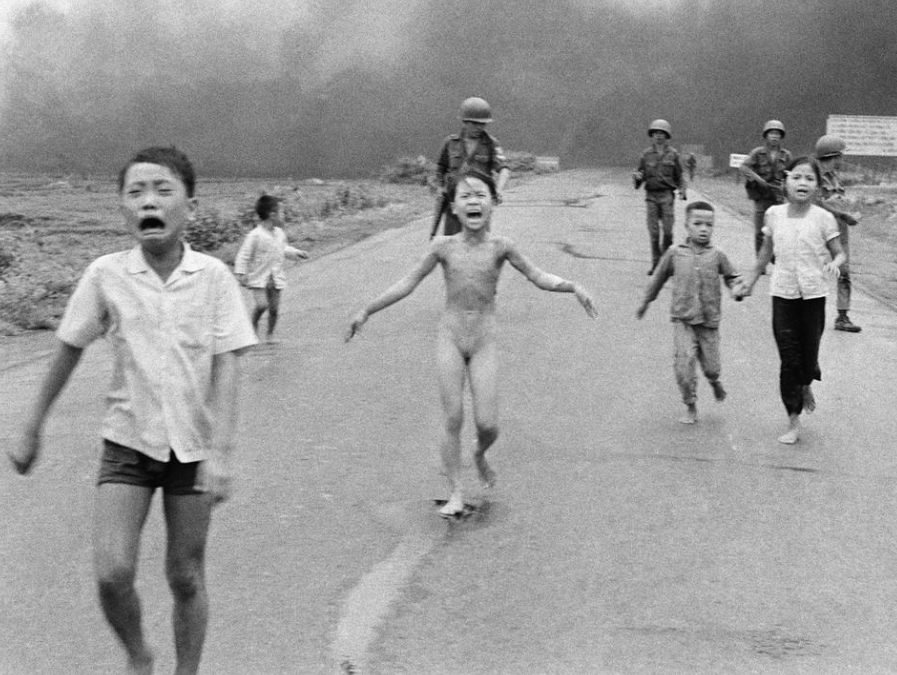
This is a famous photograph from Vietnam that is probably the most memorable of all time. You see South Vietnamese forces following terrified children. At the center is 9-year-old Phan Thi Kim Phùc, as she and other children are running from an aerial napalm attack on suspected Viet Cong hiding places on June 8, 1972. The plane accidentally dropped napalm on South Vietnamese troops and civilians. As always, just the collateral damage of war. The terrified girl had ripped off her burning clothes while fleeing. This photo was taken by Nick Ut of The Associated Press that captured the horror of Vietnam worldwide. It was 1972 when President Nixon said enough and promised to bring the troops home.
This 9-year-old make girl running from napalm, Phan Thi Kim Phúc, had profoundly changed her forever. Such people are tormented for a lifetime. They wake up at night dreaming over and over about the horror of those events for the rest of their lives. Kim Phúc was bitter and full of hatred she said. Later, she picked up the Bible and converted to Christianity. Today, she lives in Toronto with her family and helps other children victims of war around the world. It is those who survive who are profoundly tortured for the remainder of their lives. That is the real cost of war that nobody cares about.
The official estimate of civilian deaths in World War II stands at a total of 70–85 million. The actual military deaths were 21,000,000 to 25,500,000. There is ALWAYS an equal amount of civilian deaths in times of war. Those in power never want to talk about that.
Posted originally on the CTH on January 1, 2023 | Sundance
This is an interesting interview in that International Monetary Fund Globalist Director Kristalina Georgieva seems to be laying the landscape for some truthful economic news to surface on the geopolitical level; albeit keeping up the globalist pretenses around western collective energy policy.
One of the more important points Mrs. Georgieva hits on is the reopening of China, from district level COVID bubbles as a containment feature, and the likely impact it will have on global supply chains. Mrs. Georgieva is correct on this issue.
China continued operating their industrial manufacturing base (despite COVID) because they built strict covid isolation bubbles around their industrial sectors geographically. However, with China lifting those isolation bubbles, there is a great potential for the manufacturing sectors to be hit hard by short to medium term virus outbreaks. This could/will have the potential ripple effect of global supply disruptions.
In an ironic twist, ‘deglobalization’ is now a 2023 catchphrase as various nations realize having their supply chains both dependent and interconnected is not good when there are interruptions. A new discussion centering around being dependent on China is the specific issue now being raised. However, the globalists are isolating their viewpoints only to raw material resourcing and development. WATCH:
[Transcript] -MARGARET BRENNAN: I want you to take us around the world and kind of us give us that global view. Let’s start in China. China has been this hub of cheap manufacturing for the world, we are all so dependent on it but right now it looks like COVID cases are exploding as they start pulling back those zero COVID restrictions. What will that mean for the global economy Longterm and short-term?
GEORGIEVA: In the short term, bad news. China has slowed down dramatically in 2022 because of this tight zero COVID policy. For the first time in 40 years China’s growth in 2022 is likely to be at or below global growth. That has never happened before. And looking into next year for three, four, five, six months the relaxation of COVID restrictions will mean bush fire COVID cases throughout China. I was in China last week, in a bubble in the city where there is zero COVID. But that is not going to last once the Chinese people start traveling.
MARGARET BRENNAN: Because they also- they don’t have an effective vaccine right now.
GEORGIEVA: The- the vaccinations fall behind. They have not worked on anti-viral treatments and how that can be offered to people, and so they will go through this tough time. If they stay the course, and this is our advice, stay the course, over time they would be able to catch up with the rest of the world, both in terms of focusing their vaccinations, bringing mRNA vaccines into China, expanding antiviral treatment, and the economy would function. But for the next couple of months, it would be tough for China, and the impact on Chinese growth would be negative. The impact on the region would- would be negative. The impact on global growth would be negative.
MARGARET BRENNAN: Because this is the second-largest economy in the world, and we’ve learned how dependent the world is on the Chinese supply chain. So do you expect then, a domino effect? Will inflation get worse, because all of a sudden there aren’t workers healthy enough to go to factories in China?
GEORGIEVA: We expect that there would be counterweight from the sheer opening of the economy, because up to now, the biggest impact on global value chains came from restrictions due to COVID. When you close down a big city or a big port, the repercussions for the economy is- are significant. Now, we would have the impact of people getting sick, not going to work, but the economy would be open. So the expectations we have for China is to gradually move to a higher level of economic performance, and finish the year better off than it is going to start the year. But you’re absolutely right, the world has relied on China’s growth for a long, long, long time. Before COVID, China would deliver 34, 35, 40% of global growth. It is not doing it anymore. It is actually quite a stressful for the- for the Asian economies. When I talk to Asian leaders, all of them start with this question, what is going to happen with China? Is China going to return to a higher level of growth?
MARGARET BRENNAN: You’ve said that you fear that we are sleepwalking into a world that is poorer and less secure because of a split in the global economy between the US and China. What do you mean by that? Do you see efforts here in Washington to stop it?
GEORGIEVA: It is very easy to reflect on the benefits of the world being more integrated. When we look back over the last three decades, the world economy tripled because of this reliance on an integrated world economy. Who benefited the most? Emerging markets and developing economies, they quadrupled. But rich countries also benefited, they doubled in size of the economy. So we have to be careful not to throw the baby out with the bath water. Yes, the way we have operated created excessive dependency in global chains. We were too focused on costs, how can we make products cheaper. And COVID and then the senseless war Russia started against Ukraine has shown that this is not enough. We cannot just concentrate on what is cheaper. We have to think of the security of supplies and that means diversify the sources of products that make the economy function well, lifting up the level of cost. That economic logic is not only appropriate, it is a must to follow. But we shouldn’t go beyond. We shouldn’t say, okay, we break the world into blocks, one works here, the other one works there because the costs are very, very high. We calculated that just trade, limiting trade into two blocks, would chop $1.5 trillion from the global GDP year after year after year.
MARGARET BRENNAN: If you tried to separate the US and China?
GEORGIEVA: You separate- you separate them, there is an excessive cost. So the logic should be where for security reasons there has to be careful recalibration of supply chains, do it, but don’t go beyond- don’t go into benign areas of products that have no strategic significance but they benefit the US consumer, they benefit the world economy. And this is what we are arguing for, don’t go in a direction in which this separation would make everybody poorer and the world less secure.
MARGARET BRENNAN: So you’re telling Beijing and Washington, figure it out. You can’t be in conflict.
GEORGIEVA: What we have seen in Bali is an indication that this rationale–
MARGARET BRENNAN: You’re talking about the G20 meeting–
GEORGIEVA: The G20 meeting in Bali, when the two presidents, President Biden and President Xi Jinping, met, they spent three and a half hours discussing exactly that. Where is the point of contact that makes both countries better off? And where is that- that there are differences that cannot be bridged and therefore we have to keep them–
MARGARET BRENNAN: The US is trying to block some Chinese technology companies from doing business here. They’re taking measures that are drawing some pretty bright lines between the US and China. Is that tolerable?
GEORGIEVA: We always prefer countries to seek their common interest in economic integration. And when you start breaking the interactions that are based on fair trade, you harm your own people, you not only harm the- the Chinese and therefore it has to be thought through very carefully. Again, I want to be very clear, some diversification of supplies for the security of supply chains is necessary. COVID taught us this lesson, the war taught us this lesson. So the U.S. is right to look into some areas where strategically they need to guarantee the functioning of the U.S. economy without interruptions. But do that keeping in mind the interests of the American people that would like to still have prices moderating, and actually, when we think about prices, one good news we have for 2023 is that towards the end of the year, we do expect inflation to trim down. So don’t take actions that may be contrary to that trend.
MARGARET BRENNAN: But you are predicting inflation to slow to six and a half percent from about 7%. Is that right?
GEORGIEVA: Well, towards the end of the year, we- we project it would go even further down towards the end of 2023, provided central banks stayed the course. Our big worry is that with the economy slowing down globally, we are projecting global growth to go down to 2.7%, maybe even lower next year. Remember, 2021, it was 6%. It dropped to 3.2 this year, 2022. And it will continue to drop down if central banks get the cold foot and say, ‘oh, my god, growth is slowing down, let’s slow down the fight against inflation.’ We risk then inflation to be more persistent. So our message is to central banks, you have to see credible decline in inflation and only then you can think about re-calibrating rate policy.
MARGARET BRENNAN: One of your IMF researchers gave a pretty dire prediction. Overall this year, shocks will reopen economic wounds that were only partially healed post-pandemic. In short, the worst is yet to come and for many people, 2023 will feel like a recession. What do you need to brace for?
GEORGIEVA: The- this is- this is what we see in 2023. For most of the world economy, this is going to be a tough year, tougher than the year we leave behind. Why? Because the three big economies, U.S., E.U., China, are all slowing down simultaneously. The US is most resilient. The U.S. may avoid recession. We see the labor market remaining quite strong. This is, however, mixed blessing because if the labor market is very strong, the Fed may have to keep interest rates tighter for- for longer to bring inflation down. The E.U. very severely hit by the war in Ukraine. Half of the European Union will be in recession next year. China is going to slow down this year further. Next year will be a tough year for China. And that translates into negative trends globally. When we look at the emerging markets in developing economies, there, the picture is even direr. Why? Because on top of everything else, they get hit by high interest rates and by the appreciation of the dollar. For those economies that have high level of that, this is a devastation.
MARGARET BRENNAN: And I want to- I want to come back to you on that. And just to explain that for some of our listeners, a stronger dollar, it’s good for Americans when they go shopping abroad. It’s not good for poor countries who have taken out loans, for example, and borrowed money in dollars. And according to the IMF, 60% of low income countries are in distress because of this- this debt. So what does that look like? Do you- do you see governments collapsing with defaults? Does that bleed into the global financial system? I mean, how much of a contagion does this become?
GEORGIEVA: So far the countries that are in that distress are not systemically significant to trigger a debt crisis. Let’s just look at the map, which are these countries? Chad, Ethiopia, Zambia, Ghana, Lebanon, Surinam, Sri Lanka, very important for their people that we find the resolution to the debt problem, but the risk of contagion is not as high. However, if that list continues to grow, and let’s remember, 25% of emerging markets are trading in distressed territory, then the world economy may be for a bad surprise. And this is why at the IMF, we are working very hard to press for debt resolution for these countries and we have engaged the traditional creditors, the Paris Club, the non-traditional creditors, China, India, Saudi Arabia. I would call this very simple: urgency, we have to act. When I look at the- the debt of the world. Yes, we have to be concerned. During COVID, what did we do? Everywhere governments borrowed, rightly so, to help their people.
MARGARET BRENNAN: Money was cheap.
GEORGIEVA: Money was cheap, and we prevented a collapse of the world economy. That was the right thing to do. But once Russia invaded Ukraine and that added impetus to inflation, money is not- not cheap anymore. So what is the advice we give to governments? Focus on your budgets, make sure that you have sufficient revenues to collect and that you spend very wisely.
MARGARET BRENNAN: That’s good advice, but it’s not always easy politics to follow that advice, as you know–
GEORGIEVA: Of course it is not.
MARGARET BRENNAN: And so that’s why I want to- if- if you can explain for our viewers. You know, we spoke to the CEO of JPMorgan Chase, Jamie Dimon, recently, and he said he sees the global risk as explosive right now. He was saying things like migration, energy, national security, liquidity in the banking system, war, these are all the knock on effects of a government not being able to pay its bills and not being able to deliver for its people. Is that what you are seeing too?
GEORGIEVA: Well, what we’re seeing is the world has changed dramatically. It is a more shock prone world. The lessons we learned from the last couple of years are that no more we operate with relative predictability of what the future would bring. And these shocks COVID, the war, costs of living crisis, they compound their impact. What does that mean for governments? First and foremost, it means that we need to change our mindset towards more resilience, more precautionary actions. And at the IMF, this is what we tell our members. Act early, don’t wait until the problems deepen. And for those who need help, this is why we exist for the developing countries. The fund is a source of resilience and I am- I am very pleased that many of our members are coming to us. Just since the war started we got 16 countries coming for programs to the IMF, $90 billion in support for these countries. And right now we have 36 requests. So that acting early, when you see trouble, look for ways to strengthen your fundamentals, to have buffers to protect you and your people. This is the advice we give to governments. For those who don’t know the IMF, we were created from the ashes of the Second World War to stabilize the world economy. And at a moment like this, we come strong to help our members. My message, don’t think that we are going to go back to pre-COVID predictability. More uncertainty, more overlap of crises wait for us. Rather than crying for the time we had, we have to buckle up and act in that more agile, precautionary manner I described.
MARGARET BRENNAN: I want to make sure I get to Ukraine because I know we’re running out of time. You’ve said- excuse me- you’ve said the single most negative factor in the global economy is the war in Ukraine. And Vladimir Putin says this is going to go on for some time. President Zelensky said they need $55 billion in foreign support next year. He expects $20 billion from the IMF, is he going to get it?
GEORGIEVA: We are working on providing support for Ukraine. So far, out to the international financial institutions, we have provided the largest amount of financing for Ukraine, $2.7 billion in emergency financing, and we are working for 2023 to be a significant part of the support for Ukraine. I expect that sometime early in the year we will go to our board with the request. We have assessed the needs of Ukraine to range somewhere between three and five billion dollars a month. What Putin did with destroying critical infrastructure in Ukraine, this is horrific, and it means that in the next months the country would be more on the high end of this range because it is put in an awful position to have to restore access to electricity, to heat, to water. I have relatives in Ukraine. What I- what I know from them is it is cold, it is dark, and it is scary. Bombardments of civilian areas continue. What I also want to say is that Ukraine has proven to be remarkably resilient. Ukrainian economy is functioning. Pensions are being paid. When there is bombardment, restoration of energy, water, heat is done very quickly and we see revenues collected in Ukraine in a very disciplined manner to support the functioning of the country.
MARGARET BRENNAN: So the government’s not going to collapse?
GEORGIEVA: The government is very well functioning under incredibly difficult circumstances. No, they’re not going to collapse. And then the other thing that is so remarkable is actually the world has proven to be more resilient than we feared, a year in the beginning of the year. We look at the response to the energy shock in Europe, and Europe is moving towards independence from Russia decisively. Yes, there will be a tough winter, maybe the next one would be even tougher, but freedom from dependence on Russia is coming. It is going to be there.
MARGARET BRENNAN: I want to ask you two questions before we go. How do you describe the state of U.S. economics and politics?
GEORGIEVA: The US economy is remarkably resilient. Decision making in the US because of the way the political set is at the moment, it is more difficult. But nonetheless the US has taken some very important steps that are helping to the US economy. Like the child tax-
MARGARET BRENNAN: The tax credit. It expired.
GEORGIEVA: The credit that is it. It is contributing so significantly to reducing poverty in the US, like the infrastructure bill, like the Inflation Reduction Act. These are things that are bringing more dynamism in the US. Good for the US, good for the world. And of course staying on that course is going to be more challenging. But I do hope that the US is not going to slip into recession despite all these risks. We expect one third of the world economy to be in recession. And yes, as you said, even countries that are not in recession, it would feel like recession for hundreds of millions of people. But if that resilience of the labor market in the US holds, the US would help the world to get through a very difficult year.
MARGARET BRENNAN: And as I let you go, my final question is what leaves you hopeful in 2023?
GEORGIEVA: What leaves me hopeful is that I know when we work together, we can overcome the most dramatic challenges. In 2020, the world came together in the face of tremendous threat and was able to overcome this threat. In 2023 we have to do the same. And in this world of ours, of more frequent and devastating shocks, we have to hold hands, we have to work together. And my institution is there to bring together economic policymakers so we can be wise and persistent in the face of truly dramatic challenges we face.
MARGARET BRENNAN: Madam managing Director, thank you for your time this morning.
Everything he says I have confirmed from other sources. French soldiers who volunteered said the same thing, Ukrainians kill Russian prisoners sometimes ruthlessly. It is a total disgrace that we are supporting these Neonazis – the very people still practicing ethnic cleansing.
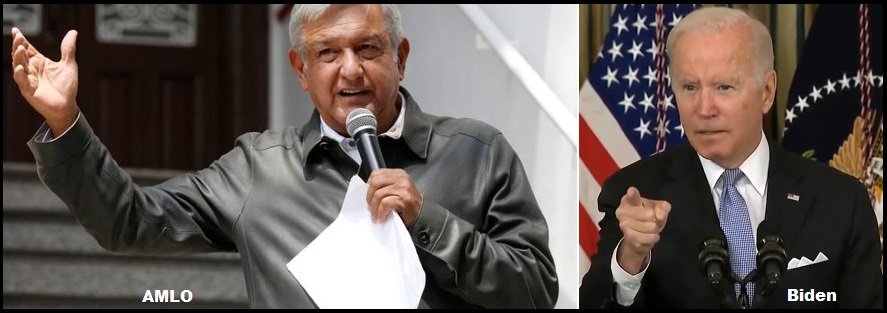
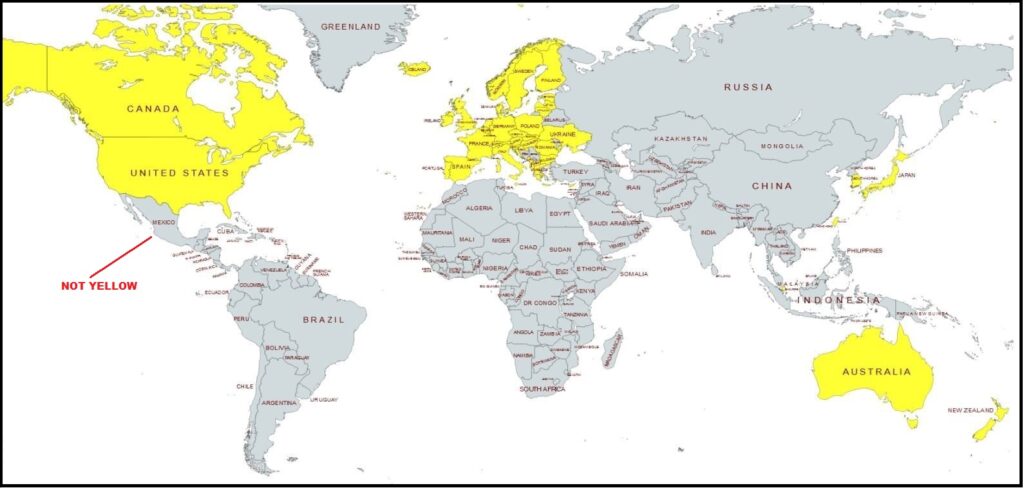
As we’ve been saying for seven months, keep watching how the globalists respond to Mexico. AMLO doesn’t want to join the economic suicide pact known as Build Back Better, or the North American version “Green New Deal.” This puts him in a precarious place.
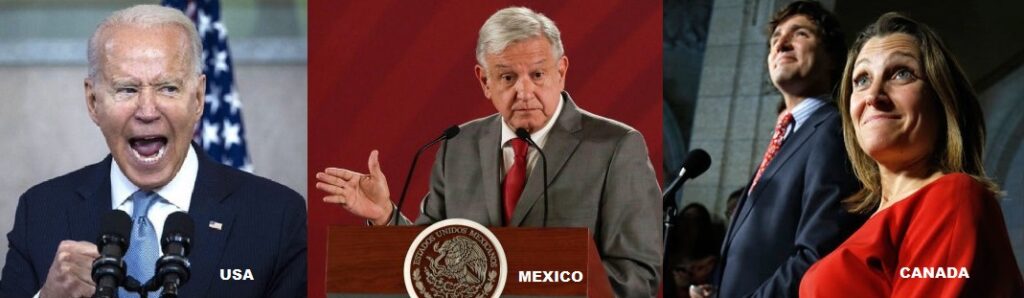
This sentence from a recent financial analysis article in Reuters is telling, “concerns about a U.S. recession and a trade spat Mexico is embroiled in with the United States and Canada over Lopez Obrador’s energy policy, which critics call nationalist, muddy the outlook for the peso.” A “nationalist energy policy”?
What exactly is a “nationalist energy policy,” and why would international financial people be having fits about it?
In the past year the Mexican peso has outperformed the U.S. dollar, in part because Mexico is not following the economic roadmap, a World Economic Forum inspired united inflationary malaise as an outcome of unified energy policy. [Side Note: The Brazilian currency was also outperforming the western bloc and dollar; but that situation has been rectified now, Bolsonaro removed, and the central bank will start contracting the economy.]
The global financial control mechanisms now start to look at the Mexican non-compliance:
(Reuters) – Mexico’s peso, which is ending 2022 with one of its strongest performances in a decade, could have its gains wiped out in 2023 after an expected end to the Bank of Mexico’s rate hikes cycle and a possible recession in top trade partner the United States.
The peso last month clawed its way back to pre-pandemic levels and has appreciated over 5% versus the U.S. dollar in 2022, making it one of the best-performing global currencies alongside Brazil’s real.
But the peso’s impressive run may be ending as markets expect the large capital flows to Mexico in recent months, attracted by the Bank of Mexico’s restrictive monetary policy stance, could soon start to slow.
[…] Banxico, as the central bank is known, has been increasing its benchmark interest rate since June 2021 to stem inflation, and hiked it to a record 10.5% at its last policy meeting.
In the coming months, Banxico is expected to end its rate hiking cycle and likely decouple from the U.S. Federal Reserve, which is seen continuing to increase rates. That would narrow the rate differential and could spark an outflow of capital.
Concerns about a U.S. recession and a trade spat Mexico is embroiled in with the United States and Canada over Lopez Obrador’s energy policy, which critics call nationalist, muddy the outlook for the peso.
“The perception of risk could rise due to the consultations in the framework of the USMCA (trade deal), which could lead to the imposition of measures against Mexico,” said Banco Base.
Traders at the Chicago Mercantile Exchange, considered a bellwether of market sentiment, have started to bet the peso will begin depreciating. (read more)
There is no upper limit to the amount of pressure the Western Alliance will put upon Mexico.
COMMENT: Thoughts regarding your “Trump and 2024” comments. I’ve been following your blog for well over 10 years and signed up on your basic Socrates program months ago. I’m 67 and voted Democrat most of my life until 2016. I voted for Trump. No way I was voting for Hillary Clinton and considering the political DNC and Deep State gamesmanship following Trump’s victory I’ll likely never vote blue again. It was and is disgusting. I’m also a Floridian and voted for DeSantis. I think he’s a great governor for Florida. But there is absolutely no way I’ll vote for him for POTUS. If DeSantis is the GOP candidate I’ll stay home on voting day. In my mind, deep down, he’s just another RINO and will just return us to the status quo. He also has a few ghosts in his closet. I’m personally peeved that he held one of his first cabinet meetings in Israel. And his time at GITMO, if true, is likely to come back to haunt him.
To me Trump is the only one that would, shall we say, have the motivation to get done what really needs to get done inside the beltway and beyond. One would only hope he learned the necessary lessons and could surround himself with the right support staff. Of course, that’s the mystical, magical question. He obviously listened to McConnell too much last go around. I would never profess to have more insight than you and certainly not Socrates. I am simply expressing a personal belief that Trump is our best hope to navigate what’s coming our way. I’m not ready to give up on him yet…and if I do I’ll just throw in the towel and hope for the best. From a Loyal Follower of your Blog!
DH
REPLY: I think a lot of people just have a false impression of politics these days. They take what politicians say seriously. I also think that was Trump’s problem. He did try to actually keep his promises, which politicians routinely do not do. Biden said he would make abortion a constitutional right. He knew that was total BS. To create a Constitutional Amendment you first have to get it through Congress and then every state legislator must agree. It would take years even if you tried. which was total nonsense. But if it gets votes, no problem.
Trump thought being President actually meant you got to run the country like a corporation. They stuffed his cabinet and the Deep State always runs the game. He had to find that out the hard way.
As I said before, I could run for office promise whatever you want to hear. Then when you get there, the Party boss has a gathering and you are told how to vote and when. Just look at the votes in Congress. They are Party Line. Personally, I would prefer DeSantis to stay here in Florida. I think he has done a great job. However, Washington is nothing but a conflict of interest on steroids. Just look at how they poured money into Ukraine, Zelensky then fed it to FTX and FTX became the 2d largest donor to the Democrats. It was money laundering that will never be allowed to get to trial.
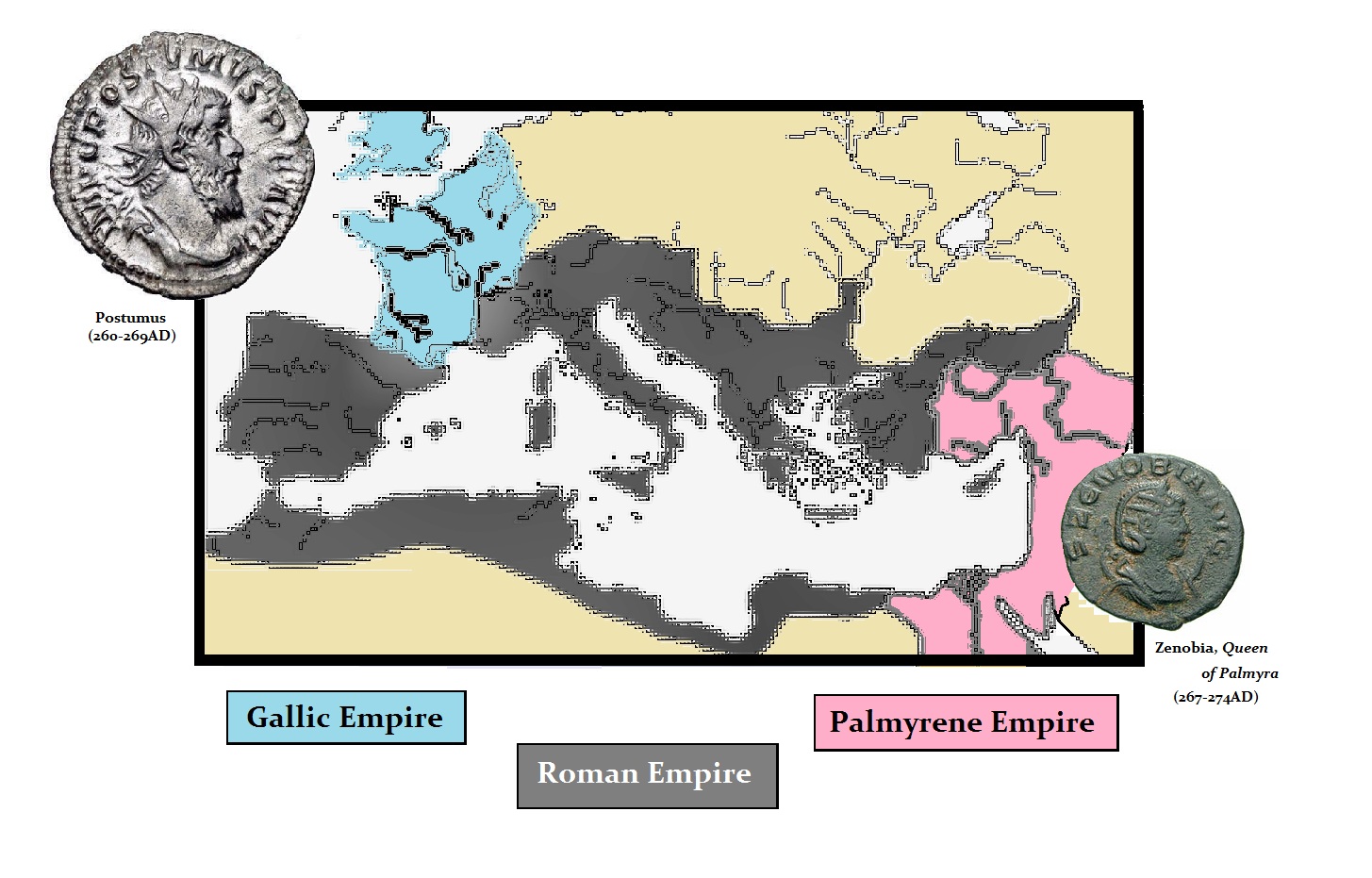
People do not understand that running the nation is far different than an individual state. Look at California and New Jersey v Florida and Texas. They do not even blend together to form a united country. In New Jersey, stores are not allowed to give you a bag. The governor is constructing windmills in the ocean and it’s only a matter of time before he outlaws gas cars and gas stations. The United States is rapidly becoming ungovernable as a united nation. The political difference is so great, it no longer makes sense to have a single nation. The Roman Empire split into three, a civil war was fought to bring it back together.
Then Diocletian divided the Empire in two and this created the Tetrarchy. That lasted just 23 years before Constantine I (307-337AD) reestablished one emperor. But then the West fell and the East survived as the Byzantine Empire after about 180 years. The official Byzantine Empire began in 498AD with the Monetary Reform of Anastasius I (491-518AD). The Byzantine Empire lasted until 1453. The likelihood of the separation of the United States begins to increase post-2024. The United States as we have known it may no longer exist post-2036.
Posted originally on the CTH onDecember 27, 2022 | Sundance
Cobalt is a mined mineral needed for all rechargeable batteries including phones, pads, laptops and Electric Vehicles (EV’s). According to Siddharth Kara, an author and expert on modern-day slavery, human trafficking and child labor, approximately 72% of all the cobalt mined globally comes from the Congo.
Within his new book “Cobalt Red: How the Blood of the Congo Powers Our Lives,” Kara outlines how slave labor and child labor work these cobalt mines. Kara appeared on the Joe Rogan podcast {Direct Rumble Link to segment} to discuss his research and findings after visiting these Congolese mines. Contrasting the “Green Movement” claims that their efforts are to “save the planet” by switching everyone to EV’s, the issues Kara outlines are remarkable. WATCH:
I have created this site to help people have fun in the kitchen. I write about enjoying life both in and out of my kitchen. Life is short! Make the most of it and enjoy!
This is a library of News Events not reported by the Main Stream Media documenting & connecting the dots on How the Obama Marxist Liberal agenda is destroying America









 Centinel2012