♦Puerto Rico has a long history of public corruption and abuse of federal funds. Back in 2015 ten government officials in Puerto Rico were arrested for corruption, bribery, honest services wire fraud, extortion and various schemes related to giving payments to friends and family via federal contracts. [LINK] This is the typical corruption PR is known for.
♦A few weeks ago (June 28) the FBI, Public Corruption Unit, posted a notification of an ongoing corruption probe and provided a tip-line for leads related to bribery and/or corruption of public officials. [LINK] This probe is connected to the billions of dollars U.S. taxpayers have provided to Puerto Rico for recovery after hurricane Maria (2017).
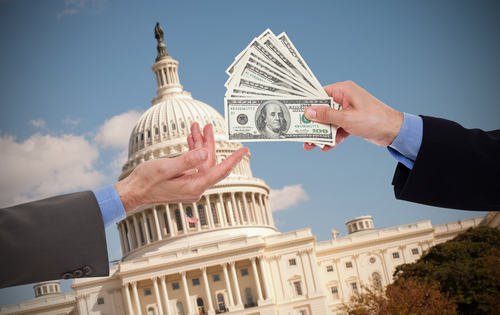
So much money is poured into the island that hundreds of local and regional officials seized the opportunity to indulge their friends and family with funds from recovery accounts. This is the widespread corruption President Trump previously drew attention to. This overt and in-the-open corruption is why Nancy Pelosi took the entire Democrat caucus to Puerto Rico in January for a vacation with her favorite lobbyists. Everyone in/around PR knows this corruption is the norm, not the exception.
Today, six more people were indicted under new federal charges, including two government officials: Julia Keleher, who served as Puerto Rico’s education secretary until April; and Ángela Ávila-Marrero, who was the executive director of the Puerto Rico Health Insurance Administration until late June. They are variously charged with wire fraud, money laundering and conspiracy, according to the 32-count indictment.
WASHINGTON – […] The federal indictment says the former officials illegally directed federal funding to politically connected contractors. The arrests come about a month after Congress approved a controversial disaster aid bill that earmarked additional funding for Puerto Rico’s recovery from Hurricane Maria in 2017, which were tied up in part because President Trump called Puerto Rico’s officials “incompetent or corrupt.”
Rep. Raúl M. Grijalva (D-Ariz.), chair of the Natural Resource Committee that oversees Puerto Rico, called on Rosselló to resign amid the ongoing federal investigation.
“We’ve crossed that crucible now,” Grijalva said in interview. “The restoration of accountability is so key going forward.”
Prosecutors said Rosselló was not involved in the investigation, according to the Associated Press.
A spokesman for Rosselló did not immediately return requests for comment.
The arrests come as senior White House officials are searching for new ways to limit the amount of federal aid going to help Puerto Rico, and the island’s allies fear the arrests will give Trump greater justification for curtailing additional aid to the island.
“The governor of Puerto Rico and his administration have now given President Trump the ammunition he needed,” said San Juan Mayor Yulin Cruz, a political opponent of the governor. (read more)
President Trump was exactly right when he both informed and warned voters of what would happen with the money dumped into Puerto Rico. Here’s a reminder:
Some updates in the Michael Flynn case. As requested the DOJ has filed a response to Judge Sullivan’s order. The DC judge wanted to know what the status of the prosecution position was now that Michael Flynn is no longer a cooperating witness for the DOJ in the EDVA case, against his former business partner.
Strange position considering the backstory. The government wants to delay sentencing until after a case where Flynn is no longer involved is completed?
Additionally, Jessie K Liu added yet another lawyer to the Flynn prosecution today. SEE HERE. Suspicious cat is suspicious.
Earlier today President Trump delivered remarks about an important executive order initiative to fight kidney disease. [Video and Transcript]
.
[Transcript] THE PRESIDENT: Well, thank you very much, Secretary Azar. And thank you for everyone being here. Please sit down. Let’s enjoy it. It’s much better. You’d rather sit, right?
But today we’re taking groundbreaking action to bring new hope to millions of Americans suffering from kidney disease. It’s a big deal.
I want to express my gratitude to Secretary Alex Azar, Secretary Robert Wilkie — who’s here. Thank you, Robert. Thank you. Secretary Eric Hargan. Thank you, Eric. Thank you. Nice to see you. Administrator Seema Verma, who’s so outstanding. Done such an incredible job. And Director Adam Boehler. Thanks also to Senator Todd Young. Where’s Todd? A young, great senator. And Representatives Michael Burgess and Matt Cartwright. Thank you. Thank you, fellas. Thank you very much.
As part of our commitment to ensuring great healthcare for every American, my administration has already launched many bold initiatives to battle major diseases and save American lives.
We are aggressively confronting the opioid, fentanyl, and drug addiction epidemic. And that’s what it is. It’s an epidemic. But we’re making tremendous strides. I think you’re probably hearing about it. We’ll be talking about it very soon. It’s hard to believe we’re making tremendous strides. Very tough situation.
We’re working with Congress to develop a 500-million-dollar investment in new treatments and cures for childhood cancers. And we’ve launched a campaign to end HIV/AIDS epidemic throughout America. We think that within a fairly short number of years, like 10, we will have that epidemic totally under control. And if you would’ve said that two years ago, people would’ve said, “There’s no possible way.”
(Baby coos.)
THE PRESIDENT: Hi. (Laughter.) He’s even happy. (Laughter.)
To give critically ill patients access to lifesaving cures, we passed Right to Try — something I’m so proud of — where people that are terminally ill, or very, very ill, can go and see their doctor. And when we have something in our pipeline — and nobody has a pipeline like the United States of America; we have the greatest technicians, doctors, labs in the world by far, and medical research — we can get them a possible cure.
We give them hope. It’s really hope. It’s “Right to Try.” I love the name. But it’s hope. So instead of going to Asia, instead of going to Europe, or wherever they may go in the world — they go all over the world. They go to places you’ve never heard of, if they have money. If they don’t have money, they go home with no hope and they die.
And we now have the Right to Try so that if we have something that’s five years off, but it’s looking good, they sign a piece of paper and we give it to them. And you have no idea how incredible some of the results are. We’ve had some people — one young woman, in particular. It’s so — so incredible the results. People that were expecting to die are living.
And, Alex and Seema, it’s been — that’s been a tremendous thing, the results. Not only is it a wonderful thing in terms of knowing how a certain medicine or possible cure works, but it’s incredible to see the results. We’ve had incredible results.
So we’re very proud of Right to Try. They’ve been trying to get it for 44 years. More complicated than you think to get it. A lot of people didn’t want to have it. But we got it, and it’s just something we’re very proud of.
Now, with today’s action, we’re making crucial progress on another core national priority — and that’s the fight against kidney disease.
In 2017 — (applause) — in 2017, kidney disease was the ninth leading cause of death in the United States. Kidney health affects families throughout America, and those who suffer from kidney disease experience a significant toll on their daily lives. I’ve spoken to people. They say the work is so intense. The time is so enormous that you spend. And it’s — it’s like a full-time job for people. Sometimes the work itself — I was speaking to Alex; he said the work itself is so intense, the work kills people. It literally kills. You have to work so hard.
For these patients, their loved ones, and for the impacted — all those impacted by kidney disease — I’m here to say: We are fighting by your side, and we’re determined to get you the best treatment anywhere in the world. And we’ve made a lot of progress. We are with you every step of the way.
In a few moments, I’ll sign an executive order taking vital steps to increase the supply of kidney-available transplants. (Applause.) This action will also dramatically improve prevention and treatment of this life-threatening illness, while making life better and longer for millions of Americans. It’s a tremendous thing that’s happening.
Roughly 100,000 Americans are currently awaiting a kidney donation. Every day, 10 of our fellow citizens die waiting. Many, many people are dying while they wait.
We’ll do everything we can to increase the supply. And we’ll be able to do that, and very substantially, in terms of the available kidneys and getting Americans off these waitlists so they can lead a full and healthy and happy life. That’s the best answer of all.
That’s why my order supports the selfless individuals who donate kidneys by granting them reimbursement for extra expenses associated with organ donation, such as lost wages and childcare. (Applause.) And those people, I have to say, have never gotten enough credit. What they do is so incredible. They have never, ever gotten enough credit.
Secondly, we are revising the rules of governing organ procurement organizations. So the organ procurement organizations are going to have rules which really ensure available kidneys and that they reach waiting patients as quickly as possible, because oftentimes they just don’t make it in time. There are cases where they have to be there immediately; they have a certain period of time. They don’t make it in time. We are going to make it so that it gets there in time.
We’ll establish more transparent, enforceable, and objective metrics for identifying potential kidneys for transplant. The result will be more and faster transplants for those in need.
By streamlining rules to help patients and by incentivizing the supply of kidneys — very substantially incentivizing, I have to add — an estimated 17,000 additional Americans could receive kidneys that they desperately need. We think that’s going to happen. We think that number is very doable, and it could even be higher than that.
In addition, up to 11,000 more Americans could receive heart, lung, and liver transplants annually. So, heart, lung, and liver. That would be up to 28,000 American lives saved every year, and that number could be quite a bit higher if it works the way we anticipate it to work. (Applause.) Thank you.
Because a kidney transplant costs much less than prolonged dialysis — which is an incredible thing — the ultimate is the kidney transplant, and the cost is far less when you think about it. It makes a lot of sense in so many ways. Our policies will save up to $4.2 billion a year for patients, families, and taxpayers. That’s an incredible thing.
Today, we’re also taking important steps to improve kidney disease treatment and prevention. We will be changing the way that we reimburse Medicare providers, encouraging them to diagnose and treat patients earlier — very important, the word “earlier” — allow for home care; and increase the rate of transplants.
Crucially, our new system will ensure that more patients undergoing dialysis can do so from the comfort of their own home. (Applause.) And doing this from the home is a dramatic, long-overdue reform — something that people have been asking for for many, many years. It sometimes amazes me that it never got done. So many things don’t get done in government, but now we’re getting them done. (Applause.) Right, Todd? Right? We’re getting them done. You better believe it.
Right now, only 12 percent of patients on dialysis receive care at home. My executive order will change that and reduce cost, transform care, and greatly improve the quality of life for kidney patients all across the nation.
Finally, this executive order — such an important executive order — encourages private enterprises to partner with government to achieve incredible medical breakthroughs. We are going to prioritize a truly transformative goal: the development of an artificial kidney. (Applause.) And it’ll happen. It’ll happen.
Here with us are a group of very strong and brave Americans who will tell us about the urgency of improving kidney health.
I’d like to start by introducing Jamie and Andrew Nash to come up and tell us about their one-year-old, beautiful son, Hudson. Please. (Applause.)
MS. NASH: Good morning everyone, and thank you, Mr. President, for welcoming us here today.
Kidney care is very dear to our hearts, as our son, Hudson, one year ago was born with significant damage to both his kidneys. He spent two months in the NICU. And since then, to keep him going, he takes numerous medicines, receives multiple shots, blood draws, and more doctors’ visits than I can count.
Hudson will go on peritoneal dialysis until he is big enough to receive a living donor kidney transplant, we are hopeful, within the next year. This is a disease Hudson will have to deal with his entire life — never going more than three months without a blood draw and multiple medicines twice a day forever.
Our family is hopeful that today’s executive order will raise awareness, drive kidney care innovation, increase access to transplantation, and provide much better care and treatment for Hudson and the millions and millions of Americans living with kidney disease.
Mr. President, thank you for your commitment you have made today to improve the lives of everyone affected by kidney disease, including our Hudson. Thank you. (Applause.)
THE PRESIDENT: So beautiful. Thank you, Hudson. Get better soon, Hudson. You’re going to be good. By the time it comes, by the time he’s a little bit older, I think you’re going to have a lot of answers that we’re not even thinking about right now. You really believe that, right?
MS. NASH: I think so too. Yes.
THE PRESIDENT: I really believe it. Beautiful baby.
Nancy Scott is a retired nurse and an ordained minister who was afflicted with kidney disease for more than a decade.
Nancy, please come up and tell us your story. It’s some story. (Applause.) Thank you.
MS. SCOTT: Thank you, Mr. President. Good morning. As he said, my name is Nancy Scott. I am an ordained minister, retired nurse, president of Dialysis Patient Citizens Education Center, and currently slowly working on a doctorate in industrial organizational psychology. But most of all, I am a patient.
In March of 2004, I woke up on a Saturday morning and I could not see nor could I stand up. I went to the emergency room, and by Monday I was a full-fledged dialysis patient.
My daughter said, “Mom, you can’t be hooked up to a machine three times a week. I’m going to give you a kidney.”
We went for a workup, and they found out that I also had breast cancer. So I was on dialysis for seven years. I received chemo and radiation. I had to wait three years before I went on a transplant because, in the state of Delaware, you have to wait three years.
I am transplanted now for eight years, and I’m living proof — (applause) — don’t make me cry. Don’t make cry. (Laughs.) I’m living proof, as I said, that dialysis does not mean the end of your life. I did dialysis. I did not let it do me.
Mr. President, thank you for this executive order that thousands of us had been working for, focusing on these issues. And I’m glad to see, in my lifetime, that some of it will come to fruition. Thank you all very much. (Applause.)
THE PRESIDENT: Wow. That’s an incredible story. That’s hard work, Nancy. Huh? That was hard — that was hard work.
MS. SCOTT: Yes, it was.
THE PRESIDENT: You just say that — that the regimen of what she had to do and go through, incredible. Great story.
At age 25, Tunisia Bullock was blindsided by kidney failure while she was being treated for another disease. Tunisia, please come up and tell the story. (Applause.)
MS. BULLOCK: Thank you, Mr. President. As a young woman, just graduating college with a degree in flute performance, the world was at my fingertips. I was so excited to start my life as a graduate student at the University of New Mexico.
Little did I know that on the morning of July 1st, 2006, my world would change. The total trajectory of my life would change. Four months later, I was diagnosed with lupus. And a year after that, I was diagnosed with end-stage renal disease.
On June 13th, 2008, I woke up in the hospital attached to a dialysis machine. I had no idea what was happening to me. Would I live, or would I die? It was in this moment that I knew I was in the fight of my life.
As I journeyed through dialysis care, I learned that I had to take my care into my own hands. It was through my own curiosity and research that I found what treatment mode would best be suited for me.
As I reflect back, I now realize that my healthcare providers failed me at the beginning of the dialysis continuum.
Mr. President, I am optimistically hopeful that the policies being proposed will help dialysis patients and families navigate the renal care system with less confusion and more ease.
THE PRESIDENT: Thank you.
MS. BULLOCK: Thank you. (Applause.)
THE PRESIDENT: Thank you very much. Thank you. Thank you. Do you still play the flute?
MS. BULLOCK: I still play the flute.
THE PRESIDENT: Good.
I just asked Tunisia, “Do you still play the flute?” She said, “I still play the flute.” I’ll bet you play it well, too, right? (Laughter.) I’ll bet you’re good.
Thank you very much, Tunisia.
With today’s order, my administration is taking one more vital step in a series of actions to deliver great healthcare for the American people.
We’ve launched a bold initiative to lower the cost of prescription drugs. That’s a big thing, and we’re working very hard on it. And we have some very big moments coming up, I think, over the next week, having to do with that — Seema and Alex and everybody. I think we have some very big moments coming up very shortly. That will be something very special.
Last year, we saw the first drop in prescription drug prices in over 46 years. We’re expanding affordable insurance options for millions of American workers through association health plans, short-term plans, and health reimbursement arrangements. Some of the options are 60 percent less expensive than what you have today, or, I should say, probably a year or two ago.
And we will always protect patients with preexisting conditions. It’s an absolute fact. It’s done. The Republican Party will protect patients with preexisting conditions. (Applause.)
We’re working with Congress to stop surprise medical billing because no American should be blindsided by medical bills to services that they never agreed to in advance. They go home; they get a bill that’s more money than they have in the bank. They don’t know what to do. And we have stopped that, and we’ve made tremendous progress in that. That was a tremendous problem and continues to be until people find out what the new system is.
To give patients the ability to choose the best doctor at the best price, we’re giving you the right to know the price and quality of healthcare services before you purchase care — something that you were not able to do.
We’re giving you transparency. And that is something that some people think will be, in many ways, bigger than healthcare. It’s going to be an enormous thing. We signed the bill a month ago, and the regulations are being worked out right now. And I assume you’re going to have them done quickly.
I know Alex and Seema, they’ll have them done probably within a couple of days. (Laughter.)
SECRETARY AZAR: On your desk.
THE PRESIDENT: How long it will be — how long will it be? Pretty —
SECRETARY AZAR: Really fast. (Laughs.)
THE PRESIDENT: It will be really fast. Okay. He’s very smart. (Laughter.) He’s a very smart guy.
So that’s a big thing: transparency. It will be bigger than most people understand. One of the bigger things that we’ve done from the medical and healthcare standpoint.
Finally and most significantly, we’re creating millions of new jobs, each one with the means to help families afford better healthcare.
We will not rest until Americans have the healthcare system that they need and deserve: a system that finally puts American patients first. We say, “America first. America patients first.”
Thank you very much for being here. I just do want to thank some of the people, because Seema and Alex and so many of the people — senator, congressman — you’ve worked so hard on these things. You’ve worked so hard on the kidney. Very special — the kidney has a very special place in the heart. It’s an incredible thing. People that have to go this — people that have loved ones that are working so hard to stay alive. They have to work so hard. There’s an esprit de corps. There’s a spirit like you see rarely on anything.
So I just want to thank all of you folks for being here. It’s really fantastic. And it’s truly an exciting day for advancing kidney health in our country.
I just want to end by saying, on behalf of every American with kidney disease, I will now sign this historic executive order.
This is a first, second, and third step; it’s more than just a first step. But we’re going to come up with solutions that, over a period of 5 years and 10 years — I think most people, even in this room — experts in this room — won’t even believe. From what I hear, there are signs and potential out there that’s just incredible.
Thank you very much for being here. And let’s sign the executive order. Let’s get going. (Applause.)
I think we’ll give this pen to Hudson. (Laughter.) We’ll give this one to Hudson.
U.S. Secretary of Labor Alexander Acosta announced a media availability today at 2:30 p.m. EST to make a statement and possibly answer questions regarding the Jeffrey Epstein arrest and prosecution in Washington, DC.
Acosta was the former U.S. Attorney in Miami during a prior plea agreement. Democrats are calling for him to resign. It’s possible this presser may provide answers.
Re-Posted from The Conservative Tree House on July 10, 2019 by sundance
U.K. Ambassador Kim Darroch (pictured left) wrote disparaging diplomatic cables about U.S. President Donald Trump. The cables were leaked to the media. Embarrassed by the publicity of the content Ambassador Darroch has resigned after President Trump called him a “pompous fool” and said the administration wouldn’t work with him.
The British Ambassador writes:
“Since the leak of official documents from this Embassy there has been a great deal of speculation surrounding my position and the duration of my remaining term as ambassador. I want to put an end to that speculation. The current situation is making it impossible for me to carry out my role as I would like. Although my posting is not due to end until the end of this year, I believe in the current circumstances the responsible course is to allow the appointment of a new ambassador.“
Various British politicians are upset about the resignation, saying the U.K. government should have done more to support their embattled Ambassador. Ultimately this is all a little funny…. The British are going bananas; and President Trump doesn’t care.
Dictionary.com defines itself as “the world’s leading online source for English definitions, synonyms, word origins, audio pronunciations, example sentences, slang phrases, idioms, word games, legal and medical terms, Word of the Day and more. For over 20 years, Dictionary.com has been helping millions of people improve their use of the English language with its free digital services.” Nevertheless, the entry of “Zionism” is fraught with inaccurate examples and a decidedly political bias.
The site casts doubt while also attempting to sound authentic for Zionism – “The belief that Jews should have their own nation; Jewish nationalism.” Zionism is Israel’s patriotism, just as Americanism is America’s patriotism, without the overtones of “belief,” which smacks of invalidation. Wikipedia defines “patriotism” as national pride, the feeling of love, devotion and sense of attachment to a homeland and alliance with other citizens who share the same sentiments, such as ethnicity, cultural, political or historical aspects. Merriam-Webster defines it as “the love for or devotion to one’s country,” such as Italians’ devotion to Italy or Canadians’ to Canada. The American Heritage Dictionary defines Zionism as “A plan or movement of the Jewish people to return from the Diaspora to Palestine . . . originally aimed at the re-establishment of a Jewish national homeland in Palestine and now concerned with the development of Israel.”
The Bible is, first and foremost, a sacred document, but wherever it touches upon history, it has been proven wholly reliable. It records how a single family, descended from
Abraham, Isaac and Jacob, was established some 3,500 years ago in the land called Israel. These Israelites are the progenitors of those we now know as Jews, after the predominant tribe of Judah. Despite exiles, massacres, at least three attempts at genocide, and a 2,000-year global dispersion, these people have endured as a recognizable people group, sharing the same ethnicity, history, culture, religion, and sacred language, and, in 1948, they finally returned to their ancient homeland, Israel. Although other groups – Assyrian, Babylonian, and Roman Empires – have passed from history, the Jews miraculously survived multiple attempts at annihilation. Faithfulness to the laws of Moses, recorded in the Torah/Pentateuch, require residency in their ancient homeland and Zionism IS their RETURN to their ancient homeland. The site disgracefully overlooks all these points.
Dictionary.com further indicates that the origin of Zionism was first recorded in 1895-1900, an attempt to erase its long history. Zionism derives from the term “Zion,” and appears 152 times in the Hebrew Bible, seven times in the Christian Bible, and in quotations.
Establishment of the State of Israel and its recognition by the United Nations took place on May 14, 1948. The site imprecisely and dismissively says, “the late 1940s.” Israel was the official end to the British Mandate in “Palestine,” an impertinent name given the general area by the Romans centuries before, in yet another attempt to eradicate the names of Israel and Jew from the world. The site goes on to say, “Zionism is opposed by most Arabs,” another slur to support the envious Islamic ideology of conquest. Did the staff insert that East Timor, a tiny island nation of Catholics, is opposed by all Arabs and subjected to ongoing genocide – along with Mali, Niger, and Burkina Faso? If we delve further, Czechoslovakia was opposed by most Nazis.
The entry further specifies that Zionism opposes “global capitalism, European integration and Zionism” (how can Zionism oppose Zionism?) without explanation, thereby dubbing it the enemy of an otherwise-preferred ideal. Let’s understand globalism. It is the desire to establish one governing entity over every aspect of each territory, each nation, each free society, and all its people therein. It is authoritarian and oppressive in nature. It is therefore logical that all patriotism, national loyalty, and love of country would be diametrically opposed to any foreign concentration of power. A free and independent nation is best served when its citizenry maintains jurisdiction over its own functions – laws, trade, monetary system, schools, culture, etc. The UK, for example, is currently battling the European Union (EU) for the return of its own independence of trade. America would lose its identity were it to join the European Union. Israel would be annihilated were it “governed” by its Islamic neighbors. Israel is physically located in the Middle East, not part of Europe. Given Israel’s history, it would be foolhardy and lethal if she were to cede control over her own survival to anyone – indeed, for any country to cede dominion to the power hungry of the world.
The returning Jews of the Diaspora along with the descendants of those who remained in the Middle East accomplished a miraculous reclamation of the land, rescued the survivors of the Holocaust, built a robust entrepreneurial economy that places it within the Top 20 Global Economies, and created an artistic and cultural renaissance – all while dealing with deadly attacks by the neighbors who, time and again, refuse to make peace.
Dictionary.com also provides biased, propagandist opinions, citing information found in books that may be highly praised by the left, but whose veracity has been challenged elsewhere. A case in point is the “widely acclaimed” book, “My Promised Land,” by left-wing Israeli journalist Ari Shavit, known for its distortion of history and damaging for peace. The book lacks scholarly citation; there are no endnotes.
Sol Stern, senior fellow at the Manhattan Institute and a contributing editor of City Journal, wrote “The Triumph and Tragedy of Ari Shavit’s My Promised Land,” which Dictionary.com failed to include for contrast. Neither did the site make known that Shavit broke with the Israeli left after he was convinced by facts – i.e. the suicide bombers of the second Intifada – that the Palestinians were not amenable to peace or compromise. Shavit may have attempted to balance two sides of the 1948 Arab-Israeli war, but his “gross historical distortions” of events in Lydda, explained by Stern, overwhelms his testimonial to the positive side of Zionism.
Stern further explained that immediately after Israel’s independence was declared on May 15, 1948, five Arab armies invaded Israel, including the Jordanian Arab Legion. They overwhelmed Jerusalem, forcing out all Jews at bayonet point and endangering the heartland of the Jewish State. Lydda (pop. 40,000+), situated just 11 miles east of Tel Aviv on the route to Jerusalem, was part of the partition plan, which the Jews accepted but the Palestinians refused. It inevitably became a key battleground. The IDF had to remove that threat to Israel’s largest city and secure the road by conquering adjoining villages and pushing out the Jordanian force. Shavit wrote that Zionism took Lydda in 47 minutes; he did not state that Jordanians and armed Palestinians returned to attack in armored cars the next day, firing at everything in their path, and losing again, which resulted in the self-evacuation of 35,000 Arabs the next day. All serious historians agree that Lydda was not the dispossessed indigenous nation. The war was launched by the Arab states and Palestinian militias for the explicit purpose of annihilating the Jews, but Zionists were blamed for a “massacre.” Dictionary.com was disingenuous in its reportage.
Shavit accused Zionism of racism, that it could not permit an Arab majority, Lydda, to survive in its midst, but Sol Stern rightly contradicted that Zionism could, and did, permit the Arab Nazareth (pop. 60,000) and Umm al-Fahm (pop. 50,000) in the center of Israel. Zionism is clearly not racist. Simply, those Arabs did not attack the Jewish state. Shavit also intentionally omitted additional information: (1) that the Secretary General of the Arab League Abdul Rahman Azzam vowed that this would “be a war of extermination and momentous massacre which will be spoken of like the Mongol massacres and the crusades”; (2) that the Palestinian Mufti of Jerusalem, Haj Amin al-Husseini, collaborated with Hitler in the Final Solution of the Jewish People in 1947; (3) that Haifa’s Jewish mayor Shabtai Levy begged the Arabs and their leaders to stay, that they would be protected, but the Arab leaders said they were compelled to follow al-Husseini’s orders; and (4) that of the many Arab massacres of Jews or the expulsion of Jews from Hebron and Jerusalem, not a single Jew was allowed in any area occupied by the Arab armies during the 1948 War, but some Arabs had remained in Lydda and some had returned, so a substantial minority citizenry does exist.
Shavit’s one scholarly source, written by Benny Morris in a 2010 letter to the Irish times, explained that the Palestinians launched hostilities against the Jewish community in defiance of the international community (UN General Assembly Resolution of November 29, 1947) but they lost, resulting in the displacement of 700,000. Most fled with the expectation of a victorious return to their homes; others evacuated on order of their leaders. The hostile Lydda and Ramla communities were expelled by Jewish troops. Clearly this was neither a racist crime nor ethnic cleansing, but the result of national conflict and war, launched by the Arabs themselves. They and their descendants remain in refugee camps to this day, unwelcome by their own brethren, refused sanctuary as a pawn to overtake Israel. Israel welcomes displaced Jewry. The Arabs caused their own “Nakba,” a concept nurtured to establish a global caliphate.
Dictionary.com selected quotes that questioned the validity of Zionism; therefore, as much-needed counterbalance, I would recommend the following:
“We Arabs, especially the educated among us, look with deepest sympathy on the Zionist movement . . . we will wish the Jews a hearty welcome home . . . We are working together for a reformed and revised Near East, and our two movements complement one another… The movement is national and not imperialistic. There is room in Syria for us both. Indeed, I think that neither can be a success without the other.” – Emir Faisal, King of Iraq, 1975
“I have come gradually to see that, in a dangerous and largely hostile world, it is essential to Jews to have some country which is theirs, some region where they are not suspected aliens, some state which embodies what is distinctive in their culture.” – Bertrand Russell, Nobel Prize Laureate, Zionism and the Peace Settlement in Palestine, 1943.
“Zionism springs from an even deeper motive than Jewish suffering. It is rooted in a Jewish spiritual tradition whose maintenance and development are for Jews the basis of their continued existence as a community.” – Albert Einstein, Manchester Guardian, 1929.
The Canadian psychologist and author talks to BBC 5 live’s Sarah Brett and Nihal Arthanayake about his latest book “12 Rules for Life: An Antidote to Chaos”. If you like this, subscribe to the Headliners podcast to hear the best of 5 live’s interviews each and every week: http://www.bbc.co.uk/programmes/p02nr…
QUESTION: you spoke about trump draining the swamp, how would you drain the swamp, we agree it needs draining?
tg
ANSWER: The first thing you have to do is eliminate the control of the regulatory agencies by the bankers. Enough is enough. We must start there. We will NEVER see any hope for the future until we eliminate that control. We must also make it a criminal offense for any politician to use their power for a family member as Biden, Clintons, and countless others have done. They should also be prohibited from having any sort of charity they set up which is just a funnel for money to buy votes. Both Hillary did that as well as John McCain and they are not the only politicians to have used that ploy.
With the departures of Gary Cohn, Steve Bannon, and Dina Powell from the White House, has Goldman Sachs’ initial influence on the Trump Administration dwindled?
The wrote: “Jay Clayton, Goldman Sachs’ past and likely future lawyer, is not alone in the Trump-Goldman axis at the SEC. To better understand how corporations consistently manage to maneuver ostensibly independent agencies in their interest, it is instructive to consider one of Clayon’s “Senior Policy Advisors,” Alan Cohen.
Before Cohen joined the SEC in the summer of 2017, he “served as Goldman’s compliance head for 13 years, after joining the bank in 2004 as a partner from law firm O’Melveny & Myers.” It makes sense that Clayton would reach out to Goldman for senior advisors — not only did Clayton represent Goldman while Cohen was helping run the megabank, Clayton’s wife worked at Goldman Sachs until Clayton’s ascent to the SEC. It’s a small and quite rich circle in which the likes of Clayton and Cohen run.
But while the “how” of Cohen’s rise to SEC prominence is sadly intuitive, the “what the heck” nature of the hiring merits significant explication.
First, what does it mean to have been in charge of “compliance” for Goldman? Per their website, “the global compliance division is dedicated to protecting the reputation of the firm and managing risk across all business areas.” The compliance division is supposed to “ensure compliance with regulatory requirements and determine how the firm can appropriately pursue global market opportunities.”
How did Goldman do under Cohen’s reign? Not well. Not well at all.
Recent weeks have brought an avalanche of news about how Goldman Sachs is at the center of an epically corrupt Malaysian state investment fund called 1MDB. Indeed, just this past Monday (November 12th, 2018), “Goldman Sachs shares slumped the most since November 2011 after Malaysia’s finance minister demanded a full refund of fees it paid the bank tied to a doomed investment fund.”
Why is Malaysia furious at Goldman Sachs? Goldman played a key financial architecture role in the 1MDB fraud. Their engineering assistance to the scheme has already led a senior Goldman banker to plead guilty and has touched Goldman CEO Lloyd Blankfein (Blankfein twice met with the Malaysian fraudster, Jho Low)
It was Cohen’s job to ensure Goldman bankers did not do several of the specific acts that “former senior Goldman Sachs banker Tim Leissner pleaded guilty to,” launder money and violate the Foreign Corrupt Practices Act by paying bribes.
These actions by Goldman under Cohen’s watch are also actions governed in part by the SEC itself. Cohen failed to prevent crimes policed by the SEC, and now he is a senior figure at the SEC.
Given the laxity of current ethics law, so long as Cohen doesn’t specifically meddle in an investigation into Goldman Sachs like 1MDB, he needn’t recuse. That means Cohen can advise on broader enforcement priority issues that implicate SEC policy toward money laundering and the Foreign Corrupt Practices Act, even if he cannot interfere in this specific investigation.
The corruption of Goldman that 1MDB represents is, of course, not the exception but rather the norm for Goldman under Cohen’s watch.
For instance, the SEC is now investigating allegations from a former senior investment banker at Goldman Sachs, James Katzman. Katzman “raised concerns about what he viewed as unethical conduct at the bank” via Goldman’s whistle-blower hotline in 2014. Rather than take Katzman’s concerns seriously, “David M. Solomon, who is now Goldman’s chief executive, urged Mr. Katzman to move past his complaints, and he left the firm in 2015.”
Indeed, Katzman initially felt silenced by a confidentiality agreement with Goldman. A serious compliance director would seek to act on the concerns of a whistle-blower, rather than stifle their complaints.
There are other issues. For instance, one can hardly avoid laughing at the dark comedy of the Forbes headline, “A Bad Omen When Goldman Sachs’ Compliance Staff Is Charged With Insider Trading,” noting that “Perhaps Goldman Sachs needs to hire compliance staff to monitor its compliance staff.”
However, the biggest issues at Goldman under Cohen’s watch cut to the core of the Great Recession.
Consider the take of the Justice Department on Cohen’s handiwork. “The Justice Department, along with federal and state partners, announced today a $5.06 billion settlement with Goldman Sachs related to Goldman’s conduct in the packaging, securitization, marketing, sale and issuance of residential mortgage-backed securities (RMBS) between 2005 and 2007.”
If you watched The Big Short and came away unimpressed by the ethics of Goldman Sachs, or if you agree with Matt Taibbi’s colorful claim that the “world’s most powerful investment bank is a great vampire squid wrapped around the face of humanity, relentlessly jamming its blood funnel into anything that smells like money,” then you think Alan Cohen failed at Goldman Sachs.
But enough about the past; what is the SEC currently doing that would make Clayton and Cohen especially valuable to Goldman Sachs?
Per Bloomberg, one big priority for Wall Street is to make sure that European investor protections “don’t spread to America.” Bloomberg notes that the “dustup is playing out behind closed doors in Washington at the Securities and Exchange Commission, where brokers want the agency to make clear they can continue combining the cost of financial research and trading in one bill for U.S. customers — the practice that is being banned in the European Union.”
And who is at the center of this closed door effort by the SEC to ensure Goldman and comparable firms can reap profits European regulators have determined are unfair? Alan Cohen, whose hiring was announced by a press release stating that Cohen was hired in part to advise Clayton on issues including “new European Union regulations (e.g. MiFID II).”
Pro-investor groups and large state pension systems that manage money for government employees object to this set up.
Typically, Goldman Sachs is the favorite in a dispute against “investor groups” and “state pension systems” because Goldman is richer, more powerful, and savvier about the inner workings of the government than its opponents.
Hopefully, that is not always going to be true.
The Revolving Door Project has announced an Independent Federal Agencies Leadership Tracker because agencies like the SEC are obscure to nearly everyone who doesn’t have business before them. In other words, banks like Goldman Sachs wield influence over the SEC because it matters enormously and directly to their bottom line. Figures like Alan Cohen are not exceptions but the norm.
That should change.
The Revolving Door Project is committed to educating the broader public about issues previously rendered obscure by entrenched banks operating exclusively in their self-interest.”
QUESTION: Your correlations about the weather have been very interesting. What I understand is that as the climate has shifted into solar minimum, the weather gets more volatile with colder winters and spike heat waves in summer that decline in duration. Then for some reason, this is also the same period when volcanoes become more common. Do you have any idea why there seems to be such stubbornness in viewing history and correlating the data for what it simply is?
MF
ANSWER: I believe the problem stems from this idea of linear thinking which so many use in these fields to the exclusion of just looking at the data. As I have explained before, Chaos Theory emerged from studying weather. The Father of Chaos Theory is Edward Norton Lorenz (1917–2008) who was an American mathematician and meteorologist. Lorenz was certainly THE pioneer in Chaos Theory. A professor at MIT, Lorenz was the first to recognize what is now called chaotic behavior in the mathematical modeling of weather systems.
During the 1950s, Lorenz observed that there was a cyclical non-linear nature to weather, yet the field relied upon linear statistical models in meteorology for weather forecasting. It was like trying to measure the circumference of a circle with a straight-edge ruler. His work on the topic culminated in the publication of his 1963 paper Deterministic Non-periodic Flow in the Journal of the Atmospheric Sciences, and with it, the foundation of Chaos Theory. During the early 1960s, Lorenz had access to early computers. He was running what he thought would be random numbers and began to observe a duality of a hidden repetitive nature. He graphed the numbers that were derived from his study of convection rolls in the atmosphere. What emerged has been perhaps one of the most important discoveries in modern time.
This illustration of the Lorenz Strange Attractor is incredibly important and was first reported in 1963. Lorenz’s discovery of a strange attractor was made during an attempt to create a model of weather patterns. The actual experiment was an attempt to model the atmospheric dynamics of the planet. It involved a truncated model of the Navier-Stokes equations. It is a visual example of a nonlinear dynamic system corresponding to the long-term behavior in a cyclical manner. It reveals a hidden order we cannot otherwise observe.
Those who support global warming ignore all evidence of nonlinear activity in the weather. The Lorenz Attractor is proof beyond a shadow of a doubt that there is a hidden order to weather. They are ignorant of how to do research and have been manipulating the data to pretend that they are correct to the detriment of society. Government hands them billions for fake research so they can justify raising taxes. Just follow the money.
QUESTION: Hi Marty, Happy 4th July to you & your team. My question is: Have the Central Banks now created an asymmetric trade (free bet!) with respect to the stock market? It appears they cannot let any market fall. Sincerely,
Alan
ANSWER: I understand many people always look for some party to blame for a move. But what is going on is far more serious. There is a rising tide of major capital that is beginning to understand that we are on the brink of a serious collapse in confidence. I have been warning that the stock markets are the alternative to government, and we are facing a bubble in government bonds beyond anything recorded in history to date. There is no place to run other than private assets. Sure, you will get the goldbugs preaching all will come crashing down except gold. There is just no such period in history where that scenario has EVER unfolded.
The shift from public to private is unfolding. The bubble in bonds is in part created by regulation where pension funds MUST be invested in government paper for the government claims they are AAA and safe. But historically, governments always go broke as their debt is unsecured. Whereas with corporate debt, you get liquidation and some return on assets when sold. With government, you get nothing. Decreeing pensions must have some portion of government paper, even if they lose money on the transaction, has led to a huge bond bubble. We have many pension funds attending our WECs because of this very crisis.
It is not the central banks supporting the stock markets. They lack power. The central banks are trapped thanks to Draghi’s more than 10 years of quantitative easing and there is no way to fix the problem now without monetary reform on a grand scale.
I have created this site to help people have fun in the kitchen. I write about enjoying life both in and out of my kitchen. Life is short! Make the most of it and enjoy!
This is a library of News Events not reported by the Main Stream Media documenting & connecting the dots on How the Obama Marxist Liberal agenda is destroying America





 Centinel2012