Introduction to present value | Interest and debt | Finance & Capital Markets | Khan Academy


Published on Sep 5, 2008

SUBSCRIBE 4.8M
A choice between money now and money later. Created by Sal Khan. Watch the next lesson: https://www.khanacademy.org/economics… Missed the previous lesson? Watch here: https://www.khanacademy.org/economics… Finance and capital markets on Khan Academy: If you gladly pay for a hamburger on Tuesday for a hamburger today, is it equivalent to paying for it today? A reasonable argument can be made that most everything in finance really boils down to “present value”. So pay attention to this tutorial. About Khan Academy: Khan Academy offers practice exercises, instructional videos, and a personalized learning dashboard that empower learners to study at their own pace in and outside of the classroom. We tackle math, science, computer programming, history, art history, economics, and more. Our math missions guide learners from kindergarten to calculus using state-of-the-art, adaptive technology that identifies strengths and learning gaps. We’ve also partnered with institutions like NASA, The Museum of Modern Art, The California Academy of Sciences, and MIT to offer specialized content. For free. For everyone. Forever. #YouCanLearnAnything Subscribe to Khan Academy’s Finance and Capital Markets channel: https://www.youtube.com/channel/UCQ1R… Subscribe to Khan Academy: https://www.youtube.com/subscription_…


Interest (part 2) | Interest and debt | Finance & Capital Markets | Khan Academy


Published on Apr 22, 2008

SUBSCRIBE 4.8M
More on simple and compound interest. Created by Sal Khan. Watch the next lesson: https://www.khanacademy.org/economics… Missed the previous lesson? Watch here: https://www.khanacademy.org/economics… Finance and capital markets on Khan Academy: This is a good introduction to the basic concept of interest. We will warn you that it is an older video so Sal’s sound and handwriting weren’t quite up to snuff then. About Khan Academy: Khan Academy offers practice exercises, instructional videos, and a personalized learning dashboard that empower learners to study at their own pace in and outside of the classroom. We tackle math, science, computer programming, history, art history, economics, and more. Our math missions guide learners from kindergarten to calculus using state-of-the-art, adaptive technology that identifies strengths and learning gaps. We’ve also partnered with institutions like NASA, The Museum of Modern Art, The California Academy of Sciences, and MIT to offer specialized content. For free. For everyone. Forever. #YouCanLearnAnything Subscribe to Khan Academy’s Finance and Capital Markets channel: https://www.youtube.com/channel/UCQ1R… Subscribe to Khan Academy: https://www.youtube.com/subscription_…


Introduction to interest | Interest and debt | Finance & Capital Markets | Khan Academy


Published on Apr 22, 2008

SUBSCRIBE 4.8M
What interest is. Simple versus compound interest. Created by Sal Khan. Watch the next lesson: https://www.khanacademy.org/economics… Missed the previous lesson? Watch here: https://www.khanacademy.org/economics… Finance and capital markets on Khan Academy: This is a good introduction to the basic concept of interest. We will warn you that it is an older video so Sal’s sound and handwriting weren’t quite up to snuff then. About Khan Academy: Khan Academy is a nonprofit with a mission to provide a free, world-class education for anyone, anywhere. We believe learners of all ages should have unlimited access to free educational content they can master at their own pace. We use intelligent software, deep data analytics and intuitive user interfaces to help students and teachers around the world. Our resources cover preschool through early college education, including math, biology, chemistry, physics, economics, finance, history, grammar and more. We offer free personalized SAT test prep in partnership with the test developer, the College Board. Khan Academy has been translated into dozens of languages, and 100 million people use our platform worldwide every year. For more information, visit http://www.khanacademy.org, join us on Facebook or follow us on Twitter at @khanacademy. And remember, you can learn anything. For free. For everyone. Forever. #YouCanLearnAnything Subscribe to Khan Academy’s Finance and Capital Markets channel: https://www.youtube.com/channel/UCQ1R… Subscribe to Khan Academy: https://www.youtube.com/subscription_…

Sharyl Attkisson Discusses “Spygate” as a Cover Operation….


Sharyl Attkisson discusses Spygate from the position of the Obama intelligence apparatus having a history of political surveillance they needed to cover-up.  A Trump victory in 2016 sent panic throughout the intelligence apparatus.

.

CTH agrees, everything after March 9th, 2016, is a function of two intelligence units, the CIA and FBI, operating together to cover-up prior political surveillance operations.

Prior to March 9th, 2016, the surveillance and spy operation was using the NSA database to track and monitor their political opposition.  However, once the NSA compliance officer began initiating an internal review of who was accessing the system, the CIA and FBI moved to create ex post facto justification for their endeavors. [Full Backstory]

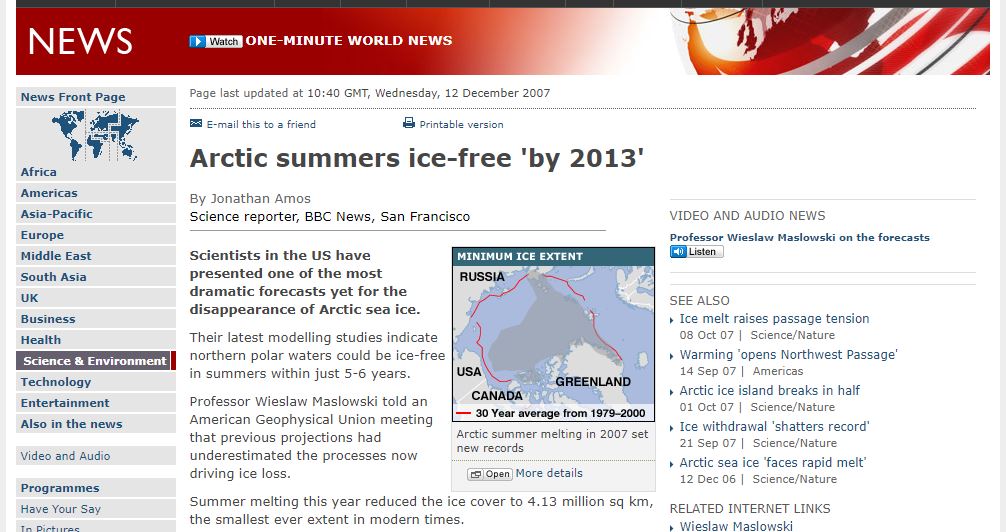
Al Gore Forecast there would be NO Ice remaining at the North Pole by 2013


Al Gore in 2009 forecast that there would be no more ice by 2013. The BBC reported those crazy forecasts back in 2007. I have explained many times that the forecasting methods uses is to assume whatever trend is in motion will remain in motion forever. In other words, is the Dow Jones were to rally by 25% in one year, then they would predict that same percentage movement will continue forever. The methodology is completely void of any cyclical understanding how everything functions according to a cycle in the universe.

Republican Justin Amash Calls for Impeachment – While Holding Personal Business Interests in China…


Michigan Republican Congressman Justin Amash made headlines Saturday by declaring on Twitter that President Trump deserved impeachment.  The media was quick to promotehis position and advance an anti-Trump narrative.  However, a review of Amash’s financial interests quickly reveals a very personal business motive.  His family tool business is heavily invested in Chinese manufacturing.

In his 2017 financial disclosure forms (pdf here), Representative Amash reports income of between $100,000 to $1,000,000/yr. for his ownership stake in Michigan Industrial Tools.  Michigan Industrial Tools is the parent company, manufacturing in China, that produces Tekton Tools, Justin Amash’s Michigan family business.

According to an earlier Michigan article “Amash is a co-owner of Dynamic Source International, a Chinese company that supplies Michigan Industrial Tools.”  A visit to the website of Dynamic Source International (link) shows the company operates “manufacturing and factory facilities located in Hangzhou, capital city of Zhejiang Province”, China.

When you follow the internal link [“MIT-Tool“] within Dynamic Source International website, it connects to the portal of  Tekton Tools:

Dynamic Source International Link -and-  Tekton Tools Link

What you quickly discover is it appears Republican Congressman Justin Amash was challenged in 2010 [News Link] for his family business claiming to sell hand tools made in the U.S.A. but were actually manufactured in China.

Dynamic Source International and “Michigan Industrial Tools” (financial disclosure) appear as same corporation doing manufacturing in Hangzhou, China.  The finished product is then shipped/sold in the U.S. by the Amash family (Justin and his brother Jeff) under the name Tekton Tools.

Justin Amash was called out for lying about his product being manufactured in America during a campaign challenge.  For some reason the local media didn’t call Amash to task on the connection to his DC financial disclosures (maybe they didn’t look).

.

It is demonstrably a fact (as above) that “Michigan Industrial Tools” operates as a manufacturer in China, and the product they produced is Tekton Tools which is Amash’s family company (as admitted in the interview).

Obviously President Trump’s tariff and trade position against China is adverse to the financial interests of Justin Amash.

In addition to previously lying about his Michigan company selling product “Made In USA” and the nature of his business relationship with China, the family business contains the financial motive for Representative Amash to call for President Trump’s impeachment.

GeekRad@RadGeekpartduex
BenTallmadge@BenKTallmadge
Replying to @BenKTallmadge

According to Justin Amash’s financial disclosure forms, Amash is a co-owner of Dynamic Source International, a Chinese company that supplies Michigan Industrial Tools.

Dynamic Source Int is located in Hangzhou, China.
No wonder Justin Amash’s been attacking Trump’s Tariffs! ‼️

View image on Twitter
194 people are talking about this

Kimberley Strassel: The “Mindset” of the “Coup” is more alarming than Partisanship…


Excellent presentation by Kimberley Strassel discussing the scale and scope of the government weaponization during the 2016 election; and the willful assistance by an ideological U.S. media.

Conservatives Celebrate Stunning Win in Australian Elections…


The Australian election was held today; voting is compulsory as everyone over the age 18 is required to vote; turnout was greater than 95%…  and all the media and pollsters are stunned, shocked, jaws-agape, as the conservative coalition has received a stunning, unexpected, unanticipated victory.

Australian Prime Minister Scott Morrison has won the election.  Yes Alice, 2019 media in Australia look identical to media in the U.S. circa November 2016.

The economy, immigration and push-back against the insufferable climate-change nonsense appear to be the top issues that led to Morrison’s surprising win.  None of the pollsters or media saw it coming.  The BBC are stunned:

BBC – […] The final result of the election may not be known for some hours, but with more than 70% of votes counted the [Conservative] Coalition has won, or is ahead in, 74 seats in its quest for a 76-seat majority, with Labor on just 66 seats.

[…] Try finding someone who says they saw this result coming.

For well over two years, the coalition has trailed behind Labor in the opinion polls, and the assumption had been it would be Labor’s turn to govern.

But somehow Scott Morrison managed to turn things around at the 11th hour – and he did it largely on his own.

With some of his cabinet colleagues considered too toxic to appear in public on the campaign trail, ScoMo made this election about him, and his ability to be the trustworthy, daggy-dad Australia needed.  (read more)

Labor leader Bill Shorten , who has led Labor since it lost office in 2013, conceded defeat and congratulated Morrison.  Shorten’s losing moonbat platform was centered on creating a “fairer society”, similar to the social justice movement in the far-left U.S. Democrat party.

The labor movement planned to increase taxes on the wealthy and bring social justice demands to central government.  Their agenda was counting on strong support from college-aged students and climate change activists.  However, the majority of Australians saw the predictable economic damage that was certain from the proposals to raise taxes and institute the Australian version of the Green New Deal.

Australian left-wing media is going bananas….

The progressive movement is crying in the streets.

Regulating Monopolies: A History of Electricity Regulation – Learn Liberty


Published on Feb 10, 2012

SUBSCRIBE 190K
Prof. Lynne Kiesling discusses the history of regulating electricity monopolies in America. Conventionally, most people view regulation of monopoly, such as the Sherman Antitrust Act, as one of government’s core responsibilities. Kiesling challenges this notion, and finds that government regulation of monopoly actually stifles innovation and hurts consumers. The American electricity industry was booming in the 1890s, with several small firms competing against one another. Over time, Kiesling argues that the fixed costs began to escalate, increasing the cost of entry into the industry. Put another way, large competitors gained a significant competitive edge over smaller competitors through economies of scale. Eventually, in places like New York and Chicago, Kiesling claims that the competitive process led to one large firm. These monopolies were feared by the public, and led to demands for government regulation. The electricity industry, knowing that regulation was coming, used these demands for regulation as cover to construct legal barriers to entry. Ultimately, the regulations passed by the government reduced competition by granting legal monopoly privileges to powerful firms within a certain geographical territory. In modern times, we are seeing the real cost of these old one-size-fits-all regulations: 1) People aren’t adjusting their energy consumption behaviors. For instance, in peak hours, technological solutions that could smooth electricity consumption are being ignored. 2) The electricity industry doesn’t evolve and account for new types of renewable energy. 3) Innovations have been discouraged. If these archaic regulations were removed, innovations and improvements beneficial to consumers would flourish. For more information, check us out here: http://lrnlbty.co/zcPIQr

Opportunity Costs: The Parable of the Broken Window – Learn Liberty


Published on Nov 17, 2016

SUBSCRIBE 190K
Some people argue that natural disasters and other acts of destruction create wealth and employment as we repair the damage they’ve caused. Professor Dan Russell explains that this fallacy fails to take into “opportunity costs” into consideration. Whenever we use a resource for one purpose, like fixing a window, we give up the opportunity to use that resource for another purpose. We only know if the use of a resource has created value if we compare it with the the alternate uses we had to forego. forego.