The fragmentation of Canada is bubbling beneath the surface, as we see in the United States as well as in Europe. There is a huge divide between LEFT and RIGHT politics, and never since the late 19th Century to the 1920 period has there ever been such a stark political divide.
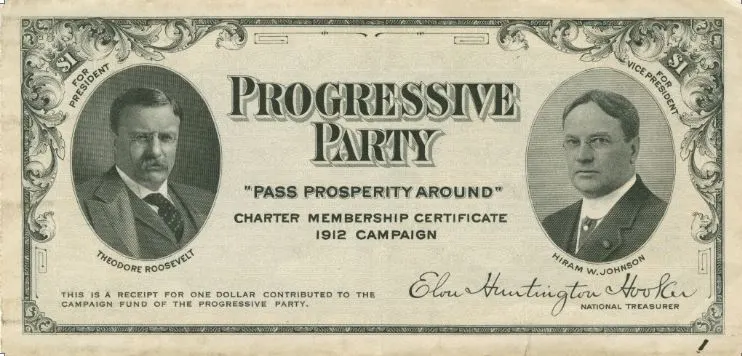
There was such a rise in Progressive Socialism that Teddy Roosevelt abandoned the Republican Party, splitting off to create the Progressive Party, also known as the Bull Moose Party, in 1912 following a split within the Republican Party.
There was an ideological split with President William Howard Taft, and these ideas led to the Income Tax in 1913. Roosevelt, a progressive Republican, grew disillusioned with Taft’s conservative policies, such as his support for the Payne-Aldrich Tariff (which raised rates and angered progressives) and his handling of the Ballinger-Pinchot Affair (a dispute over conservation that portrayed Taft as anti-environmental). Roosevelt believed Taft had abandoned progressive reforms
Roosevelt sought the Republican presidential nomination in 1912 but lost to Taft at a contentious convention. Alleging corruption and delegate theft, Roosevelt and his supporters walked out, forming the Progressive Party to continue his Marxist-style agenda. His Progressive Platform was called the “New Nationalism” platform, advocating for:
Strong federal regulation of corporations and monopolies.
Women’s suffrage.
Workers’ rights (minimum wage, workers’ compensation).
Direct election of senators.
Primary elections to reduce political corruption, with candidates selected as in Parliamentary systems.
Social welfare programs (e.g., pensions, child labor laws).
The party aimed to unify reformers and address growing public demand for economic fairness and government accountability during the Progressive Era. It was launched in August 1912 at the Chicago convention, where Roosevelt was nominated for president. The split in Republican votes between Roosevelt (27%) and Taft (23%) handed victory to Democrat Woodrow Wilson, who signed the income tax into law in 1913. Despite losing, the Progressive Party’s ideas influenced later reforms, such as the New Deal and Progressive Era amendments (e.g., direct Senate elections, income tax).
The party dissolved by 1916, but its platform left a lasting mark on U.S. progressive politics. Roosevelt’s campaign highlighted the power of third-party movements to shift national discourse, even in defeat.
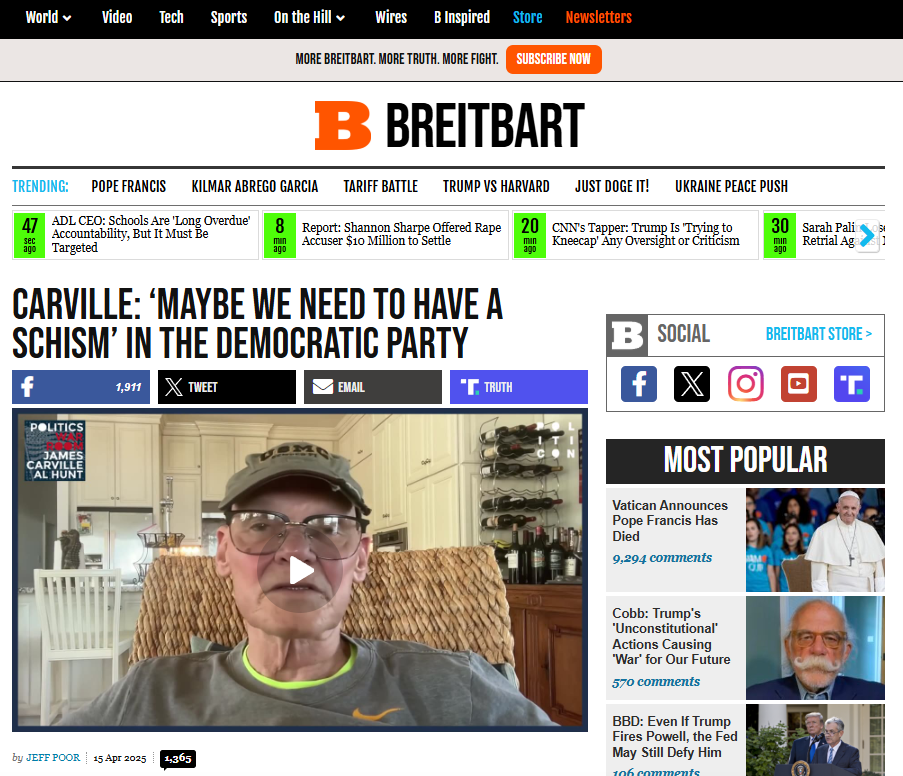
We have reached the critical 112-year half-cycle of FAR-LEFT Progressiveness. It is going crazy everywhere. Now, the famous Democratic Advisor James Carville has come out and said the Democratic Party should split. They lost as Teddy Roosevelt lost, and they are taking the Democratic Party with them. We see the same in Canada with Carney. Europe has also gone extreme to the left, censoring free speech to maintain its ideas.
Throughout History – it is ALWAYS the Left that Destroys Civilization
Posted originally on Apr 15, 2025 by Martin Armstrong
The United States has about 330 million people, and one in every $3 spent in world trade is by American Consumers. Europe has 450 million people, but it still clings to Marxism, is highly regulated, and is very anti-entrepreneurial. Trump fails to grasp here that trade wars will NOT even the score. The global consumer market seems to be ignored. As I have explained, the Current Account, which people call the trade account, also includes all interest and dividends on stocks, bonds, and investments. In theory, if China bought 100% of the US national debt, then the perceived trade deficit from interest of $1 trillion would flow to China, and this has nothing to do with jobs or manufacturing anything.
Let’s clarify trade. The United States has the largest economy in the world, so it’s the top contributor to global consumer spending. China would be next, followed by countries like Japan, Germany, the UK, India, and so on. Note that China is already the #2 consumer-based economy. Europe is far too Marxist, and it still clings to the old theories of Mercantilism. The average German has less net wealth than an Italian, yet they are the biggest economy.
In recent years, the global GDP has been around $100 trillion. Depending on the economy, consumer spending typically makes up about 60-70% of a country’s GDP. So, if we take 65% of $100 trillion, that’s about $65 trillion in global consumer spending annually in theory. Now, breaking this down by country. The US GDP is around $25 trillion. If US consumer spending is about 68% of GDP, that would be roughly $17 trillion. Therefore, the US share would be 17/65, approximately 26%. That means we have a US consumption-driven economy.
China’s GDP is around $18 trillion. However, consumer spending as a percentage of GDP is lower, maybe around 40%, because their economy is more investment—and export-driven. So 40% of $18 trillion is $7.2 trillion. That would be about 11% of the global total ($7.2T / $65T).
Let’s compare this to Japan’s GDP, which is about $4.9 trillion. Consumer spending there is higher as a percentage, maybe around 55%, so $2.7 trillion. That’s roughly 4.15% globally.
Germany’s GDP is around $4.2 trillion. With consumer spending at around 50% of GDP, that’s $2.1 trillion, so 3.2% globally.
India’s GDP is approximately $3.4 trillion. Consumer spending accounts for a larger part, maybe 60%, so the total is $2.04 trillion, which is about 3.14% of the global total.
The UK’s GDP is about $3.1 trillion. Consumer spending at 60% would be $1.86 trillion, so around 2.86%.
France’s GDP is $2.9 trillion. Consumer spending at 55% gives $1.6 trillion, about 2.46%.
Brazil’s GDP is $2.0 trillion. If consumer spending is 60%, that’s $1.2 trillion, so 1.85%.
Italy’s GDP is $2.1 trillion. Consumer spending at 60% would be $1.26 trillion, around 1.94%.
Canada’s GDP is $2.0 trillion. Consumer spending at 57% gives $1.14 trillion, which is 1.75%.
South Korea’s GDP is $1.7 trillion. Consumer spending at 50% is $0.85 trillion, so 1.3%.
Russia’s GDP is around $1.8 trillion. If consumer spending is 50%, that’s $0.9 trillion, about 1.38%.
Australia’s GDP is $1.6 trillion. Consumer spending at 55% would be $0.88 trillion, 1.35%.
Consequently, the total for these top countries is around 59.65%, leaving about 40.35% for the rest of the world. This is all based on rough estimates. Then we also have nominal GDP vs. PPP (Purchasing Power Parity). However, consumer spending in nominal terms is usually what’s used for such global comparisons, further complicating our exercise.
Another consideration: The figures I used for consumer spending as a percentage of GDP might not be accurate for each country. For example, China’s consumer spending as a percentage of GDP has been increasing but was historically lower. According to the World Bank, in 2022, China’s household final consumption expenditure was about 38% of GDP. The US was around 68%, Japan about 55%, Germany 52%, India was around 59%, UK 63%, France 54%, Brazil 64%, Italy 61%, Canada 57%, South Korea 48%. So my initial estimates were somewhat close but may need adjustment.
US: 25T GDP * 68% = 17T
China: 18T * 38% = 6.84T
Japan: 4.9T * 55% = 2.695T
Germany: 4.2T * 52% = 2.184T
India: 3.4T * 59% = 2.006T
UK: 3.1T * 63% = 1.953T
France: 2.9T * 54% = 1.566T
Brazil: 2.0T * 64% = 1.28T
Italy: 2.1T * 61% = 1.281T
Canada: 2.0T * 57% = 1.14T
South Korea: 1.7T * 48% = 0.816T
Russia: 1.8T * 52% = 0.936T (assuming 52%)
Australia: 1.6T * 55% = 0.88T
Spain: 1.4T * 58% = 0.812T
So total consumer spending from these 14 countries is approximately $41.389 trillion out of about $65 trillion globally.
Now, converting each country’s consumer spending to a percentage of global:
US: 17 / 65 = 26.15%
China: 6.84 / 65 ≈ 10.52%
Japan: 2.695 / 65 ≈ 4.15%
Germany: 2.184 / 65 ≈ 3.36%
India: 2.006 / 65 ≈ 3.09%
UK: 1.953 / 65 ≈ 3.00%
France: 1.566 / 65 ≈ 2.41%
Brazil: 1.28 / 65 ≈ 1.97%
Italy: 1.281 / 65 ≈ 1.97%
Canada: 1.14 / 65 ≈ 1.75%
South Korea: 0.816 / 65 ≈ 1.26%
Russia: 0.936 / 65 ≈ 1.44%
Australia: 0.88 / 65 ≈ 1.35%
Spain: 0.812 / 65 ≈ 1.25%
Others: 36.3%
Please remember that these percentages are estimates of global consumer spending by country based on GDP and consumption patterns. The United States is the largest consumer-based economy in the world, and about 26% of total world spending involves the American consumer. China is only 10.5%, and Japan is at 4.1%. Europe comes in at around 12%.
In summary, China is actively trying to build a more consumer-based economy, with policies and trends supporting this shift. However, structural and demographic challenges might slow this transition into 2028. The progress is evident, but it’s a work in progress. After 2032, they hold the potential to surpass the United States as the financial capital of the world. The problem in the United States is that the Democrats keep trying to oppress the economy like Europe, imposing socialistic goals that are not economically efficient.
Key Evidence of China’s Transition:
Rising Consumption Share of GDP:
Household consumption contributed 53% of GDP in 2023, up from ~35% in 2010. While still lower than the U.S. (~68-70%), this marks significant growth.
Services and high-tech industries are expanding, reflecting demand for healthcare, education, and entertainment.
Policy Shifts:
“Dual Circulation” Strategy:
Emphasizes domestic consumption (internal circulation) alongside international trade, reducing reliance on exports.
Social Reforms:
Efforts to strengthen social safety nets (pensions, healthcare) aim to lower household savings rates, freeing income for spending.
Urbanization and Middle-Class Growth:
Over 60% of China’s population now lives in cities, fostering a consumer class with higher disposable income.
E-Commerce and Digital Economy:
China leads globally in e-commerce (e.g., Alibaba, JD.com) and digital payments, facilitating consumer spending. The digital economy accounts for ~40% of GDP.
Challenges to a Consumer-Driven Model:
Structural Imbalances:
Investment and exports still dominate (e.g., state-led infrastructure, real estate). Transition requires rebalancing toward the private sector and services.
Household debt
has risen to ~62% of GDP (2023), potentially constraining spending.
Demographic and Social Factors:
Aging Population: By 2035, 30% of citizens will be over 60, likely increasing savings and reducing consumption.
Income Inequality: Rural-urban gaps and uneven wealth distribution limit broad-based consumption growth.
Geopolitical and Economic Risks:
Trade tensions and global demand volatility (e.g., post-COVID, U.S.-China decoupling) pressure China to prioritize domestic demand.
Real estate sector
Slowdowns could dampen consumer confidence.
China is deliberately building a consumer-based economy through policy reforms, urbanization, and digital innovation, rejecting the European mercantilist economic philosophy. While progress is evident, structural hurdles, such as reliance on investment aging demographics, mean the transition will be gradual but ongoing. The government’s success in addressing these challenges will determine the pace and sustainability of this shift. China’s economy remains a hybrid model, blending consumption growth with traditional drivers like state investment.
The current account is a key component of a country’s balance of payments, recording international transactions in goods, services, income, and transfers. It consists of four main components:
Trade in Goods (Visible Trade):
Exports and imports of tangible products (e.g., machinery, vehicles, electronics).
The balance of trade in goods is often referred to as the “merchandise trade balance.”
Trade in Services (Invisible Trade):
Exports and imports of intangible services (e.g., tourism, financial services, education, consulting, transportation).
Combined with trade in goods, this forms the trade balance (goods and services).
Primary Income (Income Flows):
Cross-border income from investments and employment:
Investment income: Dividends, interest, profits from foreign investments (e.g., dividends from overseas stocks).
Compensation of employees: Wages, salaries, or benefits earned by workers in a foreign country (e.g., remittances from expatriates).
Secondary Income (Current Transfers):
One-way transfers where no goods, services, or assets are exchanged in return:
Remittances: Money sent by migrants to their home country.
Foreign aid/grants: Government transfers (e.g., disaster relief, development aid).
Pensions, gifts, or donations: Transfers between individuals or organizations.
A Trade War based on just the gross of the Current Account does NOT reflect our trade deficit or surplus.
Foreign investors overall own roughly 10-20% of Manhattan’s high-end residential properties (e.g., condos), with Europeans constituting a significant but minority share of this group. For example, if Europeans account for 30-40% of foreign-owned properties, their stake might be 3-8% of Manhattan’s luxury residential market. While exact figures are elusive, Europeans likely own 3-7% of Manhattan’s total real estate, with higher concentrations in luxury residential and prime commercial sectors. This is only an estimate and not definitive. Any income, such as rents, on that property will flow out through the current account and will appear as a trade deficit when it has NOTHING to do with trade.
As of 2023, approximately 23-24% of the total U.S. national debt is held by foreign entities. This calculation is based on foreign holdings of around $7.4 trillion out of $31.4 trillion at the time. Therefore, of about $1 trillion in interest expenditures. Thus, about $230+ billion is flowing out through the current account that has nothing to do with trade. The major holders of US national debt include Japan, China, and the United Kingdom.
Understanding these components is now CRITICAL in the middle of a trade war. The sale of US debt will go through the capital account, but it will reduce the interest paid to foreigners that go through the current account, creating the illusion of a trade deficit. I disagree with Trump’s formulas, and the risk of a permanent trade war with China is now assured unless he gets on a private phone call. You cannot make public demands against China for then they cannot back down based on their culture.
Posted originally on Apr 14, 2025 by Martin Armstrong
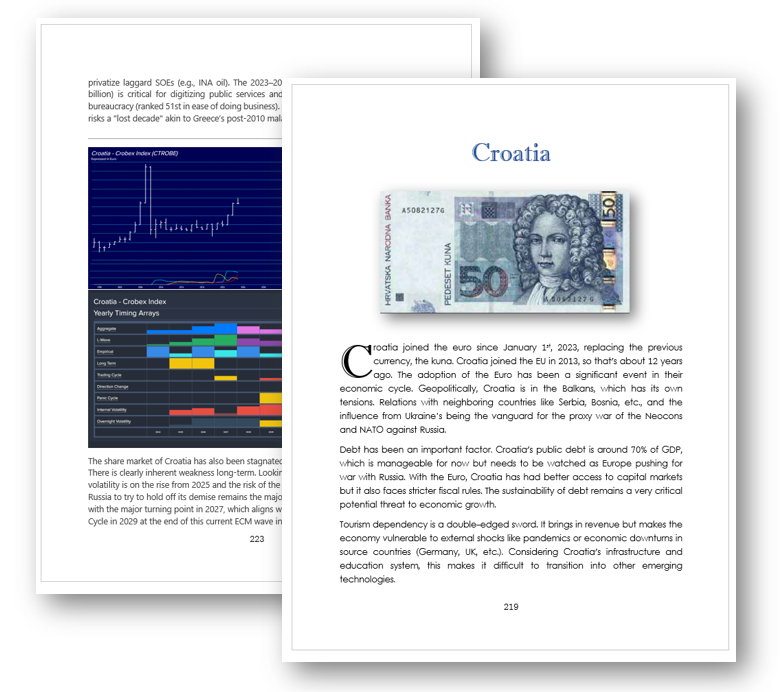
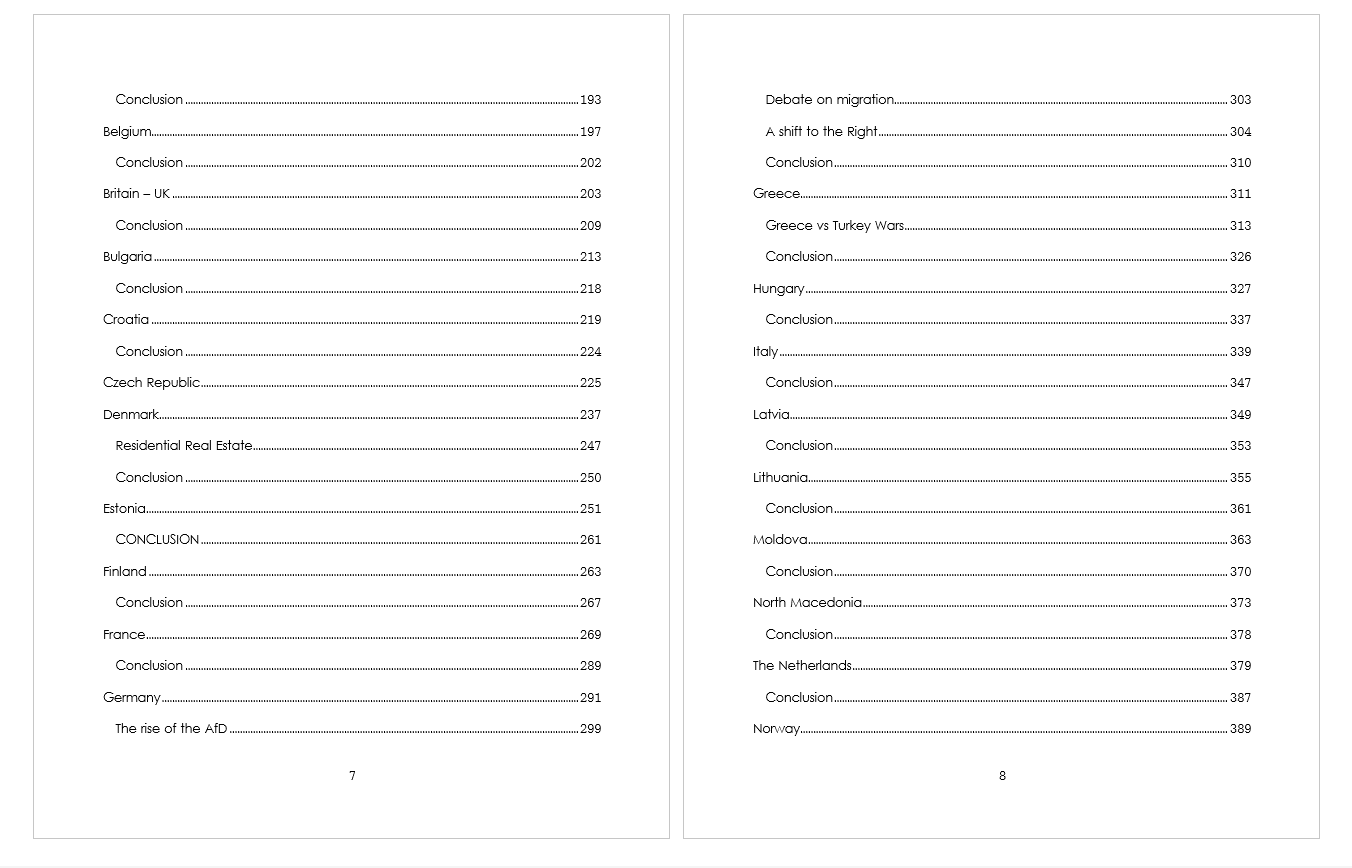
Our Institutional Report covering Europe’s countries with their forecasts generally out to 2032 has been a monumental effort. We greatly appreciate your patience, but this is vital for the decision-making for future investment in Europe. Things are certainly different from the past. Countries like Sweden and Switzerland, which had been neutral during previous world wars, have surrendered their neutrality and will not prove a safe harbor for capital during this conflict. Sweden has joined NATO and even sent jets to Poland. Switzerland gave up all foreigners with accounts and seized over $8 billion of accounts belonging to Russians, abandoning its historic traditions.
This report covers countries that nobody else even covers.
This also addresses the War with Russia & The eventual breakup of the EU itself
577 Pages fully illustrated with Charts and Arrays Per County, covering Currency and share markets
This Report is massive, and the price is $10,000 per institution.
(Please email to let us know how many reports you may need)
Posted originally on CTH on April 8, 2025 | Sundance
After previously saying her number one concern about President Trump’s tariff program was Beijing dumping all their excess products into the EU at a discount, EU Commission President Ursula von der Leyen announces she is coordinating the tariff response with China.
Apparently, the EU recognizes the ideological alignment of support from Canada just isn’t going to be enough to pressure President Trump and retain leverage into the U.S. market. This is quite a remarkable admission from von der Leyen all things considered. [STATEMENT]
President von der Leyen held today a phone call with Premier Li Qiang to discuss the state of EU-China relations, as 2025 marks the 50th anniversary of diplomatic ties.
The two leaders held a constructive discussion during which they took stock of bilateral and global issues.
The President underscored the vital importance of stability and predictability for the global economy. In response to the widespread disruption caused by the US tariffs, President von der Leyen stressed the responsibility of Europe and China, as two of world’s largest markets, to support a strong reformed trading system, free, fair and founded on a level playing field.
The President called for a negotiated resolution to the current situation, emphasising the need to avoid further escalation.
President von der Leyen emphasised China’s critical role in addressing possible trade diversion caused by tariffs, especially in sectors already affected by global overcapacity.The leaders discussed setting up a mechanism for tracking possible trade diversion and ensuring any developments are duly addressed. (more)
In the 2017 – 2019 version of the same dynamic, the EU was slow to realize the Trump impact to the Chinese economy would lead to less industrial purchases from Beijing. This dynamic pushed the EU toward recession. In 2025 von der Leyen is trying to proactively mitigate that outcome.
This coordination of response between Brussels and Beijing is happening simultaneous to the Chinese central bank beginning a rapid devaluation of their currency. Direct subsidies and currency manipulation are the first two approaches taken by any economy dependent on access to the U.S. market.
The difference this time is the scale of the tariffs President Trump is delivering. There’s no way to subsidize and lower currency value at a rate significant enough to mitigate a near 50% tariff impact across all sectors. China and the EU will subsidize and devalue, but they cannot repeat their prior defensive programs to this scale.
The key takeaway from this public admission by the EU President is to note how consequential the tariffs are to their parasitic endeavors.
The EU is directly working with Beijing against American interests.
Posted originally on Apr 1, 2025 by Martin Armstrong
Cuba is a tragic example of what can happen to a society under a Marxist–Leninist socialist republic—equal in poverty. New reports show that nearly a quarter of Cuba’s population has fled the nation in the past four years alone in search of economic opportunities.
Such a mass exodus is usually only seen during times of war. Estimates state that around 545,011 people escaped the island in 2024, with 45.5% fleeing to the United States. Spain, Serbia, Mexico, and Uruguay remain popular for socialist refugees. The study was conducted by Cuban economist Albizu-Campos as the nation has not held a formal census since 2012. The National Office of Statistics has acknowledged that the population has fallen beneath 10 million, with their estimates stating 300,000 fled in 2024.
Cuba has been in a crisis for many years now. The nation faces one of the worst energy crises and it has become commonplace for entire regions to go a day without any power. Trade restrictions have caused widespread shortages of essentials such as food, water, and oil.
Their currency is worthless. Inflation hit 500% in 2021, falling to 200% in 2022, but the nation is unable to keep proper figures. In 2021, authorities attempted to establish the Cuban peso as the main currency and introduced a new currency pegged to the dollar called “moneda libremente convertible” (MLC). Cuba, like Venezuela and other socialist economies, has suffered from economic mismanagement rather than just US sanctions. There is no private property, the dual-currency system has failed, and central planning is non-existent.
President Miguel Díaz-Canel reached out to Russia, Turkey, Algeria, and China for financial assistance but remains blacklisted by most of the West. Canada is actually the top importer of Cuban goods, accounting for $585.61 million of exports in 2023 out of a total of $1.59 billion. Tobacco, nickel, ores, and alcohol remain Cuba’s last standing exports but most nations sanctioned Cuba long ago and they are hard-pressed to find any buyers. Exports declined by $900 million as agriculture and tourism plummeted.
Russia has attempted to help Cuba bypass sanctions by supplying essentials like meat and dairy, and President Diaz-Canel is expected to visit Moscow in the coming months. Russia and China are Cuba’s last hope for a financial lifeline.
The Cuban Human Rights Observatory (OCDH) estimates that at least 89% of Cubans currently live in “extreme poverty.” This is a textbook tragic example of how a nation inevitably falls under Marxist–Leninist socialist policies that dictate everyone must be equal in poverty.
Posted originally on Apr 1, 2025 by Martin Armstrong
The World Health Organization admitted that it has “no choice” but to cut its budget substantially. America’s exodus from the organization left the WHO with a budget gap of $600 million for FY2025, and it plans to cut expenditures by 20%.
The United States provided 16.3% of all funding from FY2022-2023, amounting to $1.3 billion of the organization’s $7.89 billion. Trump believes the WHO partnered with China to hide the origins of COVID-19, and he is particularly disgruntled that the US was paying 10X more into the organization compared to China at a cost of $500 million annually. “The World Health Organization has become nothing more than a corrupt Globalist scam…paid for by the United States, but owned and controlled by China,” Trump stated in November 2024. “I will not allow public health to be used as a pretext to advance the march of global government,” Trump stated before vowing to leave the organization.
“Dramatic cuts to official development assistance by the United States of America and others are causing massive disruption to countries, non-governmental organisations and United Nations agencies, including WHO,” WHO director-general Tedros Adhanom Ghebreyesus said in his e-mail to staffers. “While we have achieved substantial cost savings, the prevailing economic and geopolitical conditions have made resource mobilisation particularly difficult.”
Tedros is the first person in the 75-year history of the WHO who is not a medical doctor. Klaus Schwab supported him for that post, just as he recommended Lagarde for the IMF and then for the European Central Bank. He has also put in the head of the IMF from his board of the WEF as well. Schwab has the WHO in his back pocket. To put someone who is not a medical doctor at the head of the World Health Organization would be like putting Jeffrey Epstein as the head of a monastery.
The Bill and Melinda Gates Foundation was the second-largest donor to the WHO, and Gates used the organization to push the pandemic response, urging nations to use the very vacations he helped to fund. That man had ties to every globalist health organization. Still, Gates has come forward in recent weeks saying his organization simply can’t make up for the budget gap caused by the US withdrawing—and that is GOOD NEWS.
All the world leaders supporting the Great Reset were eager to relinquish complete power to the unelected officials at the WHO. The WHO wanted to seize the ability to force health mandates on the global population. The organization continually asks for global taxation in the name of health.
The scheme is to eliminate democracy. They accomplished that in Europe, where the people are allowed to vote only for an MP who has no power to overrule the Commission, which never stands for election, as is the case with the head of the EU, who is also UNELECTED by the people. The general belief is that the people are TOO STUPID to know what is best, and democracy became populism when Trump was elected. This proposal is clearly stated as part of the Great Reset put out by Klaus Schwab and the World Economic Forum.
The Pandemic Treaty would have allowed the WHO to bypass national laws and impose its will on the people. There has never been a more massive power grab than what we witnessed under the guise of the pandemic. The WHO attempted to force nations to sign a Pandemic Treaty in 2022 to ensure it could remain in control:
“The COVID-19 pandemic has exposed gaps in the governance, financing and systems needed to keep the world safe from epidemics and pandemics. There is an emerging global consensus around the need for an international treaty or other legally binding instrument, to provide the framework for a more coherent and coordinated response to future epidemics and pandemics.”
They had plans for global passports, taxation, and every method to provide a small group of unelected “visionaries” with centralized control over the world. The WHO is one of the organizations that was used to help them achieve their goal. As stated on the World Economic Forum’s website:
“To achieve a better outcome, the world must act jointly and swiftly to revamp all aspects of our societies and economies, from education to social contracts and working conditions. Every country, from the United States to China, must participate, and every industry, from oil and gas to tech, must be transformed. In short, we need a “Great Reset” of capitalism.”
Now I could go on endlessly about the plans for the Great Reset, but focusing on the WHO’s involvement—their role was to weaponize public health to provide the WEF and UN with the ability to restructure the global economy. Trump’s withdrawal from the organization was a major win for global freedom. We will see the nations still on board with the Great Reset attempt to boost funding, as the power the pandemic provided was far too great to relinquish.
Posted originally on Mar 31, 2025 by Martin Armstrong
For centuries, the main reason no government has ever survived its own greed for money and power is that whoever is in power at present constantly assumes that this time it is different—they are in charge. Communities rise from humble beginnings and expand into formal governments that seek to become nation-states, often absorbing the communities around them. When they emerge as a nation, they will typically seek to expand further into empires. To maintain that lofty position, they will inevitably become authoritarian when they feel that power slipping away.
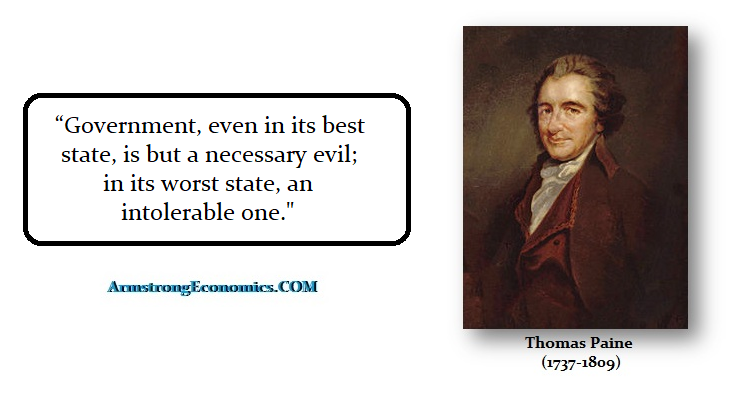
Thomas Paine (1737-1809), whom the British hated because he wrote Common Sense, finally influenced the American colonists to rise up against the abuse of the king and centralized government in England, which they called – no taxation without representation. Thomas explained that those in control bathe themselves in glory and power and quickly forget that they are not the sovereign of the state – that is, the people. Pasine explanned:
“Some writers have so confounded society with government, as to leave little or no distinction between them; whereas they are not only different, but have different origins. Society is produced by our wants, and government by our wickedness; the former promotes our POSITIVELY by uniting our affections, the latter NEGATIVELY by restraining our vices. The one encourages intercourse, the other creates distinctions.”
The very problem is emerging within states where centralized governments are seeking to strip local citizens of the right to vote in their local communities and to impose taxation without representation all over again. This is always the problem within all governments – the endless thirst for endless power, like the Neocons and their endless wars of conquest.
Home Rule in the United States is becoming a major issue as a consequence of severe abuse of authority by tyrannical state governments seeking to grab power from municipal governments, often being “bribed” by real estate developers who don’t want to have to comply with local zoning regulations and approvals from municipalities. This is the very same tyranny that led to the American Revolution – no taxation without representation.
These state politicians are seeking to usurp all the rights of local residents because some real estate developer has “donated” to someone’s campaign to overrule a local community by overriding local zoning regulations put in place by local residents. Any politician who makes such a motion in a state legislature should be compelled to disclose ALL donations and promises of future contributions or job offers. To submit such a motion with a conflict of interest should result in disbarment from ever holding public office and 20 years in prison.
It is time this corruption ends –NOW!
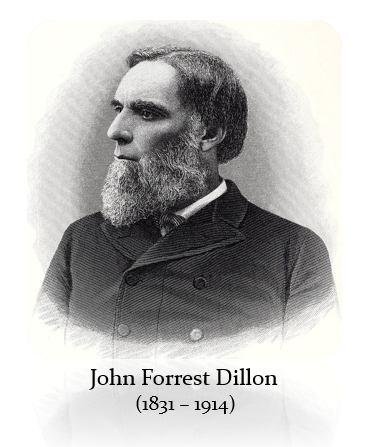
Forty of the 50 states apply some form of the principle known as Dillon’s Rule, which says that local governments may exercise only powers that the state grants explicitly to them, to determine the bounds of a municipal government’s legal authority. Dillon resigned from the bench and became a professor of law at Columbia University from 1879 to 1882. This is outrageous and tyrannical, contrary to the very principles on which the American Revolution was fought. This theory of state preeminence over local municipal governments was expressed as Dillon’s Rule in an 1868 Iowa State case:
“Municipal corporations owe their origin to, and derive their powers and rights wholly from, the legislature. It breathes into them the breath of life, without which they cannot exist. As it creates, so may it destroy. If it may destroy, it may abridge and control”.
Clinton v Cedar Rapids and the Missouri River Railroad, (24 Iowa 455; 1868)(Per Curiam.)
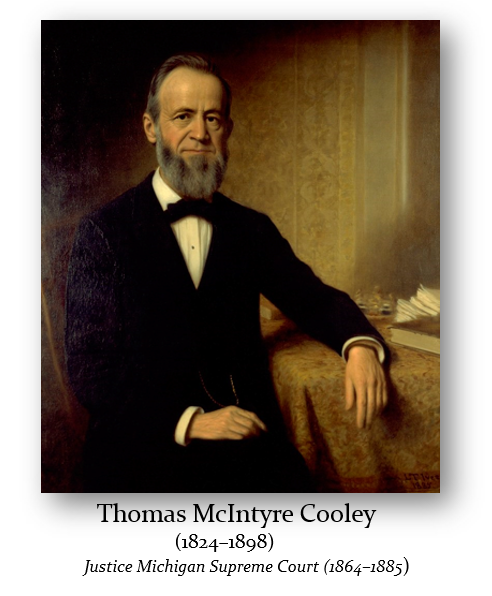
However, against this tyrannical decision stands the Cooley Doctrine, often referred to as the Doctrine of Home Rule. This doctrine upheld the spirit of the American Revolution as it recognized an inherent right to local self-determination, which should be a human right. In a concurring opinion, Michigan Supreme Court Justice Thomas M. Cooley in 1871 stated:
“local government is a matter of absolute right; and the state cannot take it away”.
In the treatise Municipal Corporations (1872), Dillon contended that the power of states is unlimited, with the only restrictions under the state or federal constitutions. He wrote that municipalities only have the powers expressly granted to them by the state. Therefore, in a typical tyrant of centralized power like the King of England in 1776, the power of a municipality’s very existence rested upon the state’s authority. This formulation of the municipal power scope became known as “Dillon’s Rule.” It is clearly one-sided and seeks to expand the power of a state over all municipalities. Then the King was right, the American colonists should have shut up and jumped as high as the king commanded. Overlooked is that these municipalities in the 13 colonies pre-existed the states. He advocated a usurpation of local power, and that is the very power grab that has destroyed every form of government for thousands of years.
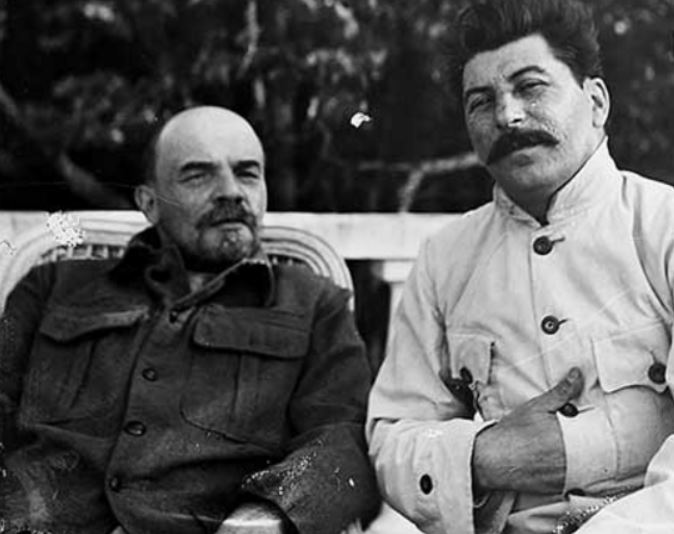
One of the best examples of this abuse of power is probably Russia. Lenin, although communist, was copying the United States, whereas the individual republics would retain their separate culture and sovereignty. Sensing there would be a future political crisis, Lenin’s Testament became a document dictated in late 1922 and early 1923. Lenin proposed changes to the structure of the Soviet governing bodies and criticised Bolshevik leaders Zinoviev, Kamenev, Trotsky, Bukharin, Pyatakov, and Stalin. He warned of the possibility of a split developing in the party leadership between Trotsky and Stalin. Lenin also suggested that Joseph Stalin be removed from his position as General Secretary of the Russian Communist Party’s Central Committee. Stalin seized power upon Lenin’s death and carried out in Russia the equivalent of Dillon’s Rule. He stripped all the republics of their independence and sovereignty and established a centralized power in Moscow that eliminated all local municipal rule and autonomy. This is what is being carried out right now at the state level in the USA – both blue and red states.
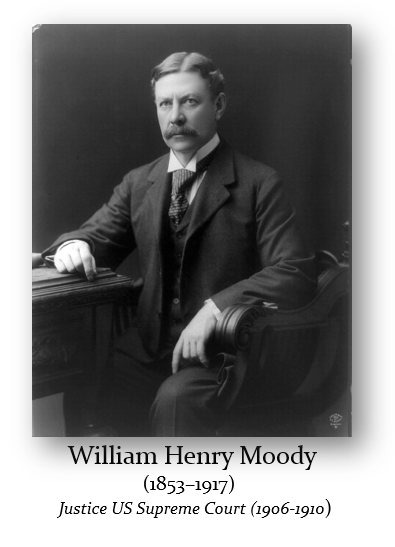
The Supreme Court of the United States cited Municipal Corporations and fully adopted Dillon’s emphasis on state power over municipalities in Hunter v. Pittsburgh, 207 U.S. 161 (1907), written by Justice William Henry Moody (1853–1917), a Progressive appointed by Teddy Roosevelt, believing in the supreme power of government. The Progressive Justice Moody upheld the power of Pennsylvania to consolidate the city of Allegheny into the city of Pittsburgh, despite the objections of a majority of Allegheny’s residents. The Court’s ruling held that states could alter or even abolish at will the charters of municipal corporations without infringing upon contract rights, relying upon Dillon’s distinction between public, municipal corporations and private ones. However, the Court did not prevent states from passing legislation or amending their constitutions to explicitly allow home rule.
The Court also did not address the entire core issue of taxation without representation. That argument has not been raised and goes to the heart of the Due Process of Law secured by both the 5th and 14th Amendments.
This constitutional allowance was reiterated in Trenton v. New Jersey, 262 U.S. 182 (1923), where the Supreme Court held that:
“In the absence of state constitutional provisions safeguarding it to them, municipalities have no inherent right of self-government which is beyond the legislative control of the state, but are merely departments of the state, with powers and privileges such as the state has seen fit to grant, held and exercised subject to its sovereign will”.
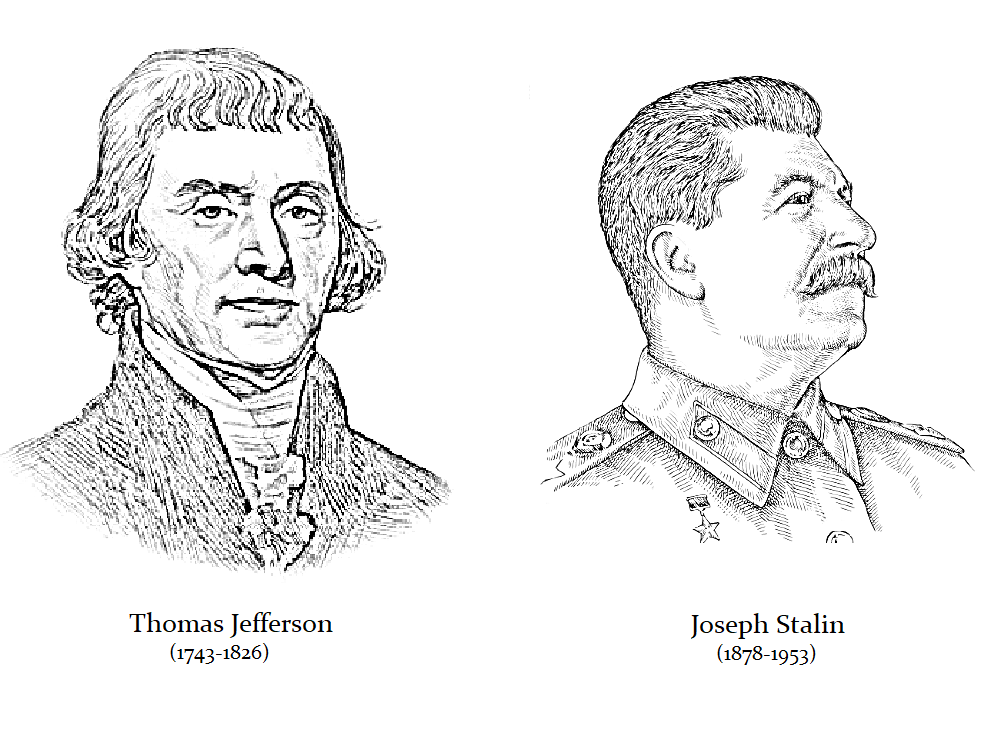
These decisions are anti-democratic and are purely the way governments always behave to usurp supreme power, leading to their self-destruction. Neither of these decisions dealt with the fact of local taxation or zoning. What is taking place now is the attempt at usurpation of power by centralized government in the spirit of Joseph Stalin rather than Thomas Jefferson. You bought a house in a particular municipality for the quality of the local school, the local zoning ensuring it remains residential, and because of property taxes. States think that they can usurp local power, take bribes from developers, and overrule local residents, denying them Due Process of Law, which is the cornerstone of freedom, including the right to be heard.
The U.S. Supreme Court articulated that due process includes the right to be heard as early as 1908 in the case of Londoner v. City and County of Denver, 210 U.S. 373 (1908). In this decision, the Court ruled that property owners must be given an opportunity to present objections before a tax assessment could be imposed, emphasizing that due process requires “an opportunity to be heard at some stage of the proceedings.”
However, the principle was further solidified and expanded in later cases. Notably, in Goldberg v. Kelly, 397 U.S. 254 (1970), the Court held that due process mandates a pre-termination hearing for individuals facing the loss of government benefits, reinforcing the right to be heard in administrative contexts. While earlier cases like Hagar v. Reclamation District No. 108, 111 U.S. 701 (1884) touched on notice and hearing requirements, Londoner is often cited as the foundational case explicitly linking due process to the right to present one’s case. This stems from the Bible and Genesis. God summons Cain after he murders Abel, and when he already knew he had killed his brother, God directly confronts him and affords him the right to be heard, asking, “Where is your brother Abel?” This inquiry reflects the very foundation of Due Process of Law. Did he murder him? Was it in self-defense? These states are stripping local communities of their most fundamental right to be represented in their local community. I grew up, and my town allowed bars. The next town was a “dry” town. Residents have a right to make those decisions, and the state has no moral authority to overrule that.
CAN A MUNICIPALITY SECEDE FROM A STATE?
Prior to 1820, the area now known as Maine was part of Massachusetts, referred to as the “District of Maine.” Frustration had built up because the state of Massachusetts was the Federalist stronghold, and they had been pro-British. Thus, their lack of support during crises like the War of 1812 led to the Separation Process. Maine held a statehood referendum in 1819, with voters approving separation from Massachusetts, which finally consented to the split, and Maine drafted its constitution. The role of the Missouri Compromise (1820) was interesting because Congress admitted Maine as a free state under the Missouri Compromise, which balanced it with Missouri’s entry as a slave state to maintain the Union’s free/slave state equilibrium. Hence, Maine officially became the 23rd state on March 15, 1820, marking its peaceful separation from Massachusetts.
Kentucky (1792): Originally part of Virginia, it was ceded to the federal government and admitted as a separate state. While not a direct “split” in the same political context as Maine or West Virginia, it originated from Virginia’s territory.
Tennessee (1796): Formed from land ceded by North Carolina to the federal government, which later became the Southwest Territory before statehood. Like Kentucky, this was a territorial transition rather than a direct split.
The Dakota Territory was established in 1861, covering present-day North Dakota, South Dakota, and parts of Montana and Wyoming. On November 2, 1889, it was split into the states of North Dakota and South Dakota as part of the U.S. government’s push to admit western territories as states. The division was driven by political and economic factors, including railroad interests and balancing congressional representation.
In the United States, the ability of a municipality to secede from its state is a complex legal issue governed by constitutional principles and state laws. This is my view:
Constitutional Framework:
U.S. Constitution: Article IV, Section 3 stipulates that no new state may be formed within an existing state’s jurisdiction without the consent of both the affected state legislature and Congress. This implies that municipal secession would require similar approvals if it results in creating a new state or altering state boundaries.
Supreme Court Precedent: In Texas v. White, 74 U.S. 700 (1868), the Court ruled that states cannot unilaterally secede from the Union. While this case addressed state secession, it underscores the principle that territorial integrity is protected, extending by analogy to municipalities. This held that the Confederate States were always still part of the Union, and it was obviously self-serving.
State Authority:
Most state constitutions outline processes for creating, altering, or dissolving municipalities, but seceding from the state itself is typically not addressed.
A municipality seeking to secede would likely need explicit approval from the state legislature, potentially through a constitutional amendment or specific legislation.
Practical Considerations:
Historical Examples: There are a few instances of successful municipal secession. Proposals (e.g., parts of Colorado seeking to join neighboring states, or Staten Island’s attempts to leave New York City) often face legal and political hurdles.
Political Challenges: Secession requires consensus among local residents, state lawmakers, and federal authorities, making it politically contentious and rarely achievable.
Conclusion:
Legally Possible? Yes, but only with consent from the state legislature and Congress, per Article IV.
Realistically Feasible? Extremely unlikely due to procedural complexities, political opposition, and historical precedent favoring territorial continuity.
In summary, while municipal secession is theoretically possible under strict constitutional conditions, practical implementation is highly improbable without unprecedented cooperation across multiple levels of government.
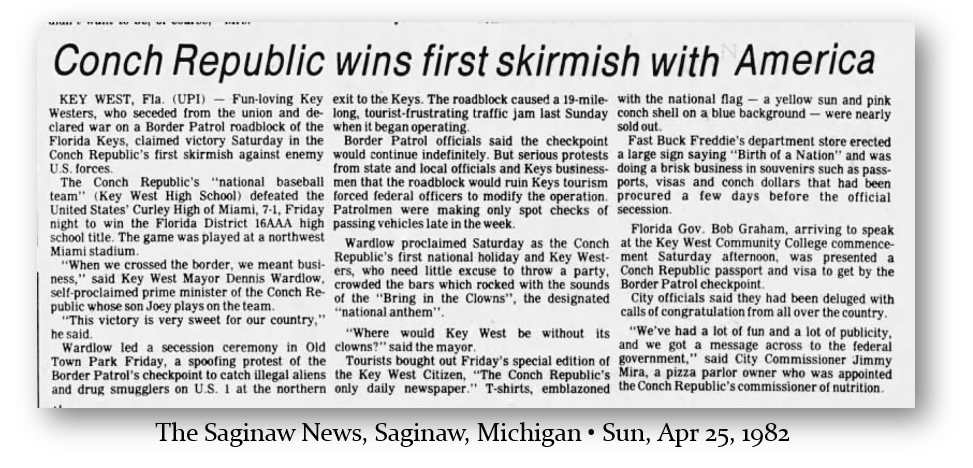
In Florida, Key West humorously attempted to “secede” from the United States in 1982, an event now famously known as the creation of the Conch Republic. The U.S. Border Patrol set up a roadblock and immigration checkpoint on the only highway connecting the Florida Keys to the mainland, causing severe traffic delays and economic harm to tourism. Since you had to prove you were an American to leave Key West, the Fed made it seem you were not part of the USA. On April 23, 1982, Key West officials declared “independence” as the Conch Republic, completing a mock secession ceremony. Mayor Dennis Wardlow “surrendered” to a naval officer and demanded $1 billion in “foreign aid” to rebuild. The Gesture was a smash hit in Miami. The secession was a satirical protest, not a legal attempt. It aimed to draw attention to the checkpoint’s negative impact and advocate for its removal.
The stunt garnered national media coverage, and the checkpoint was eventually lifted. The Conch Republic remains a beloved symbol of local identity, celebrated annually with festivals. There are restaurants still named the Conch Republic – the symbolism of what America was all about – FREEDOM! While Key West never legally seceded, the event was a creative and successful protest that highlighted community concerns while embracing a whimsical spirit.
States are Grabbing Power to our Destruction
This is not a whimsical protest anymore. States are seeking dictatorial power and eradicating the Due Process Rights of their citizens. This is as bad as what Stalin did to Russia, stripping the republics of their sovereignty that Lenin promised. This is the backdrop to rising civil unrest and the ultimate separation of the United States, as every empire has collapsed throughout history. The United States, Europe, and Canada, for that matter, are all feeling oppressed by a centralized government. Under the parliamentary system, the people have no due process right to vote for who will be the head of state. We are witnessing this even in Florida, and these oppressive power grabs are undermining the very foundation of our communities and nation.
We need DOGE at the State Levels as well!!!!!
Any politician who Submits Bills to Strip Local Residents of the right to be heard under Due Process is a traitor to the Constitution and everything the American Revolution was fought for.
This is happening in both Blue & Red States – even here in Florida.
This moral corruption MUST stop!
Some Propose Mass Refusal to Pay Property Taxes without Representation
I have created this site to help people have fun in the kitchen. I write about enjoying life both in and out of my kitchen. Life is short! Make the most of it and enjoy!
This is a library of News Events not reported by the Main Stream Media documenting & connecting the dots on How the Obama Marxist Liberal agenda is destroying America












 Centinel2012