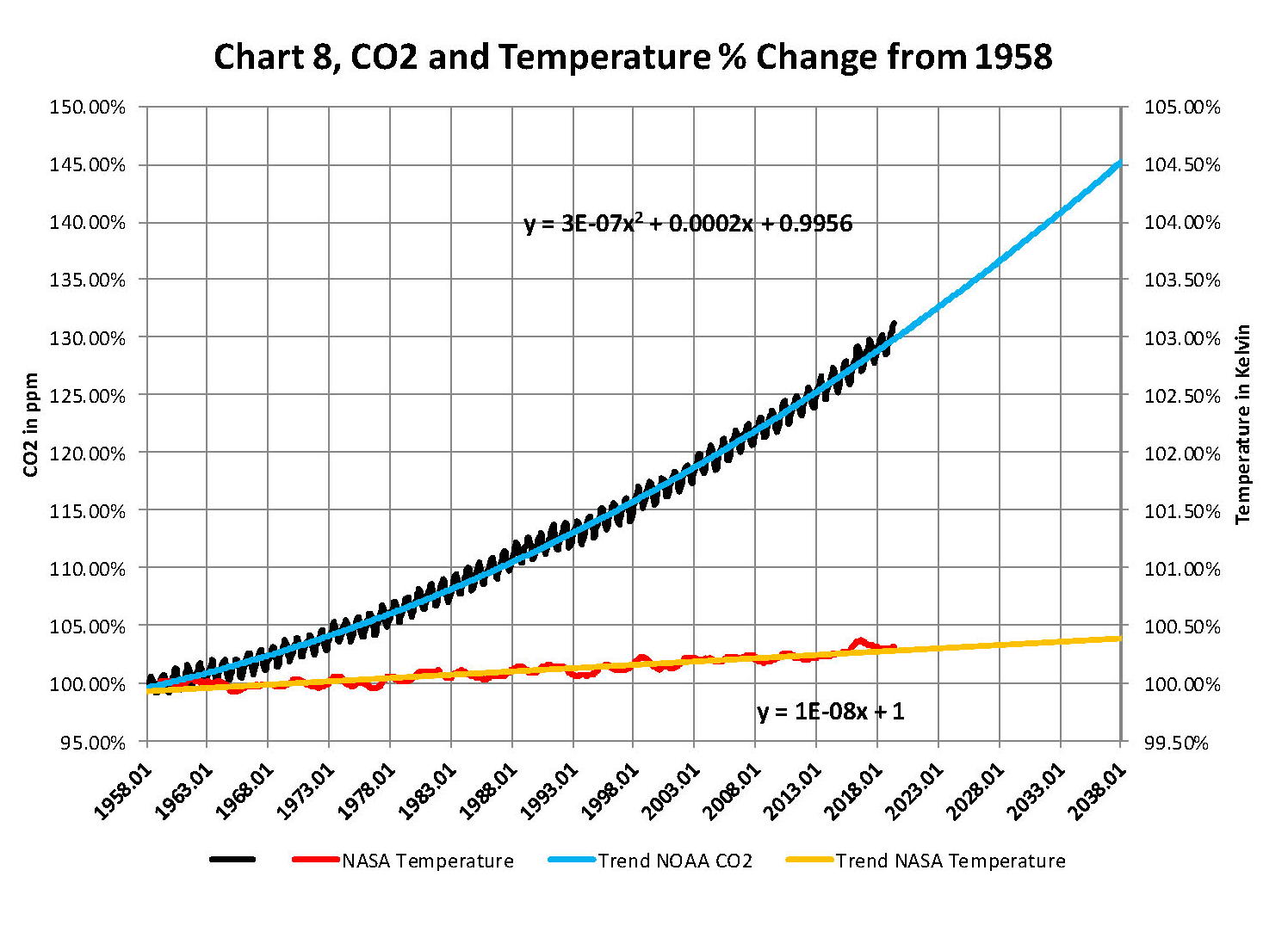
From the attached report on climate change for May 2019Data we have the two charts showing how much the global temperature has actually gone up since we started to measure CO2 in the atmosphere? To show this graphically Chart 8 was constructed by plotting CO2 as a percent increase from when it was first measured in 1958, the Black plot, the scale is on the left and it shows CO2 going up a bit over 30.0% from 1958 to May of 2019. That is a very large change as anyone would have to agree. Now how about temperature, well when we look at the percentage change in temperature from 1958, using Kelvin (which does measure the change in heat), we find that the changes in global temperature (heat) are almost un-measurable. The scale on the right side had to be expanded 10 times (the range is 40 % on the left and 4% on the right) to be able to see the plot in the same chart in any detail. The red plot, starting in 1958, shows that the thermal energy in the earth’s atmosphere increased by .30%; while CO2 has increased by 30.0% which is 100 times that of the increase in temperature. So is there really a meaningful link between them that would give as a major problem? The numbers tell us no there isn’t.
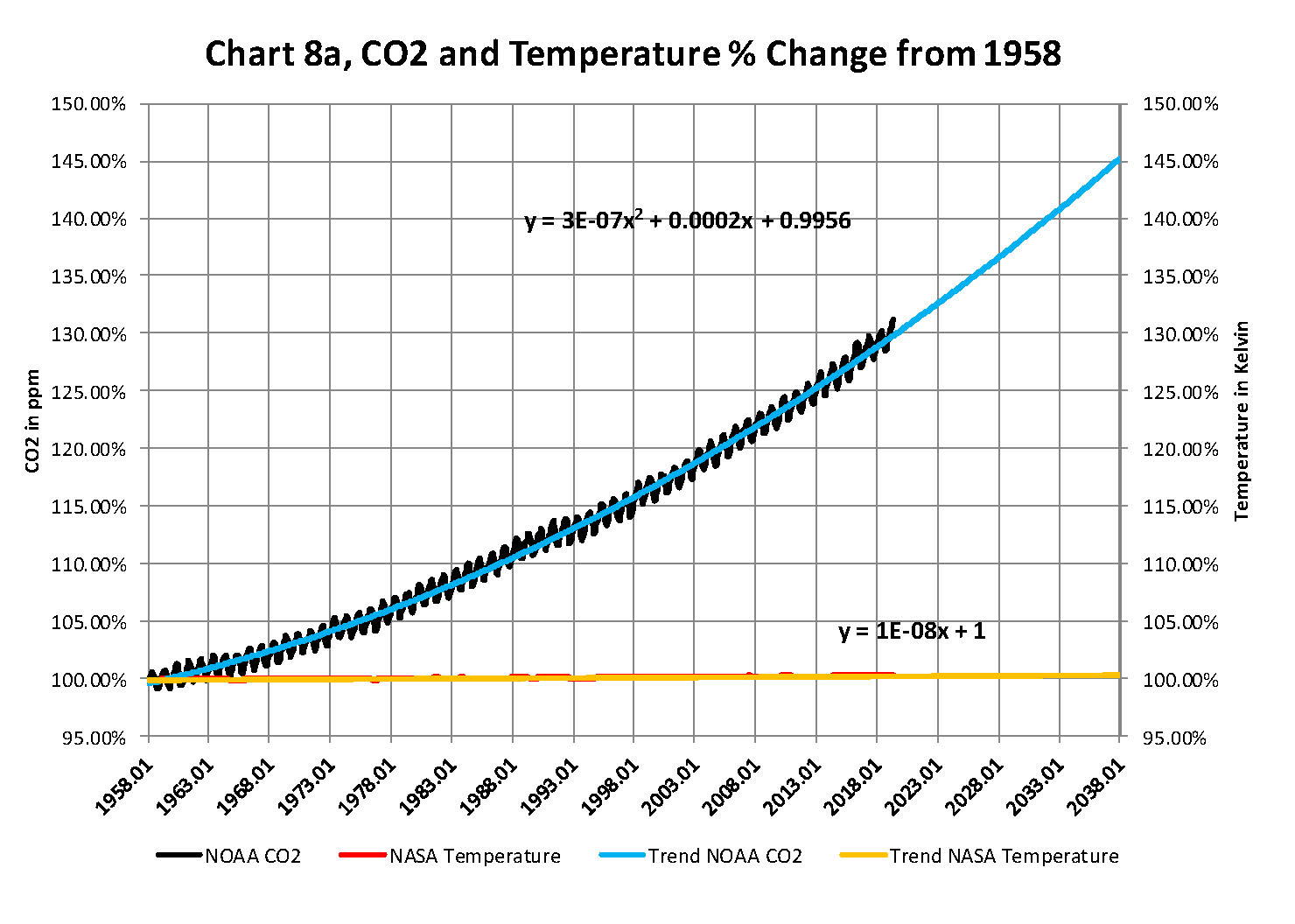
The next chart is Chart 8a which is the same as Chart 8 except for the scales which are the same for both CO2 and Temperature. As you see the increase in energy, heat, is not visually observably in this chart hence the need for the previous chart 8 to show the minuscule increase in thermal energy shown by NASA in relationship to the change in CO2. Based to these trends, determined by excel not me, in 2028 CO2 will be 428 ppm and temperatures will be 15.0o Celsius and in 2038 CO2 will be 458 ppm and temperatures will be 15.6O Celsius. This is what the data shows no matter what the reasons are, so I have no idea how the IPCC gets to predict that the world will end in ten or even twenty years.
The full 37 page report explains how these charts were developed and why using NASA and NOAA data are used with out change to prove that The New Green Deal is not required and any attempt to compliment that plan will be a world wide disaster.
Click on the link below for the full report that you can download.
Scientists conduct a social experiment in dozens of countries to see who will return a found wallet, and if results vary based on the amount of cash in it. The results surprised them. Nearly everyone, everywhere, is more likely to return a cash-filled wallet than an empty one. Bill Whittle Now explores the reasons behind this near-universal virtue, and what impact the finding should have on our political discourse. Seeking truth vigorously, and challenging dominant narratives — these characteristics define the Members who make this show possible. They cling to time-tested principles, and work to advance ideas best suited to produce a happy society. If that sounds like you, find your people at https://BillWhittle.com/register/
Stephen Green finds a way to talk about one of Google’s forbidden topics without going broke. He’s forced to refer to certain companion robots as “knitting” bots to avoid getting flagged and demonetized for appealing to prurient interests. Together with Bill Whittle and Scott Ott, Steve examines the benefits and drawbacks of these high-tech “knitting bots” while trying to avoid Google and YouTube’s secret defamation. If you think we need more free speech, not less, join the people who made this show. They run their own private blog away from Google’s prying eyes at https://BillWhittle.com/register/
The idea of some Universal Basic Income has been around for a long time. Here is Milton Friedman on his proposal of a Negative Income Tax. There will always be welfare for there are people who cannot work for some disability and others who prefer not to work and game the system. Even programs where the state directly pays for the food rather than food stamps or restricts the food stamps to certain products, the ingenuity of some people cannot be underestimated. They will sell the products they get for cash. There are signs on the streets buying needles and strips from people who are diabetic and get them for free from the state. There are instances where a woman has a child and tells the state she has no idea who the father is yet a night he shows up and leaves when a case worker is due to arrive. These are abuses of the system that no matter what we try to do, there will be people who figure out how to work the system. So there will NEVER be 100% compliance no matter what system we devise.
The recent Financial Times investigation revealed that Microsoft had collected discreetly a facial recognition database of some 10 million images of some 100,000 people. They apparently used it for facial recognition software. When the FT began investigating, Microsoft discretely deleted the database. The public dataset, called ‘MS Celeb,’ included images of ‘celebrities’ pulled from the internet, but also contained photos of ‘arguably private individuals,’ often without their knowledge or consent, the FT found.
The classic film, the Minority Report, takes place where facial recognition is just using eye scans. To become invisible, he goes through a procedure where he gets eye transplants to hide his identity. This scene shows that when walking through a store, they scan his eyes and offer advertising tailored to preferences. There is no question that this technology can become much like the movie but using facial recognition eliminating the option of just getting our eyes replaced.
Already there are government agencies using facial recognition to look for people walking in public places. New York Police Department’s facial recognition system, includes image alteration and the use of non-suspect images. They are using facial recognition in Britain to look for criminals, but it is apparently wrong 96% of the time. There has even been lawsuits filed over this intrusive approach. San Francisco banned the police from using facial recognition. There are companies offering facial recognition for police.
There is no question that facial recognition poses a significant threat to our privacy and could hamper First Amendment-protected protests and other legal activities. Anyone who exercises their right to join some protest can find their faces suddenly recorded into a secret database that pops up on any encounter with governments.
QUESTION: Mr. Armstrong; I attended your WEC in London back in 1997 when the Euro Commission took the entire back row. I remember your forecast that we would begin a period of a dramatic shift in the bond-equity correlation I believe you said would last for at least 23 years. That is nearly due. You were obviously correct and that did begin with the introduction of the euro in 1998. You were dead center between Barton Biggs and Steve Roach. Do you still see this inverse relationship flipping in 2021 as you forecast back then?
JK
PS I left the bank….. and am now retired.
ANSWER: A lot of people I knew in the various banks back in the 1990s have left before the cards start to fall. I remember well. They were at Morgan Stanley back then and the two were polar opposites on their forecasts if I remember correctly. Barton Biggs argued that the world would be flooded by a glut of cheap Asian labor and Steve Roach was pointing to the Philips Curve warning that public deficits in the west would lead to a massive inflationary bonfire.
The Stock-Bond Correlation was the real debate. Our model was warning that stocks and bonds would indeed behave very differently which has materialized. Since 1998, stock prices and bond prices have been negatively correlated. In other words, when stock prices go up, bond prices go down and vice versa. Overall, stocks and bonds are indeed currently acting in opposition to each other on the macro-trend level. There has been a negative correction which some call the “flight to quality” when confidence collapses in the private sector, capital fled to the public sector. The broader 250-year relationship would argue that this is highly unusual. It is true that stocks and bonds moved up and down together throughout the 250 years prior to the 21st century.
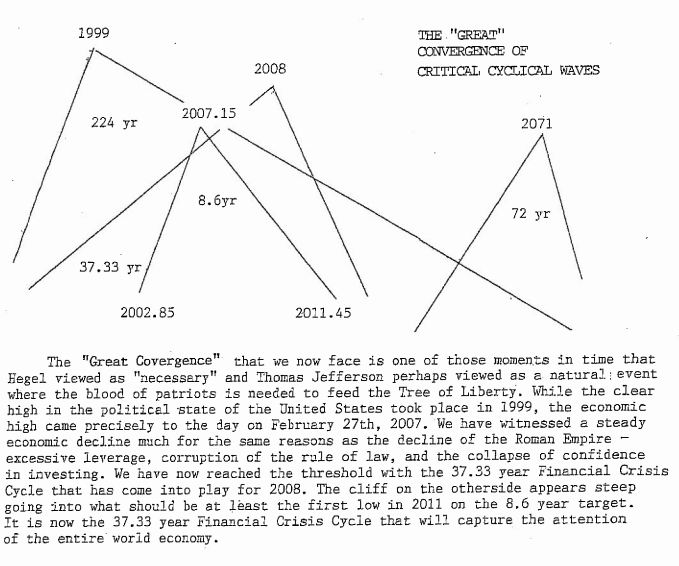
The reason I delivered that forecast back then was the realization that government debt had entered a perpetual borrowing cycle ever since World War II. Moreover, the 224-year cycle of political change was due in 1999. That meant the political peak in government would take place at that time. The economic peak would by 2007. Both of those forecasts have been absolutely correct. Politics has declined steadily and ever since the 2007-2009 crash, interest rates have dropped sharply and there has been a contraction in inflation with a decline in economic growth.
In Its Just Time, I wrote: “While the clear high in the political state of the United States took place in 1999, the economic high came precisely to the day on February 27th, 2007. “
The flip in this relationship is still on target. Nothing requires any change to that forecast I delivered back in 1997. This is all being driven by the Sovereign Debt Crisis.
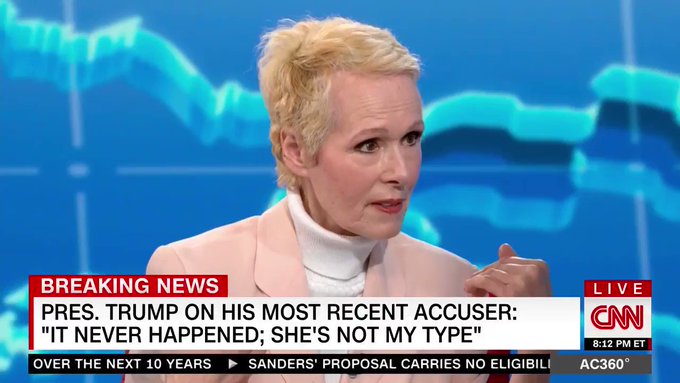
E Jean Carrol made headlines recently with her rather bizarre and sketchy claims of a forced sexual encounter with Donald Trump in a Bergdorf Goodman dressing room two decades ago. President Trump denies even knowing who she is…. but the media, well, you know…. OrangeManBad; so anything goes.
In addition to personifying an abject lack of credibility Ms. Carrol just imploded on CNN with Anderson Cooper, explaining her definition of rape is not sexual, nor doe it include sex. However, before getting to that recent development, a historic reference to Ms. Carrol is, well, weird.
(h/t BAXT3R) In 1995 E. Jean Carroll shares her unique perspectives on an Esquire article, “Do Women Love Men?” and discusses changing gender roles with Charlie Rose:
At this point it’s difficult to imagine anyone lending credibility to this claim. Then again, this is 2019, and the media is fraught with Trump Derangement Syndrome.
The official media account of how the intelligence community gained the transcript of incoming National Security Adviser Michael Flynn talking to Ambassador Sergey Kisliyak on December 29th, 2016, surrounds “incidental collection” as a result of contact with an agent of a foreign power. Meaning the Flynn call was picked up as the U.S. intelligence apparatus was conducting surveillance on Russian Ambassador Kisliyak.
If this version of events were accurate (it’s not), it would fall under FISA-702 collection: the lawful monitoring of a foreign agent (Kislyak) who has contact with a U.S. person (Flynn).
In order to review the identity of the U.S. person, a process called ‘unmasking’, a 702 submission must be made. That submission, the unmasking, leaves a paper/electronic trail. In a 2017 congressional hearing, Senator Lindsey Graham asks Deputy Attorney General Sally Yates and former DNI James Clapper about this process. [Watch first 3 minutes]
.
However, in the two years following this testimony, there was nothing that would deliver the answer as to: who unmasked General Michael Flynn?
The reason is simple, Flynn wasn’t unmasked – because he was under FISC authorized active surveillance. Here’s how we know.
♦ First, Lisa Page and Peter Strzok were watching that hearing where Senator Lindsey Graham was questioning Sally Yates and James Clapper. As they discussed in their text messages the issue of “unmasking” is irrelevant. “incidental collection” is the “incorrect narrative”:
The “incidental collection” is an “incorrect narrative” because the collection was not incidental. Flynn was actively being monitored. Flynn was under an active FISA surveillance warrant.
♦ Second, more evidence of Flynn under active surveillance is found in the Mueller report where the special prosecutor outlines that Flynn was under an active investigation prior to the phone call with Ambassador Kislyak:
Mary McCord was the Assistant Attorney General in charge of the DOJ National Security Division, after John Carlin left in October of 2016. McCord would have signed-off on the Flynn FISA warrant, or any extension therein, throughout the Trump transition period.
[McCord was also the person who Sally Yates took with her to the White House to confront White House Counsel Don McGahn about the Flynn call and FBI interview.]
♦ Third, from the 2017 House Permanent Select Committee on Intelligence (HPSCI), when Devin Nunes was Chairman, the four targets of the Trump campaign -under investigation throughout 2016- were outlined:
SUMMARY: ♦In real time Lisa Page and Peter Strzok were saying the “incidental contact” (unmasking) narrative was incorrect. ♦Then Devin Nunes outlines the targets of the 2016 FBI investigation which included Flynn. ♦Then Robert Mueller says Flynn was under investigation prior to the 12/29/16 phone call with Kislyak.
Put it all together and…. (1) There was never an unmasking request because the collection was not incidental…. (2) Because the intercept was not incidental. (3) Because the intercept was part of the FISA court granting a surveillance warrant.
The lack of incidental collection is why FISA-702 doesn’t apply; and why there’s no paper trail to an unmasking request. The intercept was not ‘incidental‘ because the intercept was the result of direct monitoring and FISC authorized surveillance being conducted on Michael Flynn.
There are only three options:
Incidental collection = unmasking request.
Direct intercept / Legal = Active FISA Title-1 surveillance authority.
Direct intercept / Illegal = Active surveillance without Title-1 authority.
All of the evidence from documents over the past two years indicates #2 was the status of Michael Flynn at the time of the Sergey Kislak call.
The incoming National Security Advisor of President-Elect Donald Trump was under active FBI surveillance as granted by the FISA court. That’s how the FBI intercepted the phone call with Sergey Kislyak and why there’s no unmasking request.
This doesn’t deal with the propriety of the FISA warrant, or the legal basis, the legal predicate that must exist prior to granting the FISA warrant. However, accepting that Michael Flynn was under court approved surveillance reconciles all the issues.
Additionally, this would explain two more issues. #1) President Obama warning incoming President Trump not to hire Michael Flynn as his Nat. Sec. Advisor; and #2) a very strong possibility that Flynn’s status is the redacted paragraph in the January 20th, 2016, Susan Rice memo.
At 12:15pm on January 20th, 2017, Obama’s outgoing National Security Advisor Susan Rice wrote a memo-to-self. Many people have called this her “CYA” (cover your ass) memo, from the position that Susan Rice was protecting herself from consequences if the scheme against President Trump was discovered. Here’s the email:
“On January 5, following a briefing by IC leadership on Russian hacking during the 2016 Presidential election, President Obama had a brief follow-on conversation with FBI Director Jim Comey and Deputy Attorney General Sally Yates in the Oval Office. Vice President Biden and I were also present.
President Obama began the conversation by stressing his continued commitment to ensuring that every aspect of this issue is handled by the Intelligence and law enforcement communities “by the book“.
The President stressed that he is not asking about, initiating or instructing anything from a law enforcement perspective. He reiterated that our law enforcement team needs to proceed as it normally would by the book.
From a national security perspective, however, President Obama said he wants to be sure that, as we engage with the incoming team, we are mindful to ascertain if there is any reason that we cannot share information fully as it relates to Russia.”
[Redacted Classified Section of Unknown length]
“The President asked Comey to inform him if anything changes in the next few weeks that should affect how we share classified information with the incoming team. Comey said he would.”
I would suggest the redacted section relates to President Trump being under FBI investigation; and NSA Advisor Michael Flynn being under investigation and FISA surveillance. Hence the issues with “sharing information”.
While Michael Flynn being under active FISC authorized surveillance would indicate there’s no need for unmasking of Flynn, there would be a need for unmasking of everyone else captured within the Flynn surveillance. Hence the dozens of White House unmaskings identified by Devin Nunes in March 2017.
Additionally, Flynn being under FISA authorized surveillance still doesn’t excuse the leak -likely by Andrew McCabe- to the Washington Post about the phone contact between Flynn and Ambassador Kislyak on December 29th, 2016.
There are likely multiple FBI 302 reports on all sorts of contacts by Michael Flynn; as the FBI was investigating and updating their files.
This FBI surveillance background of Flynn would also reconcile another unusual date within the Mueller report. An FBI 302 written on January 19th, 2017,before the Flynn interview on January 24th, 2017, about Kislyak:
Flynn was under surveillance and the FBI reports on Flynn’s surveillance did not start with the January 24, 2017, interview of Flynn – As you can see above there are FBI 302 reports that preceded it. [h/t Techno Fog] This aligns with Lisa Page, Peter Strzok, Mary McCord, Devin Nunes and Robert Mueller all saying Flynn was under investigation prior to the 12/29/16 Kislyak call.
Lastly, release and unredact the Comey memos, and Flynn’s status under a FISA warrant is likely outlined by copious Comey CYA diary entries.
Earlier today President Trump announced a new executive order, constructed to facilitate a regulation change, that will require healthcare providers to inform patients of the cost of their procedures in advance of treatment. [Lots of Background Here]
The President makes the announcement [Video and Transcript Below]
[Transcript] – 3:17 P.M. EDT – THE PRESIDENT: Thank you very much. (Applause.) Thank you. Thank you. Wow. (Applause.) Wow. That’s very nice. Thank you very much everybody. Wow. We must be doing something right lately. (Laughter.) That’s very nice. I appreciate it very much. And welcome to the White House. Great place. No place like it, actually.
We’re here to announce new groundbreaking actions that we’re taking to dramatically increase quality, affordability, and fairness to our healthcare system. This landmark initiative continues our campaign to put American patients first. This is a truly big action. People have no idea how big it is. Some people say bigger than healthcare itself. This is something that’s going to be very important.
For too long, it’s been virtually impossible for Americans to know the real price and quality of healthcare services and the services they receive. As a result, patients face significant obstacles shopping for the best care at the best price, driving up healthcare costs for everyone.
With today’s historic action, we are fundamentally changing the nature of the healthcare marketplace. This is bigger than anything we’ve done in this particular realm. And probably, Alex, it’s not even close, from what they’re telling me.
We will empower patients with the information they need to search for the lowest costs and the highest-quality care. In other words, they’ll be able to seek out their doctor, seek out the doctor they want, and they’ll be given vast amounts of information about those doctors.
We’re grateful to be joined by Secretary Alex Azar and Administrator Seema Verma. Thank you very much. Alex? Where’s Seema? Hi, Seema. (Applause.)
And I also want to recognize and thank a great senator, Chuck Grassley. Chuck, thank you very much. (Applause.) And, by the way, congratulations on ethanol. E15, right? He fought so hard. Oh, he’s tough. When he goes after you, he’s brutal. (Laughter.) But he gets what he wants and then he likes you, right? Anyway, congratulations to the farmers, frankly, Chuck. Right? Great job. Appreciate it. And that’s all year-round.
And Mike Braun. Mike, thank you. Thank you, Mike. Great job you’re doing.
Representatives Greg Walden — we worked so hard together on Right to Try, Greg. Right? Right to Try. People are loving it. Michael Burgess, Doug Collins, Devin — Devin Nunes. Thank you all. Incredible people.
Lieutenant Governors Geoff Duncan and Dan Forest. Thank you, fellas. Thank you. Thank you. You didn’t get a very good seat. I can’t believe it. (Laughter.) That’s not like you.
And all of our great state legislators. We have a lot of them with us today, and a lot of great medical people and doctors.
For decades, powerful insurance companies, lobbyists, and special interests have denied the public access to the real cost of the healthcare services they provide. It’s that simple. This lack of price transparency has enriched industry giants greatly, costing Americans hundreds of billions of dollars a year.
Patients have been billed nearly $800 for saline; more than $6,000 for a drug test, at the simplest methods used, and $6,000 — I’ve seen them; and over $17,000 for stitches to just stitch up a minor wound. Often, prices differ drastically between providers and hospitals for the exact same services. And there’s no consistency. There’s no predictability. And there’s, frankly, no rhyme or reason to what’s been happening for so many years.
As a result, Americans, such as Erika Jay, who is here today, find themselves in deeply unfair situations. Erika, please, if you would come up and just explain what happened to you. Thank you very much. Thank you very much. (Applause.)
MS. JAY: Thank you. Over the last three and a half years, while fighting a stage-three cancer, we visited many healthcare facilities. We saw price variations that just caught us off-guard and really surprised us — took us by surprise — from one facility to the next. And it caused us financial hardship.
An example of this is when I had two identical bone biopsy procedures only 11 days apart at facilities that were only 17 miles apart from each other. We learned, when we received the bills for the second procedure, that it cost us more than 330 percent than the first time we had it done. Different facility, identical procedure: drastically different pricing.
This is one of many stories our family has. If price transparency had been required, we would have been empowered to find the best pricing for my care, saving thousands of dollars over the last three years.
Mr. President —
THE PRESIDENT: Yes. I’m right here. (Laughter.)
MS. JAY: Thank you for this executive order.
THE PRESIDENT: Thank you.
MS. JAY: And thank you for empowering and helping families like mine all over the nation.
THE PRESIDENT: Thank you very much. That’s very nice. (Applause.) Thank you. Thanks very much, Erika.
We believe the American people have a right to know the price of services before they go to visit the doctor. Therefore, in just a few moments, I will be signing a breakthrough executive order. It will create unprecedented transparency about healthcare prices and provide this information to the American people for the first time ever — first time it’s ever been done. People knew it should have been done years ago, but they never got it done. I wonder why.
With this order, hospitals will be required to publish prices that reflect what people actually pay for services in a way that’s clear, straightforward, and accessible to all. And you’ll be able to price it among many different potential providers, and you’ll get great pricing. Prices will come down by numbers that you won’t even believe. You won’t even believe it. More price transparency will mean more competition, and the cost of healthcare will go way, way down.
Vanderbilt economist — highly respected — Dr. Larry Van Horn is here with us. Larry was introduced to me by a gentleman who is a great gentleman, great economist: Art Laffer. And Art Laffer just got — as you know, Larry — just got the Presidential Medal of Freedom a couple of days ago. And Art was telling me that he’s the head of a hospital, where he comes from. He’s on the board. And they did this. He said it is beyond anything he’s seen, from an economic standpoint and even a health standpoint.
And I said, “Let’s talk about it.” And we discussed it, and it’s something known very well, but a lot of people don’t do it because there won’t be some rich people that will be too happy about this. But the people will be happy about it.
So, Larry, could you — (applause) — so, Larry, if you would — one thing, before Larry gets up: One of the other big beneficiaries are really good doctors. The good doctors. And they should be the beneficiaries — not the bad doctors, but the good doctors. And I think all of the doctors in the audience know exactly what I’m talking about. So thank you for being here, because I guarantee you’re all probably very good doctors.
So, Larry, if you would, please come up and share a little of your wisdom and what this is all about. Thank you. Thank you very much. (Applause.)
DR. VAN HORN: Thank you, Mr. President, for taking this action that will put healthcare information in the hands of the American consumer. This truly will be transformational.
For years, I’ve studied the impact of hidden prices and what that’s had — the impact that’s had on markets — healthcare markets — as well as American consumers.
My analysis suggests that when cash prices are transparent, upfront, in the market, on average, they’re 39 percent cheaper than the amounts that third-party payers pay for like services.
Even when insurance covers the cost, there is, on average, a 300 percent price variation within a market across — for the exact same services. Your healthcare transparency initiative will empower consumers and use free market forces to drive healthcare markets towards lower prices, better outcomes, greater access, and greater value.
But this is bigger than healthcare. Lower prices for healthcare leaves more money in Americans’ wallets and in their paychecks for the purchase of all other goods and services that are important parts of their lives. This will be good for America and good for Americans. (Applause.)
THE PRESIDENT: Thank you very much, Larry.
Today’s action is not just about lower prices. It’s also about helping Americans find excellent care. Currently, patients do not have adequate tools to find the doctors who would deliver better health outcomes at an affordable cost.
And when they used to talk about Obamacare, “You can keep your doctor,” that turned out to be a lie. Twenty-eight different times it turned out to be a lie. Here, you can keep your doctor, but you can also maybe find somebody other than your doctor at your choice, and that would be based on talent and it would also be based on price.
Because of this, you’ll be able to search out for the right doctor. And it really is, in a true sense, the opposite of Obamacare. You get much better pricing, and you’ll get the doctor that you want and maybe you’ll get better than the doctor that you originally thought about. It’s pretty incredible.
Low-quality care often means unnecessary services. For example, a bad doctor may routinely perform an expensive spinal surgery for back pain without first trying physical therapy.
That’s why my order directs agencies to help inform the public about the quality of doctors and hospitals by leveraging all of this data. By making much better use of this new information, we will save money and save lives, and your care will be much better. It’s incredible.
We’re also joined by Dr. Elaina George, a longtime advocate for patients. Elaina, please come up and tell them a little bit about what transparency means. Thank you. (Applause.)
DR. GEORGE: I love being a doctor. However, one of the most challenging things has been the inability to be an effective advocate for my patients. I’ve had patients deny themselves care because they don’t know how much a service will cost, or, worse, be stuck with a costly bill that they didn’t expect.
I have felt powerless at times because of my inability to help them, especially if I have to send them to a hospital and we can’t find out the price of the service.
Price transparency is a solution to this problem. When patients become healthcare consumers, it will drive prices down, quality up, and most importantly, help doctors serve their patients better.
Thank you, President Trump, for this executive order. (Applause.)
THE PRESIDENT: Thank you, Elaina. Thank you very much. Great job. Thank you, Elaina.
As we fight to increase transparency and lower costs for patients, more than 120 Democrats in Congress support Bernie Sanders’s socialist takeover of American healthcare. It’s very dangerous. The Democrat plan would terminate the private health insurance of over 180 million Americans who are really happy with what they have.
Under my administration, we will never let that happen. We believe in giving patients — (applause) — we believe in giving patients choice and freedom in healthcare, ensuring access to the doctors they want, the treatments they need, and the highest standard of medical care anywhere in the world. And this will make it much better than it’s ever been.
This is a truly historic day. I don’t know that it will be covered that way by the fake news. (Laughter.) But this is truly a historic day. This is a very big thing that’s happening right now. And it’s pretty much going to blow everything away, Alex, as we discussed. People never thought they’d see us do this.
We’re making new affordable health options available to millions of American workers through the association health plans, short-term plans, and health reimbursement arrangements.
We’re working with Congress to stop surprise medical billing. And when you hear “surprise” — (applause) — right? And when we hear “surprise medical bill” we’re not talking about a positive surprise. (Laughter.) We’re talking about, you know, not surprise, “Oh, gee. How happy I am.” You’re talking about, like, a disaster.
Because no American should be blindsided by bills for medical service they never agreed to in advance. Because people get sick. They don’t really think in terms of, “Let’s sit down and negotiate for 20 minutes.” You want to get better. And then you get hit, and you get hit really hard. And that stops.
We’re expanding access to tax-free health savings accounts. To give critically ill patients access to lifesaving cures, we passed Right to Try. We were helped so much by these gentlemen in the front row. What a job you all did, and I really appreciate it. And you, too, Senator. I’ll tell you, that was really great. We think in terms of the House — because I know how hard you fought for it, Greg and Doug. You guys were amazing. But — and Devin, I know you worked on this one very, very hard with everything else you do, but I appreciate it. And very few people would’ve done that.
You know, Right to Try is interesting because it’s been — they’ve been trying to get it for 45 years. And they couldn’t do it. And it sounds simple, but it’s not, because everybody had a reason for not wanting it. The insurance companies didn’t want it because of liabilities. The country didn’t want it because they didn’t want to be sued.
But now you have terminally ill patients that used to — if they were rich enough, they’d go Asia. They’d go to Europe. They’d go all over the world looking for a cure. And we have the greatest doctors in the world right here; the greatest lab technicians and labs and medical services. We have everything. But it takes a period of time to get a certain potential cure approved. Sometimes 15 years. And, by the way, we brought that down to probably an average of six.
But you need time because you don’t want to hurt anybody. But these are patients that are terminally ill and they didn’t want to give them a potential cure because they didn’t want to hurt them, but they’re terminally ill. So we agreed that people would sign a waiver. Nobody is going to be held liable. The drug companies, which didn’t want it because they didn’t want it on their record, we made it a much less part of their record. And we set up different standards where it would be in other parts, which was great for them.
And everybody is happy, and many lives have been saved. And I’ll tell you, we had one the other day that was on — so incredible. A young — incredible young woman where they made a medical mistake and it was over for her. They were explaining last rites. And then, all of a sudden, she did this and she’s now healthy. They think she’s going to be actually fine. You might have seen it. It’s been — it was actually an incredible thing.
So I’m really happy. I talk about it a lot. Right to Try — something that sounds so simple, and yet for 45 years they’ve been trying to get it approved. And they got it.
And just so you feel good, Greg and Doug and everybody — tremendous success. Have you been seeing what’s going on? So many people that were definitely not going to make it are now living, and, in many cases, they’re going to be just fine. So it’s something very — you can all be very proud of that.
So for the first time in a long time, we’re doing things that nobody has ever done before, from the standpoint of what we’re here for.
We eliminated the Obamacare individual mandate penalty, which was the most unpopular thing in Obamacare, by far. And I had a decision to make: Do we do a good job with Obamacare — the remnant of Obamacare? Or do we do a bad job? If I do a bad job, well, there you can blame Obama and the Democrats. If we do a good job, they’ll get a little bit more credit. But it’s still very faulty. It doesn’t work, and it’s too expensive. And I told our great Secretary Alex Azar, “Don’t do a good job, do a great job. Do what you have to do. Work with the states. Do whatever you have to do to make it as good as possible.” Once we got rid of the individual mandate, it made it better.
But Obamacare doesn’t work, but it works at least adequately now. And we had that choice to make. And, politically, it’s probably not a good thing that I did, but it’s the right thing to do for a lot of people. So I want to thank you and I want to thank Seema for doing a fantastic job. I appreciate it. (Applause.)
And we spend a lot of time defending Medicare and Social Security, and we’re always going to protect patients with preexisting conditions. People don’t understand that — that we are fighting very, very hard to get it taken care of for preexisting conditions. And if we weren’t, that wouldn’t happen.
But the Republicans are very much behind that. Totally behind that. And if we do anything and if you see anything a little unusual, it doesn’t make it because we’re putting in very, very strong — taking care of patients with preexisting conditions.
And I would say, Alex, that that is, really, a very strong foundation of what we’re doing and what we’re all about. So it’s very important.
Together, we’re taking power away from bureaucrats. We’re taking it away from insurance companies and away from special interests. We’re giving that power back to patients, and we’re giving Americans the right to know. So we have the right to try, and now we have the right to know, and the right to negotiate, and the right to pick your own doctor, and the right to get great prices. And other than that, you know, what can I tell you? (Laughter.) You can’t do better than that.
But we’re taking one more giant step toward a healthcare system and a healthcare system that’s really fantastic, and it’s going to be good, and it’s going to work for the people.
So I just want to thank everybody for being here. I’m going to go and sign the executive order. And if this is half as big as some people are saying it will be, it will be one of the biggest things ever done in this world, in this industry, in this profession.
And I want to especially thank all of the doctors for being here. We have a lot of doctors in this room, and they’re very proud of what they do, and they want to have our system work. And this is something that I think is going to get it to really work efficiently and well.
Thank you very much for being here. I’m going to sign the executive order. Thank you. (Applause.)
Following an executive order signed by President Trump, Treasury Secretary Steven Mnuchin holds a press conference to deliver the details [Video and Transcript]:
[Transcript] SECRETARY MNUCHIN: So I think, as you know, I just left the Oval Office, where President Trump signed a new executive order authorizing even more expanded sanctions against Iran. So now — along with our existing sanctions authority, we have additional sanctions to go after the Supreme Leader’s Office and lock up literally billions of dollars more of assets. Along with that action today, we are also announcing specific actions targeting those responsible for recent activities.
I think, as you know, previously, we have sanctioned Soleimani for his behavior. Along with that, today I am going to announce three of his other senior leaders: Tangsiri, who is responsible for the Iranian regime’s forces threatening to close the Strait of Hormuz; Hajizadeh, who is the Commander of the Air Force and responsible for downing the U.S. unmanned aircraft in international air space; as well as Pakpour, who is responsible for IRGC’s ground forces.
Along with those, we are also designating five Naval District’s leaders: Gholamshahi, Zirahi, Yadollah Badin, Mansur Ravankar, and Ozma’i. These sanctions are all very important for recent activities.
The President has also designated — instructed me that we will be designating Zarif later this week.
So, with that, I am happy to take a few questions.
Q Mr. Secretary, the President indicated last week that he believed that the shoot-down of the drone may have been a mistake that was made by local commanders on the ground. Taken together what you’ve announced today, it would seem to indicate that maybe this wasn’t a mistake, that it was an intentional act that was known all the way up the chain of command.
SECRETARY MNUCHIN: No, I wouldn’t read anything into that. Again, many of these — the executive order that the President signed was in the works previously. These actions are people who have either made threats, or specific things. And, again, I don’t think you should interpret this anywhere otherwise, other than we are designating people who we believe were responsible for the chain of command, whether they knew it or not.
Q Secretary Mnuchin, thank you so much for doing this briefing. What is your response to your critics who say these sanctions are more symbolic than substantive, and they won’t bring Iran to the negotiating table because Iran has said they’re not coming back to the negotiating table after the President ripped up the nuclear deal?
SECRETARY MNUCHIN: Well, I think the President was very clear. If they want to come back to the negotiating table, he’s ready. If not, they won’t. For the people who say these are just symbolic, that’s not the case at all. We’ve literally locked up tens and tens of billions of dollars. These sanctions will come along with additional entities where people are hiding money. So, no, these sanctions are highly effective.
Q Mr. Secretary, we’ve seen the attack on the oil tankers. We’ve seen the attack on the drone. What makes you think that these sanctions have been effective? What signs are there that they have been —
SECRETARY MNUCHIN: Oh, there’s no question these sanctions have been very effective in cutting off funds going to the IRGC and other people. And I can only presume — I’m not going to presume why they’re doing things, but these are highly, highly effective on locking up the Iranian economy. And as the President said, we look forward to a time in releasing sanctions if they’re willing to negotiate.
Q Thank you. When you talk about sanctions on the Supreme Leader, that is as high as you can go inside of Iran. Can you give us the thinking as to why the administration wanted to bring it up to that level?
SECRETARY MNUCHIN: I think the President had been clear: maximum pressure on the sanctions. So that is — that is our strategy. And it’s not just him; it’s the Leader’s office, which encompasses a whole range of activities.
Q Mr. Secretary, thank you. Have you done the intelligence research to figure out what assets any of these individuals that you just named actually have in the United States or in the global financial system? That is, do any of these people have money or assets outside of Iran?
SECRETARY MNUCHIN: So the answer is: Whenever we do sanctions, we do do intelligence. I can’t comment on any of the specific intelligence. But again, I would say we follow the money and it’s highly effective.
Q Do any of these people have assets outside of Iran?
Q Mr. Secretary, thank you. Is a military option or military reprisal still on the table?
SECRETARY MNUCHIN: I obviously can’t comment on that. I’m going to leave that to the President.
Q Thank you, Mr. Secretary. Have you consulted with America’s allies, regarding these sanctions? And is there buy-in from America’s allies? Will they also be imposing sanctions similar to what the U.S. —
SECRETARY MNUCHIN: No, I have not consulted on these specific sanctions. The answer is: In general, I’ve had many, many conversations with all our allies. I was in Japan 10 days ago, meeting with the finance ministers and discussed our sanctions program. I’ll be going to the G20 with the President. Again, this will continue to be a topic of discussion.
Q Yeah, Mr. Secretary, if that’s to me —
SECRETARY MNUCHIN: I’ll give it to you. It wasn’t, but then we’ll go to you.
Q All right, thank you. You said this was in response to events of — and the recent events. Is that about the shooting down of the drone or the attack on the six tankers or both?
SECRETARY MNUCHIN: Again, what I said is: Some of these were in the works. Some of these are an addition. All of the above.
Yes. Go ahead.
Q I mean, you know, this is — the President came close to military action. Now you’re coming back with sanctions. What was the direct response to the shoot-down of the drone?
SECRETARY MNUCHIN: Again, I said “some of them.” I’m not going to identify which ones are which. I’ve said that some of this was in the works, some of this is a result of recent activities.
Q Mr. Secretary, how do these sanctions deal — how do these sanctions relate to President Trump’s “deal of the century” — what’s happening coming up in Bahrain?
SECRETARY MNUCHIN: I look forward — I’m leaving for Bahrain in about an hour. So I look forward to our discussion in Bahrain. We’ll be rolling out the economic plan, which will be great opportunities for the people of Palestine. We have a terrific group there of finance ministers, business leaders all around the world. I think we have about 350 people going. So I look forward to it.
Q Mr. Secretary, thank you, sir. Yeah, just following up on an earlier question. You talked about the sanctions are effective, in terms of inflicting pain on the economy. Is there evidence yet — or will there be evidence, do you think — that this is having an effect on Iran’s behavior?
SECRETARY MNUCHIN: Well, let me first comment that our issue is not with the people of Iran. So I just want to be very clear: We are not looking at creating issues for the people of Iran.
Having said that, we are — have sanctions against bad behavior. And there’s no question that locking this money up worked last time. And there’s no question locking the money up works now.
I have created this site to help people have fun in the kitchen. I write about enjoying life both in and out of my kitchen. Life is short! Make the most of it and enjoy!
This is a library of News Events not reported by the Main Stream Media documenting & connecting the dots on How the Obama Marxist Liberal agenda is destroying America






 Centinel2012